Calculating The Coup Odds

forecast-heatmap-2014

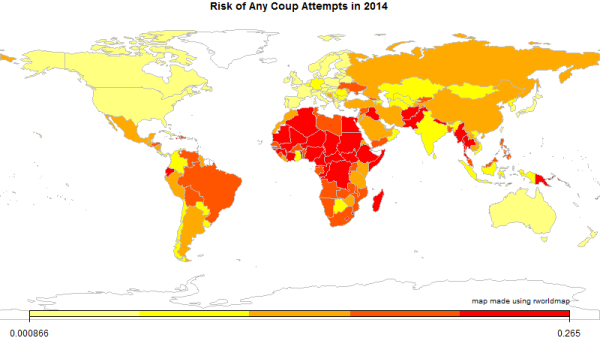
Opening with the caveat that “Coup attempts rarely occur, so the predicted probabilities are all on the low side, and most are approximately zero,” Ulfelder maps where they’re most likely to happen this year:

From cross-validation in the historical data, we can expect nearly 80 percent of the countries with coup attempts this year to be somewhere in that top fifth. So, if there are four countries with coup attempts in 2014, three of them are probably in dark red on that map, and the other one is probably dark orange.

Fisher takes a minute to “appreciate the luxury many countries have of not worrying about coups”:

A lot of democratic as well as authoritarian states, rich as well as poor, have strong enough rule of law and institutional norms that they don’t have to worry about coups. Ulfelder’s model predicts only a 0.15 percent chance in the United States; many Western democracies show similar scores. So do some countries experiencing political turmoil, such as Greece and Cuba (0.14 and 0.21 percent risk, respectively). Iran, for all its problems and political infighting, only rates a 1.43 percent chance of a coup. That’s probably great news for the United States: even if we don’t like the Iranian government, it’s preferable to chaos, and a government that can negotiate without worrying about a military coup has a freer hand to accept any U.S. nuclear deal.

Colleges Are Slow Learners

Declaring the Golden Age of higher education over, Clay Shirky wants the academic world to face reality:

The number of high-school graduates underserved or unserved by higher education today dwarfs the number of people for whom that system works well. The reason to bet on the spread of large-scale low-cost education isn’t the increased supply of new technologies. It’s the massive demand for education, which our existing institutions are increasingly unable to handle. That demand will go somewhere.

Those of us in the traditional academy could have a hand in shaping that future, but doing so will require us to relax our obsessive focus on elite students, institutions, and faculty. It will require us to stop regarding ourselves as irreplaceable occupiers of sacred roles, and start regarding ourselves as people who do several jobs society needs done, only one of which is creating new knowledge. It will also require us to abandon any hope of restoring the Golden Age. It was a nice time, but it wasn’t stable, and it didn’t last, and it’s not coming back.

La Vie En Rouge

Exploring the evolution of color perceptions, Elijah Wolfson considers how our ability to see red sets us apart from other mammals:

Most mammals, including most primates, are dichromatic, meaning they can only detect two color wavelengths: green and blue. Certain primates, though, have evolved to see a third: red. It turns out that these primates—humans, chimps, gorillas, and orangutans, to name some—all have one thing in common: bare-skinned faces. Based on this trend, experts have hypothesized that the development of trichromatic vision was, in fact, the result of an evolutionary advantage that certain primates had over others: namely, that it helped our ancestors better understand the emotional states, socio-sexual signals, and threat displays of their brethren.

The upshot was huge. Once we could actually see the red that coursed through our veins, it became a secondary communication tool: ovulating females would redden in the face and in their sexual organs to signal sexual readiness; angry males displayed dominance by reddening in the face. Modern humans might still get red in the face while angry, but we’ve also branched out to using signaling tools like cocktail dresses and soccer jerseys. While the medium has changed, the message remains: displaying red means you’re serious.

The Internet Increases Inequality?

Bill Davidow fears so:

Doing some of the obvious things like raising the minimum wage to fight the effects of the Internet will probably worsen the problem. For example, it will make it more difficult for bricks-and-mortar retailers to compete with online retailers.

Surprisingly, the much-vilified Walmart probably does more to help middle class families raise their median income than the more productive Amazon. Walmart hires about one employee for every $200,000 in sales, which translates to roughly three times more jobs per dollar of sales than Amazon. Raising the minimum wage will also make it more difficult to bring manufacturing jobs back to the U.S. The Internet is not the sole force driving income inequality in the U.S. Our languishing education system is a major contributor to the problem. But two things are certain: the Internet is creating many of those in the ultra-wealthy 1%; and it forces businesses to compete with capable international competitors while providing the tools so that businessmen can squeeze inefficiency out of the system in order to remain competitive.

Mentally Ill On The Job

Rob Lachenauer contrasts how large corporations and family-owned businesses treat workers with mental-health problems:

The Americans with Disabilities Act of 1990 prevents employers from discriminating against people who have a mental illness. But my experience as a consultant at a very large strategy firm whose clients are giant corporations had been that if someone admitted that he or she struggled with depression or mental illness, that would often be career suicide. Indeed, a former vice president of a major investment banking firm, when told about this blog, warned me against publishing it: “Clients are afraid to work with firms that have mentally ill people on the professional staff.”  …

I myself seldom heard people talk openly of depression in the workplace until I left the consulting firm where I’d worked to begin advising owners of leading family businesses. Much to my surprise, I found that these extremely successful family business owners don’t draw a sharp (and artificial) line between “us” and “them” – the mentally healthy and those less healthy. They don’t because they know they can’t. Those who suffer from mental illness are not anonymous shareholders, or nameless employees, but rather brothers, mothers, cousins, grandfathers, sons, and daughters. In family businesses, “they” are “us.”

Previous Dish on mental illness and employment here.

The Most Interesting Woman In The World?

A reader is irked by Kottke’s nomination of Peter Freuchen as one of the most interesting men in the world:

It’s always men – and the women are neglected in history. Make a thread asking readers for candidates for the most interesting women.

He nominates the Icelandic explorer Gudrid Thorbjarnardóttir, who crossed the North Atlantic more than half a dozen times around the turn of the last millennium:

Her name is known from the Icelandic Sagas about Viking travels and colonization in America. She may have been the first European woman to have a child in America during the Viking attempt to build colonies there. Also she lived in Greenland. Later she became a Christian, traveling from Iceland to Rome, making her the most far-travelled woman of her age.

Nancy Marie Brown, author of a 2008 biography of Gudrid, has suggested observing “Gudrid The Far-Traveler Day” in October:

Þorbjarnardóttirandson[Leif Eiriksson] discovered America 500 years before Columbus, which is why the official US holiday, Leif Eiriksson Day (October 9), comes before the official Columbus Day (October 12). But what happened next? Leif never went back. It was his sister-in-law who tried to settle the Vikings’ Vinland, or “Wine Land” …

Gudrid knew the killing force of the sea, of weeks at the mercy of the winds, of fog that froze on the rigging, when “hands blue with cold” was not a metaphor. She knew how fragile a Viking ship was. Sailing from Iceland to Greenland as a girl, she was shipwrecked, plucked off a rock by Leif, who thereby earned his nickname “the Lucky.”

Knowing the risks, Gudrid and her husband, Leif’s brother Thorstein, sailed west off the edge of the known world. They were “tossed about at sea all summer and couldn’t tell where they were,” says one of the medieval Icelandic Sagas. Just before winter, they reached a Viking farm near Greenland’s modern capital, Nuuk, a distance they could have rowed in six days.

That winter, Gudrid’s husband and crew died. Come spring, Gudrid ferried their bones south to Leif’s farm and buried them by the church. She remarried, to a rich Icelandic merchant called Karlsefni, and here’s the kicker: She set sail again. “Making a voyage to Vinland was all anyone talked about that winter,” says the saga. “They all kept urging Karlselfni to go, Gudrid as much as the others.”

When I tell people I’ve written a book about Vikings, they expect a pageant of bloody berserks, like the Sega Viking game “Battle for Asgard” or the Viking movie Last Battle Dreamer. “Viking,” you’d think, meant “man with a big axe.” But for me, the classic Viking is Gudrid the Far-Traveler.

(Photo by C.J. Moss)

Should College Football Unionize?

Northwestern football players are petitioning the National Labor Relations Board for permission to form a union. Marc Tracy doesn’t see why not:

If the purpose of college is “an education,” then why in some cases do student-athletes have part or all of their tuition paid for on the explicit condition that they play sports? And if they are not professionals, then why the—what do you call it?—extracurricular activity that requires extensive travel, 40-plus hour weeks, and considerable risk to future earning potential? And if they are not  being paid for that—if that tuition shouldn’t count as payment and their participation is in fact “voluntary”—then why allow that tuition to be offered in the first place? What is it even being offered for?

But Jonathan Mahler points out that the players don’t want wages, at least not yet:

The players aren’t actually asking for much. Their “demands,” laid out on the website of the National College Players Association, include making college football safer by limiting contact at practices and adding independent concussion experts at games. They want schools to pay medical expenses related to sports-related injuries. They want athletic scholarships to cover the full costs of attending college, not just tuition but also expenses such as laundry or going home for vacation. They want a small percentage of the huge sums generated by college sports to be invested in continuing education for athletes who go pro before graduating.

He thinks the NCAA should jump at the deal:

College sports are a multi-billion dollar business. If the athletes who make it popular and lucrative — after spending countless hours training, traveling and playing — aren’t “employees,” then what does the word mean? There is growing scientific evidence about the dangers of football, yet the young men who fill their schools’ stadiums and coffers, selling branded merchandise and ensuring generous TV contracts, shouldn’t be given medical coverage and insured against long-term disability as the groundskeepers and athletic directors and coaches are?

Hampton Stevens worries about unintended consequences, noting that pay-for-play can’t be far behind:

How, for instance, would those in charge go about splitting the money? Should players at Alabama and Texas get paid more because their programs generate more revenue? Would starters get paid more than benchwarmers, or does everyone on the roster deserve the same rate? Should a player’s pay be based on performance year-to-year? After all, if college athletes want the benefits of professionalism, they must also expect the drawbacks—like losing salary because of sub-par performance.

What about basketball players, who similarly produce big bucks for everyone but themselves? Don’t they deserve a union, too?  What about sports that don’t produce revenue? Surely swimmers and volleyball players should also have their scholarships protected. And let’s not even get started on the Title IX implications. The legal requirement for gender equality adds yet another layer of bewildering complexity.

John Culhane considers that snowball effect as well:

[A] decision in favor of the Northwestern players will likely explode throughout college football. A tipping point will be reached once enough teams are represented by unions. When that happens, it will be much harder for every school—and the NCAA—to resist meeting players’ reasonable demands, even if players at some universities will be forbidden from unionizing. What elite player will want to attend, say, Oklahoma, if he’s assured of post-career health care at Notre Dame? Top-tier college programs will have to cough up benefits if they want to compete with their football brethren.

The Best Of The Dish Today

IMG_1273

First up, not exactly a correction, but definitely worth noting. The lesson I took from the movie “Lone Survivor” was the following:

Exposed to real danger in a way no one in Washington ever was, these soldiers were given a chance to commit a war crime to save their asses, and chose not to.

I’m not taking that back. But it’s worth noting that the hero of the movie and of history does not share that view at all. The book by Marcus Luttrell blasts the rules of warfare as liberal media cant. This captures his views on the subject of executing unarmed civilians or torturing them:

“I promise you, every insurgent, freedom fighter and stray gunman in Iraq who we arrested knew the ropes, knew that the way out was to announce he had been tortured by the Americans, ill treated, or prevented from reading the Koran or eating his breakfast or watching the television. They all knew al-Jazeera, the Arab broadcasters, would pick it up, and it would be relayed to the U.S.A., where the liberal media would joyfully accuse all of us of being murderers or barbarians or something. Those terrorist organizations laugh at the U.S. media, and they know exactly how to use the system against us.”

For the record.

Six posts you may have missed. Are the Clintons stoppable? Is Christie toast? Our secret Syria policy (grrr). De Blasio’s cravenness and hypocrisy.  And a poem by John Updike about Syliva Plath.

The most popular post of the day was Who Can Beat Them? Second up was Republicans Endorse Obamacare Lite.

Renew here! Renew now! And see you in the morning.

“A Symptom Of A Sick Consumer Society”

A reader writes:

If you’re going to be posting any Superbowl-related links this week, might I suggest the [above video]. It is an old, old Daily Show clip that I watch every year around this time, wherein Rob Corddry gives what has to be one of his best performances ever pretending to report on what the big ads were that year and then suffering a breakdown/spiritual epiphany that leads to some of the most biting cultural satire I’ve seen… all for that special night each year “when the advertising industry takes all of our black, empty yearning and spins it into dreams!”