Stilton cheese becomes a perfume. Brits suddenly smell better.
Category: The Dish
Christianism, Debated
Another email:
Hewitt, Ponnuru, and now Goldberg? Something tells me you’ve touched a nerve. I can tell you that what you’re saying about Christianists isn’t new to any Christian that isn’t part of the southern Baptist conference, and I didn’t think much of it at first, but by devoting your Time column to it, you’re putting some real weight on the issue. Hewitt’s piece is easily the most vile attack on you that I’ve seen, and he is clearly afraid of what you’ve said. Not afraid that what you say is true – these guys have known that all along. No, they’re afraid that someone might listen to you. They’re afraid that you’ve created a buzzword.
Plenty of Christians know that their beliefs don’t jibe with those of the Christianists, but without a way to differentiate themselves, they’ve been all too willing to allow the Christianists to define their faith in public forum. The Republicans have used that to their advantage, playing up any criticism of Christianist politics as an attack on Christianity as a whole. But as Orwell demonstrated so well, a single word can be powerful. If you give the vast majority of Christians a word to differentiate themselves from the extremists, they realize how easy it is to break away from the Christianist political line. And that’s what Hewitt, Ponnuru, and Goldberg are all afraid of, because if it were to catch on, it would be a major blow to the Republican power base.
Well, my point is not to attack a Republican power base, but to resist the cooptation of a faith by a political machine. It seems as if the machine has detected the danger. Good. Now to reclaim the good word "conservative".
Quote for the Day
"We have never seen natural variability on a global scale like we’ve had in the last 100 years," – atmospheric physicist Michael Oppenheimer of Princeton University. More background in the WSJ today.
The Newly Disclosed NSA Program
Just how lawful is it? Marty Lederman has an extremely helpful guide. The answer is murky. The whole post is crack for lawyers.
Project Baghdad
Iraq the Model’s Omar sees securing the capital as the most pressing task for the new government. Khalilzad agrees. And so, apparently, does Maliki.
Eating Spaghetti in a Burka
Just as hard as you’d think.
Twinks, Bears, Google
The eternal beauty contest goes on.
We Don’t Care
Whatever the legal and constitutional worries behind massive government data-gathering of domestic phone calls, the public, it seems, couldn’t care less. Mark Blumenthal explains.
Et Tu, Mel?
Is Mr Gibson changing his tune? Money quote:
"The fear-mongering we depict in the film ["Apocalypto"] reminds me of President Bush and his guys".
Blair’s End-Game
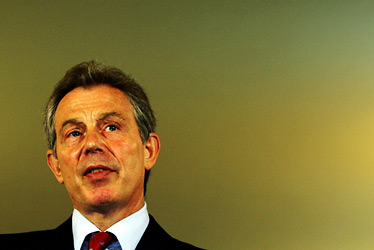
The prime minister promises to step down and give his successor, Gordon Brown, plenty of time to prepare for an election. And yet the distrust between the two camps seems as deep as ever. The Blairites – more centrist than the Brownites – are frightened of losing the middle ground of British politics:
[The Blairite ultras] want to force Mr Brown into a declaration that he will be as new Labour as Mr Blair. Ideally, he would agree publicly on a transitional programme of policy that was full of new Labour reforms. But, in the last resort, if such an agreement cannot be achieved, some are pressing [Blair loyalist] Mr Reid to stand against him in a leadership contest: not as a quixotic attempt to win, which he wouldn’t, but as a way of ensuring that the Chancellor has to match any new Labour promises that his rival would make.
In such a contest, Mr Blair would be obliged to support Mr Brown. But his private advice to the Chancellor tallies with that of the ultras. He believes that the party’s only hope of beating David Cameron‚Äôs Tories is to be riotously new Labour, because that is where the voters are. When he goes, the only question is who will be the inheritor of new Labour. If Mr Brown does not take up the mantle, Mr Cameron surely will.
British politics just got really interesting for the first time in over a decade. Stay tuned.
(Photo: Embics/Landov for Time.)

