That’s the approval rating for the Republican-led Congress. The public is too kind.
Category: The Dish
Incoming
The New Republic’s forthcoming cover-story, by Ryan Lizza, will reveal something new about Republican senator and potential GOP presidential candidate George Allen. His interest in the Confederate flag goes back much further than he has ever admitted. In fact, he is wearing a Confederate flag pin in his Palos Verdes, California high school yearbook. The piece will come online today, but no link yet. Developing …
Abused Priests
They are the forgotten victims of the Catholic Church hierarchy’s history of condoning and covering up child and teen sexual abuse by priests. But many, many younger priests or seminarians have been abused and raped by other priests, and the hierarchy, as ever, ignored them or intimidated them into silence until very recently. It’s hard to fathom the life-long pain of rape, but this one priest, as reported in today’s Washington Post, entered 35 years of depression, flashbacks and isolation. No one listened. No one wanted to know. How he managed to serve God in that time only God can know. That he recently found the courage to talk about it must be some small blessing. That he can no longer serve the very bishops complicit in such a system is understandable. That the hierarchy should seek once again to humiliate him is simply despicable.
How Dumb Is Pelosi?
Almost fathomlessly so. Check out these sentences analyzing the high price of gas:
We have two oilmen in the White House … The logical … follow-up from that is $3-a-gallon gasoline. There is no accident. It is a cause and effect … a cause and effect.
Where does one start? Perhaps one shouldn’t. But every time reasonable people despair of this incompetent, incoherent administration, they turn around and listen to a piece of transparent economic and demagoguic idiocy like this from the Democrats … and despair some more.
Ramesh Coulter?
I haven’t yet read Ramesh Ponnuru’s book, "The Party of Death: The Democrats, the Media, the Courts, and the Disregard for Human Life." Ponnuru is a highly intelligent and reasonable writer, although his 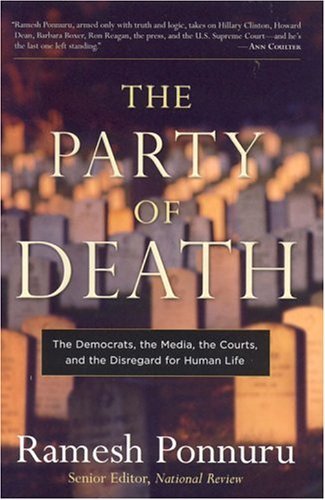 religious fundamentalism alarms me, and I’ve no doubt he has some interesting things to say. I may even agree with some of it. But this much I can say: the title of the book is reprehensible. To call half the country "a party of death" and to assign that label to one’s partisan political opponents is not, whatever else it is, an invitation to dialogue. It’s demagoguic abuse. It’s worthy of Ann Coulter (who, tellingly, has a blurb on the cover). It is one thing to argue that you are pro-life, to use the positive aspects of language to persuade. It is another to assert that people who differ from you are somehow "pro-death," (especially when they may merely be differing with you on the moral status of a zygote or the intricacies of end-of-life care). To smear an entire political party, and equate only one party with something as fundamental as life, is a new low in the descent of intellectual conservatism from Russell Kirk to Sean Hannity. Rush Limbaugh is already on-message:
Ramesh Ponnuru tells the story of how the Democrats became the party of abortion-on-demand and euthanasia, and lost the support of most Americans in the process. He hasn’t just written an engaging guide to the Party of Death–he’s written a non-vitriolic battle plan on how to defeat it.
Conservative writers have now made fortunes calling their partisan opponents traitors, godless, and now pro-death. Their rhetoric increasingly equates being a Christian with being a Republican. I never thought someone as civilized and intelligent as Ponnuru would sink to this kind of rhetoric. But it tells you something about the state of conservatism that he has.
Torture, Bush and the Drug War
Some bloggers have misunderstood my post yesterday on the use of torture in a Tennessee drug-war case and its connection to Bush administration policies. Of course I don’t blame Bush for what rogue cops in Tennessee are doing. I was merely making a more general, and conventional, point that the president does indeed set a moral standard for the country. George W. Bush himself made this argument in his first election campaign when he ran against the legacy of Bill Clinton. Bush’s moral standard is that imprisoning suspects without trial, stripping them of due process, and abusing and torturing them is morally defensible. That defining down of our moral and legal compass matters. Radley Balko elaborates the point here.
Quote for the Day
"George Orwell’s point regarding language was that society cannot face political issues unless it calls things what they are; the purpose of political euphemism, Orwell wrote, is to prevent clear thought. People living here without visas are illegal immigrants and people jailed without charge are prisoners. Politicians might be addicted to fudging words but the media, at least, should call things what they are," – Gregg Easterbrook, back blogging.
Yglesias Award Nominee
"My love for the SECDEF has nothing to do with Rummy being on my side. He is not when it comes to troop strength or military restructuring. I’m with Colin Powell in those debates. You don’t win wars on the cheap, you don’t cut troop strength and you don’t leave an opening for the enemy by giving the generals less than they ask for. The hell with fair fights. We should demand "shock and awe" as a military strategy, not a campaign slogan.
Oh yeah. And one final thought for my anti-war friends. Running off Rumsfeld will only prove what hawks like me have been saying from the beginning of this war: that we need more trained killers in Iraq, not less. That we need more instruments of death in Iraq, not less. And that our Secretary of Defense’s biggest mistake in Iraq was not failing to make peace, but failing to make war in the most ruthlessly efficient way possible.
Hmmm. Maybe we need a new leader at the Pentagon after all," – Joe Scarborough, in a column called "Rummy the Dove".
Americans on Immigrants
A new poll shows how fair-minded most people in this country are. And why the xenophobia being stirred up on the far right is a very dangerous weapon for the GOP.
In Defense of Rummy
A reader remonstrates:
You’ve been hammering away at Rumsfeld for quite a while now, and I completely agree with you that he is awful and should have been fired 2 years ago. However, when you write that:
"the evidence is simply overwhelming that this (in my view) noble, important and necessary war was ruined almost single-handedly by one arrogant, overweening de facto saboteur. That man is Donald Rumsfeld. It’s actually hard to fathom how one single man could have done so much irreparable damage to his country’s cause and standing; and how no one was able to stop him."
I think you go too far – the problem isn’t only Rumsfeld, but the war itself. Pinning all the blame on one person is simply a way for people who supported the invasion from the beginning to get themselves off the hook for not anticipating the wars failures. I haven’t read "Cobra II," but I have read George Packer’s "The Assassin’s Gate," which clearly describes how incredibly broken Iraqi civil society was at the time of the invasion.
Sure, if someone competent had been running the Pentagon, the Iraqi Army might not have been dissolved, the initial looting might have been prevented, etc.. But this would not have resolved the problematic fact that Iraq was an extremely troubled society–that the psychic wounds of Saddam’s dictatorship had poisoned the populace in untold ways.
We can blame the captain of the Titanic for many things, but we cannot blame him for the iceberg.
Some good points. Iraq was always going to be extremely tough. We under-estimated the appalling damage Saddam had already wrought on Iraqi civil society (which makes removing him even more morally defensible). However brilliantly we conducted the war and occupation, the deep ethnic divisions would have emerged, and the psychic wounds of the past revived. A patient in a fever doesn’t always mean he’s nearing death; it may even be a symptom of recovery. (I might add that Rummy is someone I have known personally for years, and always liked immensely. But such personal attachments have to be set aside in assessing national policy.)
But what I cannot forgive, as Cobra II elaborates, is how many mistakes were predicted by the military, and many alternatives to failure offered, only to be continuously, almost pathologically, rejected out of hand by Rumsfeld. On the question of troop levels, Rumsfeld was criminally reckless, as he was in arrogantly dismissing the rioting and looting and terror such inadequate policing unleashed. He was warned; he had plenty of opportunities to reverse course; but his own fanatical attachment to his own transformational theories overwhelmed all reason, all empirical evidence, all advice from the ground, and so many in the CIA, State Department and military. To persist in deliberate error out of pride and zeal, as he has done, is to prefer dogma to reality. When lives are at stake, and the whole future of democracy in the Middle East, that’s unforgivable. But for me at least, Rumsfeld’s deep involvement in the new military detention policies supercedes everything else. He has not just failed; he has dishonored his country’s reputation. He has offered to resign twice. What more does Bush need?
 The Dish