Very Pink Flamingoes

As Karl Rove prepares another rhetorical bashing of gay couples for the summer (it’s been a two-year ritual since 1996, with diminishing electoral returns), the world carries on. Part of that world is the ubiquity of gay adoption, a socially beneficial activity that is also replicated throughout the animal world. The latest example comes from the Wildfowl and Wetlands Trust at Slimbridge, England. Two pink flamingoes (apparently unaware of my Ptown co-resident, John Waters) have been busy raising three generations of flamingo chicks, in a committed relationship lasting five years now. I do not, of course, endorse their adoption methods. But no one disputes their parenting skills. Money quote:

Nigel Jarrett, WWT Aviculture Manager explains:

Flamingoes "Carlos and Fernando have been together now for five years and seem perfectly happy together. Both of them take on the male roles during the courtship ritual which involves preening, strutting and waving their heads vigorously from side to side with their necks at full stretch. Their parental instincts are also very strong prompting them to raid the nests of other couples in the flock. They have been known to fight the heterosexual birds and there is usually a ‘handbags at dawn’ moment where they will fight with another couple before stealing their egg. They are both large adult males so as a partnership they are quite formidable and are afforded more respect from the other birds. They are also very good parents and behave just as the heterosexual birds do when rearing their young."

For the first 3 or 4 weeks young flamingos are fed on crop milk a pink nutritious liquid produced by both parents so Carlos and Fernando have no problem feeding their adopted young and have so far raised three chicks.

Memo to Robbie George: there are more things in heaven and earth than are dreamt of in your philosophy.
Leave Them Alone

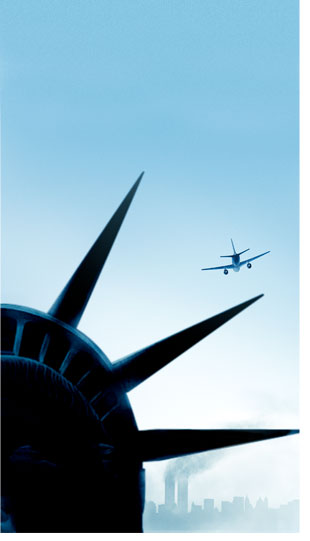
United93_splash_01 I caught the trailer of United 93 online and found myself once again with a lump in my throat and a lurch in my stomach. My feelings about the movie opening tonight are complicated. Of course, I have no issue with someone’s First Amendment right to make such a movie, even after so short a time, and even if it was a stand-in for "The Bourne Supremacy". Part of me is glad they did. The story of that flight is a transcendent one of self-government and self-defense; it’s a metaphor for ordinary folks taking back their destiny from evil; it’s an inspiring parable for democracy itself, and the genuine martyrdom it only recently demanded. I still wonder what would have happened to the American psyche if those monsters had successfully attacked the capitol, the symbol of democratic government. Whenever I think of that remarkable flight, my admiration for the men and women involved surges. (I’m particularly proud that someone who was openly homosexual helped save his country, and show once again that gay people are integral to any society as moral leaders.)

And yet, I will not see this movie, whatever its merits. The trauma is still too close. That day is still etched in me, as in all of us. It was a specific, unique trauma for those heroes on the plane; but it was also an emotional devastation for anyone who loves this country. Do we want to revisit their and our own traumas as entertainment? Perhaps this is cowardice, then, that I feel; and seeing it again would stiffen my spine against terror, and remind me of what we still owe the victims and the heroes of that day. But the years since, and the atrocities still committed by the Jihadists, have not diminished my or, I suspect, many other people’s desire to fight our enemy with vigor and precision. My spine hasn’t softened against al Qaeda. If anything, I want to defeat what they represent more now than ever.

So why the resistance to seeing it? Perhaps it’s a religious impulse. In some ways, I regard the acts of those men and women to be an almost sacred moment in the history of America and of freedom. And sometimes, the sacred is best respected through silence. Sometimes, the greatest deeds, like the most monstrous acts, are best left unrepresented. They stand alone. They demand to be left alone. One day, commemmorate. But do not so swiftly represent. Shakespeare often left the greatest moments in his plays off-stage. They have more power there.

Another One

Another former general calls on Rumsfeld to resign – on Fox News, for added piquancy. On the plane back from England, I tuck into Cobra II. I’d put it off, thinking it would be important but tedious homework. In fact, it’s a really riveting, readable narrative of the Iraq war, its origins and its unfolding. Gordon and Trainor actually do what Bob Woodward is reputed to do (and doesn’t). They give you an inside account of matters of state that is fair and devastating. I haven’t finished yet, but already the evidence is simply overwhelming that this (in my view) noble, important and necessary war was ruined almost single-handedly by one arrogant, overweening de facto saboteur. That man is Donald Rumsfeld. It’s actually hard to fathom how one single man could have done so much irreparable damage to his country’s cause and standing; and how no one was able to stop him. He makes McNamara look inspired. This is not to exonerate Bush and Cheney, who enabled and enable him. And it’s not to argue that the military shouldn’t always ultimately defer to civilian leadership. But when that leadership has been this incompetent, this bull-headed, this reckless and malevolent and petty, the generals have a patriotic duty to speak out. Until this man is removed, we can have no confidence in the conduct of the war; and no confidence in the president as commander-in-chief. It’s really as simple as that.

Leaking and the Law

There has been much harrumphing on the right side of the blogosphere about the Mary McCarthy CIA leak case. Another McCarthy wants the former CIA official in chains. Hugh Hewitt has a useful round-up of anti-leak bloggers. And, in principle, of course, they’re all right. It is against the law for CIA officials to be leaking extremely classified information – especially information as sensitive as secret detention facilities. But all these comments seem to me to have ignored the critical and unmissable context. Yes, leaking is against the law. But what if the leaker is exposing something as grave as illegal torture? Isn’t that when a leak becomes the blowing of a whistle? Wouldn’t you want law-abiding officials within the CIA to do something if their own government is breaking American law, violating treaty obligations, breaking the law of other countries – and using the secrecy of the executive branch to conceal it?

Recall the story McCarthy is accused of leaking. Better still: go read it. It just won the Pulitzer Prize, and it richly deserved to. What Dana Priest reported was that the Bush administration had taken over former Soviet camps in Eastern Europe and adapted them to abuse and torture terror suspects. The detainees’ innocence or guilt was never verified by anything approaching due process. For me, it represented the quintessence of Bush’s betrayal of Reagan. Ronald Reagan helped liberate Eastern Europe from Communist tyranny. He wielded the moral authority of freedom and tore down the walls of Communism, a system where people could be detained without trial, "disappeared", and tortured. In an inversion as hideous as at Abu Ghraib, Bush’s CIA was twisted into a reflection of our former enemy.

Many, many people in the military and CIA are in close-to-open revolt against these policies; many, many more have been placed in morally excruciating positions: they have been forced to choose between loyalty to their country and their conscience. They hate what this president has made them do: every fiber of their being as Americans and as moral individuals rebels against it. This doesn’t necessarily excuse McCarthy legally. If she is guilty as charged, she probably should have quit first, disclosed all she knew and faced the legal consequences. But when the government itself breaks the law, when it violates ancient moral standards that Americans have fought and died for, sometimes people within the government have to stand up and be counted. McCarthy may well be one of those people. And, if that’s true, I have a feeling that history will be much kinder to her than to her hyper-ventilating critics.

McCain and his Enemies

After kissing up to Falwell, John McCain is now taking money from the Wyly brothers, George W. Bush’s former "coyotes," to quote the good senator from a while back. This is what McCain once said of the siblings who are now financing his campaign:

"Are we going to allow two cronies of George W. Bush to hijack this election? Tell them to keep their dirty money in the state of Texas, my friends. Don’t spread it all over New England and America."

I’m no purist. The simple fact is that the GOP is now a religious fundamentalist organization, tethered to a corrupt corporate money machine. If McCain has any chance of winning the nomination, he has to come to terms with these forces. Would we rather Brownback or Allen won them over? On the other hand, of course, it is nauseating to see McCain kowtow to a Christianist like Falwell, a man he rightly once equated with Louis Farrakhan in terms of extremism. What would the American mainstream say if Hillary Clinton went to a Farrakhan rally to shore up her "base"? Yet that is exactly what McCain is now doing. My own acid test will be a simple one. What will McCain actually say at Falwell’s university? Will he challenge them on their bigotry? Or will he acquiesce to it?

Home

Meadow

I have a strange personal history, as far as home is concerned. 21 years continuously in England; 21 years and a bit continuously in America. When I go back and see my old friends and family, I see them move on, age, or mature perhaps more clearly than if I were there all the time. But some things stay eternally the same – especially the countryside I grew up in as a boy.

Fritillaries

I don’t think of myself as a product of a rural place. But I see now that I was. As a child and teen in the fields and woods of Sussex, I spent much of my salad days in the terminally damp, intricate rural beauty of England’s deep south. My brother just bought a house ten minutes’ walk from where we grew up. It’s pictured below – dating from 1575. When my altitudinous spouse-to-be walked in, it was like Gandalf at Bilbo’s. It’s not quite full spring in England yet, but the daffodils are out, the fritillaries and primroses blooming (see above), and on one day out of nine, we even saw sun. I was able to show my other half this lovely little place. Thanks to the miracles of digital photos and blogs, I can now share it a little with you.

Richsplace_1

After Easter

Matthew Parris, an old friend I caught up with last week, writes in this week’s London Spectator (sub req):

If Jesus Christ had not existed, it would almost certainly not have been necessary for the Church to invent someone like him. What does the Church want with a man who plainly despised ritual? Can you imagine the man who rode into Jerusalem on a donkey wanting anything to do with bells and smells and frocks, with gilt and silver and semi-idolatry, and repetitive chants and chorused inanities? The man who said he had come to break up families being paraded as a paradigm of family values? The man who had absolutely no interest in politics or administration and preached forgiveness, not ‘the rule of law’, wanting anything to do with the Conservative party or the Third Way? …

When we consider all those painfully counter-intuitive sayings and parables – the Prodigal Son, the idea that it is no good restraining your actions if your thoughts are bad, the impatience with good works (‘the poor always ye have with you’) except as a means for personal purification – and when we consider how Jesus keeps saying … the wrong thing, it becomes even clearer that he must have been real: if Jesus had been a hoax, the Church could have invented someone so much more convenient."

Of course, contemporary Christianists are trying exactly that: to rectify Jesus’ obvious and embarrassing gaffes, and His clearly misplaced priorities.

After Jafaari

Tout

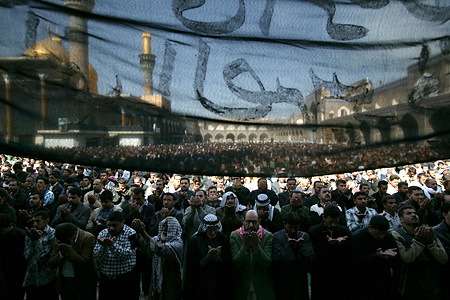
Some quick pundit house-keeping on last week. It strikes me that there was one critical development. That was Jafaari’s withdrawal from the PM slot in Iraq and the selection of Maliki in his stead. One thing we’ve learned from Iraq: it’s obviously unclear at this point what this signifies. It has to be good news that the deadlock is broken; but it’s still sobering that Maliki is expected to take up to another month to staff a government. All the reports – and I got some updates in person in London – are that each day that goes by without a national government, the power of the militias grows – and the influence of Jihadist Shiites in the South waxes. These are very hard and very dangerous trends to reverse, and could prove fatal for the prospects for peaceful self-government in Iraq. Omar is unimpressed:

[W]ill the real problem be solved by this agreement on the top posts?
I guess not because if any of the two new candidates gets to be the new PM, Iraq will – in my opinion – continue to descend for the next four years in the same way it’s been doing since the interim government was installed last year. And after all, the UIA’s decision to replace Jafari with al-Adeeb or al-Maliki is a solution designed for preserving the brittle unity of the UIA and not for the creation of a unity government because they know very well that the rest of the blocs were hoping to see Abdul Mahdi replace Jafaari. Maybe the UIA is twisting arms with this new nomination and betting on splitting the lines of the anti-Jafaari mass, thinking those would not be willing to prolong the deadlock by refusing the new candidates.

The NYT’s analysis is here; Time’s is here. One benefit of taking a breather is that I don’t have to have an opinion on this stuff every day and can get a little more perspective. One thing lingers in my head, when all is said and done: Iraq was always going to be a very tough project, and, despite the criminal negligence – even malevolence – of Rumsfeld (more later), it is far too soon to come to any settled judgment on the outcome. We now look at Kurdistan as a success story. But it was effectively liberated well over a decade ago (by our no-flight zones) and endured a very nasty civil war thereafter. Moreover, in the absence of any really good options against Iran, Iraq is still the best potential lever against Ahmadinejad. If we can achieve a unified, reasonably democratic, and stable Iraq in the next few years, especially among Shiites, we will have shifted the dynamics in the Middle East in our favor – and in favor of freedom – profoundly. We will have achieved something good proportionate to the evil of 9/11. As time passes, our rage at the defense secretary (and the president who retains him) should grow. And our conviction that we must prevail – with or despite them – should deepen.

(Photo: Yuri Kozyrev for Time.)