Can You Repair A Shattered Glass?

Stephen Glass, the fabulist who wrote dozens of false and libelous stories for TNR and other magazines in the ’90s, is still having trouble getting his new career as a lawyer going; the California Supreme Court just denied him admission to the state bar. David Plotz, who strongly dislikes Glass, calls the decision “misguided and cruel”:

The Supreme Court also worries that Glass would fabricate documents and deceive clients, a bizarre and backward conclusion. The very first thing anyone knows about Glass is that he was a liar and a fraud. Any judge he appears before will know: This is that lying journalist. Any opposing counsel will be aware: This is Shattered Glass. He’s not trying to sneak into courtrooms under a new name: He’s Stephen Glass. He is a flashing red highway sign. This is what happens when you Google him. Glass is far less likely than most lawyers to try to sneak something past a judge, because he’ll know that every single word he speaks and document he signs is suspect.

Bmaz agrees:

[W]hile what Glass did as a journalist is appalling, the unyielding and scathing tone of the California Supreme Court seems to be somewhat shocking in the face of the common story of America being a land of redemption and second chances. Especially when the lower tribunals, that heard the real evidence, found otherwise. I guess second chances and redemption are only for banksters and war criminals, but not for a guy who made up some lousy digital media stories. You don’t have to like Stephen Glass to see the disconnect here as to who in American life really gets the shots at second chances.

I hired Glass as a personal assistant way back when.

In that job, he was terrific, as well as meticulous and charming and, in retrospect, sociopathic and manipulative. Mercifully, I had gone from TNR when he was wreaking his terrible damage to the place. I still feel a lot of anger about him and what he did, but I cannot but agree with David. The man at some point deserves to be able to start over. He’s been working as a paralegal in a law firm for ten years; he has passed the bar; there have been no allegations of unethical conduct in his current job. Maybe this says something about the pecking order, as this quote from the NYT suggests:

The question is, Are we prepared to say as lawyers that a man who is no longer considered moral enough to be a journalist is moral enough to be a lawyer? If people flame out in journalism because of dishonesty, is the law open to them? I think the answer is no.

Would journalists say that of an ethically challenged lawyer seeking to write about the news? I doubt it.

The Republican Alternative To Obamacare

Avik Roy summarizes key parts of the Senate plan unveiled yesterday:

While the plan would repeal Obamacare, it would preserve some of the law’s most popular features, such as its ban on lifetime limits on insurer payouts, and its requirement that insurers cover adult children younger than 27. It would replace Obamacare’s premium hike on young people, known as age-based community rating, with a more traditional 5:1 rating band.

It wouldn’t maintain Obamacare’s individual mandate, nor its requirement that insurers offer coverage to everyone regardless of pre-existing health conditions. Instead, the plan would require insurers to make offers to everyone who has maintained “continuous coverage,” while aiding states in restoring the high-risk pools that served those who insurers won’t otherwise cover. Subsidy-eligible individuals who failed to sign up for a plan would be auto-enrolled in one priced at the same level as the subsidy for which they qualified.

Carpenter notes one major drawback:

[T]hose with pre-existing conditions that fail to maintain continuous coverage at any time could be denied coverage. Nearly 90 million Americans have a pre-existing condition. That’s quite the crack to fall through.

Beutler calls the proposal a “mess”:

If Republicans had offered this plan as an opening bid in 2009, they might have found Democrats willing to make a counteroffer and negotiate toward some kind of compromise — or they might have knocked the whole legislative process off the rails. But in 2014, a plan that devolves crucial aspects of Obamacare without any inducement for Democrats is a joke.

Yglesias thinks “key thing about this is that it doesn’t envision radically remaking the health care system along free market lines”:

Relatively to the status quo that existed in 2009, it would constitute modestly remaking the health care system along liberal lines. Most of all, as a political document it reflects an appreciation of the overwhelming political power of the status quo. You can’t kick those 25-year-olds off their parents’ insurance plan. You can’t deny the currently insured the peace-of-mind that comes from knowing that getting sick won’t make them uninsurable. You can’t change tax policy in a way that’s too disruptive. And this plan isn’t going to pass in 2014. It’s not going to pass in 2015. And it’s not going to pass in 2016. By 2017, Medicaid expansion and subsidized exchange plans will be the new status quo. Are the Coburns, Burrs, and Hatches of 2017 really going to be willing to blow that up?

Sarah Kliff’s related thoughts:

Obamacare has become the starting point for negotiations. This wasn’t really true a few years ago, or even a few months ago, before the health-care law’s insurance expansion started. It’s interesting that this proposal takes some of the contours of Obamacare and works around them, such as ending pre-existing conditions and continuing dependent coverage up to age 26. The health-care law’s $700 million in Medicare cuts stick around, too. Even though it’s a replacement plan, it also acknowledges that Obamacare isn’t totally going to disappear.

Yuval Levin talks up the plan:

It can … be called a very encouraging sign that congressional Republicans know that they will need a serious Obamacare replacement if they are to persuade the public that Obamacare must be repealed. It’s especially encouraging that Orrin Hatch – who is the ranking Republican on the Senate Finance Committee (the key committee with oversight for federal health-financing policy) and would likely become chairman of that committee if Republicans took over the Senate next year – is among the sponsors of this proposal. The ideas here are also very much in line with those laid out over the years by Paul Ryan, who is likely to become chairman next year of the equivalent House committee, the Ways and Means Committee.

This proposal is just a step, of course – an imperfect and an incomplete step, like any legislative proposal. But it is a major and important step, and a very encouraging one.

Philip Klein’s bottom line:

Ultimately, the new Coburn-Burr-Hatch plan would not usher in a free market for health insurance in the United States, which would require fully ending the distortion of the tax code and removing far more regulations. What it does do is offer individuals more freedom than now exists under Obamacare.

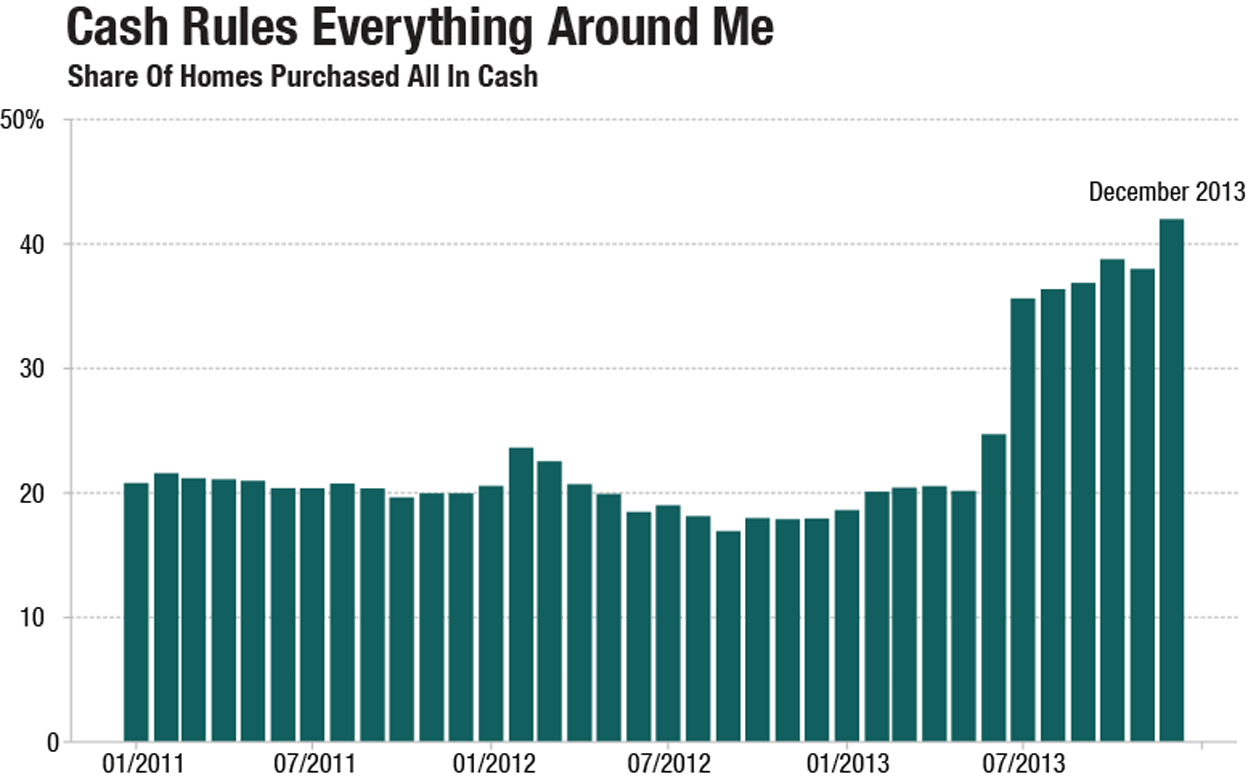
Paying For Your House In Cash

dish_cashhomes

Julia Zhu notes that in December, “all-cash purchases accounted for 42.1 percent of all U.S. residential sales, according to the latest report from RealtyTrac, a company that collects and analyzes housing data”:

There are a few things driving this. Last summer, interest rates on mortgages jumped sharply. And though rates are still low by historic standards, relatively higher rates make borrowing money a less appealing option. If you do want a mortgage, you might not be able to get one: Lending standards remain unusually tight, keeping lots of potential buyers out of the market.

Also, big, institutional investors have started buying up lots of homes and renting them out. They accounted for about 20 percent of the all-cash sales in December (and about 8 percent of home sales overall).

The Sad Story Of Dr. V, Ctd

In light of the Grantland controversy, Parker Molloy defends transgender people who choose to stay in the closet:

I may meet someone, whether it be a coworker or acquaintance, and be treated with the same casual attitude I imagine they treat everyone. Then, should they find out that I’m trans, conversations start to take odd turns. Suddenly, the topic of my genitals becomes fair game in their minds. Suddenly, they feel the right to ask what my “real name” is. Suddenly, pronouns start slipping, and I find myself called “he” by these people who had just been referring to me as “she” five minutes earlier. Suddenly, I’m no longer a human being, but rather a biological freak show.

Is that something you’d like? For every conversation to veer away from you as an individual and to instead focus on one singular part of your history? As a writer, as an author, as an activist, this is a choice that I have made for myself. I am willing to endure the awkward questions, the stares, the misgenderings, and the gawking. I do this in an effort to urge society to come to terms with the fact that transgender people are just like anyone else. I do this because I choose to. Essay Vanderbilt did not choose to put her trans status front and center, and taking that from her is not journalism, but rather a betrayal of her right to privacy.

Update from a reader:

I read Parker Malloy’s piece on Dr. V and a lot of the commentary on the Grantland piece. And while I agree with Parker’s point of view – that no one has the right to “out” a person as transgender – I think Parker and others ignore an important fact:

Dr. V raised money from investors. When you do that, you may not make an untrue statement of a material fact or fail to disclose a material fact necessary to make the statements made, in the light of the circumstances in which they were made, not misleading. In almost all instances that means disclosing biographical information about key employees. I don’t know how Dr. V could have possibly done that without revealing, indirectly, that she was transgender.

Professional investors in businesses such as hers typically conduct background checks on the founders/inventors/key executives. How could they have conducted a thorough background check without knowing her prior stereotypically male name? I’m not saying that the fact she was transgender was itself material or the failure to disclose that fact was fraudulent, but it seems as though it would have been impossible to avoid revealing she was transgender in order to make accurate disclosures about other material details of her life, such as her work and credit history.

And ask yourself this question: what if you knew her background disclosures were misleading? The obvious course would have been to encourage her to update them or pull the offering, but what if she refused? A lawyer would be obligated to keep such information confidential, but probably would also be obligated to withdraw as her counsel (and perhaps make what’s called a “noisy” withdrawal).

But what if you were the CFO of the business, not subject to attorney-client confidentiality? Would the “you may not out a transgender person” rule apply to you? If you don’t say anything, you could find yourself in the legal crosshairs. Put another way, should you be forced to commit securities fraud because she chose to keep her transgender status a secret? Again, I’m not saying you’d be obliged to reveal she was transgender, but I can’t see how you could correct the misstatements and omissions without also inadvertently revealing she was.

People have rights – like a transgender person’s right to decide whether to keep her personal history secret – but they also have duties – like an entrepreneur’s obligation to make accurate and complete disclosures to investors. If a transgender person wants to keep that part of her personal history a secret, then she’s going to have a real hard time raising capital from investors in a manner that complies with law.

Scenting A Text Message

You may be doing it soon:

The obvious starting point for smell communication is the smartphone, a ubiquitous device we already bling to death, and for which a growing panoply of notifications, vibrations and ambient signals are added with each new release. Japan’s Scentee sells a plug-in atomizer for smartphones (currently selling for around $35 on Amazon.jp), which can be customized when triggered by an app to spritz standard aromas such as rose and lavender, as well as more unique tastes of curry, coffee or cinnamon roll, costing just over $5 for 100 sprays. The company suggests its product be shared by “lovers,” and lists use cases such as getting a whiff of your chosen scent each time you get a Facebook like or, as part of a wakeup alarm. There’s no word yet on whether it will come to the US.

Liz Stinson speaks to David Edwards about the oPhone, one of several “smellable” devices currently being developed:

There’s one big problem when it comes to doing this, says Edwards: “Odor transmission to date is not smart,” he explains. “If I give you the odor of a pizza, I have a difficult time immediately after giving you the odor of the sea and then giving you the odor of a cactus.” Basically what Edwards is saying, and what we already know from letting trash sit in our apartments a day too long, is that odors linger. Which makes it hard to craft any sort of cohesive and decipherable olfactive narrative.

The oPhone solves this problem with its main innovation: the oChip. This little cartridge, about the size of a fingernail, contains olfactive information that can produce hundreds (and soon thousands, says Edwards) of odor signals. The idea is that these chips can be installed in the oPhone, and via a bluetooth-connected app called oTracks, scents can be sent to yourself or an oPhone-carrying friend with the push of a button.

Where Language Is Slow To Evolve

John McWhorter doubts that English will ever embrace a gender-neutral pronoun:

In language there are open-class and closed-class words.

Open-class ones, such as nouns and verbs, can be made up, or used in brand new ways, as new things and actions arise in the course of human affairs. Closed-class words are much harder to create out of thin air. They aren’t things or actions, but tools to show the relationships between them. For example, prepositions situate things in space and time. Note that you can’t make one up, such as one that describes something being airborne instead of on the ground. The plane is gunch the air—cute, but hopeless.

Pronouns are the same way. They stand for something, namely nouns. They’re tools. We use them more than we use nouns themselves—rapidly, unconsciously, all day. Thus, we are no more likely to change them than we are to alter the way we swallow. We are, as one might say, “severely” conservative about pronouns.

Raised From The Bed

Amid serious drought in the American West, once-flooded towns are re-emerging:

6403502759_b6790dca0c_oNear this Sacramento suburb [of El Dorado Hills], man-made Folsom Lake has receded to less than one-fifth of its capacity amid bone-dry conditions in California, recently revealing outskirts of a ghost town called Mormon Island founded during the mid-19th century gold rush. On an unseasonably warm winter day recently, throngs of visitors descended on the cracked mud flats of the reservoir to inspect hand-forged nails, rusted hinges and other vestiges of frontier life that were inundated when the lake was created in 1955. …

Texas’s Lake Buchanan shrank in 2011 to reveal the original site of the town of Bluffton, drawing visitors to the remains of homesteads, a store and cotton gin that had been mostly under water since the reservoir was created in 1937, said Alfred Hallmark, a local historian. The town is one of more than 200 archaeological sites in Texas, including cemeteries, that have been uncovered by drought, said Pat Mercado-Allinger, director of the Texas Historical Commission’s archaeology division.

Geoff Manaugh stresses the fragility of these rediscovered locations:

6403495359_0b348c155f_bCurious visitors and amateur collectors alike are beginning to pick the old sites dry, rambling through the ruins of these dead towns revealed by drought, carrying metal detectors and looking for worthy artifacts. In the process, they are removing old objects – even whole pieces of architecture – before local authorities have the time and resources to catalog and protect what is re-emerging there. This surreal and unexpected opportunity to explore what was lost – in some cases nearly 100 years ago – mummified by water and preserved beneath the rising waves of western reservoirs, might thus simply go to waste.

Instead, the best option might be for the sites to be drowned all over again, assuming the drought will end and that these historic locales can once more be inundated, taken off the tourist map and sealed for their own protection beneath the calm surfaces of artificial lakes. Perhaps, then, future archaeologists better prepared for moments like this might yet be able to explore these historic sites when yet another drought rolls through.

(Photos from Texas’s Lake Buchanan by Merinda Brayfield)