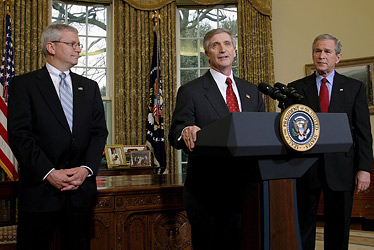
Washington says goodbye to president Bush’s "manservant," Andy Card.
(Photo: Martin Simon/EPA.)
I presume some Christianists will soon be declaring the Commonwealth’s Supreme Judicial Court’s decision today another exercise in rampant "judicial activism." The decision – supported by the far right’s bete noire, Margaret Marshall – upholds a 1913 anti-miscegenation law that made Massachusetts marriages invalid if they were entered into by residents of another state with the intent of violating the marriage laws of that other state. (The law was crafted to stop inter-racial couples getting married in Massachusetts and returning to, say, Virginia and trying to have their marriage recognized as legal. Virginia’s current position on same-sex marriage is identical to Virginia’s previous position on inter-racial marriage: it’s an abomination.) The Massachusetts Court’s decision seems to me to be the right one. If the Massachusetts legislature wants to repeal the 1913 law, they are entitled to. Until then, it’s the law. It also seems clear to me that other states may legally and constitutionally decide not to recognize Massachusetts’ marriages, with or without the 1913 law.
Along with other federalist conservatives, I believe in the right of individual states to make their own decisions on marriage rights. They are so doing. I think it makes sense in a country as diverse and polarized as this one to allow Alabama to have different laws on gay relationships than, say, Oregon. What Massachusetts has now done therefore is to destroy the last crumbling pillar of the argument for a federal constitutional ban on all legal protections for gay couples. The whole point of this amendment was supposed to be to stop Massachusetts marriages from being "forced" on neighboring or other states. Now, the Massachusetts Supreme Judicial Court has ruled these marriages invalid out of state before they even begin! The debate is now over, right? And the Republicans will withdraw their polarizing "Marriage Protection Amendment" from Congress this summer, right? There’s no need for it whatever now, is there?
Prayers were answered. JPod is beyond help.
Apologies for the lighter blogging. I went in Monday for another foot check-up; and my podiatrist administered another wart-treatment (they seem to have gotten even worse) that felt fine when it happened, but has subsequently created three large, gruesome-looking burn-blisters on the ball of my right foot, making it impossible for me to walk. In fact, for a while yesterday, it hurt like hell just to lie down and feel the nerve endings absorb the chemicals. They give you a painkiller, which would be lovely if I weren’t in pain. As it is, it keeps the pain away but makes me a little spacy, so I’ve been easing up on the posts. Not that you’d notice or anything, but just saying … Now where was I?

Watching the intensity of the youth protests and riots in France, it’s impossible not to reflect on the massive cultural gulf between the U.S. and continental Europe. These young people are rioting against a law that would almost certainly help more of them get a job. They are rioting to stay unemployed. And the main complaint from some French observers is that some of them are not violent in the correct, traditional French way:
"In France, we always imagine violence to be political because of our revolutions, but this isn’t the case," said Sebastian Roch√©, a political scientist who specializes in delinquency in the suburbs. "The casseurs are people who are apart from the political protests. Their movement is apolitical. It is about banal violence ‚Äî thefts, muggings, aggression."
Ugh. This violence, it is so … apolitical, so banal. Where did the good old political violence go? It’s important to remember that excessive welfare states do not only impede economic growth and freedom, they also change people’s minds and souls – from independence to dependency, from self-help to resentment, from pride in work to rioting to perpetuate unemployment.
(Photo: Jerome Sessini, Time.)
You’ve got to love a quote like this:
"You know how he is, somebody presents an idea; he says, ‘No, not doing that, next question.’ But he was not like that, so that means he was at least digesting some of the advice suggesting change."
Not quite as fast as the average Arctic glacier these days, but an improvement.
The "Iron Sheik" wrestler tells some poor schmuck called Brian Blair what he would like to do to him. Unhinged homophobia. Pure. Distilled. Deadly.

The abuse of Christianity by the religious right is beginning to be exposed and understood more thoroughly. But more needs to be done. Critically, we have to rescue the concept of faith from the hands of fundamentalists, of all kinds. They have turned Jesus’ message into its opposite, as this reader recognizes:
"Didn’t Jesus tell his followers to love their enemies? Didn’t he tell them that God does not choose sides, but like the sun, shines his love on all, sinners and innocents alike? Would Jesus recognize Delay and the Republicans as being on "His" side? Did Jesus have a side? Obviously not. If Delay and Bush and the Christianist Republicans would truly ask themselves the question "What would Jesus do?", wouldn’t the answer obviously be to love your enemies rather than separate oneself from them and fight them? Wouldn’t Jesus see both Democrats and Republicans as one people whom he loved equally, and not take sides at all, or see either of them as enemies? If these people truly see themselves as bringing Jesus’ mesage into the world, and living a truly spiritual relationship to Jesus as the basis for their personal and political lives, wouldn’t they bring this same loving embrace of equality and charity for all into the political sphere? That kind of "Christianizing" of America would be a wonderful thing."
Yes, it would. And it still can be. Another trap is to play into the hands of fundamentalism and try to defeat their version of faith, rather than working, daily and hourly, on improving one’s own morality, bettering one’s own soul. Opposing one ideology with another is simply to perpetuate the same mistake. I admire Karen Armstrong’s work a great deal; and in this profile, the intrepid breadth of her own faith journey comes through. Money quote:
"It’s a mistake to define God. I gave it up a long time ago …’To define’ literally means to set limits. That is a travesty to try to define a reality that must go beyond our human thinking. The idea of a God overseeing all of this death and despair is untenable. That’s the antithesis of God. If you looked at the history of the 20th century, who is overseeing this? Elie Wiesel says that God died at Auschwitz. That’s just one human idea of God as overseer, and it’s a childish idea of God."
"The Ministry of Defense requests that civilians do not comply with the orders of the army or police on nightly patrols unless they are accompanied by coalition forces working in that area," – Iraqi blogger, River, at her blog. That’s the sentence she read scrolled across her television last night. Hey, stuff happens.
A reader writes:
"Well, I would consider Tom DeLay’s remarks inappropriate
if they had been delivered on the floor of the House, but since they were made at a Christian conference, I don’t have a problem with them. And if he were a Jewish congressman who made analogous remarks at a gathering of Jews, that would be fine, too, and the same applies to any faith. DeLay is entitled to have and express his religious views; the First Amendment guarantees that right to him as well as to the rest of us.
If his religious views align more closely with the Republican Party than the Democratic, there’s nothing wrong with that. Wanna find the party affiliations of the more outspoken Atheists? If they feel more comfortable in the Democratic Party, that’s okay, too.
Was he pandering? Possibly, but I don’t know. He might really believe what he said or he might not, but it’s clear from the report that the audience thought he was sincere."
My own view is not that DeLay shouldn’t have the right to say such things. Of course he should. But dividing the world and country into two sides at war, and placing Christ on one side, that of the Republicans’, are politically dangerous and morally repugnant gambits. It sickens me to see my own faith abused and purloined in this way. I hope there are some Republicans left who can call this demagoguery and abuse of faith for what it is.
(Photo: Harris County Sheriff’s Office/AFP/Getty.)

 The Dish