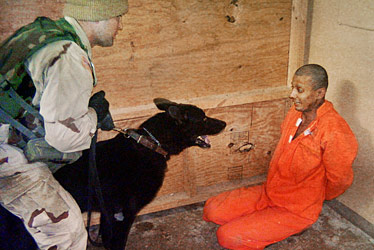
You thought scenes like the one above can no longer happen? We had the McCain Amendment, no? Dream on. More blogging on the trial of Sgt Michael Smith can be found here.
When I moved to Time.com, several of you asked for the return of that little box I used to have on my old site that listed my most recent articles, with links to read them. We’ve now added it to the new site, and it’s down there on the right, titled "Latest Essays". Thanks for the input. When I’m done with the book, we’ll be adding more new features. Feel free to suggest any.
David Brooks has a great column today which is too important to be available for non-subscribers. He recounts how many distant pundits saw immediately the problems in the invasion almost as soon as it started. Rumsfeld and Franks didn’t, which is why, in Bush’s house of mirrors, one was given the Medal of Freedom and the other is still in office, refusing to concede any errors. The worries the rest of us had were specifically the insufficient troops and emerging guerrilla resistance in the first days of armed conflict on the ground. Since I’ve been beating myself up lately for getting things wrong before the war, I went back to my own archives to see what I was thinking in March 2003. I was worried, but still gung-ho. The tone of my comments about the anti-war crowd is hubristic and occasionally cringe-inducing, to be honest (although it remains a matter of historical fact that some on the anti-Bush left clearly wanted the war to fail solely to attack the president). Still, I was clearly rattled by the emerging reality, even from my distant perch, even in the first few days. Some money quotes:
March 24:
"The question, to my mind, is who these resisters really are. Senior Saddamites who know they could get killed when power shifts? Islamist terrorists? Opportunists? Regular soldiers? It’s extremely hard to tell; and it certainly helps reveal the difficulties ahead for governing a country where such units can melt away into residential neighborhoods.
Do we have enough troops in time for the final battle? Have we gone too fast too soon? Those seem reasonable concerns to me, although I’m not qualified to take a side in the argument. But it is not too unreasonable to worry that with one northern front denied us, we need overwhelming force to smash through to Baghdad quickly enough. Do we have enough? And do we have enough humanitarian follow-through available soon enough to build support in the South?"
A day later, my concerns were deepening:
"It seems to me that we may have under-estimated the psychological effect of president George H. W. Bush’s brutal betrayal of the Iraqi people in 1991, at the behest of the U.N. No wonder Iraqis are still skittish about Americans and fearful that this interlude may end. The allied strategy of simply skirting past major cities also means that Saddam’s henchmen may still be in control there, and so feelings are still deeply skeptical, mixed or shrouded. I also think that we hawks might have under-estimated the Iraqis’ sense of national violation at being invaded – despite their hatred of Saddam."
Two days later, I was still fretting, while providing material on the other side of the argument:
March 26:
"The Shi’a population in the South is still not sure of an allied victory. It seems we under-estimated their skittishness about an allied war – due in large part to their understandably bitter feelings at being betrayed in 1991. If we had more overwhelming force in the region, that may have been less of a problem. But it appears we don’t, for reasons of logistics and Turks but also of war planning."
By March 27, I was beating myself up again:
"It may also be true that some of us have again under-estimated something: the power of a totalitarian cult over its enforcers. The guys fighting us are the equivalent of the SS. We’re invading a milder version of Nazi Germany – only after eleven years of relative peace. These guys have barely been softened up at all. Why did conservative hawks like me not believe our own rhetoric about the horrors of totalitarianism? The point about such systems, as Orwell showed, is not just their brittleness and evil, but their success in indoctrinating and marshalling the shock troops. I’m chagrined at my own optimism in this regard. I should not have been surprised by the ferocity of the elite’s defense of itself."
By March 31, I had come to the same conclusion that Francis Fukuyama was to assert three years later:
"The experience of the collapse of the Soviet Union perhaps lulled us into over-confidence."
The point is not to exonerate myself. I was too confident before the war, trusted the Bush amdinistration far too much and was too scornful of the opposition’s bias to hear some of their substantive arguments. But I was quickly adjusting to reality. The point is: if even I could see this, why couldn’t Rumsfeld or Bush? Or Franks?
Of course, there were some even more optimistic than the president or me. I wasn’t the person who declared: "This war is going to be over in a flash." That was Bill Clinton, the man whose formal 1998 policy of regime change in Iraq was finally being implemented.
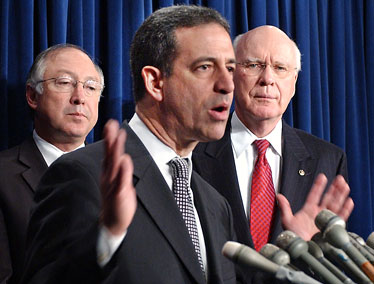
One thing has struck me these past few years about the right in America. As it has slowly abandoned its own principles – limited government, individual freedom, balanced budgets, federalism – it has been forced to resort to three fundamental issues to keep itself alive. The first was the war on terror, the second fundamentalist Christianity, and the third, hatred of the left. The first has waned somewhat, not because we aren’t still at war and in great peril, but because it is manifestly obvious that this administration is stunningly incompetent in its execution of the war. There’s only so much you can do to defend it at this point. The evangelical base whose support for Bush is entirely for religious rather than political reasons – the theocratic heart of the GOP – will never stop believing, as long as the Supreme Leader refuses to show any doubt and keeps preventing vaccines from being developed, puts pro-lifers on the Court, and keeps up the pressure on gays. But the rest – and they’re critical – are motivated entirely by being anti-left.
The most depressing aspect of this was the vile "Swift Boat" attack on John Kerry in the last election campaign. But you only have to watch O’Reilly or read Powerline or listen to Sean Hannity or David Horowitz to know that the only thing that really gets them fired up any more is loathing of liberals. The only way the GOP base will be motivated to vote for an incompetent, exhausted, fiscally insane administration is if they get to vote against "libruls". Michael Moore, the Daily Kos, Paul Krugman, George Clooney, et al. are therefore the GOP’s last, best hope this fall. Feingold’s call for censuring the president is the best thing to happen to Bush for a long time. Hillary will help, whatever she actually does. The question is merely whether the anti-left card will work any more. It barely did the trick last time – in a buoyant economy, in wartime, against a candidate as pathetic as Kerry, Bush could have lost if a few thousand votes in Ohio hadn’t been beaten out of the anti-gay scrub. My gut predicts a huge swing against the GOP this fall. So watch out for the anti-left hate and hysteria from Republicans. It’s coming. It’s all they’ve got left.
(Photo: Dennis Cook/AP)
My fiance and I had dinner Tuesday night with Jon Rauch and his boyfriend. I’ve known Jonathan for many years; he’s not just one of the most decent and principled writers I know; he’s a lovely guy. But he’s also hard to get to know, a little socially awkward at times, occasionally remote. He mentioned that one piece he had once written had proven over the years to be the most popular he’d ever had published. Here it is. Money quote:
Do you know someone who needs hours alone every day? Who loves quiet conversations about feelings or ideas, and can give a dynamite presentation to a big audience, but seems awkward in groups and maladroit at small talk? Who has to be dragged to parties and then needs the rest of the day to recuperate? Who growls or scowls or grunts or winces when accosted with pleasantries by people who are just trying to be nice? If so, do you tell this person he is “too serious,” or ask if he is okay? Regard him as aloof, arrogant, rude? Redouble your efforts to draw him out?
If you answered yes to these questions, chances are that you have an introvert on your hands‚ and that you aren’t caring for him properly.
No one believes me, but I think I may be one too. Jonathan has a Q and A about the article here.
"’Achievement’ is the ‘diabolical’ element in human life; and the symbol of our vulgarization of human life is our near exclusive concern with achievement. Not scientific thinking, but the ‘gifts’ of science’; the motor car, the telephone, radar, getting to the moon, anti-biotics, penicillin, telstar, the bomb. Whereas the only human value lies in the adventure and excitement of discovery. Not standing at the top of Everest, but getting there. Not the ‘conquests’ but the battles; not the ‘victory’ but the ‘play.’ It is our non-recognition of this, or our rejection of it, which makes our civilization a non-religious civilization. At least, non-Christian: Christianity is the religion of ‘non-achievement,’" – Michael Oakeshott, in an unpublished notebook, retrieved by Paul Franco in his very useful introduction to Oakeshott’s increasingly vital thought.
It’s hard not to be troubled by a quiet ruling from the Bush administration qualifying the Clinton administration’s clear removal of sexual orientation as a barrier to security clearance. Money quote from the AP:
"The [Clinton administration] regulation stated that sexual orientation ‘may not be used as a basis for or a disqualifying factor in determining a person’s eligibility for a security clearance.’
Bush removed that categorical protection, saying instead that security clearances cannot be denied ‘solely on the basis of the sexual orientation of the individual.’
The new rules say behavior that is ‘strictly private, consensual and discreet’ could ‘mitigate security concerns.’"
Scott McClellan says nothing has changed, but he doesn’t seem to know what’s in the new regulation and his argument doesn’t add up on its face. Money quote:
"McCLELLAN: There’s no change in our policy. The language that you’re referring to reflects what is in that executive order.
Q So why take it out if there’s no change in policy?
McCLELLAN: I don’t think they took out language. I think that they updated the language to reflect exactly what was spelled out in the executive order. There’s no change in the policy.
Q But they took this language out. This is gone. It doesn’t say that anymore.
McCLELLAN: I don’t know what language you’re specifically referring to, because I think the language is very similar to what it says in the executive order and the policy remains the same."
My hope is that this language change is mere bureaucratic tinkering; or has some benign explanation. But my fear is that some within the administration made this change and did it for a reason. The new rules seem to qualify what was once a clear renunciation of sexual orientation being in any way an issue for security clearance. The protection now seems to refer to "strictly private, consensual and discreet" gayness. Could that mean that if you’re out of the closet, the government may discriminate against you in security clearances? If so, it’s bizarre logic. The only gay men and women who might have problems are precisely the closeted ones: they’re the only ones conceivably subject to some kind of blackmail; whereas openly gay people have nothing to fear and nothing to hide. So the change seems to serve no rational purpose, except, perhaps, to intimidate gay people in government service into being closeted. And the Bush people would never do something like that, now, would they?
Atwar Bahjat could have been the future of Iraq:
"She was a poet, a journalist and a feminist. She had written a book tracing her adventures as a war reporter and had begun work on a second book, examining the role of women in Iraq. She didn’t fit into either side of the mounting religious clash ‚Äî her mother was Shiite, her father Sunni.
She had the talent and connections to get out of Iraq, but she chose to stay because she was determined to see her country knit into a coherent nation.
She wore a gold pendant in the shape of Iraq as a symbol of her indignation over efforts to thwart that unity, and she argued with editors against identifying people as Sunni or Shiite in her broadcasts, friends and colleagues said. The hatred was hot enough already, she told them. She wanted to calm things down, not stoke the anger."
And so she was murdered in the "unbelievable mess" the Bush administration let grow and fester for the past three years. May she rest in peace.
I referred earlier today to a website which broadcast a call on a chat-thread to murder the tweve signatories to the anti-Islamist manifesto. The website contains many Islamist posts and has a very anti-Western, anti-Israel and anti-American slant. But it is fair to point out that many of the posters on its forums also dispute Islamists. Describing the website as Islamist is a little reductive. But check it out for yourself.
It takes a village to keep track of them. Greg Djerejian has the latest.
 The Dish