The Sunnis Quit

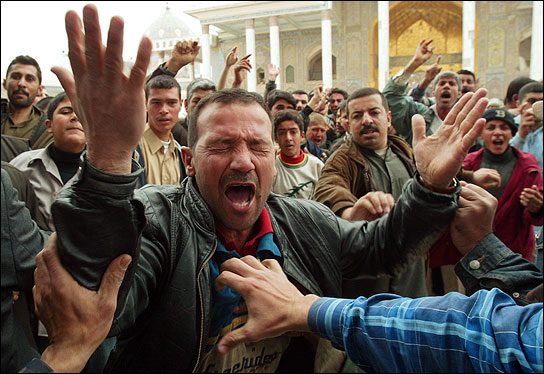
The main Sunni parties have quit negotiations on a new government. Sadrite Shiites rally in Baghad. The Iraqi government has acted calmly and sanely since the shrine atrocity, but we are at a point when we need minimal sectarian strife. Which is why the terrorists struck, of course. Khalilzad now has an even higher mountain to climb. But the alternative is a nightmare. Hang in there, Zalmay.

03

Sistani Shifts

He argues for peaceful demonstrations, whereas in the past, he has called for people to stay home. And he is so concerned about security for the country’s Shi’a mosques that he has even hinted that if the Iraqi government cannot protect them, he may ask militias to do so. Juan Cole has an update. I have to say this seems to me to be an ominous moment. Michael Novak gets it too. This is what happens when you break a deeply divided country and then fail to maintain minimal public order. I fear the spiral of violence just advanced another circle.

The West’s Awakening

The people of Eastern Europe may have a better grasp on the value of freedom than their fellows in the West or even in America, where so many of us take it for granted. Here’s a perceptive piece from the Czech Republic on some of the fast-disappearing illusions of many of us Westerners:

"The purple elephant in the middle of this crossfire is the contemporary notion — or, more accurately, the Western one — that the values of most Islamic societies have modernized along with the rest of the world.

The unraveling of the Iron Curtain revealed former enemies who, despite cultural differences, retained essentially the same values: a passion for freedom, mutual respect and at least a capacity to coexist with dissimilar viewpoints.

But the unexpected commonality between those nations could not have been brought into sharper focus than by the rise of global Islamic fundamentalism.

The West has naively greeted this scorpion with its Cold War handshake, believing that the virtues of peace and democracy appear self-evident; as if good intentions, by definition, will be good enough. But even the mainstream Islamic mindset has proven inscrutable to the West in a way that communism was mythologized to be but never truly was.

To many Islamic nations, freedom is not a tonic, but a toxin; it’s regarded not just as something that permits a challenge to faith, but is a challenge to faith by itself."

And there are some fundamentalists in America who feel the same way.
Bush and the Right

Are we in another quagmiers? Tom DeFrank suggests not:

"Delay is Bush’s best tactical weapon. An emerging strategy is to slide next week’s decision date by 30 to 60 days so the White House can launch the education job with Congress and the public it should have done weeks ago."

Politically, it seems to me that the Bush response should be more than this. It should focus on a renewed effort to secure the ports, allotting as much money and manpower as we do for airports. He can and should defend the P&O deal, while acknowledging that much more needs to be done for port security. Of course, given the rebellious mood among the GOP grass roots, this may still not be enough. Live by Jacksonian rhetoric; die by it.

The Real Port Issue

Leave the xenophobia and paranoia behind. There is an issue with port security, and it has nothing to do with P&O:

"A study completed last year by the Coast Guard and the U.S. Department of Homeland Security identified 66 of the nation’s 359 ports as being especially vulnerable to terrorist attack. But while the country has spent $18 billion securing airports since the terrorist attacks of Sept. 11, 2001, it has spent just $630 million to improve security at the nation’s ports. The Department of Homeland Security’s Inspector General last year sharply criticized the port-security program, saying it didn’t direct funds to the most vulnerable ports and compromised the nation’s ability to stave off terrorist attacks."

Can we please tackle the real problem with as much intensity as we tackle imaginary ones?

A City On Edge

Mohammed at ITM reports:

"The sense in the streets and the statements given by some Shia clerics suggest that retaliation attacks are organized and under control and are focusing on mosques frequented by Salafi and Wahabi groups and not those of ordinary Sunnis.
Looking at the geographic distribution of the attacked mosques, I found they were mostly in areas adjacent to Sadr city forming a line that extends from the New Baghdad district in the southeast to al-Hussayniya in the northeast."

But he’s relieved that the Sunnis do not seem to be responding in kind. An uneasy, relative peace reigns today. But the worries are there:

"Baghdad looks more alive today but in a very cautious way, traffic in the streets is heavier than it was yesterday but still way below normal.
There’s some kind of shopping frenzy because people are trying to be prepared if the worst happens; people are stock-piling small reserves of food, cigarettes, bottled water‚ etc especially after they heard some of the roads to/from Baghdad are closed and vehicles were turned away."

Militias Unleashed

The sectarian crackup of Iraq seems to be underway. The Sadrite Shi’a forces have taken hold of several mosques. Check out this report from Zeyad:

"The Al-Qudus, Al-Shaheed, and Al-Abrar mosques in Sadr city were evacuated and occupied by the Mahdi army. In the Baladiyyat and Binook districts, the Ahmed Ra’ouf, Al-Qudus, Dhiyouf Al-Rahman, Al-Fayyadh, Al-Muhannad, Al-Hassan bin Ali, and Ibad Allah Al-Muttaqeen mosques have been taken over by armed mobs from Sadr city."

Sunnis are responding by taking to the streets:

"It’s almost 3 am and I can still hear gunfire in the neighbourhood. Word of the street in our area is that Sunni neighbourhood watch teams are patrolling several Sunni districts in Baghdad, such as Adhamiya, Ghazaliya, Khadhraa, Adil, Dora, Amiriya, Bayaa, Mansour and Al-Jihad. They say if any Interior ministry forces (read Badr brigade) enter the area, local mosques will shout three Allahu Akbar’s through loudspeakers as a sign for residents to defend themselves."

Over 100 mosques have now been attacked.

Genes and Homos

More evidence that biology may play a role in male homosexuality. I should say I don’t think the genetic origins of sexual orientation should affect the debate either way. But I do find it fascinating to see the small insights science is giving us about the origins of the great gift of gayness. My own account of the origins of sexual orientation can be read in "Love Undetectable." It’s the second essay: "Virtually Abnormal."