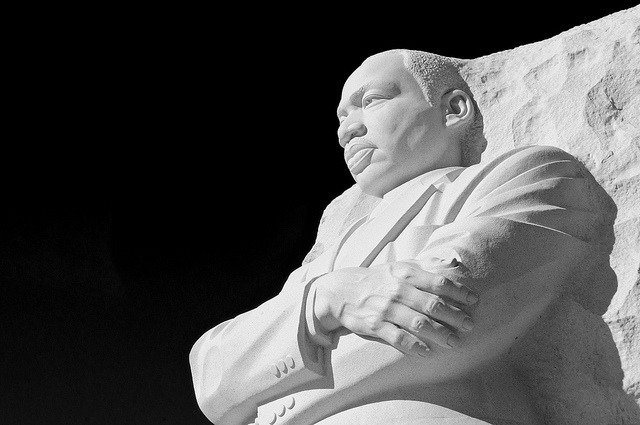
Commemorating King

dish_mlk2

Gary May pays tribute:

Looking back on King’s life and career, some would say that he had died at the right moment, that martyrdom rescued him from an equally serious blow: irrelevancy. The Voting Rights campaign had clearly been his greatest achievement and, as it turned out, his last. But the 1964 Civil Rights Act and the 1965 Voting Rights Act are a testament to his leadership and commitment to achieving change through nonviolent protest. Nearly 50 years after his death it is King’s words and deeds that live on in the American memory — not that of the racists who hated him or the Black Power advocates who scorned him.

King left us a rich legacy. Nonviolence became an effective tool in the hands of reformers throughout the world as well as the United States, which experienced the end of segregation in a relatively bloodless revolution. Despite his self-doubts and the attacks of critics in his own camp, he persevered, committed always to nonviolence and to the fulfillment of American democracy however long it would take. That is what we should be celebrating on this day.

Jenee Desmond-Harris urges us to refrain from asking “What would MLK think?” when it comes to today’s politics, emphasizing that his views could be difficult to pin down during his own lifetime:

“He was constantly evolving in his thoughts, and that evolution would have continued to impact his politics,” says Hasan Jeffries, professor of history at Ohio State University.

Jeffries points to the way King “trailed his wife, who’d already participated in anti-war protests years earlier” before finally making the Riverside Church declaration against the Vietnam War, getting himself cut off from more-conservative civil rights activists. It’s evidence that neither King’s positions nor his alliances were static. … Naturally, as his reality and his adversaries changed, so did his positions and his goals.

And even when it comes to people who are living today, it’s not as if everyone on the left, everyone who was active in the civil rights movement or all black politicians or activists are of the same mind when it comes to contemporary issues. Where would he stand on education reform? The Affordable Care Act? What about President Obama’s responsibility to African Americans in an environment that could be seen as the embodiment of King’s dreams but that goes hand in hand with racialized political potholes he couldn’t have imagined? Scandal? Your guess is as good as mine.

Meanwhile, Aura Bogado casts a critical eye at The GAP’s “MLK Event” sale, adding that she never “lets the day go by without reading King’s ‘Letter from a Birmingham Jail.'” Drawing on Taylor Branch’s Parting the Waters, Paul Elie details the “strange circumstances” of how the “Letter” was written:

What strange circumstances?  That King, prompted to set out his views after reading a newspaper article in which white liberal clergymen denounced nonviolence as an incitement to “violence and hatred,” started to write the letter in the margins of the newspaper. That he developed his argument (Branch reports) among “pest control ads and garden club news,” drawing arrows and loops to connect one insight to another — such as the point that “time is neutral” and so “we must use time creatively.” That once he got some note paper from his SCLC associate Clarence Jones, he crafted a three-hundred-word sentence explaining “why we find it so difficult to wait” for justice. … That a New York publisher suggested that an expression from the letter, simplified, should be the title of a book, King’s third: Why We Can’t Wait.

Ellen Blum Barish recommends listening to a 1958 speech given at her synagogue in Evanston, Illinois.  MLK’s Nobel Prize acceptance speech can be viewed here. Update from a reader:

Your post missed what I thought would have resonated with you today: how much Pope Francis sounds like MLK.  From the 1956 sermon “Letter From St. Paul to American Christians“:

They tell me that one tenth of one percent of the population controls more than forty percent of the wealth. Oh America, how often have you taken necessities from the masses to give luxuries to the classes. If you are to be a truly Christian nation you must solve this problem. You cannot solve the problem by turning to communism, for communism is based on an ethical relativism and a metaphysical materialism that no Christian can accept. You can work within the framework of democracy to bring about a better distribution of wealth. You can use your powerful economic resources to wipe poverty from the face of the earth. God never intended for one group of people to live in superfluous inordinate wealth, while others live in abject deadening poverty. God intends for all of his children to have the basic necessities of life, and he has left in this universe “enough and to spare” for that purpose. So I call upon you to bridge the gulf between abject poverty and superfluous wealth.

Previous Dish on MLK here, here, and here.

(Photo of Martin Luther King, Jr. memorial in Washington DC via Flickr user InSapphoWeTrust)

The Case For Small-Scale Science

This year’s Edge question is “What scientific idea is ready for retirement?”  From mathematician Samuel Arbesman’s response:

While the trends clearly point to the advent of team science, small and clever science—the realm of the tiny budget or the elegant experiment, or sometimes even the hobbyist—is by no means over.

To be clear, small science is not necessarily the lone underdog working against the establishment. More often it is simply one or two underfunded scientists doing their best. But it seems that they can still survive even in this modern era of big science. For example, several years ago, a paleontology graduate student made a discovery that cleared a dinosaur of cannibalism charges that began with a very simple observation: by looking at one of the fossil casts on the wall of the American Museum of Natural History’s subway station. Or take the scientists who examined the space of possible ways to tie a necktie, and whose research was published in Nature. Little science is still possible. …

You can even still do science on the cheap. Several decades ago, Stanley Milgram measured the well-known Six Degrees of Separation using little more than postcards. While science has become bigger since then, in some ways it has become even easier to conduct large-scale science by the scientist who operates at a small scale: due to massive computational advances and widespread data freely available (not to mention easier data collection online), now any scientist can do big science cheaply and in a small and easy way. Technology has allowed research scientists to leverage a tiny budget in astonishing ways. And each of us can now even easily contribute to science as an amateur, through the growing prevalence of citizen science, where the general public can help—often in a small incremental way—to collect data or otherwise help with science. From categorizing galaxies and plankton to figuring out how proteins fold, everyone can now be a part of the scientific process.

Achieving Identity

Juliet Jacques, who kept a blog about her gender reassignment surgery, reflects on a history of media coverage of transsexualism:

It was only after the Second World War, as photographs on newspaper covers became commonplace, that transsexualism developed into a mass media phenomenon. On 1 December 1952, the New York Daily News ran the sensational story of Christine Jorgensen under the headline ‘Ex-GI Becomes Blonde Beauty’ – with contrasting images of her as a male soldier, then glamorous woman, dominating the spread. Instantly, Jorgensen became a celebrity, working as an actress, singer and transgender rights advocate.

In Transgender History (2008), Susan Stryker claims the fascination with Jorgensen ‘had to do with the mid-20th-century awe for scientific technology, which now could not only split atoms but also, apparently, turn a man into a woman’. Stryker, a professor of gender studies at the University of Arizona, also notes that Jorgensen was the first American transsexual woman to become prominent after the war changed women’s relationships with paid labour and domestic work. It wasn’t just gender roles that were in flux, but gender itself.

As it transpired, The Transsexual Phenomenon (as the sexologist Harry Benjamin called it in his influential 1966 book) did not destroy US society. Or even visibly change it. Looking at the New York Daily News photographs of Jorgensen now, they come nowhere near to justifying their attention-grabbing tag – ‘Operations Transform Bronx Youth’. Jorgensen’s facial structure, her hairline, eyes, nose and chin, barely altered between 1943 and 1952: the main differences were her clothes and make-up.

(Video: 1953 British newsreel coverage of Christine Jorgensen)

The Bilingual Brain, Ctd

Arturo E. Hernandez explores how age affects the ability to learn multiple languages:

Particularly sensitive to age is a person’s ability to speak without an accent and to detect speech sounds that are not present in their native language. For example, infants can detect sounds from a language not in their environment at six months of age. By 10 months of age they lose this ability. This suggests that the ability to detect speech sounds from around the globe is available to all infants but slowly fades away. Another arena where age plays a role is in the processing of grammar. Those who learn a second language later in life do not perform as well on tests of grammar as early learners. Hence, the ability to learn grammar and speech sounds appears to be very dependent on the age that one first learns a language.

Despite this general rule, there are some very interesting exceptions.

For example, Christophe Pallier and his colleagues tested a group of adults who had been born in Korea and adopted as children in France between the ages of 4-8. This group of adults were asked to listen to sentences in Korean, French, or an unknown language. The results revealed no difference in their brain activity when compared to native French speakers. That is, both groups showed similar activity for French, Korean, and a foreign language. Furthermore, the Korean adoptees had no discernible accent. They sounded French. The results are intriguing because they suggest that a language can be lost even relatively late in childhood. This suggests that the age at which a language is learned is not the only predictor of how well a language is spoken as an adult.

Previous Dish on the subject here.

The Deadliness Of Doing, Ctd

Antonia Macaro considers how “doing nothing” may work to our benefit:

[A] lot depends on what we mean by “nothing”. In our achievement-orientated culture there is a danger of construing this as any activity without a clear end-product. In fact, there are different ways of doing nothing, some positive and some negative. There is a passive watching-TV-all-day kind of doing nothing, which is indeed often a sign of malaise. But there is also a “doing nothing” that includes reading, walking, reflecting, attending to the small things in life. An active doing nothing, if you know what I mean.

I’m not advocating doing nothing as a general policy in life. But it’s important not to confuse all unproductive activity with wasteful idleness. Allowing and cherishing a “doing nothing” of the active variety could enrich life as much as a passive doing nothing is likely to impoverish it.

Baggini looks to “The Dude” of The Big Lebowski, whose philosophy advocates “abiding” over “doing”:

I’m not sure many of us would really like to live like The Dude and the real world is more complicated than the often surreal universe of The Big Lebowski. But we can learn something from him even if we don’t become card-carrying dudeists. It’s that many battles are not worth fighting, even though our cause is just and our enemies in the wrong. The world is unfair and, if we cannot accept that fact, we will often end up further disturbing the peace of ourselves and others. We should not let people get away with everything, of course. But against the perennial temptation to believe something must be done, doing nothing is often the more courageous and fruitful path.

Oakeshott’s views on the matter here.

Plugged In To The Real World

Oppenheimer pores over the research of Rutgers professor Keith Hampton:

Hampton found that, rather than isolating people, technology made them more connected. “It turns out the wired folk — they recognized like three times as many of their neighbors when asked,” Hampton said. Not only that, he said, they spoke with neighbors on the phone five times as often and attended more community events. Altogether, they were much more successful at addressing local problems, like speeding cars and a small spate of burglaries. They also used their Listserv to coordinate offline events, even sign-ups for a bowling league.

Hampton was one of the first scholars to marshal evidence that the web might make people less atomized rather than more. Not only were people not opting out of bowling leagues — Robert Putnam’s famous metric for community engagement — for more screen time; they were also using their computers to opt in.

A Glimpse Inside Outsider Art

This year, the Smithsonian American Art Museum will host a traveling exhibition of the works of James Castle, who never learned to speak or write but who communicated through art made from spit and soot:

The Smithsonian American Art Museum acquired 54 works by Castle, who lived from 2013.27.34R_1.tif 1899 to 1977, last year. … Castle’s art isn’t exactly obscure — the Philadelphia Museum of Art held a retrospective in 2008 and the Museo Reina Sofia in Madrid staged another in 2011 — but it’s not too well-known outside the art world. And it’s gritty and strange, scrapped together with found ads and packaging, abstract figures from Castle’s life alongside jittery landscapes of rural Idaho shaded with stove-soot; his handmade books are full of arcane symbols and allusive narratives. Maybe bringing this art out to more rural places like those Castle was responding to in Idaho will give it a context that hasn’t always been there. Maybe it will allow Castle’s work to start being discussed as less of a wonder and more of a real reflection of American art. If nothing else, it’s encouraging that the Smithsonian American Art Museum is not just continuing to make these significant acquisitions, but also to put them in the context of the greater art history of the country.

(Image of “Untitled” by James Castle courtesy of the Smithsonian American Art Museum)

Face Of The Day

Screamers

For his series Screamers, Stefano De Luigi captured close-ups of protestors in Italy. Sahara Borja talked to De Luigi about the project:

Give us a bit of context here, which protests did you mostly attend? Can you describe the feeling in the air?

“I worked extensively for about a year on the social protests erupting in the country. Italy has been facing an economic recession for about three years now and the crisis is reaching its peak. What I tried to photograph is the terror felt by the middle class who are losing all the conquered certainties they have acquired over the last 50 years in Europe—this includes widespread wealth, secure jobs, free and high-quality education, and one of the most efficient healthcare systems in the world.”

Regarding the image format, why did you choose to focus on faces only and not the wider scene?

“I deliberately decided to focus on expressions—sometimes very dramatic ones. Images of masses in protest are not able to convey this sense of social discomfort affecting many citizens in Italy, and broader Europe. These frozen faces in a screaming expression of rebellion, terror, and sometimes anger better reveal the drama that many are facing.

(Photo: Milan – 7 October, 2011 – J., 15 years old, by Stefano De Luigi)

Not Jewish Enough For Marriage?

Israelis disagree about what makes a person Jewish, with the state using one identity test and rabbis, who oversee marriage and divorce, using another. The result? Some immigrants are in limbo:

In a concession designed to widen support for the new state, when Israel was founded its secular rulers left matters of marriage, divorce and burial in the rabbinate’s hands. It decides who is eligible for these rites, as well as carrying them out—so would-be brides and grooms must demonstrate their Jewish credentials. Supplying the necessary documents and witnesses can be inconvenient and galling: people resent having to prove what they know to be true. Immigration has made the system seem not just irksome but unsustainable.

For example, the Ethiopian Jews who migrated to Israel in the 1980s-90s, risking their lives and losing relatives along the way, have faced persistent doubts as to whether they are properly Jewish in doctrine and descent.

“I feel that I’m the Jew I want to be,” protests Fentahun Assefa-Dawit of Tebeka, an advocacy group for the 130,000-strong community. “I don’t want anyone to tell me how to be Jewish.” Western migrants, too, are sometimes doubted. The rabbinate considers some American rabbis too lax to vouch for their congregants and rejects their testimonies; it deems many overseas conversions inadequate. Many Israelis worry about the impact of such disdain on the diaspora’s political and financial backing for their state.

The biggest problem comes from the clashing consequences of two great ruptures in 20th-century history: the Holocaust and the collapse of the Soviet Union. Under Israel’s Law of Return, anyone who has, or whose spouse has, at least one Jewish grandparent can claim citizenship—a standard expressly modelled on the criteria for persecution under the Nazis’ Nuremberg laws of 1935. The Law of Return also recognises conversions that the rabbinate rejects. The wave of immigration from Russia in the past two decades means the discrepancy between these two standards has become glaring. There are now several hundred thousand ex-Soviet Israelis who were Jewish enough to get in, but are not Jewish enough for the rabbis