The Most Literary Liqueur

Absinthe:

In the poem Poison, from his 1857 volume The Flowers of Evil, Baudelaire ranked dish_toulouselautrec absinthe ahead of wine and opium: “None of which equals the poison welling up in your eyes that show me my poor soul reversed, my dreams throng to drink at those green distorting pools.” Rimbaud, who “saw poetry as alchemical, a way of changing reality,” Edmund White notes in his biography of the poet, saw absinthe as an artistic tool. Rimbaud’s manifesto was unambiguous: he declared that a poet “makes himself a seer through a long, prodigious and rational disordering of all the senses.” Absinthe, with its hallucinogenic effects, could achieve just that.

Guy de Maupassant imbibed, as did characters in many of his short stories. His A Queer Night in Paris features a provincial notary who wangles an invitation to a party in the studio of an acclaimed painter. He drinks so much absinthe he tries to waltz with his chair and then falls to the ground. From that moment he forgets everything, and wakes up naked in a strange bed.

Contemporaries cited absinthe as shortening the lives of Baudelaire, Jarry and poets Verlaine and Alfred de Musset, among others. It may even have precipitated Vincent Van Gogh cutting off his ear. Blamed for causing psychosis, even murder, by 1915 absinthe was banned in France, Switzerland, the US and most of Europe.
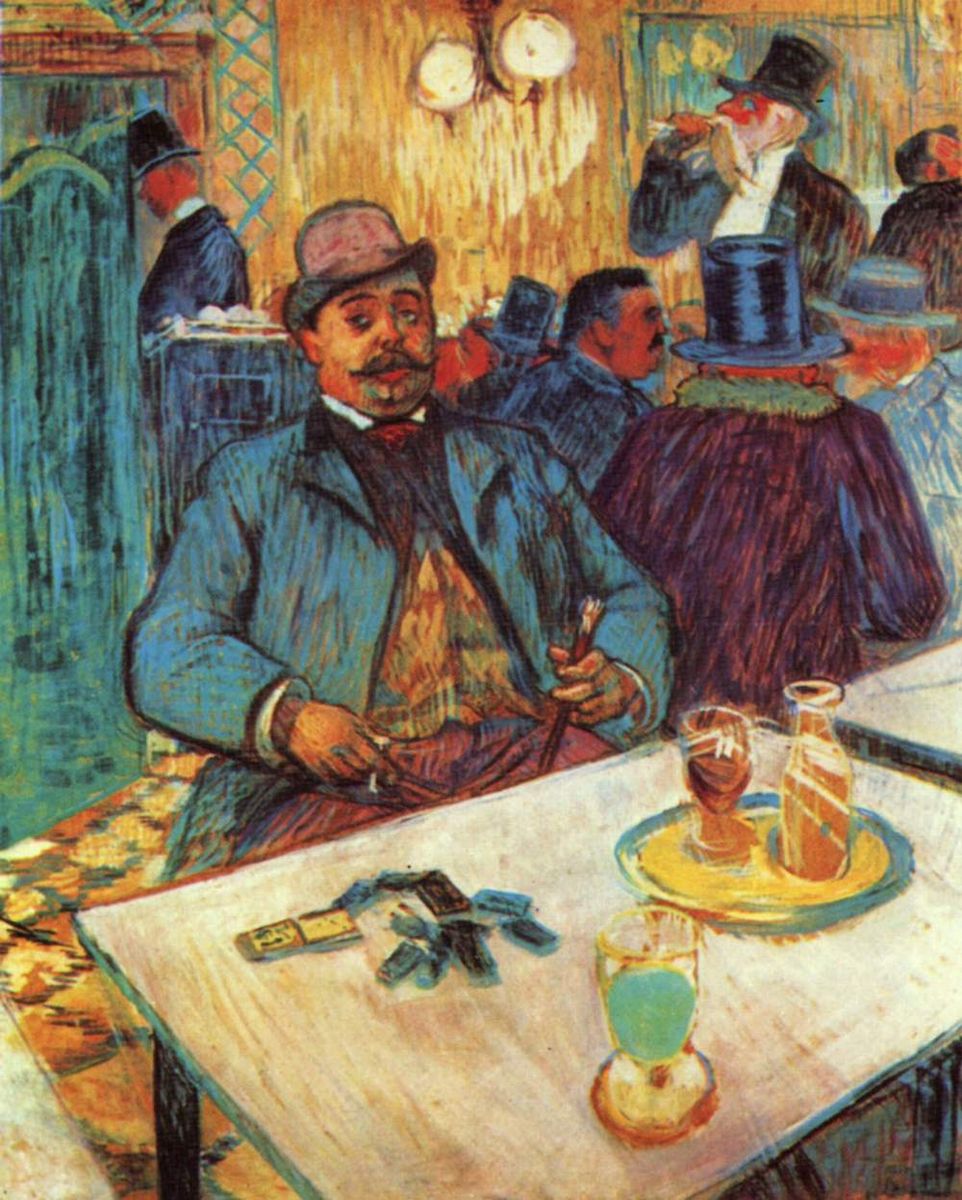
(Image of Monsieur Boileau by Henri Toulouse-Lautrec, 1893, via Wikimedia Commons)


A Rebirth Of Storytelling

Hugh Howey forecasts the future of literature:

If these are the end times for literature, then we must be traveling in circles, for the death of storytelling looks an awful lot like its birth. The novel itself isn’t all that old. Sure, we can find a handful of examples going back thousands of years, but you have to stretch your definition of novel the further back you go. Really, the idea of an immutable and unchangeable text dates only to the printing press. Before that, every scribe tasked with producing a tome thought he was an author. Like movie producers dabbling with plot, it was difficult for the hand-copiers of text not to make a tweak here or there. Books were ever-changing. Stories evolved. And that was the way things were until Gutenberg’s time.

Fast forward to 2012, where 1 out of every 5 books sold was part of the 50 Shades of Grey series. Originally a work of Twilight fan fiction, the monumental success of 50 Shades of Grey turned a spotlight on the shadowy world of fan-generated literature. Soon, publishers were seeking out other popular works of fan fiction and signing authors to mega deals. Then Amazon announced its Kindle Worlds program, which commercialized fan fiction and opened up licensed worlds for exploration. To purists—who mix a love of history with a thin understanding of the past—the sanctity of the written word was in jeopardy. It was raining frogs. The volcanoes were angry. These lovers of the very modern novel clamored for a return to our roots. And yet—that is precisely where we are heading.

A Short Story For Saturday

A passage from Edgar Allan Poe’s disturbing 1838 tale, “A Predicament“:

Leaning upon the arm of the gallant Pompey, and attended at a respectable distance by Diana, I proceeded down one of the populous and very pleasant streets of the now deserted Edina. On a sudden, there presented itself to view a church—a Gothic cathedral—vast, venerable, and with a tall steeple, which towered into the sky. What madness now possessed me? Why did I rush upon my fate? I was seized with an uncontrollable desire to ascend the giddy pinnacle, and then survey the immense extent of the city. The door of the cathedral stood invitingly open. My destiny prevailed. I entered the ominous archway. Where then was my guardian angel?—if indeed such angels there be. If! Distressing monosyllable! what world of mystery, and meaning, and doubt, and uncertainty is there involved in thy two letters! I entered the ominous archway! I entered; and, without injury to my orange-colored auriculas, I passed beneath the portal, and emerged within the vestibule. Thus it is said the immense river Alfred passed, unscathed, and unwetted, beneath the sea.

Keep reading here. Peruse Poe’s Complete Tales and Poems here. Previous SSFSs here.

What’s Different About Poetry?

Nick Laird spells it out:

Poetry is a way of being alone without feeling alone. It allows you to experience another mind, I suppose. And it does that more fully than other art forms, I think. It doesn’t simply describe an experience, or a feeling, or a moment: it evokes it through, say, rhythm or tone or diction or metaphor. It creates a mood. A poem communicates before it is understood; it’s not a fully paraphrasable form, which distinguishes it from other forms of writing.

It’s also perhaps the oldest art form. We can go back to an age-old idea of naming things, the Adamic impulse—to give something a name has always been an immensely powerful thing. To name something is to own it, to capture it. A poem is still a kind of spell, an incantation. Historically, a poem also invoked: it was a blessing, or a curse, or a charm. It had a motile power, was able to summon something into being. A poem is a special kind of speech-act. In a good poem there’s the trance-like effect of language in its most concentrated, naked form.

On a similar note, Canada’s new Poet Laureate, Michel Pleau, describes in a recent interview what he’d like to achieve over his two-year term:

You speak about poetry as being fundamental to what makes us human.

Poetry has existed since the beginning of humanity. Our ancestors gathered around the fire and tried to communicate with mysteries bigger than themselves. That’s still what we do with poetry. We write with the hope there’s someone at the other end of our poem.

But you also think poets are the object of too many clichés.

When you see poets, it’s in places like the Just for Laughs Festival. They’re caricatures and they’re always a bit ridiculous – you know, a guy with a beret on his head and a scarf around his neck who says inane things in rhyme. It makes people laugh. But poetry is deeper than that.

You want to change that image?

Yes. My goal would be to make people feel that maybe they love poetry more than they imagine. Our relationship to poetry is often a bit academic. Sometimes it’s linked to bad memories from having to learn poems by heart and reciting them in school. People often don’t realize they’re surrounded by poetry. At the very least, it’s in the songs they listen to. I often say that lovers’ words – when they whisper them to one another in the ear – are an expression of poetry in our daily lives.

A Poem For Saturday

Dish poetry editor Alice Quinn writes:

The winsome English poet Stevie Smith (1902-1971) is most famous for the poem we’re posting today and for her legion of admirers—among them Robert Lowell (“On gray days when most modern poetry seems one dull colorless voice speaking through a hundred rival styles, one turns to Stevie Smith and enjoys her unique and cheerfully gruesome voice”) and Sylvia Plath (“I am a desperate Stevie Smith addict”). She was a great chider, as anyone call tell from her poem “To an American Publisher”:

You say I must write another book? But I’ve just written this one.
You liked it so much that’s the reason?  Read it again then.

In a review of her Collected Poems, published in 1975, Seamus Heaney captured the quality of “these odd syncopated melancholy poems” describing how “her gift was to create a peculiar emotional weather between the words, a sense of pity for what is infringed and unfulfilled” citing the poem below as a supreme example. New Directions has a brand new Best Poems: Stevie Smith, richly illustrated with her own drawings, from which we’ll be selecting poems today and in the days ahead.

“Not Waving but Drowning” by Stevie Smith:

Nobody heard him, the dead man,
But still he lay moaning:
I was much further out than you thought
And not waving but drowning.

Poor chap, he always loved larking
And now he’s dead.
It must have been too cold for him his heart gave way,
They said.

Oh, no no no, it was too cold always
(Still the dead one lay moaning)
I was much too far out all my life
And not waving but drowning.

Update from a reader:

Another reason I renewed: “Dish poetry editor Alice Quinn writes:”

(From Best Poems: Stevie Smith © Stevie Smith 1937, 1972 and © New Direction Publishing Corporation 1988, 2014. Reprinted with kind permission of New Directions)

Kids Can’t Handle The Fiction?

Natasha Vargas-Cooper suggests that “maybe the novel is not the best device for transmitting ideas, grand themes, to hormonal, boisterous, easily distracted, immature teenagers”:

[M]ost high-school-age kids … go to overcrowded, underfunded schools, staffed by largely well-intentioned adults who don’t have the resources, or sometimes even the intellectual vigor, to make emotional landscapes of the western front, nineteenth-century London, or Pamplona very real to sixteen-year-olds. … Maybe there is a better format and genre to spark a love of reading, engage a young mind, and maybe even teach them how to write a coherent manner. Thankfully this genre exists: It’s called non-fiction.

Journalism, essay, memoir, creative nonfiction: These are only things I started reading as an adult because of how little I enjoyed reading novels in high school. Surely, the un-made-up stuff would be more of bore, I thought. Yet when I finally read In Cold Blood, Into Thin Air, the works of Hunter S. Thompson and Joan Didion, I continually pleaded aloud my friends in their twenties, “Why didn’t anyone make me read this in high school?!”

Margaret Eby agrees with Vargas-Cooper that most high schools may be unequipped to make novels appealing to teenagers, but “that’s not the point of teaching novels”:

At its loftiest, the idea of a high school curriculum—really, the idea of education in general— is to get students to think about, react to, absorb, and otherwise navigate situations that they wouldn’t have to outside of school. Solve a calculus problem. Dissect a frog. Memorize the preamble to the Constitution. These aren’t just party tricks for later, the point is the introduction. Just because teenagers might not totally grasp the implications and nuances of a subject doesn’t mean we shouldn’t expose them to it. Realizing that you don’t understand something is how you begin to understand it.

She adds:

What’s striking about the hypothetical syllabus Vargas-Cooper caps her essay with—one that’s brimful of literary journalism gems—is that the authors on it all owe a tremendous debt to fiction writing.  Truman Capote’s “In Cold Blood” and Adrian Nicole LeBlanc’s “Random Family,” to name two selections from Vargas-Cooper’s list, are engrossing reads not just because of the extensive research their authors conducted, but because they deftly employ the storytelling conventions of novels in their writing. I’m willing to bet that none, or very few, of the writers on her list got to where they are without reading novels.

The View From Your Window Contest

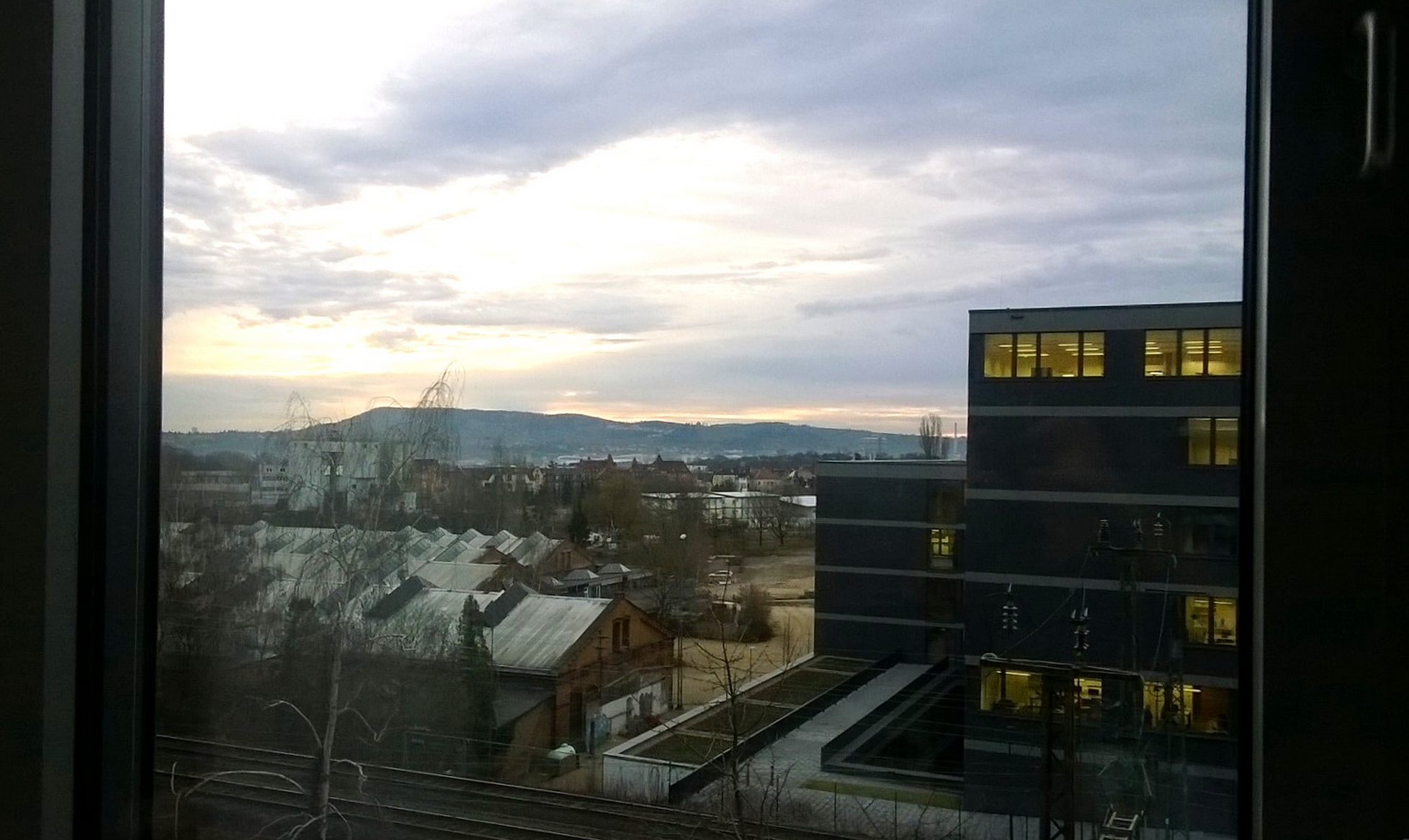
vfyw_1-18

You have until noon on Tuesday to guess it. City and/or state first, then country. Please put the location in the subject heading, along with any description within the email. If no one guesses the exact location, proximity counts.  Be sure to email entries tocontest@andrewsullivan.com. Winner gets a free The View From Your Window book  or two free gift subscriptions to the Dish. Have at it.