Considering A Career Change?

MilkyWayNoLabels_CarterRoberts935x593-full

There’s never been a better time to be a planetary scientist:

For almost all of [the field’s] history, it could study only the eight planets that make up the local solar system. But the boom in exoplanet research over the past decade or so has furnished the field with a wealth of data from elsewhere in the galaxy. Much of this has come from a specially designed space telescope called Kepler, some of the discoveries of which are illustrated in the artist’s impression above, along with objects from the local solar system, for comparison. Kepler’s discoveries, and others, have done plenty of exciting violence to old theories of what planets are and how they form. Several papers discussing what is happening were presented at the meeting of the American Astronomical Society which took place this week in Washington, DC.

Astronomers are particularly interested in planets intermediate in size between rocky Earth and gassy Neptune, which along with Uranus is one of the solar system’s two “ice giants,” and which has a radius 3.8 times that of Earth and is around 17 times as massive. Planets of this intermediate size are common, but because the local solar system does not host one, they are also mysterious. Are they scaled-up Earths, scaled-down Neptunes or a mixture of the two? And, if they are a mixture, where is the boundary between the rocky ones, known as super-Earths, and the gaseous ones, known as mini-Neptunes?

(The Kepler telescope has identified 238 planets and 3,538 “planet candidates” in this section of the Milky Way. Photo: Carter Roberts.)

Carting Out Confucius

Evan Osnos reports that the Chinese government – which just a few decades ago blamed Confucianism for fostering “monsters and freaks” – has found a new use for the ancient scholar:

In the eighties, the Party studied how Confucian values had helped to stabilize other countries in East Asia. Generations of Chinese thinkers had dreamed of finding the optimal recipe for “national studies” – the mixture of philosophy and history that might insulate China from the pressures of Westernization. After the democracy demonstrations at Tiananmen Square in 1989 ended in a violent crackdown, leaders needed an indigenous ideology that might restore the Party’s moral credibility. The Communists gave speeches at meetings devoted to Confucianism, and state television launched a series about traditional culture intended, it said, “to boost the people’s self-confidence, self-respect, and patriotic thought.” In 2002, the Party officially stopped calling itself a “revolutionary party” and adopted the term “Party in Power.” The Prime Minister, Wen Jiabao, declared, “Unity and stability are really more important than anything else.”

The view from Qufu, Confucius’ home town:

In 2007, the city’s International Confucius Festival was cosponsored by the Confucius Wine Company. Thousands of people filled a local stadium, giant balloons bearing the names of ancient scholars bobbed overhead, and a Korean pop star performed in an abbreviated outfit. Near the cave where Confucius is said to have been born, a five-hundred-million-dollar museum and park complex is under construction; it includes a status of Confucius that is nearly as tall as the Statue of Liberty. In its marketing, Qufu has adopted comparisons to Jerusalem and Mecca and calls itself “The Holy City of the Orient.” Last year it received 4.4 million visitors, surpassing the number of people who visited Israel.

Official Websites For Unofficial States

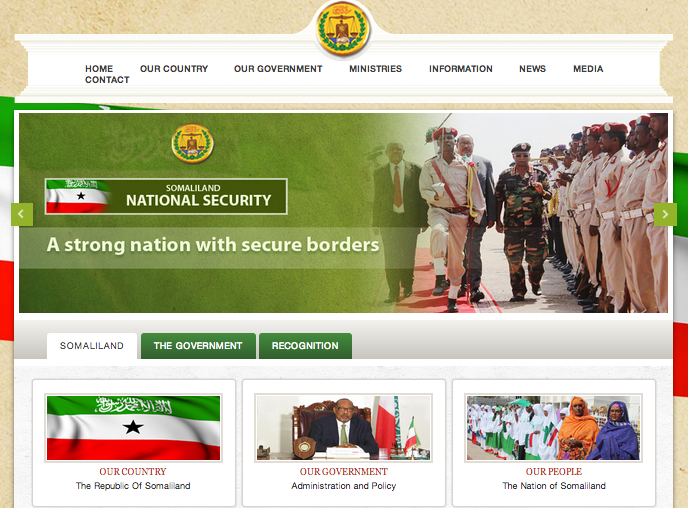
Screen Shot 2014-01-15 at 10.37.15 AM

A political scientist analyzes how breakaway states market themselves online:

Territories hoping for independence present themselves as already functioning states in the hope that they can gain access to the international system and that other states will trade with them, investors will spend their money there and tourists will visit. This would all make survival easier, and more pleasant, even without international recognition.

The Somaliland government website argues that the territory has “one of the most thriving economics in Africa” and the Transnistrian counterpart also highlights the many economic opportunities it can offer and a detailed powerpoint presentation for potential investors. Over in Nagorno Karabakh, several websites try to sell the entity to investors with posts such as 10 Reasons to Invest and aim to raise money from the Armenian diaspora.

Their arguments are vehemently opposed by the states to which these territories legally still belong. Countries such as Georgia and Azerbaijan also make frequent use of the internet to counter these messages, and instead describe these entities as illegal breakaway territories founded on ethnic cleansing, controlled by unscrupulous leaders, and dominated by organised crime. The strategies used by the unrecognised territories can therefore be described as “competitive democratization” or “competitive state-building”. They are trying to convince the world that they are more democratic and more stable than their parent states. Since most of these entities emerged from violent conflicts, they are also keen to demonstrate their peaceful intentions.

(Screenshot from Somalilandgov.com)

Face Of The Day

DJ Dave Lee Travis In Trial For Alleged Sex Offenses

Radio presenter Dave Lee Travis arrives at Southwark Crown Court in London, England on January 15, 2014. Dave Lee Travis, whose real name is David Patrick Griffin, is charged with 14 counts of indecent assault and one of sexual assault, which allegedly took place between 1977 and 2007 against victims aged between 15 and 29. Dave Lee Travis entered a not guilty plea to the charges in October last year.  Details about today’s trial can be read here and here. By Peter Macdiarmid/Getty Images.

Clean Coal, Dirty Water, Ctd

Jedediah Purdy blames the contamination of West Virginia’s Elk River on a lack of oversight:

On the federal level, before the spill, the Occupational Safety and Health Administration hadn’t inspected Freedom Industries, and the E.P.A. seems to have left matters entirely to state officials. Attacking federal environmental regulation is regarded as a safe bet in West Virginia state politics, where the coal industry’s war on the Obama Administration has become a local insurrection. Democratic Governor Earl Ray Tomblin promised, in his last State of the State address, that he would “never back down from the E.P.A.” The state’s junior senator, Joe Manchin, a Democrat, was elected after he ran an ad in which he pumped a bullet into a copy of the (failed) 2010 cap-and-trade bill, to show his contempt for the regulation of coal. His comments on the spill have avoided talk of regulation or responsibility.

The entire crisis is a tableau of abdication: years of privatization and non-regulation followed by panic. It is an emergency, not least because inaction has insured that no one knows enough to say that it is not an emergency. The response thus far—issuing no-use orders for the water supply and mobilizing the national guard to distribute household water—is one of minimal government.

Meanwhile, Republicans have been busy gutting the Clean Water Act:

In a week when the contamination of a major West Virginia river has served as a painful reminder of how little clean water is left in the strip-mined state, Republicans pushed policies that would further endanger water quality. It’s a timely issue right now: The Environmental Protection Agency is in the midst of trying to clarify how much jurisdiction it has over small streams and wetlands, many of which are used for drinking water in rural communities. (In West Virginia, such streams have often been dirtied past the point of use thanks to mountain top removal and mining waste.) The think thank the Natural Resources Defense Council (NRDC) assembled a list of environmental riders proposed by the GOP this summer. Many concern water. One, NRDC warns, “would permanently prohibit EPA from clarifying which streams and wetlands are protected by the Clean Water Act”; another would “block the Department of Interior (DOI) from enforcing safeguards designed to protect streams from pollution from surface coal mining.”

Poverty Is Bad For Your Health

Hypoglycemia

No shit:

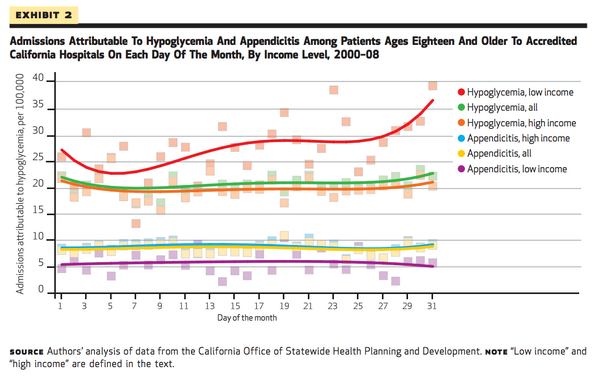
The basic idea is that people struggling to make it paycheck-to-paycheck (or benefits-to-benefits) might run out of money at the end of the month—and have to cut back on food. If they have diabetes, this hunger could turn into an even more severe health problem: low blood sugar. So we should expect a surge of hypoglycemia cases at the end of each month for low-income people, but not for anybody else.

That’s what researchers found when they looked at the numbers for California between 2000 and 2008. As you can see in their chart [seen above], low-income people (red line) were <27 percent more likely to be hospitalized for hypoglycemia in the last week of the month than in the first. There was no week-to-week difference for high-income people (orange line). …

Okay, but isn’t it possible that poorer people just tend to be less healthy in general?

Sure. That’s why the researchers also looked at when people go the hospital for appendicitis, which doesn’t depend on diet. So there shouldn’t be any end-of-the-month increase for low-income people if tight budgets are the problem. There wasn’t. As you can see above, appendicitis cases were flat across the month for both high (blue) and low (purple) income people. In other words, poorer people don’t need more care at the end of the month for every kind of condition. Just the ones that get worse when you don’t have enough to eat.

Adrianna McIntyre sees this study as an example of what gets ignored in our health policy debate:

Policy wonks have a terrible habit of focusing on insurance and health system design (and here I count myself, because health care financing is the research I find most interesting, so it’s what I write about). This gives short shrift to the “social determinants” of health—upstream factors related to lifestyle, environment, and socioeconomic status—that cannot be corrected by medical interventions. We’re fond of highlighting how much more the United States spends on health services, but an idiosyncrasy that receives less attention is how much less we spend on other social services.

Egypt Votes On A New Constitution… Again

EGYPT-POLITICS-UNREST-VOTE

Juan Cole takes a look at the contents of the charter that Egyptians have been voting on yesterday and today:

The constitution itself forbids torture and allows citizens to sue the police. If the provision is actually implementing, it seems to me Egyptians would have more rights in these regards than Americans. It gets rid of the clause that makes the al-Azhar Seminary the arbiter of Islamic law incorporated into state practices, which had been a step toward an Iran-style theocracy. It guarantees freedom of belief (the Coptic church is backing it). It is good on the rights of children. While it gives the army 8 years in which the civilian government can’t interfere much with it, that provision was in the Morsi constitution, too.

But constitutions are only as good as their implementation. Some Egyptians have argued that the interim government has overstepped its authority with its anti-protest law and ban on the Muslim Brotherhood, and that the anti-protest law, at least, is unconstitutional by the text of the new constitution. About that, we’ll see.

Manal Omar gauges the mood of voters in Cairo:

The two-day referendum, which began Tuesday, Jan. 14, is widely seen as an opportunity to end — or at least mitigate — the political debates that have been threatening to rip Egypt apart. The country has been deeply polarized since July 3, 2013, when the military deposed President Mohamed Morsi. The previous constitution was suspended, and a new road map for a political transition, led by a military-appointed government, was established. This government, which has banned the previously ruling Muslim Brotherhood and cracked down on street protesters, wrote the newly proposed constitution. The document incorporates more rights and freedoms than the last constitution, but it also guarantees greater autonomy for the military, still affirms principles of Islamic law as the main sources of legislation, limits the establishment of trade unions to one per profession, and leaves room for civilians to be tried in military courts — all causes of popular discontent.

Yet in voting, many people I spoke to said their primary interest is not in enacting a particular government charter; rather, it is in finding a way to move the country forward and to bring attention back to the much-needed social and economic reforms that inspired the 2011 revolution. Which is to say, they just want to get past it. Everyone also seemed to silently acknowledge the elephant sitting in the polling rooms: A no vote is not even an option.

Maher Hamoud doesn’t see any good coming of the referendum:

That this constitution will pass is a foregone conclusion. It is a fact that will not necessarily bring the much-mentioned stability, but it will provide the military, Mubarak loyalists and the business elite with what they wanted: power, protection and a “democratic” mask to show to international players. We have to remember that no ruler in Egypt since the mid-1970s has been able to afford being an enemy of the US or the west in general (and vice-versa).

But stability? The Muslim Brotherhood is not a small faction, and radical Islamist groups will not let bringing down the only Islamist model, which they did not necessarily like, go unpunished. The political roadmap will continue, the military will retain power (constitutionally this time) either directly or behind a civilian façade. But before we know it stability will be advocated again in another campaign, once people have realised for the third time that the revolution’s goal of freedom and social justice is not yet on anyone’s political agenda.

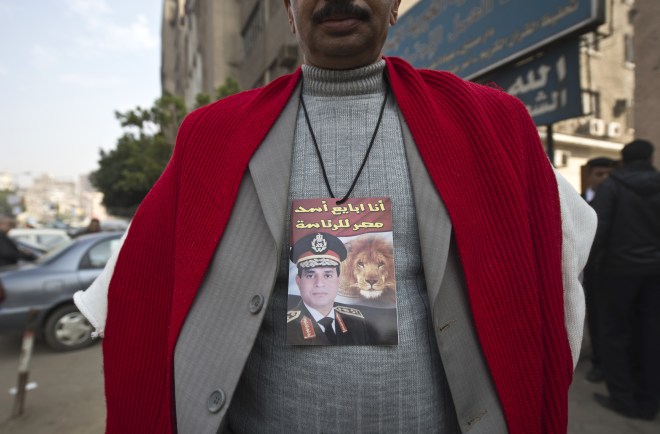
Steven A. Cook, meanwhile, begs Sisi not to run for president:

[L]arge numbers of Egyptians—with the encouragement of elites associated with the old order and important parts of the media—seem inclined toward an al-Sisi presidency. People are convincing themselves that Egypt needs a strong personality, if only temporarily, to put the country back on track.  They are comforted by the fact that the new constitution, which is up for referendum today and Wednesday, sets term-limits for the president to two, four-year terms.  This is an improvement in a country that has had problems with the overwhelming power of the executive, but observers should know that  1) presidential political systems are prone to the accumulation of power in the office of the presidency, and 2) there are reasons to doubt the durability of the term limits   After all, Anwar Sadat did away with them in 1980 when they became inconvenient.  The July 3 coup set a precedent that the political institutions of the state could be ignored, if powerful people and their allies agree that it is convenient to do so. One can easily imagine a scenario in which authorities override term limits in some way—security conditions, for example—to allow al-Sisi to remain in office. Another president for life is clearly not what Egypt needs.

(Photo: An Egyptian man has on his chest a portrait of Egypt’s Defense Minister General Abdel Fattah al-Sisi with a slogan in Arabic reading ‘I vote for the loin of Egypt for the presidency’ outside a polling station during the vote on a new constitution on January 14, 2014 in Cairo. By Khaled Desouki/AFP/Getty Images)