Democrats For War With Iran, Ctd

Cory Booker Marries Same Sex Couples As NJGay Marriage Law Goes Into Effect

Jeffrey Goldberg tries to talk sense into Iran hawks:

[A]t least in the short term, negotiations remain the best way to stop Iran from crossing the nuclear threshold. And U.S. President Barack Obama cannot be hamstrung in discussions by a group of senators who will pay no price for causing the collapse of negotiations between Iran and the P5 + 1, the five permanent members of the security council, plus Germany. “You have a large group of senators who are completely discounting the views of the administration, the actual negotiators, the rest of the P5 + 1, the intelligence community and almost every Iran analyst on earth,” said Colin Kahl, who, as a deputy assistant secretary of defense for the Middle East during Obama’s first term, was responsible for preparing all of the options that the President says are still on the table.

If these negotiations were to collapse — and collapsing the negotiations is the goal of some of the most hawkish hawks — the most plausible alternative left to stop Iran would be a preventative military strike, either by the U.S. or by Israel (Arab states, which are agitating for an American strike, wouldn’t dare take on the risk of attacking Iran themselves). Such a strike might end in disaster. …

The whole column is worth a read. Another sound point:

[W]hy support negotiations? First: They just might work. I haven’t met many experts who put the chance of success at zero. Second: If the U.S. decides one day that it must destroy Iran’s nuclear facilities, it must do so with broad international support. The only way to build that support is to absolutely exhaust all other options. Which means pursuing, in a time-limited, sober-minded, but earnest and assiduous way, a peaceful settlement.

Beinart declares that “the sanctions bill is all about torpedoing a nuclear deal”:

An analysis of the legislation by longtime senate foreign relations committee staffer Edward Levine notes that to suspend the new sanctions indefinitely, President Obama must certify that “Iran will…dismantle its illicit nuclear infrastructure.” That’s pretty vague. But AIPAC’s summary of the bill helpfully explains that “Iran’s illicit nuclear infrastructure” includes “enrichment and reprocessing capabilities.”

Which would be fine, except that the Obama administration has already conceded that it can accept limited Iranian uranium enrichment so long as it’s not near weapons-grade and is closely monitored by inspectors. To suspend the sanctions, in other words, a final nuclear deal would have to include provisions that the governments of both Iran and the United States have already insisted it will not include.

Larison responds:

It’s not surprising that the bill has set such a maximalist requirement, since the bill’s co-sponsors have previously expressed their opposition to allowing Iran to retain any enrichment capabilities. This is why no one should take seriously the claim of the bill’s supporters that they are interested in a diplomatic resolution to the nuclear issue. According to their own standard, they will only accept a deal with conditions that Iran has repeatedly stated that it will never accept, which means that no achievable final deal can avoid triggering the sanctions that they wish to impose. It is little wonder that Iran views the passage of a new sanctions bill as a deal-breaker. If the bill became law, it would mean that the U.S. had already reneged on commitments that it made in the interim agreement.

Kilgore wants anti-war Democrats to make some noise:

You will hear some Democrats and even a few Republicans claim they are trying to strengthen the adminstration’s hand in their negotiations, but that’s a shuck. The whole idea is to torpedo the talks because Bibi Netanyahu believes they are aimed at the wrong goal: keeping Iran from developing nuclear weapons, as opposed to Bibi’s demand that Iran lose its capability of developing nuclear weapons. If that means war, so be it. This time around, of course, those in the Democratic Party opposing a drift into war have the White House on their side, and the precedent of what happened when a lot of Democrats supported a similarly avoidable war with Iraq. But if antiwar Democrats don’t start making some real noise, the configuration of forces in Congress will continue to deteriorate, and we could be looking at a war foisted on an unwilling commander-in-chief.

And now the House is preparing to pass the Senate’s bill, which “would speed the process of sending a bill to Mr. Obama’s desk because the two chambers would not have to go through the process of reconciling their different bills.” It’s also intended pressure Reid into allowing a vote on the Senate bill. Larison zooms out:

When it came to the questions of bombing Libya and Syria, the House leadership was perfectly happy to defer to the executive, but when it comes to the conduct of diplomacy that is properly part of the executive’s responsibility they are only too ready to butt in and meddle where they aren’t wanted or needed. The one constant in this behavior is that most members of Congress find a way to take whichever side makes conflict with other states more likely. If the executive wants to launch a war on its own, Congress will stay out of the way, but if it wants to strike a deal that makes a future war less likely to happen they are suddenly very concerned to make their views known.

(Photo: Senator Cory Booker, who is sabotaging his own president’s diplomacy on Iran, by Kena Betancur/Getty Images.)

A Death Blow To Net Neutrality?

Andrew Leonard outlines the effects of a Tuesday court ruling that invalidated the FCC’s net neutrality rules:

In a decision widely seen as a victory for the big telecommunication companies and a defeat for defenders of the “open” Internet, the D.C. Court of Appeals struck down the FCC’s “net neutrality” rules on Tuesday. The decision in Verizon v. FCC effectively gives providers of Internet access the right to discriminate in favor of particular Internet services —  to create “express lanes” on the good old information superhighway. … But the decision is not necessarily a clear-cut ruling that net neutrality is unconstitutional. The court based its decision on a more technical issue: whether or not the broadband companies could be classified as “common carriers” that are not allowed to give special preferences to any users of their network infrastructure. Since the FCC had previously decided that broadband ISPs are not common carriers, the court ruled that the FCC could not then turn around and regulate the ISPs as common carriers.

Juan Cole warns that the ruling could allow “the corporatization of the Internet”:

The reason readers of Informed Comment can reach it as quickly and conveniently as they can reach a multi-billion dollar corporate web site is the principle of internet neutrality, built into the system by Tim Berners-Lee and other architects of the World Wide Web, which went live in 1991. Large private corporations that have been allowed to build out the pipes through which internet traffic flows have long wanted to introduce a different system, of net metering. In essence, if a corporation paid the internet provider a million dollars a year, readers could get to that site immediately. But for a site like Informed Comment without those sorts of bucks, service would be deliberately slowed and readers would have to wait a minute or two for the site to load. Studies have showed that most people won’t wait that way. So the entire independent cybersphere would be made invisible and more or less swept away. A similar thing happened to radio, which was a grassroots medium at the beginning and then was corporatized with government help.

Marvin Ammori isn’t giving up:

Those of us who had been involved with the net neutrality debate knew that, without reclassification, the flawed FCC order would never stand. But there were 100 ways it could have fallen. I thought that the court’s decision would be a baby-splitting half-loss that could enable the FCC to wipe its hands of network neutrality and pretend everything was A-OK. I was wrong on that point. The loss was so definitive, the powers granted to cable and phone companies so outrageous, that the FCC has a live grenade in its lap.

Now, every side is settling on its narrative. AT&T, Verizon, and their allies will argue that the decision means network neutrality is illegal, full stop, and the FCC can never adopt an order. They will also argue that the FCC needs to go to Congress to get more authority. Both arguments are wrong, of course. The FCC has all the power it needs to clean up the mess, simply by doing what [former FCC Chairman Julius] Genachowski—who, it must be said, is a very nice guy—knew he had to do but lacked the spine for.

Drum peers into his crystal ball:

The next step might be an appeal to the Supreme Court or it might be an FCC decision to reclassify the internet as a common carrier. But that’s what it’s come down to. If the Supreme Court upholds this decision (or refuses to hear an appeal), net neutrality is dead unless the FCC or Congress decide to reclassify broadband internet as a telecom service regulated as a common carrier. If they don’t, it will up-end the internet as we know it, with carriers free to provide, say, Amazon or Google with preferred service in return for higher access fees. That could be a big problem for startups—or anyone the telecom providers consider a competitor—who would have to contend with slower service as they tried to build their businesses. The big telecom companies say that’s not what they have in mind, and maybe they don’t right now. But they will. It’s only a matter of time.

Pethokoukis calls the ruling a victory for consumers and the free market:

The FCC rules were meant to impose one-size-fits-all price controls on Internet service providers and force them to treat, as The Wall Street Journal describes, “similar content on their broadband pipes equally.” Sounds innocent enough. Sounds fair. Sounds neutral. But at its core “net neutrality” really is nothing more than an attempt at rent seeking by content providers who want the ISPs to pay the tab for future network upgrades. It’s kind of like Apple lobbying for price controls on shippers like FedEx when transporting iPads from China to America. Whenever the transport firm bought new planes, it would have to eat the cost or pass it downstream to some other customers. In this case, the customers would have been regular consumers.

Bret Swanson agrees:

The court’s basic finding is correct and good for the Internet economy. Common carriage style regulation is not appropriate for the Internet. The Internet is a fast changing, multipurpose network, built and operated by numerous firms, with many types of data, content, products, and services flowing over it, all competing and cooperating in a healthy and dynamic environment. Old telephone style regulation, meant to regulate a monopoly utility that used a single purpose network to deliver one type of service, would have been a huge (and possibly catastrophic) step backward for what is today a vibrant Internet economy.

Marriage Equality Update

Lyle Denniston unpacks yesterday’s news out of Oklahoma:

In ruling against the state’s ban on same-sex marriage, the judge declared that it violated the U.S. Constitution’s guarantee of legal equality.  He ruled that the Supreme Court’s ruling last Term in United States v. Windsor actually provided some support both for the challenging couple and for state officials defending the state ban.

The Windsor decision, the judge said, supports a plea for marriage equality because much of the reasoning of the Court majority about the purpose behind DOMA could also be applied to state bans on same-sex marriage.  It supports the state, the judge added, because of the lengthy commentary in the opinion about states’ primary power to define marriage.

In the end, however, the judge decided that Oklahoma’s ban was based on intentional discrimination, with a “stark” negative impact on gay and lesbian couples.  “This is not a case where the law has a small or incidental effect on the defined class; it is a total exclusion of only one group.”

Allahpundit chimes in:

If they want to discriminate against gay couples, they need to show some rational reason for doing so.

“Moral disapproval” isn’t a rational reason per the Supreme Court’s ruling in Lawrence v. Texas, the landmark case from 2003 that declared Texas’s anti-sodomy law unconstitutional. The upshot of Lawrence is that you can’t legislate morality when you’re targeting intimate relationships between consenting adults. You can regulate those relationships if you have some other rational reason for doing so, but the state couldn’t produce one here: “Encouraging procreation” doesn’t fly if you’re not also excluding straight infertile couples from marriage and “encouraging mother/father households” doesn’t fly if you can’t show how banning gay marriage would actually encourage the formation of those households. As I say, all of this is S.O.P. for federal SSM jurisprudence lately. The only real novelty is that, between this ruling and the ruling in Utah last month, the new legal battlefield over gay marriage lies in America’s reddest states. That may be an extra inducement for SCOTUS to deal with this sooner rather than later.

Schopenhauer On The Age Of Sponsored Content

The Dish constantly links to and loves Maria Popova. For me, she represents the best that the Internet has to offer. She gets paid by reader Schopenhauerdonations and affiliate income. She writes what she loves. She reads books. She has seized the limitless potential of the web – but by bucking the cult of contemporaneity, by digging up the old and true rather than the new and buzzy, by building a community of readers who flock to an oasis far away from what she has called the “Buzzwashing” of our collective online minds.

In some ways, her appeal is pretty straightforward as a writer. She is unmistakably genuine. Nothing she writes is obviously designed purely for getting money (although, of course, she has done really well by simply writing tirelessly about what she loves). And so you can see why re-reading some of Schopenhauer’s essays on writing and journalism appealed to her. His brutal take-down of writing for money is about as good a case for that position as I’ve read:

The author is cheating the reader as soon as he writes for the sake of filling up paper; because his pretext for writing is that he has something to impart. Writing for money [is], at bottom, the ruin of literature. It is only the man who writes absolutely for the sake of the subject that writes anything worth writing. What an inestimable advantage it would be, if, in every branch of literature, there existed only a few but excellent books! This can never come to pass so long as money is to be made by writing. It seems as if money lay under a curse, for every author deteriorates directly [whenever] he writes in any way for the sake of money. The best works of great men all come from the time when they had to write either for nothing or for very little pay.

When I was very young, I used to wonder why the newspaper had the same size every day – as if what was actually news didn’t vary, when it obviously did. As a working writer for much of my adult life, I understand now why the economics of journalism operates that way, and probably has to. But an economics that directly rewards eyeballs at the expense of any other criterion – i.e. the current economics of most of the web – or a “journalism” that is paid for by corporations – i.e. sponsored content – would horrify Schopenhauer. His standards are impossibly high; his judgments overly broad and caustic. But he was onto something, as is Maria. And our culture could learn a lot from it.

(Painting by Jules Lunteschütz)

Telling The Truth About Iraq

Jeremy Lott hopes GOP presidential hopefuls will face reality:

Any Republican seeking nomination for the 2016 presidential election should at a minimum be willing to admit Iraq was a mistake.  It was an error that cost us upwards of $1.5 trillion, thousands of U.S. lives and hundreds of thousands of Iraqi dead, while seriously hindering our efforts to track down the real culprits of September 11. (The war, incidentally, helped pave the way for a Nancy Pelosi-controlled House and a Barack Obama-controlled White House, as well.)

Larison sees this as improbable:

There are some obstacles to what Lott proposes. Chief among them is the difficulty that many hawks in the party still truly don’t accept that the Iraq war was a mistake. Despite the fact that by virtually any measurable standard the Iraq war was a senseless waste of lives and resources, they don’t consider this to be the truth, so they won’t greet it with relief. At best, many hawks will agree that the there were flaws in the execution, but they remain convinced that the original idea was sound.

Readers know how terrible a mistake this was and is, in my judgment. Listening to what passes for “debate” about the continued sectarian warfare in Iraq – which never ended, and was never resolved by the surge, and is the core reason why Iraq as a country remains a democratic impossibility – has been a sobering moment. Men like John McCain have obviously not internalized for a millisecond the awful error they made. Their response has been either utter denialism or silence – which was roughly their position throughout the entire, horrifying experience.

And that helps explain a little the total bafflement of these old warriors at the possibility of a rapprochement with Iran. Because they haven’t yet absorbed the uselessness of military force to advance our interests in the region – indeed, its capacity to make our position measurably worse – they still see warfare as the natural response to a country now so crushed by sanctions it has allowed a relative moderate to take control. They cannot even see that the only real option to advance some kind of peace in Iraq is through Tehran, a natural ally against Sunni extremists in that “country”. And they cannot see that further polarization between the Muslim world (especially its most pro-American population in Iran) and the West does nothing but hurt us, and our standing in the world at large.

Meanwhile, Crowley wonders whether Clinton’s support of the Iraq War will become an issue in 2016:

If Clinton runs for president in 2016, she’s likely to emphasize the more dovish aspects of her record—including her public diplomacy to repair America’s international image, her focus on building ties in Asia, and her attention to women’s rights and development issues.

But at a time when fewer Americans support an active U.S. role in foreign affairs, Clinton’s comfort with the harder side of American power could be a vulnerability. A liberal primary challenger might well reprise Barack Obama’s 2007 line that Hillary’s record amounts to “Bush-Cheney lite.” One potential contender, Montana Governor Brian Schweitzer, has already been zinging her over her 2002 Iraq vote. “When George Bush got a bunch of [Democrats] to vote for that war, I was just shaking my head in Montana,” he said recently. Whether such attacks will hold even a fraction of the valence they did at the Iraq war’s peak remains to be seen.

Friedersdorf adds:

There is next to no chance I’d vote for a Republican who thought the Iraq War was prudent, or showed an eagerness for more military interventions. But neither is it enough for a Democratic candidate to claim that the problem with the Iraq was the way that the Bush Administration executed it. Habitual hawks like Clinton have to clear a particularly high hurdle. And no one should be elected president without showing, beyond any doubt, that they understand why the war was a mistake and how to avoid like mistakes in the future.

I’m with Conor on this one, unreservedly. Clinton gets no pass. I want to know how she understands her own responsibility for the fiasco. And how she accounts for it.

Democrats For War With Iran, Ctd

President Obama Departs The White House

Fallows weighs in. Read it. This truly is a critical moment for the US after 9/11. It’s one reason we elected Obama twice. And yet his own party is now trying to sabotage it, when the possibility of a breakthrough – agreed to by all the major powers – is real and as yet not fully tested. Money quote:

Republicans led by Mitch McConnell are pushing for a sanctions bill that is universally recognized (except by its sponsors) as a poison-pill for the current negotiations. Fine; opposing the administration is the GOP’s default position.

But a striking number of Democrats have joined them, for no evident reason other than AIPAC’s whole-hearted, priority-one support for the sanctions bill. The screen clip below is from AIPAC’s site, and here is some political reporting on AIPAC’s role in the sanctions push: NYT, Politico, JTA, Jerusalem Post-JTA, and our own National Journal here and here. Also see Greg Sargent in the Washington Post.

Fallows has a quote from the AIPAC website, the main lobbying group for war. It’s worth reading as well. Fournier, no Obama fan, also gives a great money quote here:

Obama dithered and stumbled on Syria, but his instincts were right: Avoid bloodshed if at all possible. He is acting prudently on Iran. He is the commander in chief, and you’d expect fellow Democrats to give him the benefit of the doubt. Is the Democratic opposition to Obama based on the merits or born of political calculation? If it’s the former, wayward Democrats had better be right, because the stakes are high. If it’s the latter, shame on them and their “antiwar” party.

Amen. None of these Democratic Senators are prepared to give the president the lee-way to try to avoid another disastrous and unwinnable war in the Middle East. Their sanctions bill would kill the only alternative to the war AIPAC wants. Democrats in New York and New Jersey should let Schumer and Menendez and Booker know that sabotaging their own president and the only potential for peace is inexcusable. That goes for Michael Bennet’s inexplicable betrayal as well.

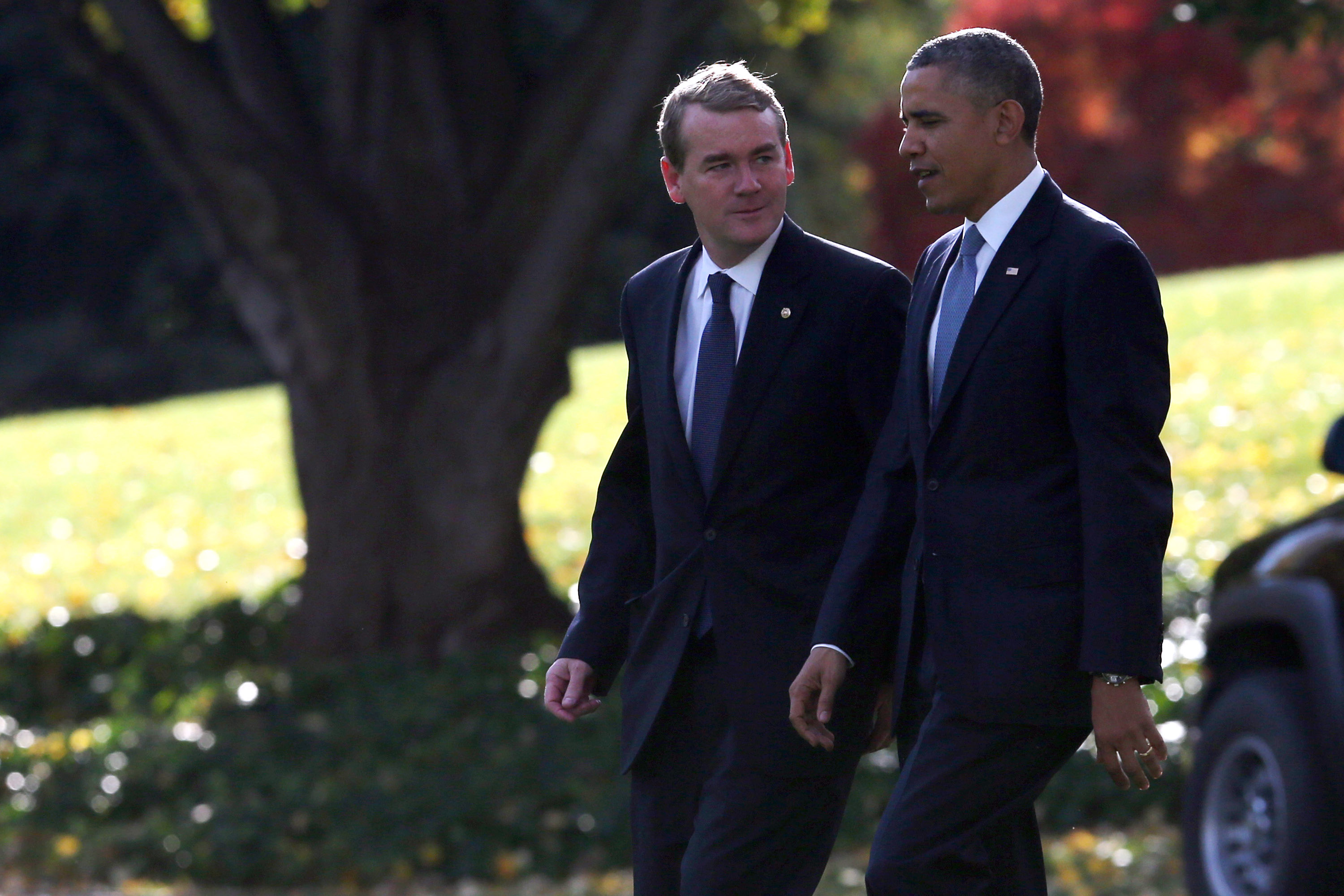
(Photo: U.S. President Barack Obama walks with Sen. Michael Bennet toward Marine One to depart the White House November 6, 2013 in Washington, DC. By Mark Wilson/Getty Images.)

Chart Of The Day

Climate Pie Chart

James Powell updates his chart on global warming research:

I have brought my previous study (see here and here) up-to-date by reviewing peer-reviewed articles in scientific journals over the period from Nov. 12, 2012 through December 31, 2013. I found 2,258 articles, written by a total of 9,136 authors. (Download the chart above here.) Only one article, by a single author in the Herald of the Russian Academy of Sciences, rejected man-made global warming. I discuss that article here.

Holly Richmond passed along the chart:

[I]f a year-long sample isn’t good enough for you, Powell previously examined 21 years of peer-reviewed literature and found that only 24 out of 13,950 articles — or two-tenths of a percent — came out and rejected human-caused climate change.

The fact that one major political party in the US rejects outright this massive preponderance of scientific research is now so familiar to us that we forget just how obscene it is. It is not a position or an argument. It is a transparent lie in defense of short-term material interest against the long-term interests of everyone. There can and should be plenty of debate about what to do about human-caused climate change; but there should simply be no serious debate about its causes. It’s impossible to take the GOP seriously until they recant their knownothingness on this subject. At this point, it is simply an affront to reason.

Paying The Jobless To Look For Work

Why cutting off benefits is a bad idea:

Recipients of unemployment benefits are required to actively search for work. With few job openings around, losing that requirement takes away the only reason many unemployed Americans kept searching. A study by economists Henry Farber and Robert Valletta found that unemployment insurance has little effect on people’s readiness to take a job, but it has a big one on people’s decision to keep searching for work. The view that desperation will force the unemployed to get a job, which seems to drive Republican opposition to extending federal benefits, just isn’t supported by the data. And that’s leaving aside the moral problems with starvation as a policy strategy.

“No Discernible Impact”

Terrorism Cases

A New America Foundation study calls into question the government’s claims about the NSA’s metadata dragnet:

Surveillance of American phone metadata has had no discernible impact on preventing acts of terrorism and only the most marginal of impacts on preventing terrorist-related activity, such as fundraising for a terrorist group. Furthermore, our examination of the role of the database of U.S. citizens’ telephone metadata in the single plot the government uses to justify the importance of the program – that of Basaaly Moalin, a San Diego cabdriver who in 2007 and 2008 provided $8,500 to al-Shabaab, al-Qaeda’s affiliate in Somalia – calls into question the necessity of the Section 215 bulk collection program.

According to the government, the database of American phone metadata allows intelligence authorities to quickly circumvent the traditional burden of proof associated with criminal warrants, thus allowing them to “connect the dots” faster and prevent future 9/11-scale attacks. Yet in the Moalin case, after using the NSA’s phone database to link a number in Somalia to Moalin, the FBI waited two months to begin an investigation and wiretap his phone. Although it’s unclear why there was a delay between the NSA tip and the FBI wiretapping, court documents show there was a two-month period in which the FBI was not monitoring Moalin’s calls, despite official statements that the bureau had Moalin’s phone number and had identified him. This undercuts the government’s theory that the database of Americans’ telephone metadata is necessary to expedite the investigative process, since it clearly didn’t expedite the process in the single case the government uses to extol its virtues.

Meghan Neal is unsurprised:

This is hardly the first time experts have searched for a link between bulk metadata collection and foiled terrorist plots and come up empty-handed. So far, the only real value in collecting and monitoring billions of US phone records has been to provide extra support in investigations already underway by the FBI or another agency, or to verify that a rumored threat isn’t real (the “peace of mind” metric), the report found. But that hasn’t stopped NSA officials and the Obama administration from drumming up a connection between terrorist attacks and surveillance to defend the agency’s snooping.

Morrissey examines the pie chart seen above and asks if the program is worth it:

What has been the most effective method? Of those explicitly stated, it’s “if you see something, say something.” Community and family tips accounted for 17.8% of the origins of investigations, followed closely by 16% started by other informants. However, 27.6% are categorized as “unclear” — the largest single category, which makes the analysis much less reliable,  and might raise questions about how the NSA got those FISA warrants. Still, there were four cases unearthed through Section 215 (and possibly more in the “unclear” category). Is that enough to justify the program as a necessary evil to prevent worse evil from prevailing?

Zack Beauchamp thinks not:

NSA metadata collection isn’t totally useless; it’s just not very useful. When you start to look at the specific cases that metadata surveillance played a key role in, the picture gets grimmer for the NSA. The New America researchers found that metadata searches never led to an arrest that actually prevented a terrorist attack. Take, for instance, the arrest of Basaaly Moalin — the only case, according to NSA Director Keith Alexander’s sworn testimony, metadata surveillance may have sparked an investigation that stopped “terrorist activity.” All the government found on Moalin was $8,500 donated to Somali terrorist group al-Shabaab; “the case involved no attack plot anywhere in the world,” according to New America’s review. In almost all of the cases profiled by New America, metadata surveillance played a supporting role, unnecessarily displaced traditional investigative methods, or failed to uncover a serious plot.

Digby reminds us that for all it doesn’t do, this data program costs an awful lot of money:

And keep in mind this whole thing is happening in the context of an ongoing, long term austerity push that has us cutting off the long term unemployed and ending food stamp benefits. That Utah data farm alone cost 1.2 billion and is reportedly going to cost at least a couple billion more before it’s online. There was a moment in the early days of the NSA story in which we discussed the incredible boondoggle all this really was but it passed as the revelations unfolded. It’s good that the congress has decided to shine a light on that again, however briefly, in this budget process. After all, we have real people suffering in a stuck economy without enough jobs. We have a growing poverty rate. Our bridges and schools are crumbling. And yet the money for the military, police and all these attendant “intelligence” agencies has been kept secret until now. It’s only right that the people should at least know what the numbers really are.

Putting The “Why” In History

Eric Foner argues for a more analytical approach to history in high school:

I’m strongly in favor of students knowing the facts of history, not just memorizing or having it drilled into their heads. I’m certainly against this testing mania that’s going on now where you can judge whether someone really understands history by their performance on a multiple-choice test. Knowledge of the events of history is important, obviously, but also I think what I see in college students, that seems to be lacking at least when they come into college, is writing experience. In other words, being able to write that little essay with an argument. I see that they think, “OK, there are the facts of history and that’s it—what more is there to be said?” But of course, the very selection of what is a fact, or what is important as a fact, is itself based on an interpretation. You can’t just separate fact and interpretation quite as simply as many people seem to think.