The Dharma Of Proust?

Pico Iyer argues that Proust was an “accidental Buddhist,” quoting from Within a Budding Grove to illustrate his point:

“We do not receive wisdom,” [the painter] Elstir tells the narrator (who has just realized that “this man of genius, this sage” is a “foolish, corrupt little painter” in another context), “we must discover it for ourselves, after a journey through the wilderness which no one else can make for us, which no one can spare us.” Could the Buddha, enjoining his disciples to “Be a lamp unto yourselves,” have phrased it any better? Or: “If there were no such thing as habit, life might appear delightful to those of us who are constantly under the threat of death—that is to say, to all mankind.” I can’t think of a clearer formulation of the Western Buddhist’s teachings that habit is how we keep ourselves away from truth, imprisoned in our heads and not the world.

Iyer continues:

Proust’s genius, like that of his compatriot [Henri] Cartier-Bresson (who called himself “an accidental Buddhist”), is to register every detail of the surface and yet never get caught up in the superficial.

Here is the rare master who saw that surface was merely the way depth often expressed itself, the trifle in which truth was hidden thanks to mischievous circumstance (or, others would say, the logic of the universe). It takes stamina, bloody-mindedness, concentration, and a fanatic’s devotion to stare the mind down and see how rarely it sees the present, for all the alternative realities it can conjure out of memory or hope. Proust had the sense to belabor us with little theology, academic philosophy or overt epistemology; yet nearly every sentence in his epic work takes us into the complications, the false fronts, the self-betrayals of the heart and mind and so becomes what could almost be called an anatomy of the soul. I’m not sure sitting under a tree in Asia 2,500 years ago would have produced anything different.

What’s A Jerk?

Eric Schwitzgebel, a philosopher, offers a “semi-technical definition”:

[S]omeone who fails to appropriately respect the individual perspectives of the people around him, treating them as tools or objects to be manipulated, or idiots to be dealt with, rather than as moral and epistemic peers with a variety of potentially valuable perspectives.

Perhaps the jerk’s greatest moral failing? A lack of mercy:

Mercy is, I think, near the heart of practical, lived morality. Virtually everything everyone does falls short of perfection. Her turn of phrase is less than perfect, she arrives a bit late, her clothes are tacky, her gesture irritable, her choice somewhat selfish, her coffee less than frugal, her melody trite — one can create quite a list! Practical mercy involves letting these quibbles pass forgiven or even better entirely unnoticed, even if a complaint, were it made, would be just. The jerk appreciates neither the other’s difficulties in attaining all the perfections he himself (imagines he) has nor the possibility that some portion of what he regards as flawed is in fact blameless. Hard moralizing principle comes naturally to the jerk, while it is alien to the jerk’s opposite, the sweetheart. The jerk will sometimes give mercy, but if he does, he does so unequally — the flaws and foibles that are forgiven are exactly the ones the jerk recognizes in himself or has other special reasons to be willing to forgive.

Tripping On Jesus

In an article adapted from his book Drugged: The Science and Culture of Psychotropic Drugs, Richard J. Miller looks at some of the theories tying psychedelic mushrooms to the development of major religions:

Pride of place here goes to John Marco Allegro’s 1970 publication, The Sacred Mushroom and the Cross. Allegro considered the possibility that ancient peoples would have been particularly concerned with two things—procreation and the supply of food. He suggested that they may have viewed rain as a type of heavenly semen that then impregnated the earth, allowing the growth of crops and the success of the harvest. Plants absorbed this holy semen—and some plants more than others. Amanita muscaria was such a plant that, when consumed, allowed a person to commune more closely with God. Allegro also suggested that the information concerning the use of Amanita muscaria as a religious fertility sacrament was subject to great secrecy, the provenance of a priestly sect. He speculated that these practices developed very early on in human history, even prior to the time when writing first came into existence during the ancient Sumerian civilization. He further suggested that the existence of the mushroom was secretly encoded in the use of particular Sumerian word roots. This secret encoding of the mushroom fertility cult down through the ages eventually led to the development of the concept of Jesus to encapsulate the identity of Amanita muscaria around the time of the sacking of the second temple by the Romans. Thus, according to Allegro, Jesus never actually existed. He purported to demonstrate, using philological analysis of the structure of the ancient Sumerian language, that the name Jesus actually meant something along the lines of “semen” and that Christ meant something like “giant erect mushroom penis.” According to Allegro, the Bible (and the New Testament in particular) is really just a series of myths that describe the secrets of the Amanita muscaria fertility cult rather than real people.

Quote For The Day

“Union with God is not something we acquire by technique but the grounding truth of our lives that engenders the very search for God. Because God is the ground of our being, the relationship between creature and Creator is such that, by sheer grace, separation is not possible. God does not know how to be absent. The fact that most of us experience throughout most of our lives a sense of separation is the great illusion that we are caught up in; it is the human condition. The sense of separation from God is real, but the meeting of stillness reveals that this perceived separation does not have the last word. This illusion of separation is generated by the mind and is sustained by the riveting of our attention to the interior soap opera, the constant chatter of the cocktail party going on in our heads. For most of us this is what normal is, and we are good at coming up with ways of coping with this perceived separation (our consumer-driven entertainment culture takes care of much of it). But some of us are not so good at coping, so we drink ourselves into oblivion or cut or burn ourselves ‘so that the pain will be in a different place and on the outside.’

The grace of salvation, the grace of Christian wholeness that flowers in silence, dispels this illusion of separation. For when the mind is brought to stillness, and all our strategies of acquisition have dropped, a deeper truth presents itself: we are and have always been one with God and we are all one in God,” – Martin Laird, Into the Silent Land.

(Hat tip: Richard Beck)

Converting To Belief In Evolution

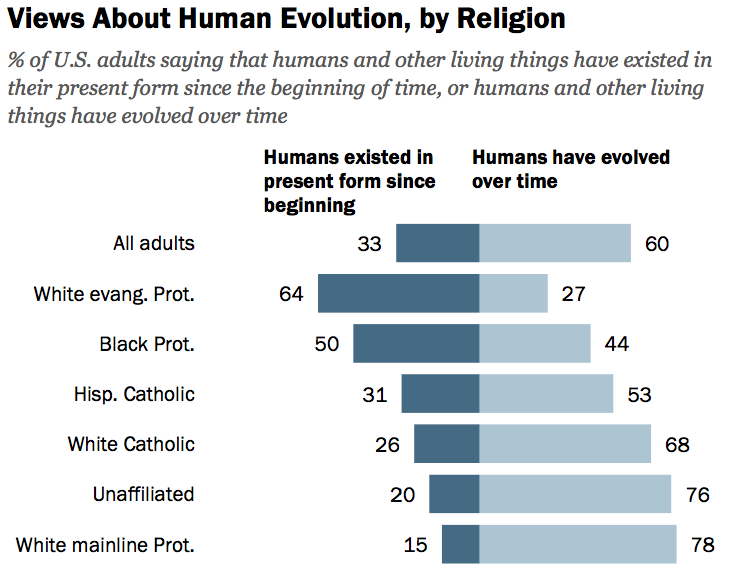
Two-thirds of Evangelicals aren’t fans of Darwin’s work (pdf):

Religion Evolution

Karl Giberson reflects on his experience teaching evolution at an evangelical college:

For a quarter century I taught scientific theories of origins—evolution and the Big Bang Theory—under a cloud of suspicion that waxed and waned but never totally disappeared. With few exceptions, my mostly evangelical students accepted these ideas. I took informal polls indicating that most of the 50 percent of my students who rejected evolution at the beginning of my course accepted it by the end. My colleagues at other evangelical colleges report similar experiences. We were hopeful that these evangelical students would become leaders of their faith communities and gradually persuade their fellow evangelicals that evolution was not a lie from hell—which was what many of them had been taught in Sunday school. But instead scientifically informed young evangelicals became so alienated from their home churches that they walked away, taking their enlightenment with them.

An alarming study by the Barna group looked at the mass exodus of 20-somethings from evangelicalism and discovered that one of the major sources of discontent was the perception that “Christianity was antagonistic to science.” Anti-evolution, and general suspicion of science, has become such a significant part of the evangelical identity that many people feel compelled to choose one or the other. Many of my most talented former students no longer attend any church, and some have completely abandoned their faith traditions.

Has The Novel Lost Its Faith? Ctd

The debate has been percolating again recently. Gregory Wolfe goes one more round, defending his thesis that faith hasn’t disappeared from the literary landscape, but writers are handling religious themes with more nuance and reserve than before.  He does, however, admit one bit of nostalgia, looking back with envy at the Christian public intellectuals who helped “to mediate what is going on in the arts to a broader audience”:

If I miss anything from that mid-twentieth-century period, it is the presence of thinkers like Jacques Maritain, Etienne Gilson, Allen Tate, T.S. Eliot, and Thomas Merton, who were equally at home in the New York Times and Commonweal. Their rich, humanistic sensibilities are sorely missed. What happened in the intervening decades is a steady shrinking of cultural and aesthetic concerns to ideological politics, including church politics. What happened was the progressive dumbing down and crudeness of what has been called the culture wars. In the relentless pursuit of partisan politics, the endless fight against heresy or entrenched orthodoxy, Left or Right, the religious community’s arteries have hardened. As [Dana] Gioia observed, “What absorbs the Catholic intellectual media is politics, conducted mostly in secular terms—a dreary battle of right versus left for the soul of the American Church.” The actual blood of everyday human experience—the stuff that art and literature capture, in all their ambiguity and resistance to ideological programs—is not circulating very well to the body’s limbs.

Faces Of The Day

SPAIN-RELIGION-POPE-ABORTION

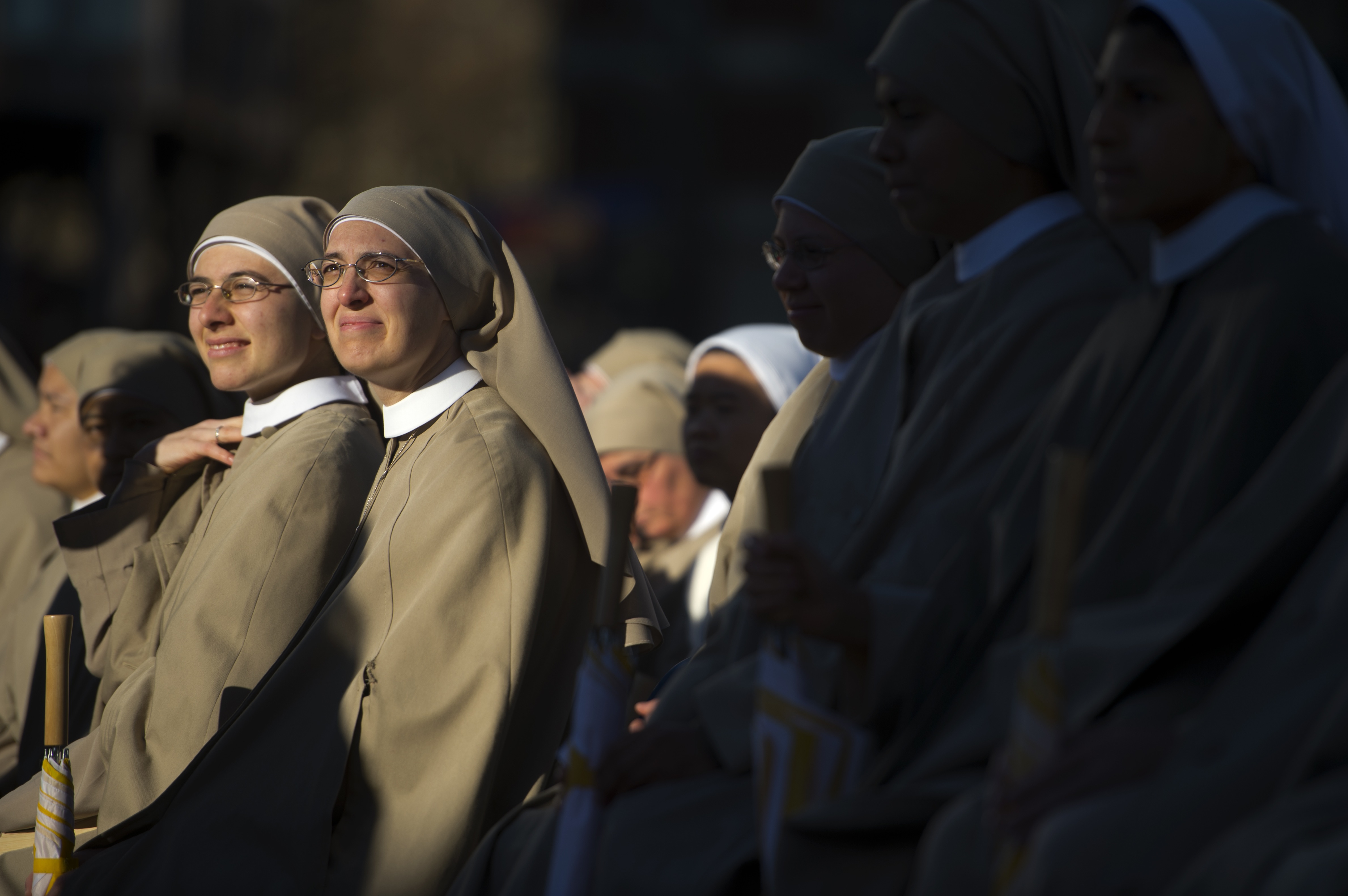
Nuns attend the mass for the Holy Family in Madrid on December 29, 2013. Tens of thousands of believers poured into central Madrid to celebrate an open-air Roman Catholic mass for the Holy Family just days after the Spanish government agreed to tighten the abortion law. By Pierre-Philippe Marcou/AFP/Getty Images.

The Theist’s Wager

Walter Russell Mead describes why he believes in a personal God:

For theists, the universe isn’t just a place with scattered bits of meaning in it. Meaning isn’t decoration or illusion, a subjective human response to hardwired stimuli in our brains or grace notes that accompany us on our meaningless way through the dark void. Existentialists and others who believe that the universe is ultimately meaningless but who still choose to act as if meaning was real are among the moral heroes of the world, but theists think there is more to life than the brave but doomed affirmation of meaningless ideals in the face of an idiot, uncaring universe.

Theists think meaning really means something, that it all adds up. The transcendence that comes to us in life doesn’t just happen in our heads; it points to the nature of ultimate reality. That ultimate reality transcends our ability to comprehend, and we only get scattered glimpses of it here and there, but whatever it is, it is greater than we are.

When theists think about that meaningfulness we experience in peak moments, we find ourselves thinking about its source.  Theists believe that the source of meaning and existence hangs together and points to something greater than itself. “Meaning” for theists is like “justice” and “truth”; it is something we don’t completely see or grasp but it is real. And because meaning is the source of such meaningful ideas as justice and beauty, its existence is even more important and more consequential than the existence of these other ideals for which people are willing to die. Theists are people for whom this concept of the meaning of life is so powerful, so present, so active that they find that it can’t be talked about except as a supreme force of transcendence and world shaping power, the truth behind all truths. Something this beautiful, this lively, this intelligent, this powerful, this transcendent, theists believe, cannot be less than alive and self aware. It is not a Thing, but a Person.

“Trying To See As God Sees”

As part of a Commonweal symposium on Terrence Malick’s 2011 film, The Tree of Life, Karen Kilby argues that “theological issues around loss and death in particular are right at the heart of the film”:

How can the suffering of the innocent, the sudden, pointless loss of life, be reconciled with the love of God? The question surfaces early in the film in connection with the death of the middle son in the family, but its centrality is signaled still earlier, in a quote that stands at the very opening of the film: “Where were you when I laid the foundations of the earth?… When the morning stars sang together and all the sons of God shouted for joy?”

To see how these lines can be taken as a kind of key to much of The Tree of Life, one needs to recall their place in the Book of Job. They come near its end. Most of the book has been taken up with an extended debate between the afflicted Job and his three friends. Repeatedly Job defends his integrity, rejecting the view of his “comforters” that some transgression must be at the root of his sufferings, and repeatedly he demands that God should appear. He wants to stage a trial: he wants God to show up and justify himself, to provide an answer to the question of why the innocent suffer. And then suddenly, shockingly, God does appear, speaking from a whirlwind. But the great oddity of the book of Job is that what follows is a massive non sequitur.

God pays no attention to questions of the injustice of the world, shows no interest in the suffering of the innocent in general, or in why Job in particular has been stricken. In fact, he seems to show no interest in humanity whatsoever. Instead he dwells boastfully, almost bombastically, on the sheer magnitude of creation, the terror and splendor of it.

What if one assumes, though, that it is not a non sequitur: what if God’s speech is not a rebuke of Job, or a rejection of his question, or a change of subject? What if one assumes that it is, in fact, somehow, a genuine answer? This, it seems to me, is part of what Malick is trying to imagine in The Tree of Life. “I want to see as you see,” prays the young Jack, and perhaps the film itself is trying to see as God sees: What does the world look like if God’s speech is not a rejection of Job’s question, but truly an answer to it?

Previous Dish on Malick here, here, and here.