What does the church of Pope Francis look like? A clue from Rome.
Category: The Dish
The Birth Of Creativity
In an interview, the painter Kathryn Lynch describes how having children has impacted her art:
Children grow you. Painting is responding to life and being a mother expands who you are and
what you respond to. If you make more life rub up against you, you have more of a world to make art from. I like what Charlie Parker says: “If you don’t live it, it won’t come out of your horn.” I feel like my paintings are better and bigger because of my children. You respond to whatever is in your life, and the people you have in your life feed your painting. Perhaps I am painting my children. I think I am putting everything and everyone I know in my work.
Because I saw myself first and foremost as an artist, I never thought I wanted children. The desire to be a mother came out of the blue at age thirty-six. Perhaps that I paint makes me more animal than intellect.
The two fastest paintings I ever did, and which I felt were some of my strongest paintings, were done two weeks after each child was born. My children brought out my lioness. When I went to paint after giving birth, it was easy to give birth to a painting, the paint just knew where to put itself on the canvas. In those moments I realized that my painting, and my ability to paint, was very directly related to events and occurrences in my life.
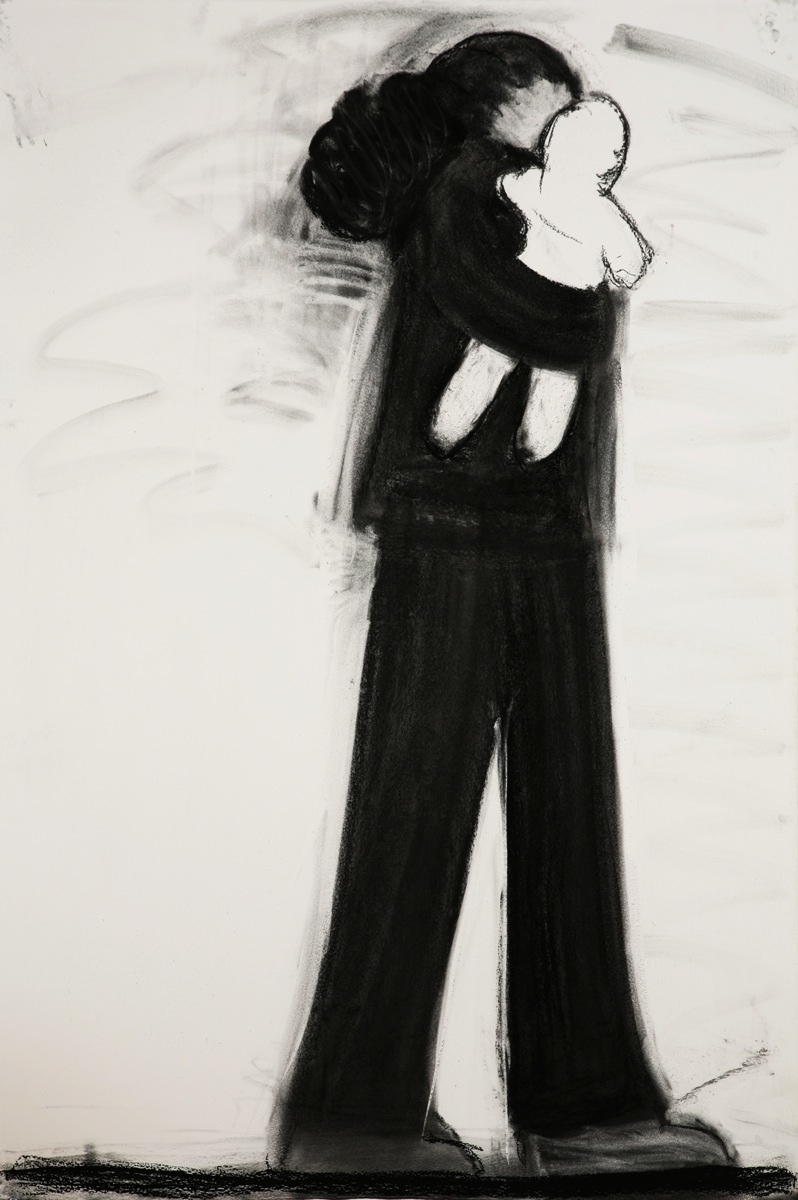
(Image: Mother and Child by Kathryn Lynch. For more of her work, visit her website here. Her painting will be featured at the Metro Show in January 2014)
How Nostalgia Helps Us
Nicholas Hune-Brown looks into research on the sentimental sensibility:
[A] study by Krystine Irene Batcho in The American Journal of Psychology examined the ways in which the nostalgia-prone cope with difficult situations. Batcho tested undergraduate subjects to see how predisposed to nostalgia they were before presenting them with a survey designed to see how they would react to stressful scenarios.
Batcho found that the nostalgia-prone were more likely to cope using helpful strategies, rather than dysfunctional ones. Counteracting the stereotype, the nostalgia-prone didn’t withdraw or go into denial: they sought social support and expressed emotions. The nostalgic had a deeper sense of connectedness to the past, and reflecting on earlier times could bring to mind coping strategies they had used before. Nostalgia proneness, Batcho concluded, came with real emotional and social benefits.
Mental Health Break
The joy for butterflies isn’t confined to people:
Our Genetic Moral Code
Back in November, in an interview with Sam Harris, Paul Bloom explained the thesis of his new book, Just Babies:
Certainly some morality is learned; this has to be the case because moral ideals differ across societies. Nobody is born with the belief that sexism is wrong (a moral belief that you and I share) or that blasphemy should be punished by death (a moral belief that you and I reject). Such views are the product of culture and society. They aren’t in the genes.
But the argument I make in Just Babies is that there also exist hardwired moral universals—moral principles that we all possess. And even those aspects of morality—such as the evils of sexism—that vary across cultures are ultimately grounded in these moral foundations.
A very different misconception sometimes arises, often stemming from a religious or spiritual outlook. It’s that we start off as Noble Savages, as fundamentally good and moral beings. From this perspective, society and government and culture are corrupting influences, blotting out and overriding our natural and innate kindness.
This, too, is mistaken. We do have a moral core, but it is limited—Hobbes was closer to the truth than Rousseau. Relative to an adult, your typical toddler is selfish, parochial, and bigoted. I like the way Kingsley Amis once put it: “It was no wonder that people were so horrible when they started life as children.” Morality begins with the genes, but it doesn’t end there.
In an excerpt from his book, Bloom explores how toddlers make moral choices:
Children tattle. When they see wrongdoing, they are apt to complain about it to an authority figure, and they don’t need to be prompted to do so. In one study, 2- and 3-year-olds were taught a new game to play with a puppet; when the puppet started to break the rules, the children would spontaneously complain to adults. In studies of siblings between the ages of 2 and 6, investigators found that most of what the children said to their parents about their brothers or sisters counted as tattling. And their reports tended to be accurate. They were ratting their sibs out, but they were not making things up. …
Part of the satisfaction of tattling surely comes from showing oneself to adults as a good moral agent, a responsible being who is sensitive to right and wrong. But I would bet that children would tattle even if they could do so only anonymously. They would do it just to have justice done. The love of tattling reveals an appetite for payback, a pleasure in seeing wrongdoers (particularly those who harmed the child, or a friend ofthe child) being punished. Tattling is a way of off-loading the potential costs of revenge.
Another excerpt looks at the other side of morality:
Not all morality has to do with wrongness. Morality also encompasses questions of rightness, as nicely illustrated by a study of spontaneous helping in toddlers, designed by the psychologists Felix Warneken and Michael Tomasello. In one condition of the study, the toddler is in a room with his or her mother present. An adult walks in, his arms full, and he tries to open a closet door. Nobody looks at the child, or prompts him or her or asks for help. Still, about half do help—they will spontaneously stand up, wobble over, and open the door for the adult.
This is a small example for a small individual, but we see this kindness writ large when people donate time, money, or even blood to help others, sometimes strangers. This behavior too is seen as moral; it inspires emotions like pride and gratitude, we describe it as good and ethical. The scope of morality, then, is broad, encompassing both the harsh, judgmental elements and the softer, altruistic elements.
A Poem From The Year

“Little Eternities” by Mary Ruefle:
When are we happiest? he asked her.
Not one of them could get the seats
to go back, not one of them really knew
what was in the glove box, though
everything there was theirs.When they got to where they were going,
a park, a gray squirrel came jumping along.
Childhood! It was in one of the houses nearby.
Money! Every day it seemed to loose itself
from its lurking-place and drift away.So he smelled the underside
of his own arm. And the squirrel
paused, one of those little eternities
never mentioned again.
Please consider supporting the work of the Poetry Society of America here.
(From Trances of the Blast © 2013 by Mary Ruefle. Used by kind permission of Wave Books, Seattle & New York. Photo by Grant Loy)
Why Awe Is Awesome
Cayte Bosler unpacks a study that “shows there are residual health benefits to having your mind blown”:
“People increasingly report feeling time-starved, which exacts a toll on health and well-being,” states the study. Using three experiments, researchers Melanie Rudd and Jennifer Aaker of the Stanford University, and Kathleen Vohs of the University of Minnesota, examined whether awe can expand perceptions of time availability. They found that participants “who felt awe, relative to other emotions, felt they had more time available, were less impatient, were more willing to volunteer their time to help others, and more strongly preferred experiences over material goods.”
It can be hard to generalize what people consider jaw-dropping, but Vohs says research demonstrates what consistently creates an awesome experience. Travel ranks high. So does gazing at the cosmos on a clear night or watching a sensational film, as well as anytime we encounter massive quantities: colorful tulips in bloom, a bustling market in India, or a stunning school of fish. Novelty and perceptual vastness forces us into the present moment. The study underscores the importance of cultivating small doses of awe in the everyday to boost life satisfaction.
More on how “awe” works:
“The experience of awe is one where you are temporarily off-kilter in terms of your understanding of the world,” explains Vohs. “People mostly walk around with a sense of knowing what is going on in the world. They have hypotheses about the way people behave and what might happen; those are pretty air-tight. It is hard to get people to shake from those because that’s just how the brain works. We are always walking around trying to confirm the things we already think. When you are in a state of awe, it puts you off balance and as a consequence, we think people might be ready to learn new things and have some of their assumptions questioned.”
Face Of The Day
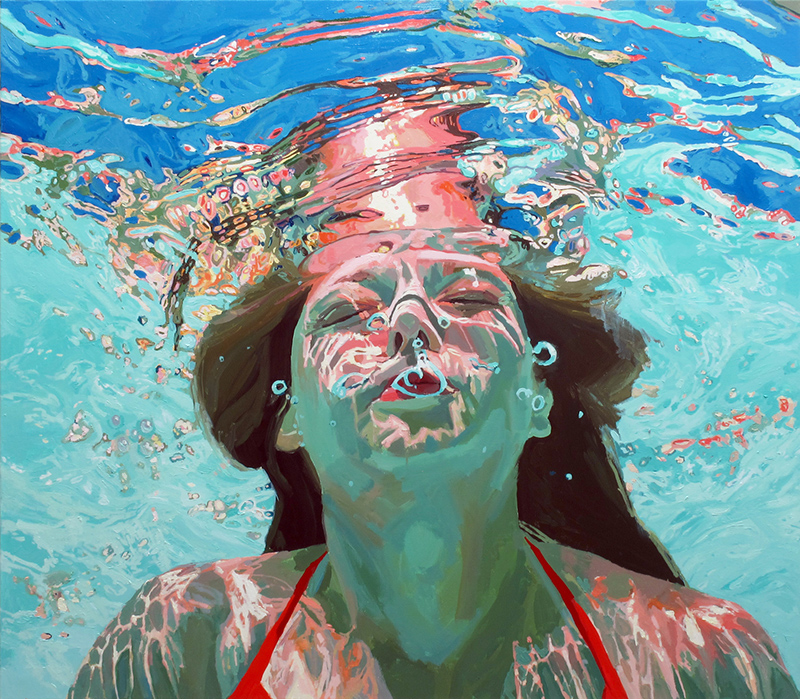
How artist Samantha French describes her work:
My current body of work is focused on swimmers underwater and above. Using vague yet consuming memories from my childhood summers spent immersed in the tepid lakes of northern Minnesota, I attempt to recreate the quiet tranquility of water and nature; of days spent sinking and floating, still and peaceful.
See more of her work here.
“The Clear Expression Of Mixed Feelings”
Recently the Dish featured the poetry of Mary Szybist, whose collection, Incarnadine, won the National Book Award in November. In an interview, she discusses the connection between her religious life and writing:
When I was young, spiritual faith had an enormous presence in my life. When I was a young adult, its absence, at times, felt enormous. Now my relationship to it is more complicated, and I try to let those complications into my poems. W. H. Auden once said that “poetry might be described as the clear expression of mixed feelings,” and my mixed feelings about faith and spirituality often drive my work…. I don’t think I was ever after spiritual clarity, at least not the kind that might be held as an enduring truth. An insight that helps me through the struggles of one day will not necessarily answer to the spiritual unrest of another. That is, I think, why artists keep creating and writers keep writing. We change; our world changes; what suffices one day will not necessarily suffice the next day. We need new visions. I like Robert Frost’s idea that a poem is a “momentary stay against confusion.” Clarity may be “momentary”—but that does not make it less valuable or needed.
She goes on to argue that the poems in Incarnadine could be seen as a feminist response to the Biblical tale of the Annunciation, when Christians believe an angel told Mary about her miraculous pregnancy:
Feminism means, in its most basic sense, a belief that men and women should have equal rights and opportunities. I do, of course, believe that. Feminism might also be described as activity in support of women’s interests, and I think Incarnadine does answer to that description. I grew up identifying with the icon of Mary, mother of God, since I was named after her. I also felt myself to be in her shadow. I think Mary is a problematic ideal to hold up to women for many reasons; she is celebrated for being both mother and virgin—an impossible ideal. It is particularly the virginity ideal that is held up to women (and not men) that I find problematic, and virginity is a concept and expectation that still has real and often dire consequences for women throughout the world. I wanted to complicate the figure of Mary and the way she relates to this “ideal.” So … I would say this is a feminist response.
The View From Your Window

Dushanbe, Tajikistan, 7.32 am

