The Marriage Equality Wins Pile Up

Toobin covers the recent surge in court victories. He calls Monday’s ruling in Ohio possibly “the most important of all”:

James Obergefell and John Arthur, who lived together in Cincinnati, married in Maryland at a time when Arthur was gravely ill. In anticipation of Arthur’s death, the couple petitioned the state of Ohio for Arthur to be listed as “married” on his Ohio death certificate, and to record Obergefell as the “surviving spouse.” Ohio, which does not allow same-sex marriages, refused, but federal judge Timothy S. Black ruled against the state and in favor of the couple. The judge said it was “not a complicated case.” Throughout Ohio’s history, Ohio has treated marriages solemnized out of state as valid in Ohio. “How then can Ohio, especially given the historical status of Ohio law, single out same-sex marriage as ones it will not recognize?” Black asked in his opinion. “The short answer is Ohio cannot.”

The Ohio decision is crucial because people in the United States tend to move from state to state. Like Obergefell and Arthur, people in same-sex marriages may well end up living in states where such marriages are illegal. Once they are in those states, these couples will become enmeshed in the legal system in the way that heterosexual married couples do. They will have children; they may divorce and dispute child custody; they will seek to file joint tax returns; they will visit each other in the hospital; they will want to be with each other when they die. Their lives will intersect with the legal system in scores of ways at those junctures. In light of this, many judges will face dilemmas similar to the one Black just resolved.

Lyle Denniston notes how the Ohio ruling relies and expands on Windsor. Mark Joseph Stern games out the cases that might make it to SCOTUS. On Utah:

Kitchen v. Herbert, Utah

Odds of reaching SCOTUS: Fairly good, but far from certain. Some observers have taken it as a given that the Utah case is destined for the high court: It’s a head-on challenge in a deeply red state, the kind of direct conflict that the Prop 8 case resoundingly was not. But it’s this straightforward factor that makes this case so risky. The court can’t wriggle out of it Perry-style; if the justices take it, they can’t get rid of it without issuing the final word on state-level bans. Given these stakes, the justices might prefer to kick the issue down the road—they’re pretty good at that—and let the lower courts figure this one out.

What happens if SCOTUS takes the case: The justices will essentially be forced to either legalize gay marriage nationwide or uphold all state-level bans. You can read the Windsor tea leaves however you want, but my money is on a broad ruling bringing marriage equality to the entire United States.

What happens if it doesn’t: That depends on the 10th Circuit’s ruling, but by denying a stay of the federal judge’s decision, the circuit judges may have already shown their hand. A court will generally stay a ruling if there’s a reasonable likelihood of reversal; here, the court has tacitly suggested, there is not. If the circuit court does uphold Judge Robert Shelby’s Scalia-baiting ruling, expect gay couples in Colorado, Oklahoma, and Wyoming—non-gay-marriage states within the 10th Circuit—to bring suit (and win).

A Poem From The Year

poetrysocietyawards_9073

“Slave Driven” by Wanda Coleman:

i barely niggle a living squirreling around
the home office. I work for myself as my own secretary.
it’s a shitty job, paperwork ceiling to floor. the
technology changes every few months. i’m on call
weekends and holidays. no benefits or perks.
there’s no vacation or overtime. the pay is less
than minimum wage.
it’s like every job I’ve ever had except I don’t drive
rush-hour traffic and can wear nightclothes if I want.
there are no racist vibes, no gender or sex preference
or intergenerational discrimination, quitting time
is determined by level of exhaustion.
i get no breaks. i sit all day.
i grab a bite while on duty
the boss never has anything
good to say

Please consider supporting the work of the Poetry Society of America here.

(From Ostinato Vamps © 2003 by Wanda Coleman. Reprinted by kind permission of the University of Pittsburgh Press. Photo of Coleman courtesy of the Poetry Society of America)

Turmoil In Turkey, Again

With Turkish officials resigning right and left over a corruption scandal, Kemal Kirişci unpacks the deepening political crisis in Turkey:

A graft scandal involving individuals close to Turkish Prime Minister Recep Tayyip Erdogan and his cabinet erupted on December 17. Subsequently, the government has removed a string of police chiefs and officers as well as members of the judiciary from their posts claiming that there is a “conspiracy” directed against the government. The PM referred to a long list of conspirators, including unnamed ambassadors that he threatened with expulsion. However, supporters of Erdogan have identified Fetullah Gülen, the head of a religiously conservative civil society movement that enjoys broad-based societal support and is alleged to have sympathisers in the ranks of the Turkish National Police and judiciary, as the primary culprit. Gülen, who has lived in the US since the late 1990s, was a long-time ally and supporter of the PM’s Justice and Development Party (AKP). Relations between the PM and Gülen’s movement had been deteriorating for some time on a wide spectrum of issues, ranging from relations with Israel to Erdogan’s recent attempt to have the lucrative prep schools shut down.

The corruption scandal comes at an unfortunate time for the government as Turkey enters an 18-month-long election cycle that will see local elections in March, presidential elections in August and a parliamentary one in mid-2015. The resulting instability from the corruption scandal also coincides with a period when Turkey’s international image has been tarnished and its foreign policy faces growing challenges in a deeply unstable neighbourhood.

Marc Champion sees signs that Erdogan is not as politically astute as he used to be:

Precisely because Erdogan has concentrated power so closely around himself in just a few men, any perception that they are corrupt will immediately infect his personal image and support. This is why Erdogan hasn’t fired the four ministers: He says the allegations against them are part of a plot to unseat him.

My guess is that he’s right, but his response gets to the second reason Erdogan may not survive, despite being far stronger than Gulen: himself. Erdogan is an extraordinary politician, one of the most intuitive I have met. Yet since the AK Party’s third thumping election victory in 2011, when he declared his “master period” to be at hand, Erdogan appears to have lost the political compass that once told him when to be pragmatic and cut his losses. His fight-or-flight response now includes only one — to fight.

In response to the allegations, Erdogan has fired dozens of Istanbul police chiefs involved in the arrests, the same ones he defended and praised over their handling of the Gezi Park protests earlier this year. He says the corruption cases are part of the same plot he detected behind the Gezi Park protests, conducted by the same dark morass of international conspirators. Except that now the police who cracked down on the protesters must be part of the conspiracy, too. This is just untenable. To make it stick and purge Gulen’s supporters from the police force, prosecutor’s office and courts, Erdogan will have to crack down in ways that will destroy what remains of Turkey’s independent law enforcement institutions and media freedoms. That will deal a huge blow to the so-called Turkish model, the idea that Turkey had cracked the code for implementing genuine democracy in the Muslim world. And that would be a tragedy, because the Turkish model is real and important, if overhyped, oversimplified and already under strain.

Michael Koplow thinks the prime minister may be done for:

If the AKP does worse than expected in the local elections in March, which is a very likely possibility, it seems to me that Erdoğan’s aura of invincibility and stranglehold on his party will be permanently broken. Once that happens the long knives are bound to come out, and with the perfectly acceptable alternative of Abdullah Gül waiting in the wings, Erdoğan’s tenure as the sun around which Turkish politics revolves (to quote my friend Steven Cook) may be done. While I have learned enough to know that Erdoğan should never, ever be counted out or underestimated, we may have finally arrived at the exception to this longstanding rule of Turkish politics.

Jack A. Goldstone puts a positive spin on the corruption probe:

Unfortunately, ALL emerging democracies tend to have considerable amounts of corruption (maybe make that ALL democracies, period. The United States had a recent case of a Congressmen found with wads of cash stuffed in his freezer, and Japan has recurrent corruption scandals). It is difficult, when people who have had no access to political power for a very long time suddenly come into very powerful positions for everyone to act like angels. It is inevitable that some people will succumb to the temptation to turn their positions into sources of income. That is why all respectable democratic regimes have vigorous investigative and judicial arms that are concerned to ensure that the law is followed and corruption is rooted out — even if that leads to people at the very highest levels of authority. Indeed, one measure of the degree to which a country is truly a well-functioning democracy is whether such investigations and the pursuit of corruption ends with low-level officials, or whether even the highest officials in the land are held accountable if they break the law. On that score, the current investigations are a sign of the maturing and truly democratic character of Turkey’s regime.

The NSA Wins A Round

A federal judge today dismissed an ACLU lawsuit to shut down the NSA’s phone metadata collection program:

Handing down an unusually sweeping ruling, Judge William Pauley III ruled that the NSA’s phone record database was fully lawful under section 215 of the Patriot Act. Beyond that, the judge ruled, “the question of whether that program should be conducted is for the other two coordinate branches of Government to decide. Judge Pauley opens the opinion with thoughts on the attacks of 9/11, which he describes as “a bold jujitsu.” The opening paragraphs detail the case of 9/11 hijacker Khalid al-Mihdhar, who the NSA mistakenly believed was living in Yemen at the time of the attacks because of insufficient data collection. (This anecdote, based on General Alexander’s congressional testimony, has been widely disputed.) The metadata collection program grew up in response to those intelligence failures, collecting more and more data so as to suss out the missed connections. Calling the program, “a wide net that could find and islolate gossamer contacts,” Pauley concludes, “this blunt tool only works because it collects everything.”

David Kravets fears that efforts to reform the program might end up making things worse:

Right now, the phone companies store phone metadata for varying times. Verizon and U.S Cellular store it for about a year; Sprint for 18 months. At the other end of the spectrum, T-Mobile maintains it for seven to 10 years, and AT&T for five, according to a congressional inquiry. While Obama’s review group’s recommendation was short on details, everybody familiar with the plan agrees it would require telcos to store metadata for some minimum amount of time, presumably for longer than many of them already do. That means the authorities would have access to this data for far longer than they otherwise might.

Meanwhile, although the NSA has maintained that metadata is anonymous, researchers have found that it can easily be used to identify people:

Armed with very sparse metadata, Jonathan Mayer and Patrick Mutchler found it easy—trivially so—to figure out the identity of a caller. Mayer and Mutchler are running an experiment which works with volunteers who agree to use an Android app, MetaPhone, that allows the researchers access to their metadata. Now, using that data, Mayer and Mutchler say that it was hardly any trouble at all to figure out who the phone numbers belonged to, and they did it in just a few hours.

Face Of The Day

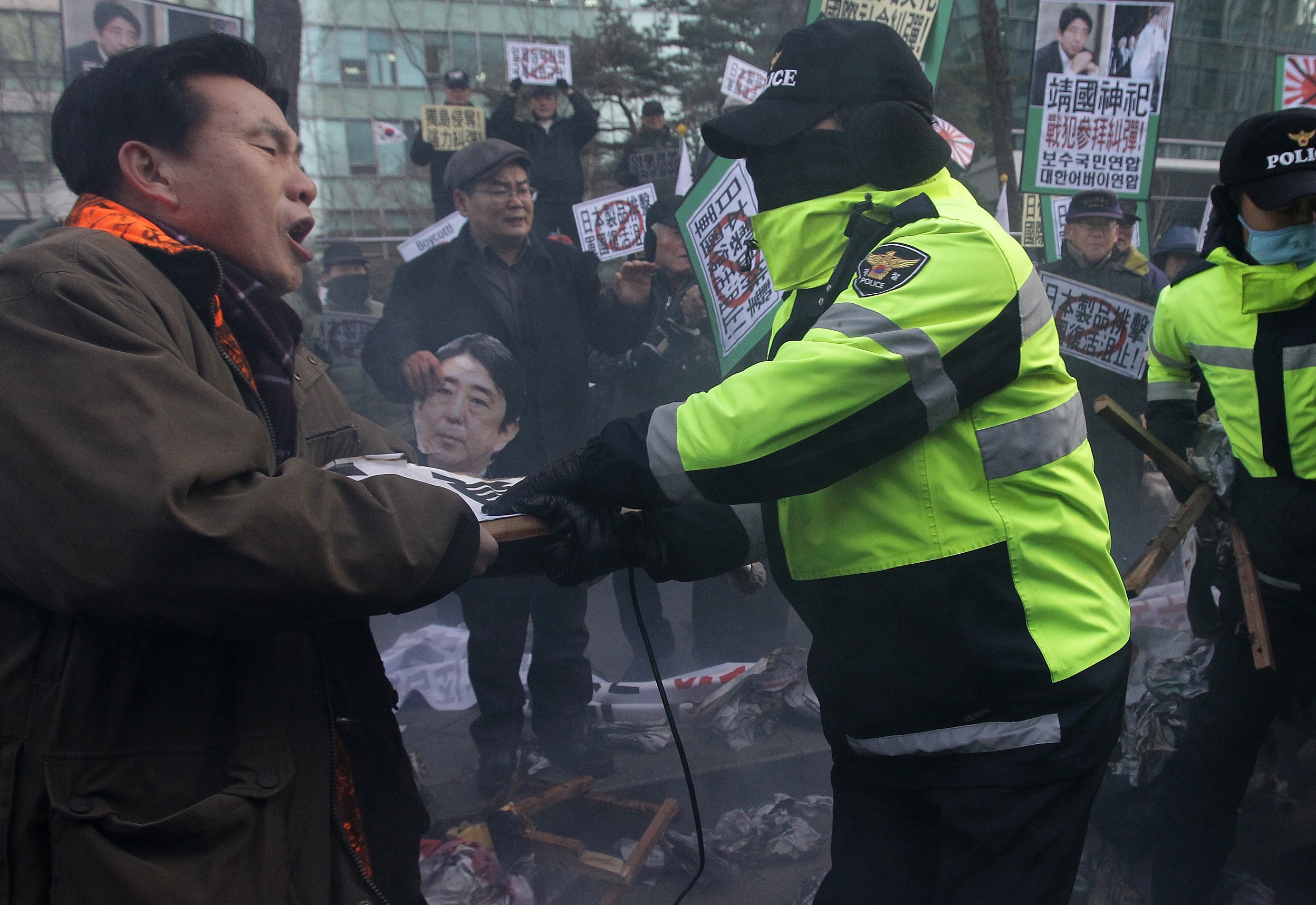
Anti-Japan Protestors Rally In Seoul Against Japan PM Abe's Visit To Yasukuni Shrine

South Korean conservative protesters scuffle with police during an anti-Japan rally in front of the Japanese embassy on December 27, 2013 in Seoul, South Korea. On December 26, 2013, Japanese Prime Minister Shinzo Abe visited the controversial shrine, which honors Japan’s war dead including war criminals during the period from 1867 to the end of the Second World War. By Chung Sung-Jun/Getty Images)

GOP Support For Reforming Obamacare

It may be increasing (NYT):

“It’s no longer just a piece of paper that you can repeal and it goes away,” said Senator Ron Johnson, Republican of Wisconsin and a Tea Party favorite. “There’s something there. We have to recognize that reality. We have to deal with the people that are currently covered under Obamacare.”

Ezra thinks Johnson’s “realization is how repeal-and-replace becomes criticize-and-reform”:

Republicans who want to reform Obamacare remain the (growing) minority. But in another sign that Republicans see the politics of Obamacare changing, there’s more talk of producing an actual Republican alternative before the 2014 elections. Rep. Paul Ryan (R-Wis.), for instance, plans to unveil the successor to his Patients’ Choice Act act early next year. That, too, is an admission that something like the Affordable Care Act is here to stay, and Republicans need to begin proposing policy for a post-health reform world rather than fantasizing about a return to a pre-health reform world.

Philip Klein wonders how GOP candidates will decide which reforms to support when “it’s very difficult to predict what the health care landscape will look like a few months from now, let alone several years from now when a potential Republican president would have a chance to make changes”:

Without knowing how much of Obamacare could be in play, it’s hard to settle on a policy. On the one hand, basing policy on the assumption that Obamacare can be entirely repealed is likely unrealistic, while on the other hand, treating Obamacare as mostly untouchable could cause Republicans to preemptively concede too much policy ground. Mounting failures of Obamacare could put more of the law in play than seemed possible just a few months ago.

Most likely, the future of Republican health care policy will be sorted out as its presidential candidates begin to lay out their plans during the 2015 primaries. But those candidates will have to adopt policies in an environment that’s largely a product of what happens in 2014.

Is The World’s Newest Country Falling Apart?

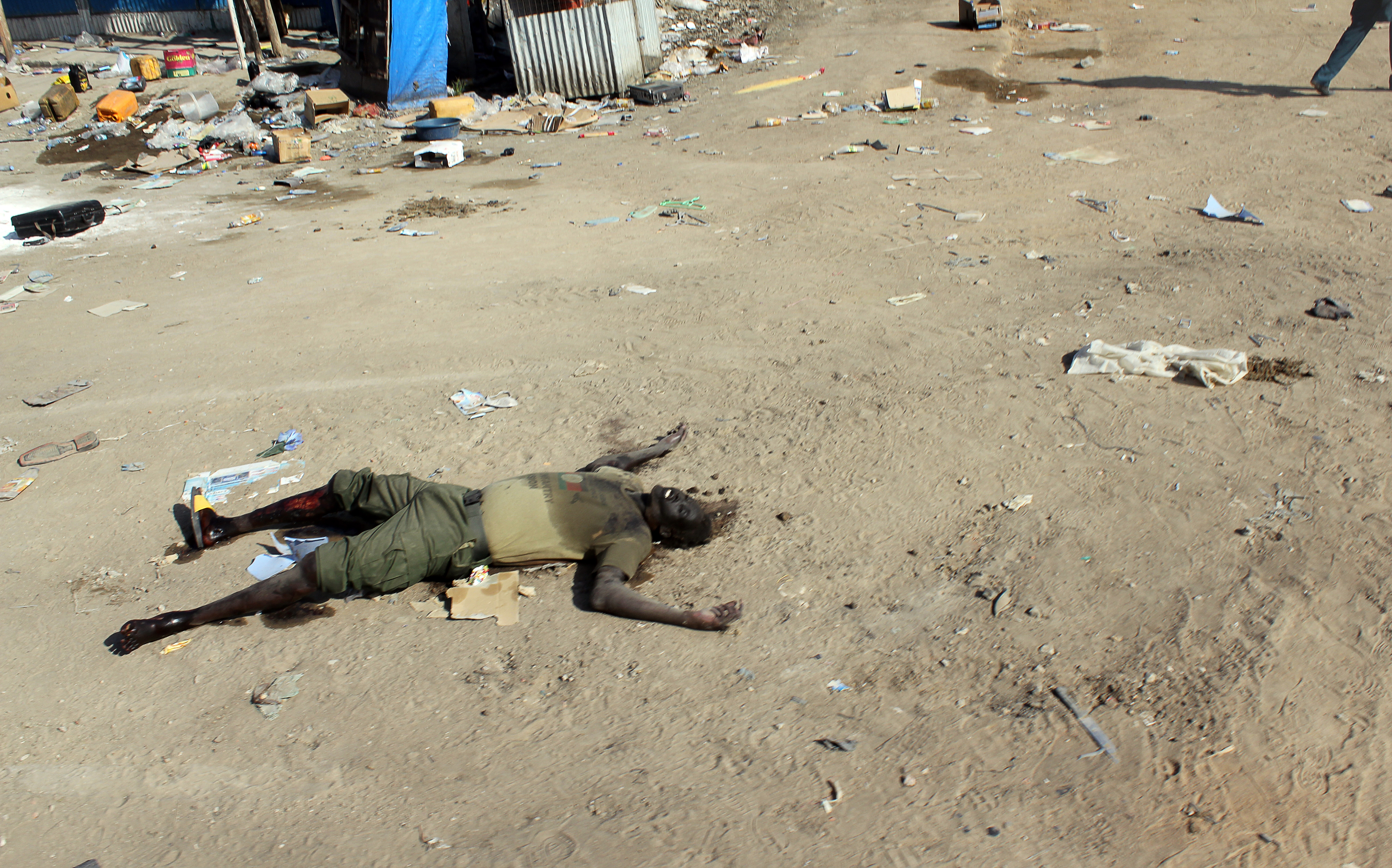
SSUDAN-UNREST-BOR

Over the past two weeks, South Sudan has come to the brink of civil war, with as many as 1,000 dead in fighting between forces loyal to President Salva Kiir and rebels led by former vice president Riek Machar. John Prendergast and Akshaya Kumar set the scene:

Tensions within the ruling Sudan People’s Liberation Movement have been simmering for years. That political power struggle among Juba’s elites has now shifted into open violence across the country. It is clear that there can be no purely military solution to this conflict. Neither forces aligned to sitting President Salva Kiir nor those aligned to former Vice President Riek Machar can seize control of the entire country. More importantly, continued violence undermines both men’s credibility. As a consequence, the initiation of an open and inclusive dialogue focused on negotiating a political settlement is essential.  South Sudan’s President Kiir has already evidenced a willingness to talk by sitting down with leading critic Rebecca Nyandeng de Mabior. Unfortunately, Riek Machar has been much more elusive, indicating that nothing short of President Kiir’s dismissal was acceptable.

Max Fisher explains how South Sudan got to this point just two and a half years after its creation:

The country’s path to independence was also a path to internal conflict. The decades before South Sudan’s independence are complicated but, in the simplest terms, it was defined by a half-century of fighting between the politically dominant, ethnically Arab north and the politically weaker, ethnically sub-Saharan south. Rebel groups in the south wanted more autonomy from the north. They had to fight very hard to get it (although they owe a lot to the north, which behaved so terribly that it galvanized world opinion in favor of the south).

The thing, though, is that South Sudan is actually pretty ethnically diverse. South Sudan, like a number of other countries in sub-Saharan Africa and particularly this region of it, is articulated by borders that have very little to do with the actual people there. The earlier, unified version of Sudan had been carved out, in part, by European and especially British colonialism. The long-running conflict between the country’s north and its south was, like many wars in post-colonial Africa, partly a consequence of European cartographers having forced disparate groups into artificial borders. Splitting Sudan in two helped to ease the tension created by these borders but didn’t solve it. The southern ethnic groups had been united by a common enemy — the north — but that’s no longer bringing them together.

Colum Lynch looks at the role of the US:

The stakes are high for the United States, as fighting threatens to upend one of the most important foreign policy initiatives of the last two decades in sub-Saharan Africa — one that unified Republicans, Democrats, African Americans, human rights advocates, and Christians. On Saturday, four U.S. troops were wounded when their V-22 Osprey came under fire during an aborted operation to evacuate U.S. nationals from the town of Bor. An additional 150 Marines have been sent to the region to prep for possible future evacuations. It’s an extraordinary and painful development, given America’s major role in securing independence for South Sudan. But the toughest part for Americans to swallow may be that it’s the U.S.-backed leaders of South Sudan — the supposed good guys — that are responsible for plunging the country into chaos and threatening to wreck America’s signature achievement in the region.

Larison is not surprised:

The “supposed good guys” happened to be the people in charge of the armed insurgency that the U.S. chose to support. Like many other insurgent groups over the years, their “goodness” was defined by their opposition to the government they were rebelling against. Like other cases of separatism gone awry, the new state that the U.S. helped to bring into being was plagued by so many political ills that its turn to authoritarianism, corruption, and internal conflict was practically guaranteed from the start. Given our recent experiences with ill-advised foreign interventions and the constant pleas to support “good” rebels in one conflict after another, Americans will have no trouble believing that the people that Washington anointed as “good guys” proved to be much less than that. They may begin wondering why our government thinks that it knows what it’s doing when it supports the creation of new states that always seemed almost doomed to fail.

Philip Roessler calls this an example of the “coup-civil war trap,” a common cause of state failure in post-colonial Africa:

The coup-civil war trap arises when political institutions are weak and ethnic groups are strong. Violence is dispersed among powerful Big Men who are embedded in and supported by different ethnic groups. And economic benefits are primarily derived from controlling the central government. Under such conditions, peace is often contingent upon power-sharing, in which the ruler strikes alliances with rival Big Men. These alliances allow the ruler to mobilize support and collect information from outside his own ethnic group, which in turn helps to secure peace and prevent civil war. But the potential danger is that in sharing real power with ethnic rivals, the ruler leaves himself vulnerable to a coup d’état. And there’s the rub: the policy solution to civil war in these weak states increases a rival group’s capabilities to win power in a coup. In more technical terms, ethnic power-sharing in the shadow of the coup d’état gives rise to a commitment problem, in which the ruler fears that rivals are supporting him only to better position themselves to take power in the future.

This commitment problem is a key source of bargaining failure and conflict in weak states because it prevents rulers from fully committing to peaceful power-sharing. Reluctant to strengthen their rivals, rulers don’t share enough power.  Fundamentally mistrustful, they pursue defensive safeguards, such as stacking the military and security organs with members of their ethnic group and other loyalists, in a bid to neutralize their rivals’ coup-making capabilities. But this only undermines confidence in the ruler. Regime partners question the ruler’s commitment to power-sharing and, even worse, fear that, having used his comrades to get to power, he is ready to dispose of them by purge or execution.

(Photo: The body of a man claimed to be a rebel lies on the ground in the market in the centre of Bor, on December 25, 2013. By Waakhe Simon Wudu/AFP/Getty Images.)

Democrats Against Peace

Senate Democrats are undermining Obama’s outreach to Iran. Beinart wants the anti-war left to wake up:

Among the senators who have cosponsored the new sanctions legislation are Charles Schumer and Kirsten Gillibrand from New York, Chris Coons from Delaware, Richard Blumenthal from Connecticut and Robert Menendez and Cory Booker from New Jersey. These are bright blue states where most Democratic voters would be appalled to know that their senators support a bill that both President Obama and U.S. intelligence believe increases the chances of a third Middle Eastern war. Indeed polls show that Democrats overwhelmingly back Obama’s Iran policy.  The more these senators are forced to publicly defend their positions on Iran, the more politically costly those positions will become. What we don’t know is whether the left can generate a movement strong enough to force that public debate.

W. James Antle III adds:

No sane political party should ever be generically pro- or antiwar. The justice and necessity of each military venture should be evaluated independently, in the context of the conditions and national interests at the time. But while the two parties advertise themselves as operating with different presumptions about the use of government at home, does either party start with a presumption of peace abroad?