Really High Art

Artists don’t always see eye-to-eye with their patrons, but when the patron is NASA and the artwork is the first sculpture on the moon, things get especially tricky:

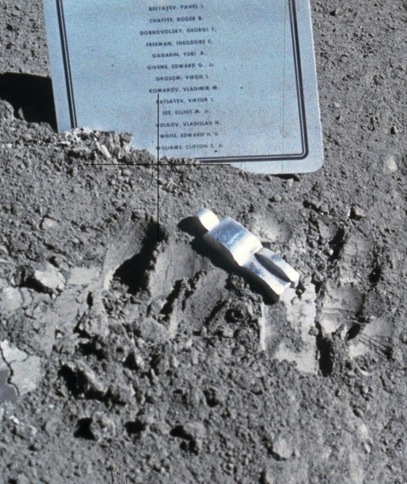
At 12:18 a.m. Greenwich Mean Time on Aug. 2, 1971, Commander David Scott of Apollo 15 placed a 3 1/2-inch-tall aluminum sculpture [by artist Paul Van Hoeydonck] onto the dusty surface of a small crater near his parked lunar rover. At that moment the moon transformed from an airless ball of rock into the largest exhibitionku-xlarge space in the known universe. Scott regarded the moment as tribute to the heroic astronauts and cosmonauts who had given their lives in the space race. Van Hoeydonck was thrilled that his art was pointing the way to a human destiny beyond Earth and expected that he would soon be “bigger than Picasso.”

In reality, van Hoeydonck’s lunar sculpture, called Fallen Astronaut, inspired not celebration but scandal. Within three years, Waddell’s gallery had gone bankrupt. Scott was hounded by a congressional investigation and left NASA on shaky terms. Van Hoeydonck, accused of profiteering from the public space program, retreated to a modest career in his native Belgium. Now both in their 80s, Scott and van Hoeydonck still see themselves unfairly maligned in blogs and Wikipedia pages – to the extent that Fallen Astronaut is remembered at all.

And yet, the spirit of Fallen Astronaut is more relevant today than ever. Google is promoting a $30 million prize for private adventurers to send robots to the moon in the next few years; companies such as SpaceX and Virgin Galactic are creating a new for-profit infrastructure of human spaceflight; and David Scott is grooming Brown University undergrads to become the next generation of cosmic adventurers. Governments come and go, public sentiment waxes and wanes, but the dream of reaching to the stars lives on. Fallen Astronaut does, too, hanging eternally 238,000 miles above our heads.
About that plaque next to the tiny sculpture:

On August 1, 1971, Fallen Astronaut was placed on the Moon by the crew of Apollo 15, along with a plaque bearing the names of eight American astronauts and six Soviet cosmonauts who had died:

Scott, Commander of the Apollo 15 mission, noted that “Sadly, two names are missing (from the plaque), those of Valentin Bondarenko and Grigori Nelyubov.” He explained that because of the secrecy surrounding the Soviet space program at the time, they were unaware of their deaths. Also not on the plaque are two US Air Force astronauts who died in 1967, Michael James Adams, in an X-15 accident and Robert Henry Lawrence, Jr., the first African American astronaut and part of the Manned Orbiting Laboratory Program, in a training accident. They are remembered on the Space Mirror Memorial.
The Fed’s Tiny Taper

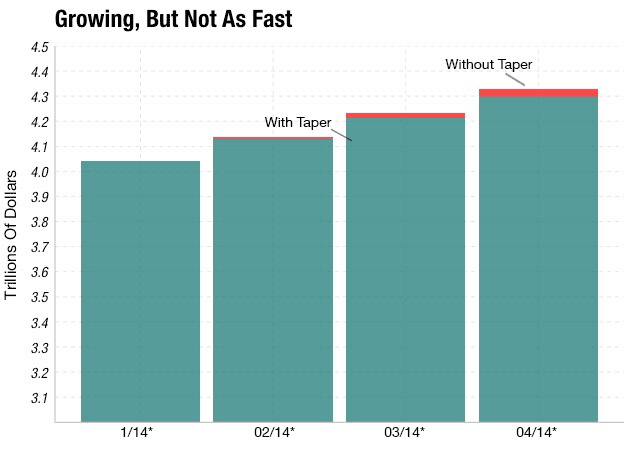
Planet Money graphed it. They had to start their chart at $3 trillion because otherwise “you wouldn’t even be able to see it”:

The Taper

Matthew O’Brien approves of the Fed’s decision:

[T]he Fed will “taper” its purchases from $85 to $75 billion of bonds a month. And it will keep doing so in $10 billion increments next year as long as the recovery stays on track. But it will try to inject just as much monetary stimulus as it’s taking out by strengthening its promises. The Fed now says it will likely keep rates at zero “well past” the time unemployment falls below 6.5 percent, especially if inflation stays below its 2 percent target.

Markets approved. Stocks jumped, bonds didn’t fall, and expectations of future rates barely budged. In other words, Bernanke finally convinced markets that tapering isn’t tightening, even though he said it was a few months ago. Neat trick.

Daniel Gross’s take:

[T]he Fed isn’t really putting on the brakes. It is just taking its foot off the gas pedal a tiny bit. And as Bernanke passes control of the steering wheel to Janet Yellen, it’s still going at a very rapid clip.

Cassidy comments on the Fed’s other announcement, “that it would most likely keep interest rates at their current record-low levels even after the unemployment rate falls below 6.5 per cent—a figure it had previously identified as a possible threshold for rate hikes”:

That was a shift in the dovish direction. As if to emphasize it, Bernanke insisted that the taper itself did not signal a move toward a more restrictive policy, saying, “This is not intended to be a tightening…. We do not think there is an inflation problem, or anything like that.” To the contrary, Bernanke stressed that he and his colleagues were concerned about the inflation rate being too low: it’s currently running at about one per cent, well below the Fed’s target of two per cent. The Fed chairman even raised the prospect of the central bank further loosening its policy stance, saying, “If inflation does not show signs of returning to its target, we will take appropriate action.”

It was a bit like a mother warning a child that she would gradually reduce the number of bags of M&Ms he could eat every week, but, at the same time, reassuring the boy that his supply of Snickers bars would be uninterrupted, and might even be stepped up if he started to lose weight.

Ezra wishes that Congress had worked with Bernanke instead of working against him:

There’s an alternate history of the last three years in which Bernanke held rates low and Congress used the opportunity to rebuild America’s infrastructure, passed a huge tax cut for businesses that hire new workers, helped state and local government reinvest after the vicious cuts forced by the recession, and wiped out the payroll tax until further notice. That’s a world where millions more Americans have jobs today. And it’s a world Bernanke did everything he could to help Congress create.


A&E Cannot Bear Very Much Reality

ABC's "Good Morning America" - 2013

I have to say I’m befuddled by the firing of Phil Robertson, he of the amazing paterfamilias beard on Duck Dynasty (which I mainly see via The Soup). A&E has a reality show that depends on the hoariest stereotypes – and yet features hilariously captivating human beings – located in the deep South. It’s a show riddled with humor and charm and redneck silliness. The point of it, so far as I can tell, is a kind of celebration of a culture where duck hunting is the primary religion, but where fundamentalist Christianity is also completely pervasive. (Too pervasive for the producers, apparently, because they edited out the saying of grace to make it non-denominational and actually edited in fake beeps to make it seem like the bearded clan swore a lot, even though they don’t.)

Now I seriously don’t know what A&E were expecting when the patriarch Phil Robertson was interviewed by GQ. But surely the same set of expectations that one might have of an ostensibly liberal host of a political show would not be extended to someone whose political incorrectness was the whole point of his stardom. He’s a reality show character, for Pete’s sake. Not an A&E spokesman. So here’s what he said – which has now led to his indefinite suspension (but he’ll be in the fourth season, apparently, which has already wrapped):

“Everything is blurred on what’s right and what’s wrong … Sin becomes fine. Start with homosexual behavior and just morph out from there. Bestiality, sleeping around with this woman and that woman and that woman and those men … “Don’t be deceived. Neither the adulterers, the idolaters, the male prostitutes, the homosexual offenders, the greedy, the drunkards, the slanderers, the swindlers—they won’t inherit the kingdom of God. Don’t deceive yourself. It’s not right … “

This is a fascinating glimpse into the fundamentalist mind. You’ll notice that, for the fundamentalist, all sin – when it comes down to it –  starts with sex. This sexual obsession, as the Pope has rightly diagnosed it, is a mark of neurotic fundamentalism in Islam and Judaism as well as Christianity. And if all sin is rooted in sex, then the homosexual becomes the most depraved and evil individual in the cosmos. So you get this classic statement about sin: “Start with homosexual behavior and just morph out from there.”

This emphasis is absolutely not orthodox Christianity. There is nothing primary about sexual sin as such in Christian doctrine. It sure can be powerfully sinful – but it’s not where sin starts. And to posit gay people as the true source of all moral corruption is to use eliminationist rhetoric and demonizing logic to soften up a small minority of people for exclusion, marginalization and, at some point, violence.

If you think I’m hyperventilating, ask yourself what the response would be if in talking about sin, Phil Robertson had said, “Start with Jewish behavior …” The argument would be totally recognizable, once very widespread, and deeply disturbing. What we’re seeing here – and it’s very much worth debating – is how fundamentalist religion seizes on recognizable, immoral minorities to shore up its own sense of righteousness. You can gussy it up – but it’s right there in front of our nose.

Then Robertson says something that tells us nothing except he has never had an honest conversation with a gay person about what it is to be gay.

He simply assumes that all men must be heterosexual, and that making themselves have sex with another man must be so horrifying it mystifies him:

“It seems like, to me, a vagina—as a man—would be more desirable than a man’s anus. That’s just me. I’m just thinking: There’s more there! She’s got more to offer. I mean, come on, dudes! You know what I’m saying? But hey, sin: It’s not logical, my man. It’s just not logical.”

No, it isn’t logical if it were a choice for a straight guy. But it isn’t. All we’re seeing here is the effect of cultural isolation. The only thing I find objectionable about it – and it is objectionable – is the reduction of gay people and our relationships to sex acts. Mr Robertson would not be happy – indeed, rightly be extremely offended – if I reduced his entire family life and marriage to sex with a vagina.

But look: I come back to what I said at the beginning. Robertson is a character in a reality show. He’s not a spokesman for A&E any more than some soul-sucking social x-ray from the Real Housewives series is a spokeswoman for Bravo. Is he being fired for being out of character? Nah. He’s being fired for staying in character – a character A&E have nurtured and promoted and benefited from. Turning around and demanding a Duck Dynasty star suddenly become the equivalent of a Rachel Maddow guest is preposterous and unfair.

What Phil Robertson has given A&E is a dose of redneck reality. Why on earth would they fire him for giving some more?

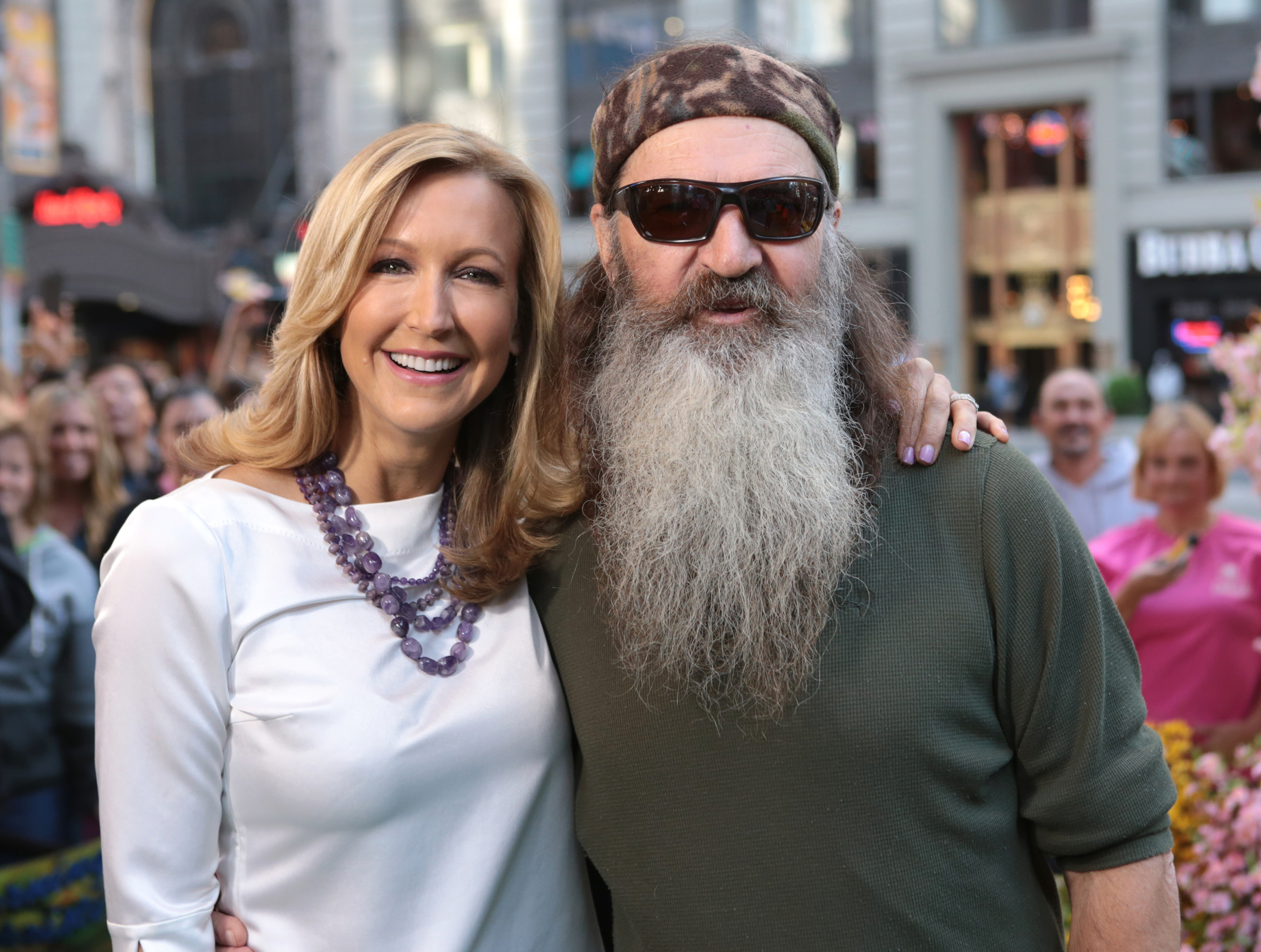
(Photo: Phil Robertson of ‘Duck Dynasty’ as a guest on ‘Good Morning America,’ 5/7/13, airing on the ABC Television Network. By Fred Lee/ABC via Getty Images.)

Is Legalization Driving Kids To Pot?

A new federal report (pdf) on adolescent drug use graphs the percentage of kids smoking marijuana over time:

Marijuana Use

The report (NYT) finds that more high schoolers smoked weed this year than last year and that fewer view it as harmful. And the numbers of teens drinking alcohol, smoking cigarettes, and using other drugs have fallen:

The report raises concerns that the relaxation of restrictions on marijuana, which can now be sold legally in 20 states and the District of Columbia, has been influencing use of the drug among teenagers. Health officials are concerned by the steady increase and point to what they say is a growing body of evidence that adolescent brains, which are still developing, are susceptible to subtle changes caused by marijuana.

Phillip Smith argues that the data don’t really support the headline:

There are short term ups and downs, but they seem to be of mainly rhetorical and polemical significance. If you look at the handy tables at the end of the report, you see that combined lifetime marijuana use for all three grades (8, 10, and 12), was at 30.7% last year, about the same as it was in 1995 (31.6%) or 2005 (30.8%). Much happens, but little changes. Ditto for annual use: 26.1% in 1995, 23.4% in 2005, 24.7% last year. Ditto for monthly use: 15.6% in 1995, 13.4% in 2005, 15.1% last year. Ditto for daily use: 2.7% in 1995, 2.9% in 2005, 3.6% last year. The daily use figures could be alarming (“Daily Teen Pot Smokers Up 25% Since 1995”), except the trend-line is not steadily upward, but varies from year to year (it was 3.7% in in 2001 and 2.7% in 2007).

NORML also pushes back against the media narrative:

Overlooked in the mainstream media’s reporting is that the use of both alcohol and tobacco among all grades surveyed has fallen consistently since the mid-1990s and now stands at all-time lows. (In fact, more teens now acknowledge using marijuana than cigarettes, the study found.) Teens are also finding alcohol to be less available and are far less likely to engage in binge drinking now than ever before. By contrast, teens self-reported annual use of cannabis has largely held steady since the late 1990s but remains elevated compared to the historic lows reported in the earlier that decade. (Present use levels, however, still remain well below the highs reported in the late 1970s.) Approximately 8 out of 10 12th graders surveyed said that marijuana was “fairly easy” or “very easy” to obtain, a percentage that has remained largely unchanged since 2009, but is well below previously reported highs circa the late 1990s. …

And what no public officials wish to acknowledge is the obvious elephant in the room. The reality that an increasing number of teens are steadily turning away from the legally regulated intoxicants alcohol and tobacco — a factoid that once again affirms that the most effective way to keep substances out of teens’ hands isn’t through criminal prohibition; it is through legalization, regulation, and public education. So why does the federal government (as well as the mainstream media) acknowledge the effectiveness of this strategy when it comes to booze and cigarettes, but continue to turn its back on these common sense principles when it comes to pot?

Sullum focuses on the oft-parroted trope that legalizing pot sends the “wrong message to children”:

Looking at annual, past-month, and “daily” use (meaning use on 20 or more of the previous 30 days) among eighth-, 10th-, and 12th-graders, you can see there were some slight increases and slight decreases, but none of the changes was statistically significant. “These findings should put to rest any claims that reforming marijuana laws and discussing the benefits will somehow contribute to more teens using marijuana,” says Mason Tvert, director of communications at the Marijuana Policy Project (MPP). “It’s time for prohibition supporters to stop hiding behind teens when debating marijuana policy.”

Pete Guither adds:

One third of 12th graders get their marijuana from someone else’s medical marijuana…. Um… think about it. Would you rather they had gotten it from a criminal dealer?

Apology Of The Day

Rob Ford: the gift that keeps on giving. Update from a reader in Toronto:

In the past two days, Rob has issued three apologies and danced to Bob Marley in the Council chambers. He indeed keeps on giving. His powers have been largely removed by Council, so he’s turned to performance. I think of him now as the civic mascot.

What If Fewer Young People Buy Insurance?

Sarah Kliff summarizes a new report from Kaiser:

If young adults (those under 35) were 25 percent less likely than the rest of the population to sign up for Obamacare, they would represent 33 percent of exchange enrollees — rather than 40 percent. This means there would be fewer young people to subsidize older insurance subscribers. To make up that difference, the experts estimated, insurers would need to increase premiums by a terrifying … 1 percent. Yes, exactly 1 percent.

Levitt, Claxton and Damico also tested a scenario where young adults are half as likely as older shoppers to enroll. In that case, the younger enrollees would make up only a quarter of the exchange market. Premiums would fall 2.5 percent short of covering subscribers.

And that kinda makes the whole death-spiral argument a bit of a red herring, no? Kilgore comments:

If these numbers are accurate, the widespread assumption (particularly among happy Republicans) that there’s nothing ahead for exchange enrollees beyond “sticker shock” forever could give way to the expectation that Obamacare will eventually be self-stabilizing, at least for most enrollees.

Not everything in the ACA was as incompetent as the website. Adrianna McIntyre identifies more reasons to stay calm:

For the market to unravel, you need fundamentally broken risk pools, not a bad year chalked up to a bad website. Considerable time and resources have been invested in the ACA (see also: the industry bending over backward to accommodate the administration’s mercurial deadlines).

And market power is at play here, too. The new exchanges represent a pretty substantial slice of the potential individual market consumer base; the more enrollees an insurer has, the more power it wields for negotiating prices with providers. Exiting the exchange is likely to be accompanied by a pretty substantial blow to that market power.

There’s one last crucial variable: we don’t actually know what level of risk the insurers baked into their premiums. Obviously they couldn’t anticipate website woes on the scale that we’ve observed in the last three months, but I find it hard to believe that they’d draw up projections that assume a perfectly balanced risk pool from the start. Call me crazy, but something makes me think that actuaries are better at hedging than the blogosphere.

Telling The NSA What’s Good For It

An advisory committee report (NYT) released yesterday encourages Obama to reform the NSA. Amy Davidson provides an overview:

The thirty-page executive summary might be further condensed to a few sentences: Don’t do things just because you can. Tell people what the rules are. Remember that “security” doesn’t just mean chasing terrorists—it “refers to a quite different and equally fundamental value,” spelled out in the Fourth Amendment: “The right of people to be secure in their persons, houses, papers, and effects, against unreasonable searches and seizures.” Stop shutting down debate by muttering about a “balance” that needs to be struck between security and freedom—they are not on opposite sides of the scale. Start thinking about privacy.

Eli Lake highlights key recommendations. Such as:

The review group recommends more stringent standards for protecting the privacy of foreign nationals. For example, it says U.S. monitoring communications of foreigners should not be based on their political or religious beliefs; should not be used to gain trade secrets; and must be “directed exclusively at protecting national security interests of the United States or our allies.” In addition the review group’s recommendations say the U.S. government should apply the Privacy Act of 1974 to foreign nationals as well as U.S. citizens. The nearly 40-year old law requires U.S. government agencies to protect personal information from U.S. citizens and not share it within the government.

Ambers points out other important bits. Third on his list:

The controlling metaphor for privacy should not involve balance; it should involve risk. One hears the voice of panel member Cass Sunstein in the following sentence: “Before they are undertaken surveillance decisions should depend (to the extent feasible) on a careful assessment of the anticipated consequences, including the full range of relevant risks. Such decisions should also be subject to continuing scrutiny, including retrospective analysis, to ensure that any errors are collected.”

Benjamin Wittes calls this “a really awkward document for the Obama administration”:

The President, after all, has stood by the necessity of the Section 215 program and objected to legislative proposals to curtail it. Then the White House handpicks a special review group, and it kind of pulls the rug out from under the administration’s position. The review group concludes “that the information contributed to terrorist investigations by the use of section 215 telephony meta-data was not essential to preventing attacks and could readily have been obtained in a timely manner using conventional section 215 orders.” It also reflects skepticism that the program functions as a kind of insurance policy, “alleviating concern about possible terrorist connections…” Ouch.

Allahpundit speculates about Obama using the report to change course:

There’s no way, really, for him to suddenly change his mind and claim that he’s spontaneously reconsidered everything he said before in defense of the program. But if his handpicked panel floats a few ideas for him, he can portray himself as the can-do executive who took the problem seriously enough to closely investigate it and then listened to his experts when they urged him to change course in a few ways. He conducted a fact-finding mission, by delegation, and now his opinion has changed in a few particulars. What a champ.

Drum bets that few of these recommendations will make it through the political process:

How much of this will survive the president and Congress? I’d like to say I’m optimistic, but I’m not, really. These recommendations are useful but modest, and I suspect that Congress will whittle them down even more.

Crowley zooms out:

It remains to be seen which of the panel’s recommendations President Obama might adopt — and how much change a Congress where the NSA has powerful allies will enact. But if the NSA’s wings are clipped, it will be another step in America’s steady march away from its post-2001 wartime footing, one that has accelerated dramatically, if quietly, in Obama’s second term.

Finally, Conor uses the report to defend Snowden:

If a government employee or contractor leaks classified information to the press, and the result is a judicial finding that the government has violated the Fourth Amendment, multiple pieces of bipartisan reform legislation circulating Congress, and a review for the president that suggests reforms to multiple secret programs, what do you call the leak? I call it whistleblowing.

Chart Of The Day

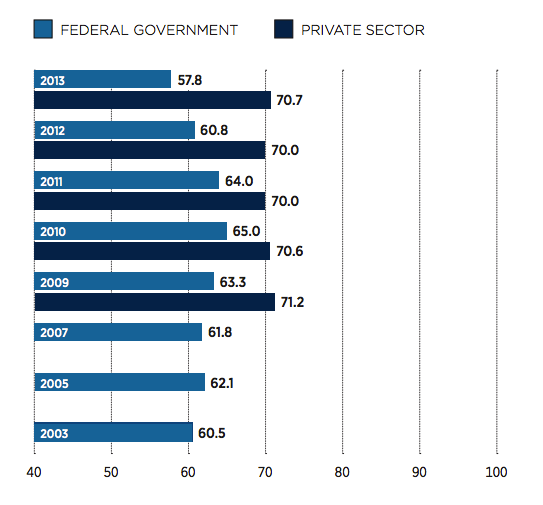
The percent of federal and private sector workers who are satisfied with their jobs:

Government Employees

Among the reasons federal employees increasingly dislike their work:

In particular, government employees hate their bosses. On average, people reported a 51.8 percent satisfaction level with their senior leaders, and this agency-by-agency breakdown indicates that there’s some pretty harsh boss-hate in certain government offices (my heart goes out to you, Financial Crimes Enforcement Network leaders: a 22.5 percent approval rating has got to hurt).

Orszag worries about this finding:

One reason federal workers are frustrated with their senior leadership is that the government isn’t doing much of substance. People are attracted to public service in no small part because they believe government can be a force for good; when the government does little, that belief is harder to sustain. Similarly, political polarization and a general decline in public expectations for government make it harder to attract talented people to lead the bureaucracy.

Cheating Death Taxes

Zachary R. Mider shines a spotlight on the GRAT, “one of a handful of common devices that together make the estate tax system essentially voluntary”:

Hundreds of executives have used the technique, SEC filings show. These tax shelters may have cost the federal government more than $100 billion since 2000, says Richard Covey, the lawyer who pioneered the maneuver. That’s equivalent to about one-third of all estate and gift taxes the US has collected since then. The popularity of the shelter, known as the Walton grantor retained annuity trust, or GRAT, shows how easy it is for the wealthy to bypass estate and gift taxes. Even Covey says the practice, which involves rapidly churning assets into and out of trusts, makes a mockery of the tax code. “You can certainly say we can’t let this keep going if we’re going to have a sound system,” he says with a shrug.

Sheldon Adelson, one of the many tax dodgers cited by Mider, has saved $2.8 billion using the GRAT. The Bloomberg editorial board is not pleased:

In its current form, the estate tax requires the rich to pay a 40 percent levy on wealth they leave to their heirs, after an exemption of $5.25 million (rising to $5.34 million in 2014). That’s the theory, anyway. In practice, for the wealthiest families, the estate tax is largely optional. … The Tax Policy Center estimates that only 3,780 households (0.14 percent of all estates) will owe any estate taxes this year. Their average payment will be $3.8 million on estates worth $22.7 million – an effective rate of 16.6 percent.

Keep in mind, too, that most wealth escapes tax as it accumulates. Appreciation of property, securities and art isn’t subject to capital-gains tax until the assets are sold. When they are passed along, much of this unrealized profit remains untaxed, thanks to the optional estate tax. The oft-repeated charge that estate taxes amount to double taxation is doubly wrong. Congress ought to close the GRAT and other loopholes.

And it might note that the voluntary estate tax exemplifies a wider issue: The U.S. tax code is insanely complicated. This favors the rich because, unlike ordinary taxpayers, they can afford to find loopholes amid the complexity. Simpler tax systems are fairer – and they distort decisions less.