Bodies Of Work

Lauren Rosewarne reflects on Christian Bale’s latest transformation – gaining 43 pounds for his role in American Hustle:

Bale’s fattening prompted the same question one might ask of Robert De Niro’s weight gain in Raging Bull (1980), Toni Colette’s in Muriel’s Wedding (1994), Renée Zellweger’s in Bridget Jones’s Diary (2001), Charlize Theron’s in Monster (2003), Jared Leto’s in Chapter 27 (2007) and Chris Pratt’s in Delivery Man (2013): Why? Couldn’t producers find plumper actors?

The obvious answer is that big budget films only get green-lit if big names are attached. The biggest names are invariably the thinnest. Yadda yadda, insert doughnut consumption. There are, of course, other explanations worth pondering. … In a world where fatsuits – as witnessed in the deplorable Shallow Hal (2001) – or special effects could offer weight gain far quicker than a junk-tastic diet, going the distance and actually fattening-up apparently separates the artistes from the poseurs. And time and time again, such gimmicky madness gets validated. Theron took home an Oscar for her fattening; Collette snared an AFI. Cinemas inevitably get filled because audiences have an unquenchable curiosity for make-overs and bodily transformation.

Update from a rant-filled reader:

“Theron took home an Oscar for her fattening; Collette snared an AFI.” Um. What?  Has Ms. Rosewarne SEEN Monster?

Charlize Theron didn’t take home an Oscar for her fattening, for fuck’s sake!  She took it home by portraying one of the most despicable, loathsome and vicious women ever born – in a tragic, human and sympathetic way, all while distinctly not looking like Charlize Theron! In fact, I constantly had to remind myself, while watching the film, that it even WAS Charlize Theron in there somewhere. Is the author seriously suggesting that the Academy voters watched this grueling, emotionally punishing, heartbreaking film and said, “Well. I was going to vote for Naomi Watts, but LORD did Theron pack on those pounds! I’m voting for the fat!”

And wasn’t Muriel’s Wedding Toni Colette’s first feature film EVER?  I’d never heard of her before that delightful little film, and the LAST thing I thought after thoroughly enjoying it was, “God I hope that Toni Colette, whom I’ve never seen before, can drop all those pounds I didn’t know she put on!”  Ugh.

I’m not discounting or belittling the massive Method madness inherent in these transformations – quite the opposite; these are actors so committed to Craft and Character that they are willing to put themselves through hell in order to wear their own bodies like alien costumes. (I am, however, put in mind of Sir Laurence Olivier’s advice to Dustin Hoffman on the set of Marathon Man, when the latter was complaining about his Method-inspired sleep deprivation and exhaustion: “My dear boy, why don’t you try acting?”) But it seems to me that if you have the time, the medical advice and the cash necessary to treat your body like an inflatable/deflatable costume, why wouldn’t you do absolutely everything you could to become the thing you portray?
Why Do So Many Go Hungry?

Pope Francis recently commented on world hunger:

With all the food that is left over and thrown away we could feed so many. If we were able to stop wasting and start recycling food, world hunger would diminish greatly.

Pascal-Emmanuel Gobry argues with the Pope about the causes of hunger:

Here’s the thing: the reason why so many go hungry is not that people in the West throw away food. That’s just not the reason. The reason is not free market capitalism. The reason isn’t even socialism (or only marginally, these days). The main reason—and I’m pretty sure this is something all serious observers of this question would agree with—is quite simply corruption. Everyday corruption of functionaries. Corruption in the broader sense of war. Corruption. …

[I]f there is any institution in the world that should put this issue front and center, it’s the Catholic Church. First because, as I’ve said, it’s already well within the bounds of Tradition and flows naturally from the Gospel. Second, because it has a unique legitimacy and presence in doing so. Who else has both the moral language and the on-the-ground presence in so many of these countries to be able to denounce corruption forcefully and effectively? The World Bank? The UN? How much great would be done if, every day, every bishop in sub-Saharan Africa and India and other places saw his number one pastoral priority as denouncing and combatting corruption by government officials, instead of (I’m sorry) bloviating platitudes about wasting food? Isn’t this something the Vicar of Christ should exhort the other bishops to do?

The Law School Bubble Bursts

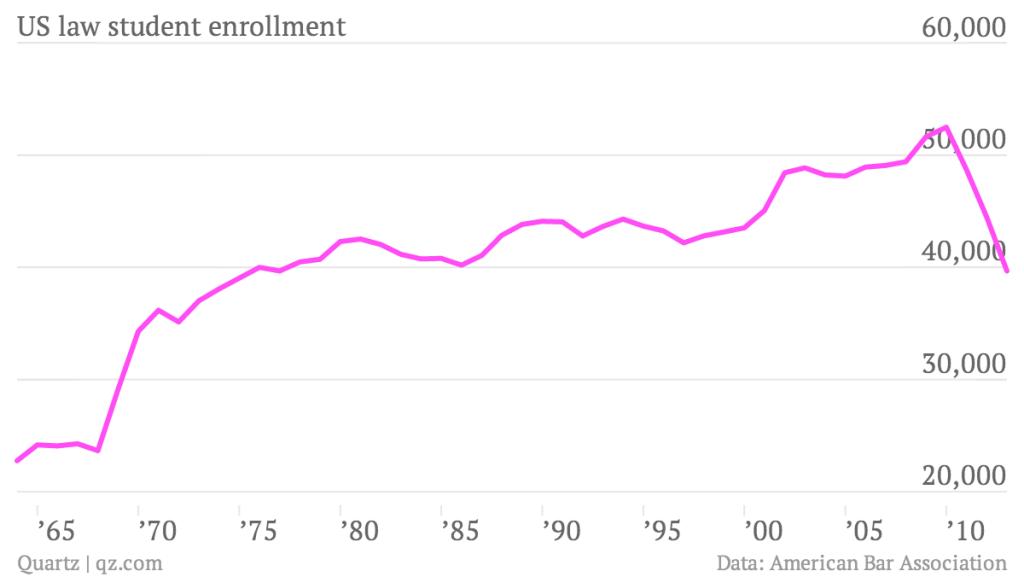
LawSchoolEnrollment

Matt Phillips remarks on the sharp decline in law school enrollment over the past two years:

Fresh numbers from the American Bar Association show US law school enrollment tumbling 11% over last year to 39,675. That’s the number of full-time and part-time students who started law school studies in the fall of 2013. Overall, enrollment is down 24% from the 2010 peak. The Wall Street Journal’s Law Blog points out that we’re back to 1977 enrollment levels, an era that predated the surging growth of lawyers during the 1980s.

Campos chimes in:

What’s particularly striking about these numbers is that first year enrollment is down by 24.4% even though admissions standards have been slashed all across legal academia (Yale, Harvard and Stanford are the only elite schools that haven’t dropped admissions standards, and many non-elite schools have cut median LSAT scores for admits by ten percentage points or more). … [I]f law schools had maintained the admissions standards that prevailed a decade ago, next fall’s incoming class would feature about 24,600 matriculants, which is a number about 13% larger than the average annual total of jobs for lawyers that the Bureau of Labor Statistics estimates will become available over the course of this decade.

The Crimes Of The Financial Crisis

Jed S. Rakoff, a US District Court judge for the Southern District of New York, contemplates why no high-level executives have gone to jail. The factor that he thinks is “arguably the most important”:

It is the shift that has occurred, over the past thirty years or more, from focusing on prosecuting high-level individuals to focusing on prosecuting companies and other institutions. It is true that prosecutors have brought criminal charges against companies for well over a hundred years, but until relatively recently, such prosecutions were the exception, and prosecutions of companies without simultaneous prosecutions of their managerial agents were even rarer.

The reasons were obvious. Companies do not commit crimes; only their agents do. And while a company might get the benefit of some such crimes, prosecuting the company would inevitably punish, directly or indirectly, the many employees and shareholders who were totally innocent. Moreover, under the law of most US jurisdictions, a company cannot be criminally liable unless at least one managerial agent has committed the crime in question; so why not prosecute the agent who actually committed the crime?

In recent decades, however, prosecutors have been increasingly attracted to prosecuting companies, often even without indicting a single person. This shift has often been rationalized as part of an attempt to transform “corporate cultures,” so as to prevent future such crimes; and as a result, government policy has taken the form of “deferred prosecution agreements” or even “nonprosecution agreements,” in which the company, under threat of criminal prosecution, agrees to take various prophylactic measures to prevent future wrongdoing. Such agreements have become, in the words of Lanny Breuer, the former head of the Department of Justice’s Criminal Division, “a mainstay of white-collar criminal law enforcement,” with the department entering into 233 such agreements over the last decade. But in practice, I suggest, this approach has led to some lax and dubious behavior on the part of prosecutors, with deleterious results.

A Trip Through The Cold War

In an excerpt from Drugged: The Science And Culture Behind Psychotropic Drugs, Richard J. Miller details one of the CIA’s more outlandish schemes:

The CIA not only performed experiments on individuals but also came up with schemes for contaminating the water supply of potential enemies with LSD so as to incapacitate entire hostile populations. For this they would need large amounts of the drug, at one point ordering the equivalent of 100 million doses from Sandoz. When they found out that obtaining such a large amount as this might be somewhat problematic they turned to Eli Lilly and Company, whose capable chemists broke the secret Sandoz patent and assured the CIA that they could produce LSD in tons or similar amounts.

Thankfully for the future of humanity, this eventuality never came to pass. In the end the CIA concluded that the effects of hallucinogenic drugs like LSD were just too unpredictable for general use in the Cold War, and should just be reserved for very specific circumstances.

Nevertheless, in the atmosphere of general paranoia that pervaded the postwar era, the CIA maintained an important role in manipulating the developing drug culture. CIA operatives acted as drug suppliers if they were interested in observing drug effects under particular circumstances, and infiltrated different drug-using groups with political points of view deemed to be of “interest” so as to relay information back to Washington.

Confounded By Consciousness

Stefany Anne Golberg explores the philosophy of Miguel de Unamuno, a man who lived “in a state of existential crisis, hovering over the abyss”:

“I am,” wrote Unamuno 100 years ago. But who am I? All we have is our individuality, wrote Unamuno — if we are something else we are nothing. “They tell me I am here to dish_Unamuno1925 realize I know not what social end; but I feel that I, like each one of my fellows, am here to realize myself, to live.” All I have is myself, wrote Unamuno, and still he tried to run away. Consciousness, he learned, was not all it was cracked up to be. Consciousness, which has shown us many interesting truths about existence, has brought even more confusion. The more systems of thought we develop — the more equations we prove — the more contradictions we are handed. The more we learn about life on Earth, the more mysterious the universe becomes. When we back away from this confusion, we become hypocrites, wrote Unamuno. Yet, when we confront the chaos, we suffer. Consciousness is our gift and our enemy. “Consciousness,” wrote Unamuno, “is a disease.” This thing called consciousness, we learn, is simply awareness of one’s own limitations. In other words, it is consciousness of death. And this is the tragic sense of life.

(Photo of Unamuno in 1925 via Wikimedia Commons)

Getting Over “Guilty Pleasures”

Tracing the term’s history, Jennifer Szalai finds that it “exudes a false note, a mix of self-consciousness and self-congratulation”:

When “guilty pleasure” first appeared in the New York Times, in 1860, it was used to describe a brothel. The term appeared only a handful of times in the paper of record until the late nineteen-nineties, when it started coming up in its contemporary incarnation again and again, at the tail end of the culture wars. (According to the online Times archives, “guilty pleasure” shows up approximately a twelve hundred and sixty times—twelve hundred and forty-seven of those since 1996.) In some ways, the timing seems strange; the guilty pleasure was becoming a part of the cultural vocabulary right around the time cultural distinctions were ceasing to matter. But maybe it was precisely because those distinctions were becoming moot that people felt emboldened to use it. The guilty pleasure could then function as a signalling mechanism, an indicator that one takes pleasure in something but knows (the knowingness is key) that one really shouldn’t. Once distinctions were blurred, you could announce a love for pop culture that, in an earlier era, you would have been too ashamed to admit.

Her conclusion:

The guilty pleasure is a vestige of America’s disappearing middlebrow culture, of that anxious mediation between high and low, which at its best generated a desire to learn, to value cultural literacy and to accept some of the challenges it requires. General magazines once flourished because of it; even Ladies’ Home Journal, better known now as a chipper dispenser of service journalism and horoscopes, used to publish the likes of Edith Wharton and W. H. Auden. But the guilty pleasure seems to me the distillation of all the worst qualities of the middlebrow—the condescension of the highbrow without the expenditure of effort, along with mass culture’s pleasure-seeking without the unequivocal enjoyment.

If you want to listen to Rihanna while reading the latest from Dean Koontz, just go ahead and do it. Don’t try to suggest you know better. Forget the pretense and get over yourself. You have nothing to lose but your guilt.

In Religious Leaders We Don’t Trust

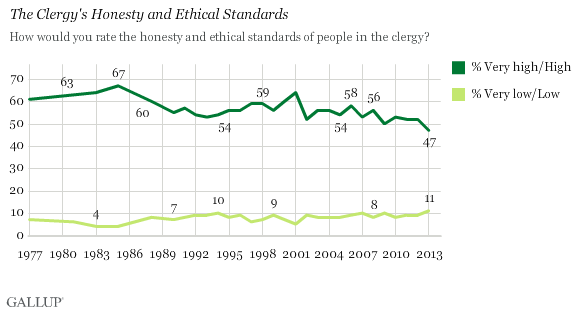
Our opinion of the clergy is declining:

Clergy Honesty

Kate Tracy unpacks the numbers:

Americans are divided along party lines, as well as age. Gallup found more trust in clergy among Republicans (63%) than Democrats (40%). Similarly, clergy members appear more trustworthy to older Americans than millennials: half of Americans older than age 55 trust clergy members, while only 32 percent of millennials (18 to 34 years) report the same.

Erik Voeten parses the poll:

[T]he authority of clergy is intrinsically linked to how much we trust them. This is especially problematic for religions like Catholicism that rely strongly on the authoritativeness of clergy. That is why clergy in these religions invest so heavily in symbols that are difficult to imitate, such as celibacy. Celibacy tends to deter imposters.  It is also why the Catholic Church is rightly worried about the consequences of declining trust.

My own view is that this is the crisis Francis has rightly judged to be a mortal threat to the church’s reach and message. So he has attempted to portray a pastoral dimension in his own actions as bishop of Rome that recasts moral authority not as something imparted by tradition or office or vestments or privilege. His very way of life is the only moral authority he wants to claim.

The Cult Of Cola

Paula Marantz Cohen labels the Coca-Cola franchise “a religion of Americana”:

Not an American religion, but a religion devoted to the idea of America — which is to say, to those Norman Rockwell scenes of homecoming, fly fishing, and presents under the tree.

Disney might be compared with Coke in having something of the same religious aspirations, but Disney has a more complicated apparatus — movies and theme parks (a visit to one of which is liable to bankrupt a family of four), not to mention the dubious figure of its founder, Walt Disney, a misanthropic anti-Semite (OK, Coke’s Colonel Pemberton was a drug-addicted Confederate soldier, but never mind). To worship at the altar of Coke, you just have to like the drink and put out the paltry sum required to buy it — which, even if it may produce rotten teeth, diabetes, and obesity, isn’t creating centuries of civil war and ethnic cleansing. It tastes good and it’s refreshing, especially after you’ve spent the afternoon trying to assemble an IKEA cabinet or five hours in heavy traffic to eat overcooked turkey at your Aunt Leona’s. …

Part of what makes Coke’s triumphal history go down so easily is that no one around today was alive before the beverage existed. Coke is “real,” as the promotional slogans remind us, because, artificial sweeteners, colorings, and preservatives aside, it has endured in more or less the same form for as long as anyone can remember. It is moving to see those old, round-cornered Coca Cola machines and those small, green-tinted glass bottles. The red on white Coca Cola script is a kind of Madeleine experience for childhood. Even if you never experienced anything like the America of Norman Rockwell (who did many of the Saturday Evening Post advertisements for Coca Cola during the 1940s and 50s) there’s something about that Coca Cola script that makes you think you did. I suspect individuals around the world feel this, even if they hate everything else that America stands for.