PTSD Isn’t Limited To Our Troops

PTSD Contractors

Mark Thompson summarizes a RAND study (pdf) on how PTSD and depression have afflicted military contractors:

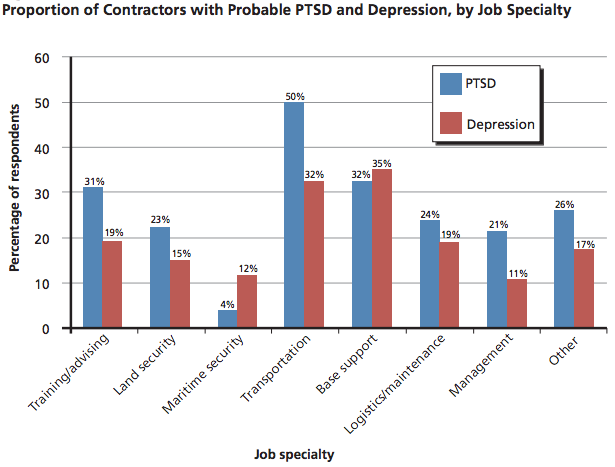
“The proportion of contractors who met criteria for PTSD or screened positive for depression was notably higher than that among military populations,” the Rand study concludes. One in four contractors surveyed probably had PTSD, the report says, but that rate doubled — to a sky-high 50% — for those operating convoys, “most likely due to greater combat exposure,” including ambushes and roadside bombs. Eighteen percent screened positive for depression and half reported abusing alcohol. Rand researchers conducted an anonymous online survey of 660 workers, nearly two-thirds of them American, who deployed at least once between 2011 and 2013. It marks the first survey of such contractors. …

Contract personnel can be a bargain: unlike troops, they generally are not entitled to government-funded help for any mental ailments that may have been triggered, or aggravated, by their civilian service. “There is a significant unmet need for health care, with only 28% of those with probable PTSD and 34% of those with probable depression receiving mental health treatment in the 12 months prior to the survey,” the report says.

Happiness Insurance

Charles Kenny points to research showing that, while having health insurance doesn’t always lead to better health outcomes, it does seem to make people happier:

The study suggested, unsurprisingly, that in places where out-of-pocket expenditures constitute a large portion of total health cost—compared to insurance and government financing—more households are burdened by high medical bills. In Brazil and Vietnam, out-of-pocket expenditures account for the considerable majority of total health spending, compared to about one-fifth of spending in the U.S. and less than 10 percent in the U.K. or Germany.

So perhaps it isn’t a surprise that expanding access to health insurance leads to fewer “catastrophic” expenditures—and greater happiness. In Thailand in the year 2000, 31 percent of households in which a member had required inpatient care faced health bills of more than 10 percent of the household’s total yearly consumption. The passage of a universal health insurance policy in 2001 reduced that proportion by half, to 15 percent.  And Patrick Asuming at Columbia University, who studied (PDF) a health insurance scheme in Ghana that covered hospital and clinic visits alongside approved medications, found that offering a random group of recipients subsidies for insurance led to more people getting insurance, better self-reported health (including fewer days feeling ill), and greater levels of contentment. Having such insurance increased the chance that recipients reported themselves happy or very happy by 22 percent.

Our Octopi In The Sky

Katherine Harmon Courage, author of Octopus! The Most Mysterious Creature In the Sea, suggests that the “new impressively oblivious (or riotously self-mocking) [National Reconnaissance Office] logo that adorned a rocket carrying U.S. spy satellites is actually not a bad choice, as metaphors go.” She elaborates on the “sinister-looking octopus perched atop Earth”:

[I]f one were to pick a mascot to represent such a broad-reaching project, the octopus is an excellent choice. For one, the octopus is one of the slinkiest, crafty creatures out there (and not in the macramé sense). As an invertebrate, an octopus can squeeze an arm—or even its whole body—into some impossibly small and unlikely spaces. … Unlike our arms, which are locked into hard joints and confined by bones, the octopus’s arms are muscular hydtrostats—the same material as our tongues. This means they can stretch and deform and squeeze while maintaining an overall volume. Need to quietly sneak out of a tank through the water outflow? No problem. Want to reach an arm into a tiny crack to get some food. Already done. Asked to crawl into your internet provider’s datacenter? Theoretically a snap.

These animals are also perhaps the stealthiest creatures, able to vanish into nearly any natural setting.

This camouflaging ability, which can involve changing color, texture and luminosity in a matter of milliseconds, has frustrated researchers and predators and often proves deadly for the octopus’s desired lunch. But it would make them awfully good spies. If they lived on land, one could be sitting on your floor right now and you wouldn’t even know it. In fact, the U.S. military is already funding research to try to decode this camo—and replicate it for our purposes with nanotechnology.

Josh Lowensohn touches on a history of octopus iconography:

It’s not the first time the US has used an octopus to get the point across, though it comes as the country is under close scrutiny — especially by technology companies — for its privacy policy. The US used imagery of an octopus wrapping tentacles around the world as part of propaganda during the cold war, depicting Joseph Stalin as a giant red octopus, stretching from country to country. The imagery has also been used to vilify imperialism, especially of England in the late 1800s.

Previous Dish on the wonders of the octopus here, here, here, and here.

What Insurance Won’t Pay For

Aaron Carroll argues that, “as evidence amasses that lifestyle interventions are as beneficial as medical ones, it may be time to rethink how [the healthcare] system works”:

Every time a doctor writes a prescription, he or she probably earns some money. The pharmacy that dispenses the meds makes some money. And, of course, the pharmaceutical company that makes the medications makes money, too. The health care system understands and even encourages this practice. Insurance pays for it without issue.

But the same health care system is not at all equipped to deal with lifestyle change. No one makes any money if you’re more active. No one would ever think to write a prescription for a gym membership, which could easily cost less than some medications, with the same potential outcomes.

What Sort Of Art Sells The Most?

Below are some tips gleaned from auctioneer Philip Hook’s new book, Breakfast at Sotheby’s:

Historical and biblical paintings are difficult to sell. They often involve death and many show a Screen Shot 2013-12-13 at 4.27.28 PMcrucifixion; people shy away from scenes of martyrdom. An exception is St Sebastian, killed nakedby arrow-shot, which offers a certain homoerotic appeal. (A German gallery once tried to exploit this by selling St Sebastian pincushions in its museum shop.) …

Grand drawing rooms are a draw, as are bathrooms by Pierre Bonnard and hotel rooms by Henri Matisse (particularly if they are in Nice). Deserted Danish rooms with a single chair are hugely desirable; interiors of churches are not.

Railways are good news in paintings. People like trains. As symbols “of a mechanical progress that is now part of history,” they are both exciting and nostalgic. The impressionists were particularly keen on them; the faster the journey, the more blurry the landscape. And if railways are good, railway stations are even better. No artist beats Paul Delvaux for juxtaposing female nudes and rolling stock.

(Photo: Saint Sebastian With Wounded Chest, 1906, by Fred Holland Day)

Tense Times In Turkey

Christopher de Bellaigue provides a pessimistic update on the country since the Gezi Park protests that made headlines last summer:

A vindictive authoritarianism is taking hold of Turkey. To the prime minister’s supporters this is regrettable but necessary; many I have spoken to think that the protest at Gezi Square was organized by foreign agitators, and that the protesters should have been crushed more harshly than they were. In a democracy, these people believe, the will of the majority is determined at the ballot box and then carried out. This, they say, is what had been happening quite successfully until the liberals, realizing they were too few to win an election, turned to seditious activities instead. The idea that the beliefs of liberal minorities should be legally protected and might actually have an influence on policymaking has not been accepted by the government, which claims to speak for the majority. …

Erdoğan has encouraged a species of conservatism that is now the dominant mode of life throughout Turkey. The culture is pietistic, implicitly anti-Alevi, and materialistic. This last factor is new, for until quite recently virtue was associated with austerity and self-reliance; now the faithful demand rewards in this world in the form of high-performance cars, iPads, and so forth—acquired using the family credit card.

But Claire Sadar sees Erdoğan’s iron fist slipping:

The AKP has been making some insane policy threats lately.  These statements have (justifiably) caused an uproar from many Turks and Turkey watchers.  However, I think we all need to take a step back and consider the possibility, or probability, that despite their current vice-like grip on Turkish politics, the neither Erdoğan nor the AKP in general have the power or mandate to carry through with many of these proposed “reforms.”  It is too early to predict the long-term consequences, but Erdoğan’s antics seem to be backfiring and causing even some former supporters to question his leadership.

The first piece of good news is that Erdoğan is not going to get his wish to become the first American-style President of Turkey anytime soon.  The commission tasked with reforming the current constitution, which was created by the generals in the wake of 1980 military coup, has fallen apart.  The AKP had already agreed in August not to push for a presidential system to be included in the new constitution.  Turkey still desperately needs a more liberal constitution but the AKP does not seem to be ready to make the concessions needed to make this happen.

Previous Dish on the situation in Turkey here, here, here and here.

A Minimal Minimum-Wage Hike, Ctd

Several readers are piling on this one:

Not that I ever had second thoughts about resubscribing to the Dish next month, but if there was ever a question, your first reader’s response reconfirmed why your endeavor is important not only for journalism, but also just for human decency – because you treat your interns like humans, and not simply economic units. I was particularly dismayed when the guy wrote:

I personally know at least a dozen seniors in high school and freshmen in college who would jump at the opportunity to work with me for nothing, let alone $3 per hour or $5 per hour. All of the ancillary skills and benefits would far outweigh any wage they may earn. Yet, the minimum wage laws prevent this from happening.

The only thing preventing this clown from hiring these students and paying them a livable wage is his own greed. Maybe there is room for a student minimum wage that’s lower, to allow for greater experience-gaining. But the sad reality of today’s economy is that there are also many people who are working in these low-wage jobs as a daily reality of their lives.

Another:

One of the striking features of this businessman’s argument is his lack of economic perspective. From his view as an owner, any dollars spent on labor are simply flushed down a gigantic economic toilet. Yet, while economists argue about whether the minimum wage increases or decreases overall levels of employment, there is near-universal agreement that raising the minimum wage increases the size of the whole economic pie (i.e., the overall GDP). His analysis shows a lack of awareness that the increased wages to workers are either invested or spent on taxes, goods, and services – which ultimately allows other companies to hire workers. He seems totally unaware that creating a regulatory environment that promotes hiring people into jobs that are so unproductive that they cannot produce $8 per hour in economic value is not a path to national prosperity. He sees the economy through some narcissistic lens of “receivables good, payables bad,” without realizing that everyone’s accounts receivables are someone else’s accounts payables and vice versa. The economy is not a business.

Meanwhile, the businessman takes issue with his earlier critics:

Your readers continue to show tremendous economic illiteracy. Let’s examine the first response you posted:

[I]f he could pay two teens $5/hour or three teens $3/hour, why can’t he afford to pay one teen $7.50/hour – or even the $15/hour implied by three teens at $5/hour? Since he won’t suffer with three, two, one or no hires, as he says, the minimum wage should make no difference. So why the discrepancy? Well, that would probably be because he’s completely full of crap.

This is a simple problem that my 10-year-old can solve. I’ll kindly illustrate:

Three teens – Bob, Steve, and Mike – are looking for work. They have few-to-no skills but are desperate to learn. Each can add additional profit to the bottom line of my business. Bob’s skills can generate additional profit of $2 per hour. Steve’s skills can generate additional profit of $5 per hour. Mike’s skills can generate additional profit of $7 per hour. At what wage would I, as an economically literate business owner, hire each of them individually?

If you’re the above Dish reader, you’d say $7.50 or even $15 per hour. And you’d be quickly out of business.

The correct answer is that I’d hire Bob for any wage under $2, Steve for any wage under $5, and Mike for any wage under $7. If there were no minimum wage law, I as a successful business owner would gladly hire all three at these wages. All three would be employed and begin to learn some valuable skills. But there is a minimum wage law. And the law says I must pay a minimum wage of $7.25. At $7.25 per hour, it is no longer profitable to hire Bob, Steve or Mike.

Instead, I hire Mary. Mary is a skilled assistant with years of experience in the financial services industry. She knows the business and can add value on day one. She can add incremental profit to my business of $20 per hour and will accept a wage of $15 per hour. The $15 per hour she demands is above the minimum wage, so it is legal for me to hire her. In addition, it is below the $20 additional profit she will bring to my firm, so hiring her is also profitable.

Only a total idiot would hire any of the teens at $15 per hour. And to answer your reader: no, I am not completely full of crap. I simply understand Economics 101.

As for your second reader: he is simply trying to kiss up to Andrew by trying to add to the “epistemic closure” files. What could one man know compared to professional economists with centuries of combined training who have spent decades studying this question? I’ll gladly answer. This one man knows and understands business. He is simply proving false the argument that the minimum wage does not kill jobs.

The above example is a real-world example that exists in my business today, although I’ve simplified the numbers. And that is the real-world effect of minimum wage. It protects the skilled worker at the expense of unskilled workers.

As surely as the sun rises, so does the minimum wage kill jobs. That is why the teen unemployment rate is so high. That is why unskilled minorities have such a high unemployment rate. That is why jobs are shipped overseas. I don’t care how many decades and how many centuries of experience professional economists have. They are simply playing upon the economic illiteracy of the majority of the population.

Another reader:

Your very successful financial advisor may need to go back to school. The US Dept. of Labor carves out teen workers from the usual requirements for the minimum wage:

A minimum wage of not less than $4.25 may be paid to employees under the age of 20 for their first 90 consecutive calendar days of employment with any employer as long as their work does not displace other workers. After 90 consecutive days of employment, or when the worker reaches age 20 (whichever comes first), the worker must receive at least the federal minimum wage.

In addition to being a very successful cheapskate, he/she hasn’t bothered to spend 30 seconds investigating the minimum wage laws.

Another looks abroad for more perspective on the issue:

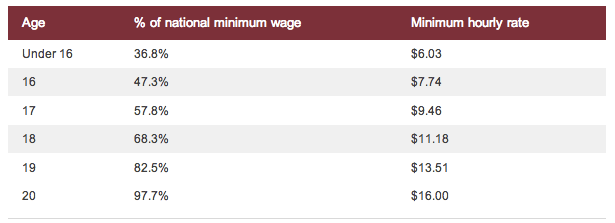
Perhaps the financial planner who won’t hire teenagers at a higher minimum wage, and those who endorse an increase in the minimum wage, could be satisfied by a system like Australia’s. That country’s minimum wage for those over 21 is $16.37 AUD per hour, but it drops by a percentage year by year for people younger than 21 until those under 16 receive 36.8 percent of the minimum wage for adults. Here’s a chart showing the breakdown:
Screen Shot 2013-12-16 at 4.52.16 PM

Another asks:

My challenge to the minimum-wage boosters is: what is the optimum minimum wage level? Why not raise it to $20/hour? Or $50/hour?

Let’s understand the historical basis for minimum-wage laws. They were meant to protect unionized labor from competition. Unions want to suppress wage competition from the underemployed, who would gladly bid wages lower in competition to win employment. No sane economist denies this or that minimum wage laws decrease the quantity of labor-hours paid for by employers, ceteris paribus. The rational arguments in favor of the minimum wage are based on static, wealth-redistribution analysis that show that the share of total income earned by the lowest quartile of wage earners will increase. In other words, the gains in earnings by those that keep their jobs exceeds the losses in earnings by those who lose their jobs.

So the optimum minimum wage according to a rational minimum-wage supporter would be one that redistributes the most to the lowest cohort of the income scale. However, from a dynamic perspective, the effect on long-term economic growth by minimum wages could actually harm the long-term well-being of these workers if job creation is stifled, as it surely will be.
The Best Of The Dish Today

I come to you from the bowels of Deep Dish, where I’m finishing my first ever long-form essay (it’s on Pope Francis and is imminent).

I have to say it’s a strange feeling. I’ve never been on a deadline for a long-form piece that wasn’t someone else’s deadline – with Tina on the phone, or James worried about the latest draft or Adam, coming up with a cover-line. You feel unprecedented freedom – there was a point at which this ghastly stomach flu I’ve been shitting through could have prompted me, the editor, to move the pub date, for me, the writer. “See? I can do that now!” But then there’s professionalism. So, no, I didn’t. I plowed on. As long as I restricted my life to shitting, writing, sleeping, a bowl of soup, shitting, writing and sleeping, then it was doable. There’s still the agony of the first edit and the fact-check and the copy-edit – but when they’re all done by your own colleagues, and you’re really grateful for them, it feels different somehow. Not so much an imposition as a mitzvah.

And when all you have to do to publish is press “publish”, and no printed version of the piece will ever arrive in anyone’s mailbox, it also feels different. Not blogging exactly – it’s a much more considered and lengthy (10,000 words) piece for that. But not quite an article for, say, TNR or the Atlantic or Newsweek, either. I don’t have to punch every card on the “magazine profile” page; I don’t have to make it accessible for millions; I just have to make it as good a piece as I can for the 33,000 of you who are subscribers. And that’s a real difference as well. It feels like I know you; and that you’ve been reading the Dish this year on the new Pope. I can write for the same audience I write for every day, and yet on a larger canvas. It feels like the continuation of a conversation. Which is to say it’s been a great way to wind up this first year at the Dish: an old thing become new again.

Today, we covered the success of the Pentagon in securing a huge budget coup with spending still at the Bush-Cheney mid-2000s level. Eisenhower wept.

The American poor now get tropical diseases; the UN continues to back Prohibition; Atlanta’s commutes make people fat; and Michelangelo’s slaves still mesmerize.

The most popular post of the day was How Anti-Christian Is Fox News? Runner-up was this haunting new poem.

See you in the morning.

Defeating The Gun Lobby

Robert Draper thinks it can be done:

Yet even as the votes in the chambers still favor the N.R.A., gun-control advocates have some cause for optimism. Time does not seem to be on the N.R.A.’s side. According to data compiled by the nonpartisan National Opinion Research Center, between 1977 and 2012 the percentage of American households possessing one or more guns declined by 36 percent. That decline should not be surprising. Tom W. Smith, director of the research center, says: “There are two main reasons, if you ask people, why they have firearms: hunting and personal protection. Now, from external sources like the federal Fish and Wildlife Service, we know the proportion of adults who hunt has declined over the decades. And since the ‘90s, the crime rate has fallen. So the two main reasons people might want to have a gun have both decreased.”

Mark Follman looks at recent gun laws:

The real action after Newtown was not in the nation’s capital—it was in most statehouses around the country, where no fewer than 114 bills were signed into law, aiming in both political directions. America has warred over its deep-rooted gun culture on and off for decades, and Newtown set off a major mobilization on both sides.