The Computers You Grew Up With

B 145 Bild-F077948-0006

David Banks maps his life through the gadgets that thrilled him as a young nerd in the 1980s and 1990s. On his family’s first computer, the IBM 5150:

[W]hat I remember most about it was how mechanical it was: All the different, almost musical sounds it made when it was reading a floppy or printing something on its included dot-matrix printer. The spring-loaded keys on its impossibly heavy keyboard made the most intriguing sound; when all ten fingers were on that keyboard it sounded like a mechanical horse clacking and clinking. My favorite part of the computer was when you’d turn it off and it would make a beautiful tornado of green phosphorus accompanied by a sad whirling sound. It sounded like this almost-living thing was dying a small death every time you were finished with it. I loved killing that computer.

Why it’s difficult to abandon even the crappiest phones:

I find myself imprinting a small portion of my love for people onto the device that connects me to them. When I switch phones I get a pang of nostalgia. Not for the phone itself, but for the news I got on it. The anxious moments I stared at it waiting for a crush to text me; the bizarre friendship I made with someone who also owned the Motorola PEBL; the phone I used to tell my parents I was engaged. These are intimate moments that are about people, but are mediated through these tiny devices.

(Photo: A child with an IBM 5150 in April 1988. By Engelbert Reineke)

Blame It On Obamacare

Sam Baker points out that “just because something is happening and Obamacare exists doesn’t mean it’s happening because Obamacare exists”:

The Affordable Care Act has become the go-to scapegoat for just about everything people don’t like about health care, if not in the economy overall. The law is being blamed for trends, economic incentives, and basic realities that it did not create and that were part of the health care system long before President Obama was even elected.

There’s not a big difference between “how Obamacare works” and “how health insurance works”—and that, health experts said, is what makes the law such a convenient target.

Drum chimes in:

Obamacare has been a boon for employers and insurers who want to cut back their health benefits but don’t want to take the blame for it. They just blame Obamacare instead.

Yuval Levin suspects that recent actions by the administration are intended to shift blame back to the insurers:

My guess, and it is just that, is that the administration has taken these steps because their internal projections at this point suggest some kind of disastrous replay of the politics of October and November in January, and this time they are intent on getting people to blame the insurers instead of the administration. I think that’s very unlikely to work, but it’s not hard to see why they would be desperate to try.

A Ruling In Favor Of Majority Rule

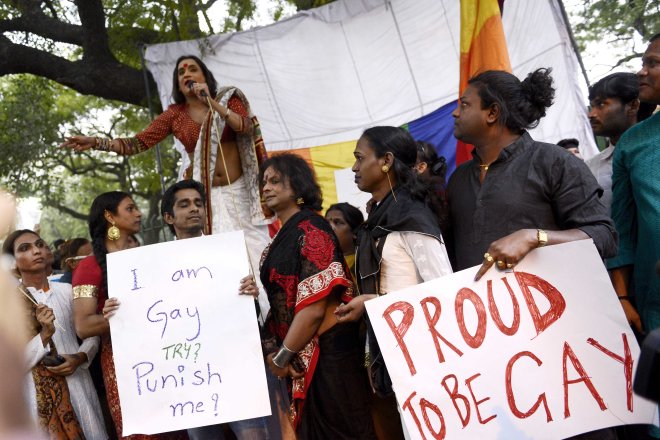
Gay rights activists take to streets in Delhi

Chanakya Sethi analyzes India’s shameful court decision re-criminalizing homosexuality:

The majority passes a law that the minority believes discriminates against it. The minority goes to court seeking relief from the majority. But because the minority group constitutes a “minuscule fraction of the country’s population,” the court will defer to the will of the legislature—that is, to the will of the majority. That, in short, is how the court wrapped itself in the flag of judicial restraint and overturned a lower court decision that had struck down the country’s sodomy laws as unconstitutional.

Kaushal v. Naz Foundation was supposed to be India’s Lawrence v. Texas, the U.S. Supreme Court’s path-breaking decision striking down state anti-sodomy laws. Instead Kaushal is already being described in the Indian press as the country’s Dred Scott or Plessy v. Ferguson: “moments of deep national shame, blots on the judicial record, examples par excellence of judges at their very worst,” as one op-ed put it.

Shivam Viz provides more details on the basis of the decision:

In the end, the court’s decision rested heavily on two dubious assertions. The first was that homosexuals in India were too small in number to constitute a “class,” and could therefore not be subject to discrimination. “What is a bisexual?” Justice Mukhopadhyay wondered aloud during one hearing; when he was given an answer, he stated with confidence that they too were not a “class.” Though it was shown that Section 377 has been used mainly to prosecute gay men, the court’s judgment maintained that the prohibition against “unnatural” sex could apply even to marital relations, and was therefore non-discriminatory.

The second main element of the court’s decision—which refers, not incidentally, to “the so-called rights of LGBT persons”—was an assertion of judicial restraint. The proper venue to debate this law, Justice Singhvi said during one hearing, is the Indian Parliament. There was not a little irony to these declamations, because the Indian Supreme Court is renowned for its judicial activism: in recent years, it has forcefully intervened in a great many legislative matters, and Justice Singhvi himself has been a vocal defender of such activism.

The final judgment makes it clear that the issue was not restraint per se, but the judges’ belief that the criminalization of homosexuality did not cause sufficient harm to justify any action from the court. The Parliament should feel free to strike the law down, they suggested, but the Supreme Court need not do so.

Nitin Rao discusses India’s view of individual rights :

We need to understand that India has always valued groups and “society” over the individual. For example, if somebody is playing music very loudly in a bus, it would likely be seen as an aggressive action to request that they wear earphones. In a country where 90 percent of marriages are arranged marriages, romantic relations are seen as a decision made by families, rather than individuals.

The horrific 2012 gang rape of a 23-year-old intern in Delhi highlighted how the concept of individual rights still has a long road ahead to acceptance. After the horrific public sexual assault, a national discussion erupted in the media in which womens’ groups had to explain that the victim is not to blame. Sadly, India’s great balkanization by religion and caste has created an environment where group rights take precedence over individual ones.

Likewise, LGBT rights are not seen as individual rights in India. Once again, the country is sadly choosing to treat life and liberty, not as being unalienable rights, but instead as matters to be judged based on clout, numbers, and “contribution to the community.”

(Photo: On December 11th, 2013, the LGBT community of New Delhi, India protests against the Supreme Court order making gay sex a punishable offense. By M Zhazo/India Today Group/Getty Images)

Fighting HIV Without Condoms, Ctd

A reader writes:

I’m a PhD student in virology at the University of Pennsylvania, and while I certainly don’t intend to (or need to) lecture you about HIV, your post contained a subtle inaccuracy of great importance. You wrote that “middle-class gay men can suppress the virus indefinitely with the cocktail.” It’s true of course that viral load can be suppressed and that life expectancies of HIV+ individuals on strict HAART regimens are close to, if not completely, normal, but that’s not the same as saying that anti-viral therapy will keep you healthy. HIV-associated neurological disorders (HANDs) are a significant problem among HIV+ individuals (up to 50% of cases in the US) and are only partially preventable and treatable by HAART. I’m sure you know people who suffer or have suffered from HAND, and I don’t want your blog to become a place where people go to learn that just because anti-retroviral therapy is highly effective, that there are no consequences of HIV infection as long as you have money and/or insurance. (I’m including links to some more papers on this topic: here, here, and here.)

Another asks:

Isn’t there a possibility that a HIV positive man might be reinfected with a new strain of virus and cause his current HIV drug regimen to fail? I thought there was always that risk.

Nope. Another quotes me:

“Bareback sex feels better for both partners.”

You’ve made similar statements before, in even less compromising terms. (“Infinitely better” I think?) And, well, you’re wrong. Maybe for some people, maybe even for most, but not all. I honestly have no preference either way, not even in terms of convenience. A condom adds a bit of hassle up front, but it saves my partner a whole lot of cleanup, so it seems like a draw there. Certainly no difference in sensation. I understand why barebacking would be fetishized – the subject is so wrapped in danger and mystery and taboo thoughts that of course some people will turn it into a kink. Humans are really good at turning things into kinks! But that doesn’t mean they can’t be used very happily by lots of people.

Another reader:

In addressing whether condom use should continue to be encouraged, you wrote, “The more important goal is for HIV-positive men to have sex mainly with other HIV-positive men, restricting the virus to a pool of the already infected.” When I met my husband in 2005 years ago, he had already been HIV positive for many years. I was (and still am) HIV negative. Sero-sorting is all very well and good in theory, and I’m sure that many people – like yourself – have successfully worked out their lives that way. In my case, I wasn’t going to let a virus cheat me out of an intelligent, funny, caring man.

Running On Reefer

Mainstream politicians are jumping on the legalization bandwagon:

The 2014 candidates’ pro-pot stance appears mostly to be a way for them to distinguish themselves in primaries where the candidates largely share the same views, particularly on social issues. In Maryland, for example, the candidate pushing legalization, Heather Mizeur, also is vying to be first openly gay governor of the state and is running a campaign designed to appeal to liberals and young people. Mizeur rejects “old paradigm assumptions about conventional wisdom and what is and isn’t safe to do in politics,” she said. “I am a candidate who never plays it safe. I always stand up for what I believe in. In the past, politics has been about catching up to where people are.”

In Pennsylvania, former governor Ed Rendell told The Daily Beast that he thought [John] Hanger’s position on marijuana was what distinguished him most among voters with the Democratic primary five months away.

Hanger said he agreed.

“This issue alone could win me the Democratic primary,” he said.

The Pentagon Wins The Budget War

Defense Budget

Dave Gilson looks at how the budget deal will impact defense spending:

[T]he Pentagon has once more gotten a reprieve from the budget ax: Under Murray and Ryan’s congressional budget deal, the Pentagon will get an additional $32 billion, or 4.4 percent, in 2014, leaving its base budget at a higher level than in 2005 and 2006. (The Department of Defense expects its total 2014 budget, including supplemental war funding, to be more than $600 billion.)

Before the budget deal, some critics of defense spending had been ready to accept sequestration as the blunt, imperfect tool that might force the military to shed some of the bulk it acquired while fighting two of the longest and most expensive wars in our history. Even with the sequester in place, the Pentagon’s base budget was set to remain well above pre-9/11 levels for the next decade, and the military would have taken a far smaller haircut than it did after Vietnam and the Cold War wound down.

Drum chimes in:

In past wars, we usually got a peace dividend afterward as spending returned to its old level. It happened after Vietnam and it happened after the Cold War. But this time it’s stalled. Spending is down a bit from its Bush-era peak, but only a bit. The war on terror, apparently, really is a forever war.

Africa Reaches For The Stars

With China becoming the third country to land on the moon this weekend, Jonathan Kalan considers the state of space research in Africa, which, as we noted a few years ago, includes a Hollywood twist:

[C]alls are growing from many on the continent – and even the African Union – for the formation of AfriSpace, a pan-African space agency. One of the more vocal proponents is Sudan’s Omar al-Bashir, who rather surprisingly, appears to be partly motivated by his dissatisfaction about a project funded by the actor George Clooney. With the money earned from his appearance in commercials for the coffee company Nespresso, Clooney has been funding the Satellite Sentinel Project (SSP), which he co-founded in 2010, to monitor the military activities of al-Bashir – who is accused of war crimes by the International Criminal Court. A satellite captures real-time imagery of Sudan, enabling a team of analysts to monitor troop movements, bombings and other aggressive activities by al-Bashir in the disputed border areas between Sudan and newly formed South Sudan. … President al-Bashir has indicated that this eye from above is rather unfair, a one-sided measurement of accountability, and so wants more African satellites up there too.

But Kalan finds that a fully-formed African space agency has some obstacles to overcome:

The expertise required to rival other large space agencies may … be a long way off – at least judging by the way some existing African space organizations present themselves to the world. While researching this story, I found that nearly every national space agency or society website was loaded with incomplete or broken content – some were not even functioning. On one call to Ethiopia’s former Minister of Capacity Building, I received a pre-programmed error message.  “The network is fizzing out. Please try again later,” it said. When I finally reached him, he told me “this is a good example for what I told you. Our use of space of technology is not to its full potential.”

Questioning Covert Conflict

Jeremy Scahill’s film and book project Dirty Wars: The World is a Battlefield examines US military policy abroad, with special attention to covert operations.  Last month, Stephen Moss reviewed the film:

The extent of the US military’s covert operations and the amount of “collateral damage” are shocking; the film shows that even US citizens have been the victims of non-judicial executions; and the argument that the war on terror is ultimately unwinnable because indiscriminate killings radicalise whole populations is persuasive. “Somehow, in front of our eyes, undeclared wars have been launched in countries across the globe; foreigners and citizens alike assassinated by presidential decree; the war on terror transformed into a self-fulfilling prophecy,” Scahill laments at the end of the film. “How does a war like this ever end, and what happens to us when we realise what was hidden in plain sight?”

Tom Gallagher elaborates on the book’s contents:

A book called Dirty Wars will naturally have no shortage of nasty stories.

One of the worst occurred on February 12, 2010, when US forces arrived in the Afghan village of Gardez, shot up a party celebrating the naming of the newborn son of an Afghan police officer and killed the father and six others, including two pregnant women. After a failed cover-up — during which family members reported seeing “U.S. soldiers digging the bullets out of the women’s bodies” in order to support a fabricated story that the women had been found already bound, gagged and executed when the Americans arrived — the U.S. military staged a very public meeting in which JSOC [Joint Special Operations Command] Commander Admiral William McRaven personally apologized for the atrocity to Hajii Sharabuddin, the head of the household. The story disappeared from the headlines and the war went on. Several months later, however, Scahill met with Sharabuddin who told him that “now we think the Americans themselves are terrorists.” You didn’t see that part on the nightly news.

Reviewing the film in June, Steven Boone expressed desensitization to some of what the camera captured:

We’ve been here before. Popular documentaries like Michael Moore’s “Fahrenheit 9/11” did their best to demonstrate that foreign kids suffering or perishing because of disastrous U.S. policy are “just like our kids.” Given the incessant, almost automatic dismissal of such murders of children in this country—by pundits, Congress members, White House press secretaries, American generals, soldiers, and average Joes and Janes—it’s hard to see any meaningful difference between the folks who danced in the streets when the towers fell and Americans who find collateral damage offensive only when the collateral is American. Casual dehumanization of foreigners has become the norm everywhere. It’s as if 9/11 rolled back the world clock a century.

Scahill, Rowley and co-writer David Riker (creator of the classic neo-neorealist indie “La Ciudad”) do their part to attack this backwardness at the root. Clear and graphic images of the piles of dead children a U.S. drone strike left in a Yemeni field say so much more than (to cite a quietly outrageous moment early on) a general smugly, idiotically speculating that a pregnant Afghan woman our soldiers gunned down might have been a combatant. (“I’ve been shot at by women.”)

A recent interview with Scahill is here.

The Place Race

We recently aired concerns that Google is acquiring a monopoly on mapmaking. Adam Fisher evaluates the “Wikipedia of mapping,” OpenStreetMaps (O.S.M.), as a “potential challenger to Google’s cartographic hegemony”:

Today, Google’s map includes the streets of every nation on earth, and Street View has so far collected imagery in a quarter of those countries. The total number of regular users: A billion people, or about half of the Internet-connected population worldwide. Google Maps underlies a million different websites, making its map A.P.I. among the most-used such interfaces on the Internet. At this point Google Maps is essentially what [Silicon Valley visionary] Tim O’Reilly predicted the map would become: part of the information infrastructure, a resource more complete and in many respects more accurate than what governments have. It’s better than MapQuest’s map, better than Microsoft’s, better than Apple’s.

“You don’t see anybody competing with Google on the level or quantity of their mapping today,” says [OpenStreetMaps founder Steve] Coast, who now works as a geographic-information professional. But, he adds, “that’s because it’s not entirely rational to build a map like Google has.” Google does not say how much it spends on its satellite imagery, its planes, its camera-equipped cars, but clearly it’s an enormous sum. O.S.M., by contrast, runs on less than $100,000 a year. Google’s spending is “unsustainable,” Coast argues, “because in the long run, this stuff is all going to be free.”

The O.S.M. map data is free now — but using it comes with a catch. Any improvement, or any change at all, that a developer makes to O.S.M.’s map must be sent back to O.S.M. It’s a clever tactic, forcing competitors of Google Maps to choose between fighting Google alone or joining a coalition that, if it prevails, will ensure that no private company will ever be able to establish a mapping monopoly.

Going Where The Winnable Seats Are, Ctd

Obama And Keyes Hold Final Debate For Illinois Senate Race

A reader disagrees with Kevin Mahnken:

With all due respect, our form of government is a “representative democracy,” meaning that those who run the government “represent” us.  I don’t believe you can represent the people if you do not know the people and you cannot know the people if you don’t live with those people. Our government was not set up to vote on various policies or ideologies, it was set up to “represent” the will of the people. There are too many people out there who just want to be professional politicians and don’t care about where they are, they just want the power of being elected.  This stinks and does a disservice to our form of government.

Another disagrees:

I was interested to read Mahnken’s belief that carpetbagging is a good thing.  The reality is, Clinton and now Scott Brown are examples of politicians moving into areas with similar character and make-up to a place they’re actually from.  In Hillary’s case, New York was a cosmopolitan place full of movers and shakers like DC had been for the previous 8 years, and Kennedy likewise was moving from one Eastern Seaboard state to another.  Brown seems to be going a little further, but he’s still in New England.  Not a radical departure.

Another:

I applaud Mahnken for defending, in principle, the idea of carpetbagging. I agree that sometimes the truly best person for the job may be the candidate who happens to be from somewhere else, geographically speaking. I think where the Scott Brown example is more problematic is that he isn’t just a candidate who happens to be from another place; he is a defeated candidate from another place. Many New Hampshire voters are probably more reluctant to vote for him because he was a failed candidate in Massachusetts, not simply because he’s from Massachusetts.

(Photo: Democratic candidate for U.S. Senate from Illinois Barack Obama and his Republican rival Alan Keyes prepare to debate on October 26, 2004. By Scott Olson/Getty Images. From Wikipedia: On August 8, 2004 – with 86 days to go before the general election – the Illinois Republican Party drafted Keyes to run against Obama for the U.S. Senate, after the Republican nominee, Jack Ryan, withdrew due to a sex scandal, and other potential draftees (most notably former Illinois governor Jim Edgar and former Chicago Bears coach Mike Ditka) declined to run. The Washington Post called Keyes a “carpetbagger”  since he “had never lived in Illinois.” When asked to answer charges of carpetbagging in the context of his earlier criticism of Hillary Clinton, he called her campaign “pure and planned selfish ambition”, but stated that in his case he felt a moral obligation to run after being asked to by the Illinois Republican Party. “You are doing what you believe to be required by your respect for God’s will, and I think that that’s what I’m doing in Illinois”.)