Tis The Season For Cheap Real Estate

Joe Pinsker flags research by L. Rachel Ngai and Silvana Tenreyro on why house are more expensive in the summer than the winter:

Ngai and Tenreyro haven’t built a model that explains exactly why prices vary with the season, but they can at least speculate. It might seem like weather would be a factor—it’s more pleasant to scope out properties during the warmer months—but prices vary significantly even in places where summer and winter are tougher to distinguish, such as Los Angeles and San Diego.

They guess that it has to do with the timing of the school year.

“We think parents of school-age children find it more convenient to search in the summer,” Tenreyro says. But, as she notes in her paper, that contingent is only estimated to make up less than a third of prospective home buyers at any given time—a substantial proportion, but not enough, it would seem, to determine when the majority of homes are sold.

This group’s disproportionately large impact gets to the heart of how Tenreyro and Ngai’s model works, in that it accounts for a snowballing effect. “Because there is this critical mass that prefers searching in the summer, then sellers put their houses on sale in the summer,” Tenreyro says. “And because there are more houses for sale, then other buyers also then prefer to search in the summer and so on and so forth. The effect gets amplified as a virtuous circle.” In this way, the unique preferences of a relatively smaller group of home buyers ends up dictating the market for everyone else.

The 2016 Senate Map

Senate Map

Kyle Kondrik sneaks a very early look at it:

Republicans really helped themselves by running up the score last month in the Senate. The importance of netting nine seats in 2014 as opposed to, say, seven or eight, is clear when one looks at the 2016 contests. If the Republicans were at only a 52-48 edge — a net gain of seven — then Democrats could get to a 51-49 majority in 2016 just by holding all of their own seats and winning the three Toss-ups, Illinois, Pennsylvania, and Wisconsin. The chances of that combination happening wouldn’t be 50-50, but they would be fairly close to even, and control of the Senate would be very much up in the air to start.

But because the Democrats need to net four or five seats to take control, depending on the party of the next vice president,the Democrats’ opening odds to win the majority are significantly less than 50-50. In order to capture the Senate, Democrats will have to put some currently leaning or likely Republican seats in play, along with winning their own seats and the three GOP-held Toss-ups. That’s certainly possible, but the GOP starts with a clear edge as the cycle begins.

Would You Report Your Rape? Ctd

A reader adds a new angle to the thread:

I was convicted in 2001 of embezzling more than a million dollars, for which I served 1-1/2 years in prison. I may come at this from a different angle, being a gay man who was raped in prison, rather than a straight women raped in college. I didn’t report my rapes (there were three). I didn’t even discuss them with friends.

First, if you think reporting a rape in a college environment is hard on the reporter, it is pure hell in prison.

The very first thing that happens is you’re transferred from your housing unit, so you lose your job and program. I was in a terrific program with one of the greatest teachers of my life, so the loss would have been substantial.

Second, why one was moved becomes common knowledge very quickly (in prison, gossip travels faster than the speed of light), so you will be a target, an known easy mark, wherever you’re put next. Third, the accused, at worst, suffers the loss of a few days good time. Most of the time, the event is found to be consensual sex (because I was gay, so of course I’d want to have sex with a man) and both are punished. I wouldn’t even be able to get medical care to ensure I did not seroconvert (I am HIV-). There was very little upside to reporting. So, I kept quiet and found ways to keep myself out of the situation.

I am sad to say that being raped was not the most traumatic thing to happen in prison. But even now, ten years later, every so often, I still wake in the middle of the night shaking with fear because of my stay there. On the other hand, I wouldn’t now report either. It is over with and done. I’ve moved on and don’t want to be involved in anything there. If this places others in danger, so be it. I don’t think the report would be fair to me or to anyone I accuse. After so long, even I don’t trust my memories of the events.

Thus, I don’t blame people for not reporting – it is a very personal decision. But I also don’t think accusations long after the rape are helpful either. Either go forward at the time, letting the chips fall where they may, or let it go.

An Iron Lady

Senate Holds Hearing On Foreign Intelligence Surveillance Act Reforms

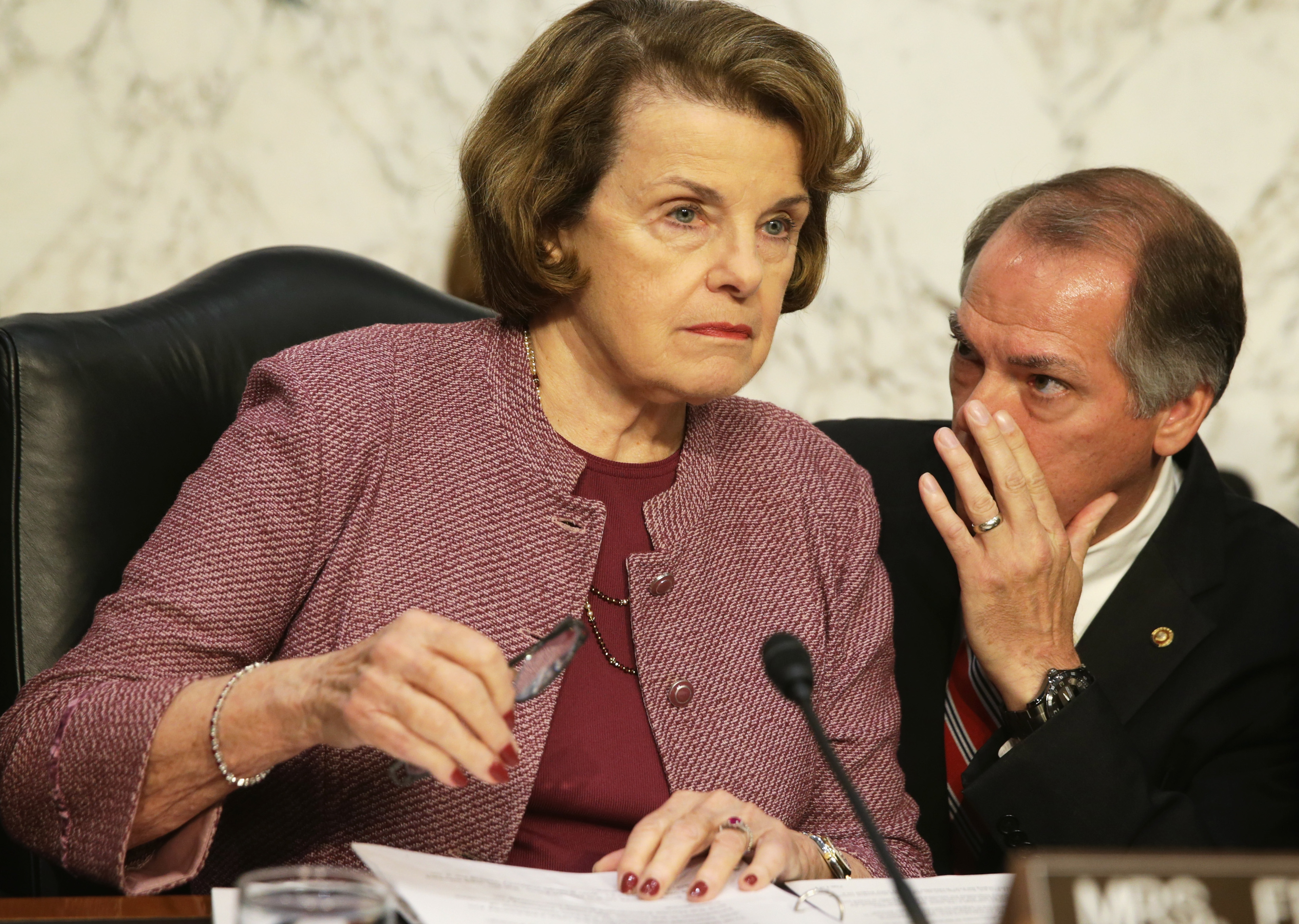
This past week has been Dianne Feinstein’s finest hour. In fact, it has been the Senate’s finest hour – with the remarkable speeches of Senator Udall and Senator McCain as well. The torture apologists often try to dismiss the report as some kind of partisan hatchet-job. But they never grapple with Feinstein’s long record of support for the CIA, and the respect she commands among her fellow Senators. Nor do they confront the unique personal perspective of John McCain, the Republican’s candidate for president only six years ago. A reader in California praises her senior Senator:

DiFi has a core of steel. Thanks so much for posting her tweet stream. She may be far – far! – from perfect to this liberal’s eyes, but she’s tough and she’s seen shit and I think she’s done putting up with it. I’m sure you’ve seen the footage of a young Dianne Feinstein, hours after having found Harvey Milk’s body, announcing his and Mayor Moscone’s death to the press. I first saw it in The Times of Harvey Milk before I lived in California, and I thought of it (as she must have) when she was the first person out to the microphones at Obama’s first inauguration. (And of course in old Washington style, she was the one who hosted the private dinner where Barack and Hillary worked it out.)

I don’t think the CIA would be wise to mess with her at this point in her life and legacy.

With any luck, they’ve learned their lesson.

(Photo: Committee chairman Senator Dianne Feinstein (D-CA) listens to an aide during a hearing before the Senate (Select) Intelligence Committee on June 5, 2014. By Alex Wong/Getty Images)

The Torture Doctors

Screen Shot 2014-12-12 at 5.49.36 PM

Michael Daly introduces us to the amateur goons who ran the torture freak show:

James Elmer Mitchell and John Bruce Jessen are not the first Americans to employ waterboarding and other “enhanced interrogation techniques” against our enemies. But they are almost certainly the only ones to get rich doing it.

They did so by employing what is widely dismissed as “voodoo science” based on misapplied principles in a program that CIA records suggest produced little, if any, intelligence of significant value. And they might have gotten even richer. The Senate Intelligence Committee report says they secured a contract with the CIA in 2006 valued “in excess of $180 million.” The CIA canceled the deal three years later, but by then the duo had received $81 million.

This is one reason I remain befuddled by the pro-torture right’s response to the facts in the report. If you are in favor of torture, you should be horrified that the CIA contacted it out to goons with no relevant experience or interrogation training. If you care about wasting government money, you should be appalled by this instance of total incompetence, rewarded by tax-payers. But the Republicans’ rank partisanship precludes them from being internally consistent and coherent. They’re just backing their own team – even as that team clearly betrayed any confidence the torture-supporters might have expected.

Then there is the question of whether qualified psychologists or doctors were implicated in these war crimes. Roy Eidelson and Trudy Bond question whether the American Psychological Association was involved:

Responding to the new Senate report, the American Psychological Association (APA) was quick to issue a press release distancing itself from Mitchell and Jessen. The statement emphasized that the two psychologists are not APA members – although Mitchell was a member until 2006 – and that they are therefore “outside the reach of the association’s ethics adjudication process.” But there is much more to this story.

After years of stonewalling and denials, last month the APA Board appointed an investigator to examine allegations that the APA colluded with the CIA and Pentagon in supporting the Bush Administration’s abusive “war on terror” detention and interrogation practices.

The latest evidence of that collusion comes from the publication earlier this fall of James Risen’s Pay Any Price: Greed, Power, and Endless WarWith access to hundreds of previously undisclosed emails involving senior APA staff, the Pulitzer-prize winning reporter concludes that the APA “worked assiduously to protect the psychologists…involved in the torture program.” The book also provides several new details pointing to the likelihood that Mitchell and Jessen were not so far removed from the APA after all.

Jefferson M. Fish also cites Risen’s book:

In the book, Risen documented the extensive contacts between APA and the U.S. government, both leading to and following the change in ethical Standard 1.02. Risen wrote:

Perhaps the most important change was a new ethics guideline: if a psychologist faced a conflict between APA’s ethics code and a lawful order or regulation, the psychologist could follow the law or “governing legal authority.” In other words, a psychologist could engage in activities that the U.S. government said were legal—such as harsh interrogations—even if they violated APA’s ethical standards. This change introduced the Nuremberg defense into American psychology—following lawful orders was an acceptable reason to violate professional ethics. The change in the APA’s ethics code was essential to the Bush administration’s ability to use enhanced interrogation techniques on detainees. (Pp. 194-195)

In December 2008, following a presidential election in which both Barak Obama and John McCain condemned torture, the APA proposed removing the offending sentence and replacing it with, “Under no circumstances may this standard be used to justify or defend violating human rights.” This change, which was subsequently implemented, would seem to imply that the sentence had been created for just the purpose described by Risen.

Relatedly, Steven Miles, author of Oath Betrayed: America’s Torture Doctorstalked to Julie Beck about the role of doctors in torture. Beck asks, “Why would people use medical knowledge and expertise learned to heal people for the opposite purpose?” Miles responds:

It’s pretty interesting, I’m writing a book on just that question. The docs who get involved in this, number one, are careerists. They get involved for rank and career, and the regimes never coerce them, or extremely rarely coerce them. Instead what happens is the regimes treat them as some kind of elite. The docs are generally not sadists. This is not the stuff of Saw, for example. They go along with the dominant political theme of the prison: “These are our enemies and we gotta squeeze them for the information.” The thing that’s so interesting is that there is research showing that force of interrogation does not work, that it’s counterproductive. These docs seem to be entirely unaware, not only of the ethics codes, but also of the ineffectiveness of these interrogation strategies, that they never mount a protest.

The banality of evil.

(Image via ABC News)

What Did Congress Know?

David Ignatius believes that the torture report “should have addressed Congress’s own failure to oversee these activities more effectively”:

A CIA review of “contemporaneous records” shows that [a 2002] briefing to Sens. Bob Graham and Richard Shelby and Reps. Porter Goss and Nancy Pelosi included “a history of the Zubaydah interrogation, an overview of the material acquired, the resistance techniques Zubaydah had employed, and the reason for deciding to use the enhanced measures,” along with a description of “the enhanced techniques that had been employed.”

Did the members of Congress push back hard, as we now realize they should have? Did they demand more information and set stricter limits? Did they question details about the interrogation techniques that were being used? It appears that, with rare exceptions, they did not.

I agree with David that the role of the Congress in acquiescing to torture needs far more attention. But, again, secrecy makes that very hard. I’d like to ask Pelosi on the record what she was actually told. When you absorb the full report and see the CIA’s relentless campaign of deceit about the program, it’s an open question whether they were lying to the Senators as well. There are euphemisms for torture techniques that do not convey the reality. That doesn’t excuse the Senators one bit. But maybe they did ask for more details. Maybe they wanted to stop it. But what options did they actually have? PM Carpenter asks:

The CIA’s “covert” torture program was by definition top secret. Had, for instance, Nancy Pelosi strenuously objected to the gruesome details she was hearing in the CIA’s briefings, just what, precisely, could she have done about it? She possessed no legal authority to go to the press and certainly none to effectively commit treason by blaring her horrified knowledge from the floor of the House–and taking complaints to the war-criminal Bush administration would have been like exposing unsavory extortion rackets to the Gambino family.

And it’s hard to imagine Congress g0t a complete briefing when even top CIA officials claim they were unaware of some of these abuses:

Working from CIA documents, the report said detainees were made to stand on broken limbs, or forced to take in food or water rectally. But Jose Rodriguez, head of the CIA’s Counterterrorism Center at the time, said the newly revealed abuses caught him off-guard, too. “I have no knowledge of people forced to stand with broken bones,” Rodriguez said in an interview the day after the Senate Intelligence Committee Democrats, led by Chairman Dianne Feinstein, released its report after five years of delays.

Nor was he aware of detainees being given water or food via their rectum. “Rectal hydration thing sounds like a medical procedure, but it was not part of the approved and sanctioned techniques that were given to us by our guys and approved” by the Justice Department, he said. (Former CIA Director Michael Hayden made similar remarks Wednesday on CNN, saying that he hadn’t heard of the practice, but that it sounded like a medical procedure.)

And the beat goes on.

The Torture Program’s Black Site At GTMO

6a00d83451c45669e20120a7e84fa1970b-500wi

Dish readers know of the three alleged “suicides” that occurred in a facility at GTMO kept firmly off the books. Scott Horton’s story on the deaths – given the National Magazine Award – has been dismissed by the usual suspects in the military and CIA as preposterous. But given what we have now learned of what happened at other black sites, is it so outrageous to suspect those deaths were actually a result of an experimental torture technique – stuffing prisoners’ throats with rags to induce the same suffocation experienced during waterboarding? At this point, let me just say, I believe nothing that the CIA says that cannot be backed up by its own records. They have long since forfeited any public trust.

The report has some new details on that facility – sometimes known as “Camp No” or “Camp 7”. It confirms for the first time that the camp was indeed run independently by the CIA under its torture program:

The release of 524 pages of the 6,700-page Senate Intelligence Committee report confirms for the first time that the CIA used Guantánamo as a black site — and continued to run the prison that held the alleged 9/11 mastermind Khalid Sheik Mohammed and 13 other men even as the Pentagon was charged to prosecute them … The report shows that Guantánamo had two of those secret CIA black sites — code named Maroon and Indigo — from September 2003 to April 2004 that held at least five detainees.

And this was kept secret from those supposed to oversee the torture program:

The report suggests all of Congress was kept in the dark about the dark site: “Because the Committee was not informed of the CIA detention site at Guantánamo Bay, Cuba, no member of the Committee was aware that the U.S. Supreme Court decision to grant certiorari in the case of Rasul v. Bush, which related to the habeas corpus rights of detainees at Guantánamo Bay, resulted in the transfer of CIA detainees from the CIA detention facility at Guantánamo Bay to other CIA detention facilities.” The CIA’s spokesman, Dean Boyd, also declined to say when — if ever — the agency relinquished control of Guantánamo’s most secretive prison.

Which means to say we do not know if the CIA is still in charge of that facility. This is the facility where paddy wagons came and went, whence screams could be heard during “aggressive questioning”, and whence three corpses are believed to have emerged in June 2006. Another nugget:

A footnote in the Senate report says that in early December 2006, three months after the CIA brought its prisoners back to Cuba, then-Director Michael Hayden visited Guantánamo’s “High-Value Detainee Detention Facility” — something not reflected in the prison’s official list of dignitary visits.

What was he doing there? Why was his visit kept off the official list of visitors?

The Government Keeps The Lights On

https://twitter.com/TheFix/status/543434538266157056

Despite fierce opposition from both the left and the right, the “Cromnibus” (a portmanteau of “continuing resolution” and “omnibus”) spending bill passed the House last night, averting a government shutdown by mere hours:

Thanks in part to a rare alliance between President Barack Obama and Speaker John Boehner, the House voted Thursday to pass a $1.1 trillion spending bill to fund the government, clearing a hurdle to avoid an otherwise imminent government shutdown. The House also passed a measure that will fund the government for two additional days in order to give the Senate time to approve the legislation before the government runs out of funding on Friday, according to NBC News.

At the eleventh hour, Obama and Boehner scrambled to salvage the bill – which passed by a vote of 219 to 206 – amid a Republican revolt over immigration and a Democratic revolt over provisions that would deregulate Wall Street and increase the amount that individual donors can contribute to national political party committees.

Ben Jacobs outlines what the respective revolts were all about:

The pill that Democrats had trouble swallowing was a provision rolling back Dodd-Frank that would allow major banks to carry out certain risky derivatives trades through funds insured by the FDIC.

The idea of weakening financial reform only years after a financial crisis that almost brought down the American economy alarmed many Democrats. … The opponents in the GOP caucus were the usual conservative suspects, upset about the fact that the bill did not defund Obama’s executive order on undocumented immigrants.

Republicans were also less than thrilled that the bill didn’t slash funding for Obamacare. The Democratic revolt was led by the party’s liberal populist wing, with Nancy Pelosi leading the pack and Senator Elizabeth Warren urging them on. Tim Fernholz has the details on what liberal Dems found so irksome about the Dodd-Frank rule change:

The big financial firms that dominate the swaps markets were particularly unhappy with rules preventing them from holding or trading derivatives within their federally insured bank subsidiaries—where they typically have an advantage. (That’s because the prospect of government bailouts arguably affords the bank subsidiaries higher credit ratings, which comes in handy when you’re playing in the swaps market.)

Facing the prospect of having their derivatives activities “pushed out” to subsidiaries unprotected by federal deposit insurance, the big banks pushed back. During the drafting of Dodd-Frank, they succeeded in keeping some categories of swaps in-house, including foreign-exchange, gold, silver, and interest-rate swaps. But the banks earned a bigger victory in 2013 by getting the Republican-controlled House of Representatives to pass a bill essentially written by Citigroup lobbyists to create large exemptions in the rule. It turns out the same language was slipped into the current spending bill[.]

Matt O’Brien weighs in:

This actually isn’t that big a deal, but the principle is. Think about it this way. If insured banks can’t make these bets, then uninsured ones will—and we’d still have to bail them out if they threaten to bring down the whole financial system. But as long as we’re talking about run-of-the-mill, and not end-of-the-world, losses, then we, as taxpayers, should clearly prefer for these swaps to happen in the uninsured banks. That way, we don’t have to foot the, admittedly small, bill. And this isn’t really a debate. There’s no real counterargument that I’m aware of why it’d be better for the mega-banks to be allowed to take more risks with taxpayer-insured money (other than it’d be good for their bonuses).

Sarah Binder questions whether the drama was worth it for the Democrats:

My hunch is that Pelosi is too smart a politician and knows her caucus too well to have been surprised by the outcome. True to form, Pelosi provided cover for Democrats seeking to show their anti-Wall Street bona fides, yet managed not to derail a bipartisan deal (that was bound to be better for Democratic priorities than kicking the can into the new Congress with a 2-3 month stop gap spending bill).

Did Warren’s gambit put the liberal wing on stronger footing in the coming Congress?  I’m skeptical.  Warren clearly put Democratic party leaders and her colleagues on notice that she will continue to oppose measures that unduly advantage Wall Street interests. But unless she can secure stronger backing from the White House (and her colleagues), I suspect that the liberal wing of the Democratic party will face a tough road ahead in a Republican-led Congress.

But Cillizza thinks Pelosi got her point across:

Pelosi — and Massachusetts Sen. Elizabeth Warren, who spoke out forcefully against it too — lost the battle on the spending bill.  But, they may have won the wider war — or at least scored a tactical victory that puts her and the party’s liberal wing in a stronger position come the 114th Congress.

What Pelosi’s revolt made clear is that while there will be more Republicans in the House and Senate come January, nothing can get done (or at least nothing can get done easily) without some portion of liberal Democrats on board.  This was a warning to the White House and Senate Democrats not to cut Pelosi out or take her  (or her liberal Democratic allies) for granted going forward. Point made.

Drum is relieved that bipartisanship worked in the end – albeit in its typical, clunky way:

This is one of those things that demonstrates the chasm between political activists and analysts on the one side, and working politicians on the other. If you take a look at the bill, it does indeed have a bunch of objectionable features. People like me, with nothing really at stake, can bitch and moan about them endlessly. But you know what? For all the interminable whining we do about the death of bipartisanship in Washington, this is what bipartisanship looks like. It always has. It’s messy, it’s ugly, and it’s petty. Little favors get inserted into bills to win votes. Other favors get inserted as payback for the initial favors. Special interests get stroked. Party whips get a workout.

That’s politics. The fact that it’s happening right now is, in a weird sense, actually good news. It means that, for a few days at least, politics is working normally again.

The Torture Regime’s Attack On Religious Freedom

Michael Peppard searches for religion-themed abuses in the torture report:

My own research on torture in U.S. detention facilities has emphasized the religious aspects of abuse (“The Secret Weapon” and “Disgrace“). And though today’s report does not contain as much along these lines as did the Senate Armed Services Committee’s report in 2009, it does analyze assertions made by CIA Director Hayden in 2007 about the role of religion in “enhanced interrogation.” … The new report does not describe the many techniques of religiously-themed abuse that I compiled from ex-detainee memoirs and interviews in 2007-08, nor does it extend our knowledge from the 2009 report, which admitted techniques such as forced prostration before an idol shrine to generate “religious disgrace.”

But what Hayden’s comments do show is that using religion as a weapon in prolonged psychological warfare was an actual “policy” – not a result of agents gone rogue. The goal was to create a burden so great that a person’s religious faith would be destroyed. Nothing could be further from our country’s founding principle.

And yet white evangelicals in America are the most supportive of this grotesque attack on the principle of religious freedom and conscience. Dreher is disturbed by these findings:

[T]o take a captured prisoner, even one we can reasonably be certain has done evil things from religious motivation, and compel him to desecrate his religion, is to my Christian mind one of the most evil things that one human being can do to another. That the history of the Church shows Muslims have done this to Christians again and again and again does not make it right. It is always and everywhere a manifestation of utter barbarism.

No Christian can believe otherwise. And the core Christian point here is that even the worst terrorist remains a human being. He can be fought, brought to justice, jailed and even killed in lawful combat. But he cannot be reduced to a sub-human level. No one can. And to treat another human being as an object to be violated even when under your total control dehumanizes the torturer as surely as the tortured. It is total power. The entire agency of a human being is taken from him or her. And that is what American did to countless of human beings – and even now it is hard to find any tone of actual remorse among those responsible.