The Truthiness Of Virality

Facebook Upworthy

Neetzan Zimmerman, the master of viral content, makes an astute observation:

I’d argue that most viral content demands from its audience a certain suspension of disbelief. The fact is that viral content warehouses like BuzzFeed trade in unverifiable schmaltz exactly because that is the kind of content that goes viral. People don’t look to these stories for hard facts and shoe-leather reporting. They look to them for fleeting instances of joy or comfort. That is the part they play in the Internet news hole. Overthinking Internet ephemera is a great way to kill its viral potential.

In response, Felix Salmon observes that there’s “now so much fake content out there, much of it expertly engineered to go viral, that the probability of any given piece of viral content being fake has now become pretty high”:

If your company was built from day one to produce stuff which people want to share, then that will always end up including certain things which aren’t true. That’s not a problem if you’re ViralNova, whose About page says “We aren’t a news source, we aren’t professional journalists, and we don’t care.” But it becomes a problem if you put yourself forward as practitioners of responsible journalism, as BuzzFeed does.

It has become abundantly clear over the course of 2013 that if you want to keep up in the traffic wars, you need to have viral content. News organizations want to keep up in the traffic wars, and so it behooves them to create viral content — Know More is a really good example. But the easiest and most infectious way to get enormous amounts of traffic is to simply share the stuff which is going to get shared anyway by other sites. Some of that content will bear close relation to real facts in the world; other posts won’t. And there are going to be strong financial pressures not to let that fact bother you very much.

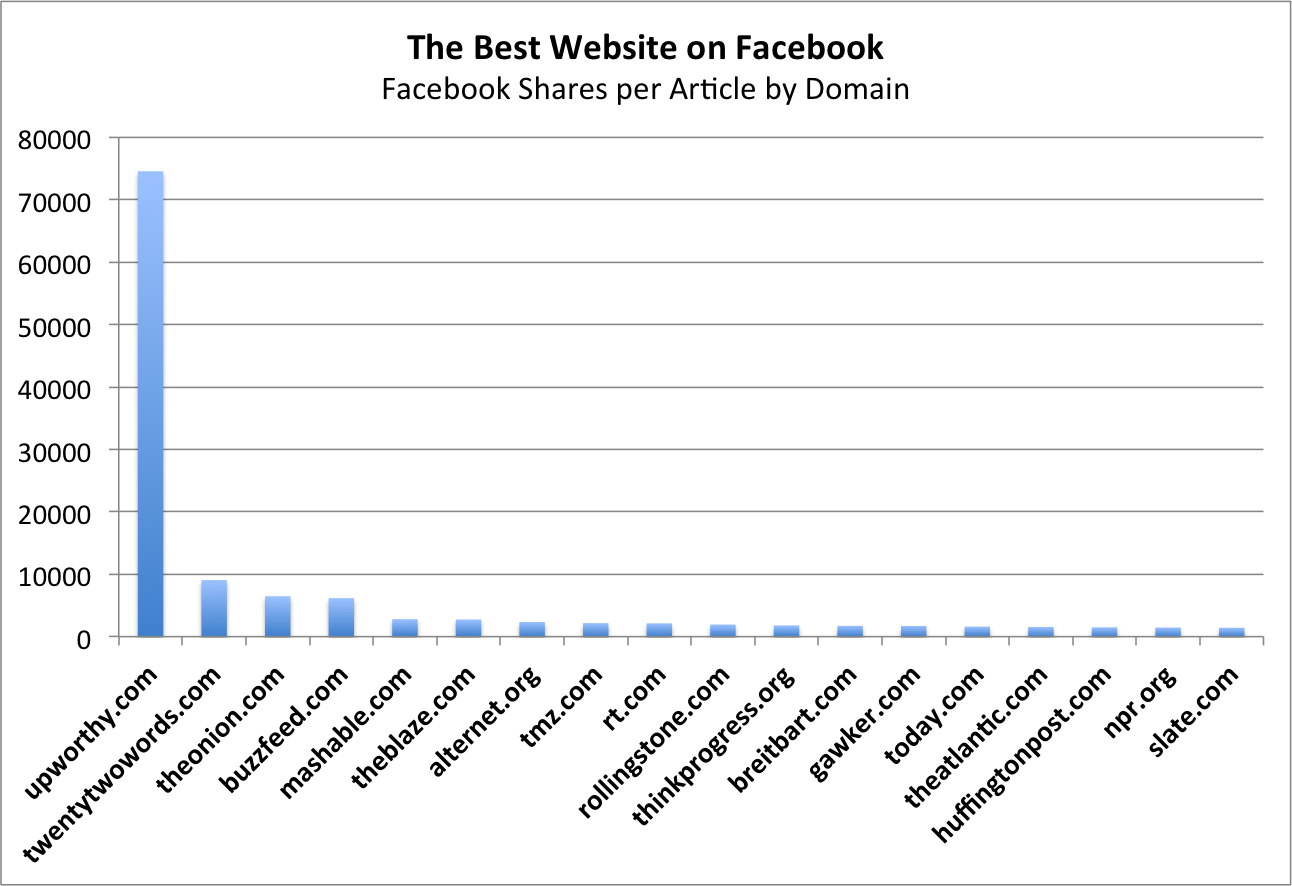
Derek Thompson passes along the above chart on viral traffic:

The most impressive thing about Upworthy is that it publishes just 225 articles a month, according to this data. That’s one for every 508 articles on Yahoo! The site is so much more dominant than other news sites on Facebook that when you graph its Facebook-shares-per-article, it looks like a skyscraper dropped into a desert. Upworthy averages about 75,000 Facebook likes per article, 12x more than BuzzFeed.

Ezra Klein ponders this fact:

The question Upworthy’s success raises is whether there are negative returns to posting so much content. Perhaps the time spent producing thousands of articles, most of which have very slight readership, would be better spent producing hundreds of articles more thoughtfully because more will go wildly viral. Lower content expectations give writers more time to find amazing stories, to get amazing quotes, to come up with amazing headlines.

Or so goes the theory. Certainly a lot of writers would like to believe that. But what Upworthy is doing isn’t giving writers a lot of time to create content that may or may not cohere into something that could go viral. They’re giving writers a lot of time to find content that they’re pretty sure will go viral. If you want to find something that will go nuts on Facebook, time spent sorting through what already exists is likely a lot more efficient than time spent creating something from scratch. It’s entirely possible that if a place like The Post attempted to ratchet back on content expectations they would end up both with less content and less virality.

Drum notes that Upworthy’s much remarked upon headlines are often misleading:

Upworthy’s headline-writing black magic has become endlessly talked about as the apotheosis of our modern, millennial, warp-speed, social-media driven culture. But you know what it reminds me of? Supermarket tabloids.

The supermarket tabs aren’t what they used to be, but back in their heyday this was their meat and drink. Every issue featured half a dozen titillating headlines on the cover that sucked you into a story on page 24 that was….usually kind of meh. They did their best to hide this, of course, but most of the time their headlines turned out to be come-ons that ultimately ended in disappointment. Still, you never knew if the next one might be the real deal. Hope springs eternal, so you kept coming back for more.

Other things in the same category: The New York Post. Modern movie trailers. Ron Popeil infomercials. British tabloids. Porn spam. TED talks.

Yglesias zooms out:

From a business viewpoint, I think an important point to make about this is that “viral” basically just means “is popular on Facebook” since Facebook is really the only host for viral content that matters. And that in turn means that all the viral traffic a website gets is really Facebook‘s traffic. It’s been clear for a long time now—like going back to well before there was an Internet—that journalism just isn’t that popular. Most households in the New York City metro area never subscribed to the New York Times, for example. Facebook, by contrast, is something that people really like. So since Facebook is so much more popular than journalism, it turns out that the most popular kind of journalism is Facebook content.

But this is still really Facebook’s traffic. Not just in the sense that Facebook can always tweak the algorithms that determine what plays well on Facebook, but in the sense that whatever economic value is created by “viral” content will ultimately be captured by Facebook. If you want to advertise to an audience of people eager to consume Facebook-friendly content, after all, the logical place to do that is on Facebook.
What Obamacare Doesn’t Cover

Steinglass unsurprised that many Obamacare plans have high out-of-pocket costs:

Obamacare’s design all but guaranteed limited choice and high out-of-pocket expenses. The insurance sold on the exchanges must comply with many rules: plans must cover a long list of “essential health benefits”, must not charge more to sick patients and must have a set “actuarial value”. (An actuarial value of 60% means that, for an average person, the health plan will cover 60% of health costs. The patient will have to cover the rest from his own pocket.) Obamacare plans are classified as bronze (60% actuarial value), silver (70%) or platinum (90%). These standards make it easier to compare one plan with another. But they also give insurers relatively little room to differentiate their products. To compete on sticker price, they have to cut costs. They typically do this by restricting choice and bumping up deductibles and co-payments.

Cohn worries about these costs:

The trend towards higher out-of-pocket expenses is nothing new. As the Kaiser Family Foundation’s Larry Levitt pointed on Monday, via his Twitter account, it’s been happening even in employer plans, although the amounts are typically lower. And people always have the option of getting policies with lower out-of-pocket expenses. Those policies, which typically fall into the “gold” and “platinum” categories, will cost more in premiums. That’s the fundamental trade-off here: You can pay more upfront, in premiums, or risk paying more later, in out-of-pocket expenses. Of course, that’s difficult for many people at low incomes, even with subsidies, which is why lawmakers should bolster the law’s subsidies and tighten those out-of-pocket limits even more.

What are the chances of that happening anytime soon? Pretty slim. Partly that’s because bolstering the law’s protections would require money, which would require either raising taxes or pushing harder on the health care industry—both defensible, but both difficult politically. The other is that most conservatives don’t actually have a problem with insurance that leaves people exposed to such high medical bills. In fact, this has been one of the most aggravating parts of the Obamacare debate: Conservatives frequently criticize Obamacare because, they say, it forces people to buy more insurance than they want. The minimum requirements, they say, should be lower. But, as the new Avalere analysis should remind everybody, the standards are already weak. How much more threadbare could the minimalist plans be?

A Godless President?

Atheist Vote

Isaac Chotiner suspects that America is ready for an atheist candidate:

A Gallup poll from 2012 … showed that only 34 percent of Americans know Barack Obama’s religion. (Some people think he is Muslim; others are not sure.) If that’s the case—and there has been a lot of coverage of the president’s faith—isn’t it at least possible that an atheist could be elected? I agree that there will be challenges, and while it wouldn’t be smart to go after someone directly for their atheism, perhaps “values-based” attacks would have more currency. Moreover, I think this imaginary atheist politician would have to be someone well established—someone the American people felt comfortable with. But if, say, John McCain or Hillary Clinton announced that while they respected Christianity and faith, they no longer believed in God, well, I think they could still get elected. (Winning a Republican primary would be the problem for McCain.) And remember, despite my caveat about the politician having to be well-known and not at all mysterious, it was also assumed that the first black president would be someone “proven” like Colin Powell. Five years before his election, Barack Obama was virtually unknown.

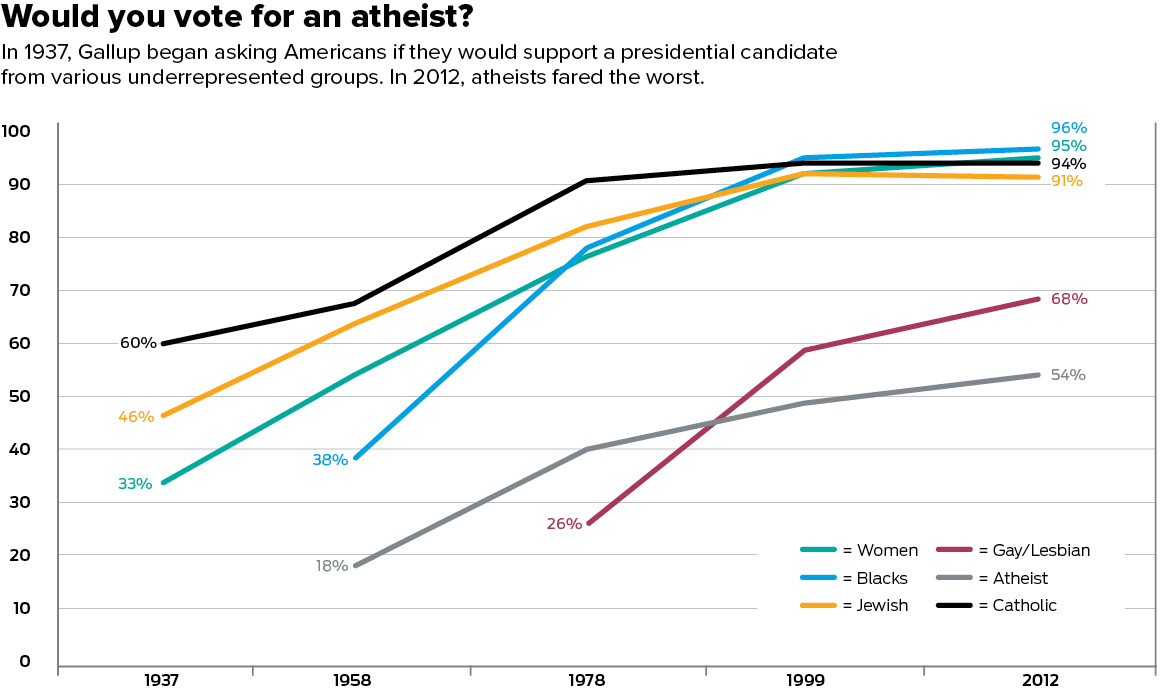
Jennifer Michael Hecht, who provides the chart above, wants atheist politicians to speak up:

Melody Hensley, the chief executive of the Washington, D.C.-based nonprofit Center for Inquiry, says she knows closeted atheists in Congress and believes it would help immensely for some of them to come out. We had a near miss with Rep. Kyrsten Sinema (D-Ariz.) when she was elected a year ago, Hensley sighs. Although 10 other members of Congress declined to specify their religious affiliation, Sinema was the only one to list “none.” Atheist groups celebrated—prematurely, it turned out. Sinema’s office quickly issued a clarification: “Kyrsten believes the terms non-theist, atheist, or non-believer are not befitting of her life’s work or personal character.”

Hensley shared with me a Facebook exchange she had with Sinema shortly thereafter, in which Hensley told the congresswoman her statement seemed to denigrate atheism and that the statement seemed cowardly. Sinema replied that she would not use that language in the future but protested: “I am not a theist, nor am I a nontheist. I don’t like labels.”

A Deal To Keep The Lights On

Suzy Khimm analyzes the budget deal proposed by Democratic Senator Patty Murray and GOP Congressman Paul Ryan:

Ryan and Murray had more maneuvering room as Congress has been almost entirely consumed with the fight over Obamacare. But their new comity was also possible because the bar was set so low. Congress and the White House have all but given up on reaching a long-term deficit reduction deal that it was originally aiming for. Instead, they entirely avoided touching major entitlement and tax programs—the biggest and most controversial sources of deficit reduction.

J.P.P. at The Economist chimes in:

There is one politically difficult thing in the agreement: federal workers will have to contribute more towards their pensions. But for the most part this is a deal that succeeded because it does not require either side to make meaningful compromises, in the sense of giving up something which is dear to them. The process that led to the deal is welcome. This is the first budget conference since 2010: in the intervening years there seemed no point in holding one as the two sides were so far apart. The substance, though, is not much more than an agreement to keep the lights on. That ought to mean it can get past Congress, where House Republicans are unlikely to bring on another government shutdown while they are having such fun with Obamacare.

Josh Green is unsure what Congress will do:

[T]his deal could easily fall prey to the same forces that wrecked earlier agreements: hardline conservatives.

The Ryan-Murray deal would raise 2014 spending to $1.012 trillion, instead of $967 billion. It also includes $23 billion in additional deficit reduction meant as a sop to hardliners, although this doesn’t appear to be doing the trick. The conservative pressure group Heritage Action called the agreement “a gimmicky, spend-now-cut-later deal will take our nation in the wrong direction.” Mark them down as a “no.” And because the Ryan-Murray deal is an ordinary bill, and not a special resolution, it’s subject to a filibuster. So Texas Sen. Ted Cruz may already be warming up his vocal chords.

Tomasky’s view:

Right now, the arbiters of the conventional wisdom are agreed that the Republicans under no circumstances would risk or permit another government shutdown. They’re probably correct. But the drumbeat on the right, especially on the talk-radio right, is likely to be that this deal is a win for the big-spending Obamabots, and if that’s the message, then support in the GOP House could vaporize pretty quickly. January 15 is a long way away. Will the hard right risk another shutdown over $45 billion? That is going to be the question. Don’t believe—yet—anyone who tells you they know the answer.

Suderman’s two cents:

Republicans on the Hill are still familiarizing themselves with the details, and they’ll no doubt find more than a few elements they dislike. But they may learn to live with it anyway. As I heard one GOP legislator describe it shortly after the announcement, the deal is simulataneously not so great and likely the best deal that Republicans can get.

Ezra wishes the deal included an unemployment insurance extension:

Democrats wanted to add unemployment insurance to the deal but found Republicans implacably opposed. Which is to say that Republicans were able to add extra deficit reduction to the deal but Democrats weren’t able to add help for the long-term unemployed to the deal. It’s a reminder of where the political system’s priorities are — and a reminder that they’re grossly out of line.

And Sarah Binder skeptical that this deal will lead to more deals:

[W]ill the bipartisan spirit that produced this deal portend additional bipartisan deals around the corner?  I’m doubtful.  Breaking the cycle of budgetary brinkmanship does not yet seem to have resolved bicameral differences elsewhere on the Hill.  Even a pared back defense bill (cobbled when GOP senators blocked progress on a broader annual bill) faces an uphill battle towards enactment.  More likely, the mini-deal is emblematic of legislative battles in polarized times: Parties come to the table only when the costs of blocking an agreement are too great to shoulder. And even then, parties will give up as little as necessary to avoid the sometimes painful consequences of stalemate.

What’s The Harm In A Handshake?

The Official Memorial Service For Nelson Mandela Is Held In Johannesburg

Uri Friedman yawns at Obama shaking Raúl Castro’s hand at Mandela’s memorial service:

Raul Castro greeted Obama’s election in 2008 with enthusiasm, noting that the newly elected president seemed “like a good man” and that Cuba was open to talks with the U.S. about “everything” (Castro’s daughter even endorsed Obama during the 2012 election—to the delight of Mitt Romney supporters). Raul’s brother Fidel was initially a supporter as well but has since grown disillusioned, asserting that a “robot” would do a better job running the United States. Obama, for his part, has lifted some restrictions on travel to and financial transactions with Cuba, but the embargo remains firmly in place and the two countries still don’t have diplomatic relations.

In other words, the exchange of a handshake and pleasantries at a memorial service is unlikely to move the needle on U.S.-Cuban relations. But if the White House doesn’t go through Clinton administration-like contortions to explain the encounter, it might be fair to conclude that shaking hands with the Cuban president just isn’t as big a deal as it used to be.

Larison agrees:

It’s worth remembering that there are any number of petty dictators and kings around the world that receive much more from the U.S. than a presidential handshake, and if one wants to direct irate criticism at U.S. coziness with authoritarian rulers it would be a lot more productive to start there. As for the handshake itself, it is an almost completely empty gesture that would have gone unnoticed but for the fact that the U.S. perpetuates an outdated and pointless embargo of Cuba. The only reason that it is remotely newsworthy that two heads of state greeted one another at another leader’s memorial is that our Cuba policy is such a useless Cold War relic.

Yglesias joins the chorus:

American policy toward Cuba is like a textbook example of something that doesn’t work. It succeeds in making Cuba a bit poorer than it would otherwise be, and in marginally inconveniencing American citizens but it is pretty clearly not an effective tool for ending Communism. Indeed, Communism ended—more than 20 years ago!—in Eastern Europe without the Soviet Union and its European satellites being subjected to this kind of comprehensive trade embargo. In parallel, Communist regimes in China and Vietnam have altered their domestic economic policies of their own volition since it turns out that orthodox Marxist-Leninist economic management doesn’t work very well.

People should be able to visit Cuba as tourists if they want to. Via direct flights from Miami and Newark and wherever else. And people should be able to go to a store and buy a Cuban cigar or some Cuban rum or whatever. If the Cuban government wants to prevent that, they should be the ones putting travel restrictions in place. They’re the Communist dictatorship, after all. We’re supposed to be the free country. Everyone knows this policy doesn’t work, but nobody wants to admit it.

But Eli Lake suspects that little will change:

“There has been a string of emissaries, both private citizens and Latin American leaders, who have begun to nudge Obama forward on engaging in talks with Cuba and also carrying a message from Castro that he’s willing to talk,” said Steve Clemons, a senior fellow at the New America Foundation who has exceptionally close ties to the Obama White House and accompanied Vice President Biden on his recent tour of East Asia.

But despite these private signals and messages, the relationship may not be ready for a thaw. Indeed, on Tuesday, as Obama and Castro shook hands in South Africa, authorities detained about 20 dissidents in Havana who gathered to demonstrate on International Human Rights Day. While human rights have not appeared to be a factor in the U.S. outreach to Iran in recent weeks, they remain at the center of U.S. policy goals for Cuba. The 1996 legislation that codified the U.S. embargo of the island, known as Helms-Burton, explicitly says the embargo shall not be lifted until Cuba releases political prisoners and holds free and fair elections.

Chait is embarrassed at McCain’s comparison of Obama with Neville Chamberlain:

[H]ere is John McCain, respected foreign-policy voice and recipient of 60 million votes for president, rambling bizarrely that he would not have shaken Castro’s hand because “Neville Chamberlain shook hands with Hitler.”

Well, okay, yes he did. And yes, Castro and Hitler are both dictators. Here are a few differences:

1. Cuba poses just a wee bit less of a military threat to its neighbors than Nazi Germany did in 1938.

2. The problem with Chamberlain’s negotiating strategy was not that he shook Hitler’s hand.

3. Castro is not promising that, in return for a handshake, he will refrain from invading our allies.

(Photo: U.S. President Barack Obama shakes hands with Cuban President Raul Castro during the official memorial service for former South African President Nelson Mandela on December 10, 2013 in Johannesburg, South Africa. By Chip Somodevilla/Getty Images)


Stopping The Next Crisis Before It Starts?

Yesterday, regulators finalized the Volcker rule, which is intended to prevent banks from engaging in certain types of risky behavior. Neil Irwin explains the rule:

It is part of the Dodd-Frank financial reform act that passed in 2010 that aims to prevent giant banks from engaging in speculative trading activity. The idea is that, while it is important for banks to support the economy by lending to consumers and businesses, when they get into the realm of making bets in exotic financial markets — known as proprietary trading — they aren’t really doing anything to support the economy. But trading for their own accounts does risk their own solvency in ways that could lead them to fail and necessitate a costly government bailout. In short, the theory is: You can speculate on financial markets. Or you can have a government safety net. But you can’t have both. …

The rule isn’t enough to prevent any future crisis, certainly. Banks have shown plenty of ability to get into trouble with strategies that have nothing to do with proprietary trading. For example, nothing about these rules would stop a bank from making crummy mortgage loans. But it is certainly plausible that this will choke off one route by which the biggest banks could come into danger of triggering another financial crisis.

Matt Levine weighs in:

The Volcker rule was supposed to shut down proprietary trading desks, and it basically already has. The Volcker rule was not supposed to shut down market making and hedging, which are risky and proprietary and complicated and all that good stuff, but which are also both economically important and specifically allowed by Congress. That’s a simple sentence to write, but a hard thing to make happen. The final rule is 978 pages long, but it’s not a bad effort at achieving that simple result.

Mike Konczal defends the rule:

The problem there is that lending to households and businesses is the core function of banking. And there are good reasons why banks provide this service instead of other types of firms. For instance, funding increases as relationships between firms and creditors evolve (for more, see Fama 1985 or Petersen and Rajan 1994). So other firms can’t easily do what banks do when it comes to lending. But other firms can definitely engage in proprietary trading—including hedge funds, mutual funds, sovereign wealth funds and others. So if proprietary trading does have any benefits to society at large, there’s nothing to worry about. It will still take place. On the other hand, if banks are prohibited from lending, it’s not clear that other institutions could pick up the slack.

Simon Johnson is withholding judgment:

The Volcker Rule could be a major contribution to financial stability. Or it could still flop. The devil now is in the details of implementation and compliance – and how much of this becomes public information and with what time lag.

David Dayen also looks at implementation:

“The truth is that this is kind of the end of the beginning,” said Marcus Stanley of Americans for Financial Reform. The regulators must now set out guidelines for market-making, hedging and other bank activities, collecting data and developing more specific parameters for what gets prohibited. And they agreed to delay actual enforcement of the rule until July 2015. This gives banks time to open more loopholes, adjust to the requirements and ready lawsuits. Already, loopholes have been uncovered allowing banks to trade foreign sovereign debt and invest in small hedge funds, which could result in risky trading merely shifting to other areas rather than being stamped out.

Stanley worries that, as the fight shifts to implementation, regulators could shield the data from public view, designating it “confidential supervisory information.” That means we may not really know whether or not the Volcker rule is working.

Jonathan Weil expects the rule to have little effect:

[T]here’s some merit to having a ban: Lots of people dislike the idea of banks gambling with federally insured customer deposits, because they might blow themselves up and either cause damage to others or require a taxpayer bailout. But once you get into the weeds, there’s always a workaround or a nasty, unintended consequence of one sort or another. Old-fashioned lending often may be riskier than betting it on prop trades anyway. It could take years before regulators figure out the full effects of all the wonderful little loopholes that well-paid bank lobbyists worked into the language. Even if the rules were flawlessly written — and they never are — there is the matter of whether they will be enforced consistently, which they tend not to be from one administration to the next.

Yglesias bets that the rule will be weakened over time:

The way the regulatory state works is that first congress writes a law, then regulators write a detailed rule, and then people who think the rule is unfair to them get to sue and get judges to throw the rule out. If you’re some kind of bank regulation junky who thinks the rule is too kind to banks, you do not get to sue and get judges to make the rule stricter. This is one of a dozen of reasons why “judicial nominations” matter for more reasons than “the Supreme Court rules on abortion rights.” There’s an ongoing fight in Congress about appointees to the D.C. Circuit Court which is rich in regulatory implications, of which the Volcker Rule battle is one.

And Stephen Mihm notes that it could take a long time to see whether the rule is working:

And therein lies a lesson about post-crisis regulation. In the chaos of a financial crisis, never mind its aftermath, it’s easy to jump the gun and impose regulations that satisfy the urge to “do something” yet achieve little to address the underlying causes of the disaster. The resulting regulation can deliver benefits, or it can be counterproductive. Or both. But neither outcome is dependent on a correct reading of the causes of the crisis. This will probably be true of the Volcker rule, too: It will be judged not on whether it was a logical response to what happened, but whether it ushers in a new era of financial stability. On that question, we may have to wait years for a clear answer.

The Oscars Suck

Daniel Carlson details one of many reasons:

[A]wards coverage treats movies as if they exist only for the few weeks at the end of the year when studios put out “prestige” titles that are designed to capture award nominations. There’s no real secret to why they put out these movies at the end of the year: our brains look more fondly on recent experiences, so studios want films to come out as close to the nominating cycle as possible. There’s also a self-fulfilling prophecy involved; since the end of the year is now associated with award contenders or prestige titles, releasing your movie at that time can give you a subconscious boost in the mind of the voter. But movies exist long after a particular awards season has ended. That’s why the notion of “great movie years” is flawed; it assumes that, e.g., Inside Llewyn Davis exists solely as an artifact of 2013 that was created to compete in a few arbitrary competitions, instead of treating it as a film that anyone can watch at any time going forward. It’ll still exist next summer, and the year after, and ten years from now, long after we’ve forgotten every fleeting pop culture story from the 2013 awards.

And then there’s the hathos of many of the hosts.

The Ghost On The Page

Alex Mayyasi explores the economics of ghostwriting and ends up defending the practice:

Jay Leno does not write his own jokes and a team of writers work on sitcom scripts. Even if books have been a more independent pursuit, every writer depends on the help of an editor whose impact on the book – cutting large sections, reorganizing, suggestions plot changes – can be substantial. Researchers are also a regular part of writing a book in both fiction and nonfiction. Ghostwriting may be an extreme case, but every book is a team effort and few writers are responsible for every single word and idea in their books. Is it more deceitful to name someone who did none of the writing an author or to give so much credit to the author in the first place?

A major benefit of ghostwriting is that it allows stories to be told that would not otherwise.

Few major public figures could write books themselves – their stories are only published because professionals step in to write them down. Even if the existence of multiple Justin Bieber memoirs does not feel like a service to the publishing world, it at least helps the bottom lines of the same publishers taking a chance on the next David Mitchell or Cormac McCarthy. It is also an open question whether ghostwriting denigrates the actual writers or celebrates their skill. Nondisclosure agreements and cryptic mentions in the acknowledgements are not signs of respect. But established ghostwriters are recognized as skilled professionals. And while ghostwriters often get asked to write at below a living wage, ghostwriting can also be one of the few ways to make a good salary writing full-time short of being a perennial bestseller.

It can also be quite enjoyable. William Novak described himself as “spoiled” by all the “wonderful people [he’s] worked with.” Michael D’Orso, who dislikes the term ghostwriter but collaborates with major figures, described in an article how “you can’t be more alive than when you’re climbing into other lives in other worlds.” Sally Collings told us that ghostwriting allows her to focus on the writing and editing part that she enjoys without having to deal with the marketing aspects that she does not. “People often ask when I will write my own book again,” she told us. “I feel like I do all the time. I have a secret sense of ownership.”

Keeping An Eye On India

INDIA-KASHMIR-UNREST-BSF

Oliver Turner chides analysts for overstating the Chinese military threat while ignoring similar issues elsewhere in Asia:

India consistently devotes a larger proportion of its GDP to its military than does China; for the past five years it has been the world’s largest importer of weapons, and it is expected to be the fourth largest military spender by 2020. Yet a new Indian aircraft carrier is immediately considered a welcome development, while in the case of China we are grimly told it is “not time to panic. Yet.”

Importantly, the more we assume that China is a probable instigator of hostility and even war, the more we ready ourselves for that eventuality. Indeed, the “China factor” is used to justify efforts by India, as well as Japan, the Philippines, Taiwan and others, to bolster their defense capabilities, leading to increasing tensions across a highly sensitive region. The “China factor” has also been used to rationalize the United States’ recent “pivot” (or “rebalancing”) towards the Asia Pacific. China is becoming a bigger threat, the logic goes, so others should prepare.

Yet we should also recognize the potential effects of an “India factor” in China and that the actions of others will not go unnoticed in Beijing. In consequence we risk trapping ourselves in a self-fulfilling prophecy of Chinese aggression. We may, in other words, end up literally imagining a threatening China into existence and through our ideas and actions become faced by the fictional demon we feared all along.

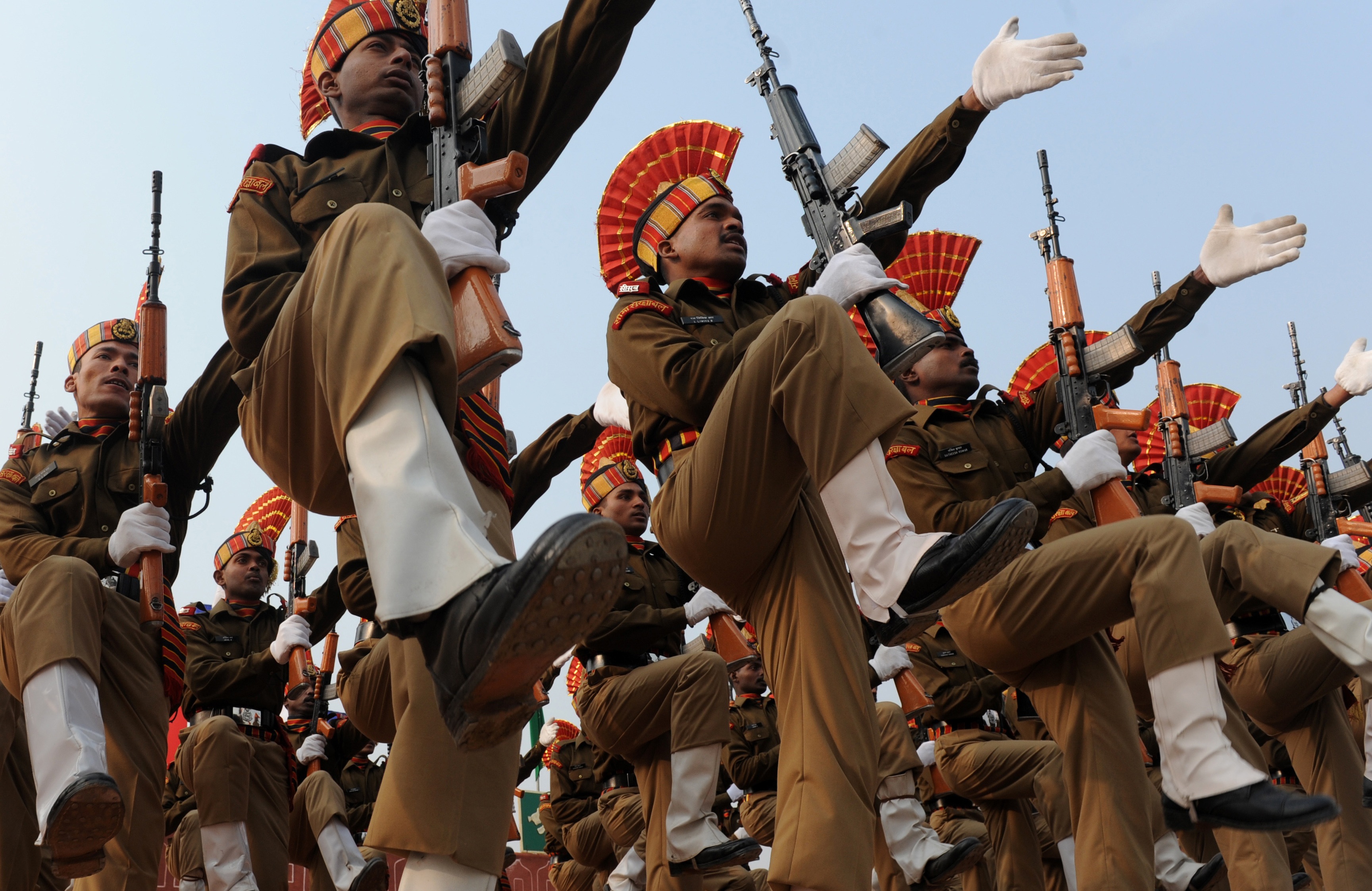
(Photo: Indian Border Security Force (BSF) recruits march during their passing out parade in Humhama, on the outskirts of Srinagar on December 6, 2013. Some 342 new recruits were inducted into the force which is fighting an insurgency in Kashmir. At least 47,000 people have died as a result of the insurgency in highly militarised Indian Kashmir, according to official count with separatists putting the toll twice as high. By Rouf Bhat/AFP/Getty Images)

The Other Cannabis Cash Crop

Nora Caplan-Bricker discusses how legalization may herald a renaissance for hemp in America:

Colorado’s new law is reaping other changes, too, among them the first legal crop of hemp that America has seen in nearly 60 years. Hemp is a cannabis plant, as is marijuana, but it contains almost none of THC, the component that gives pot its potent effect. Still, hemp—which can be used in “products from rope to auto parts to plastics, shampoo to vitamin supplements”—has paid for the stigma attached to its sister-plant: Though it is legal to buy and sell hemp in the U.S., growing and harvesting it have been prohibited. In every state that discusses legalization, hemp’s economic potential comes up: Data from Canada’s legal hemp industry suggests the crop yields revenue of $390 an acre, and the Hemp Industries Association estimates that products from the forgotten cannabis already constitute a $500 million industry in the U.S., according to The Denver Post. “I think that once people see the value of hemp, it’ll become a no-brainer,” said farmer Ryan Loflin, the Colorado man who has already planted 60 acres of the plant.