Falling In Love With The One-Armed Bandit

Anthropologist Natasha Dow Schull talks about her research on gambling addiction:

New kinds of machines are key. With multi-line slot machines, say you put in a hundred coins. If you’re betting on 100 lines of play, you’ll always ‘win’ something back. If you put in 40 coins and get 30 back, that’s a net loss, a ‘false win’, but the machine responds as if you’ve won: The lights go off, you get the same audiovisual feedback. Almost every hand, you get the same result— there are no dry spells.

On the attraction of slot machines, which account for 80 percent of casino revenue in Las Vegas:

Even though slot machines are considered to be a light form of gambling due to their relatively low stakes, ease of play and historical popularity with women, they are actually the most potent. There are three reasons why: Playing on slot machine is solitary, rapid, and continuous. You don’t have interruptions like you would in a live poker game, waiting for cards to be dealt or waiting for the other players. You can go directly from one hand to the next—there’s no clear stopping point built into the game. You don’t even have to stop to put bills in the machine; the machines take credit or barcoded tickets.

What Mandela Asked Of His Oppressors

Beinart criticizes the media for glossing over it:

Mandela refused to grant legal absolution to the perpetrators of apartheid’s crimes until they publicly confessed their guilt. In the run-up to South Africa’s first free elections, de Klerk granted clemency to 4,000 members of the South African police and security services. But after winning those elections, the ANC overturned de Klerk’s action and created the Truth and Reconciliation Commission, which required detailed, public confessions by anyone seeking amnesty. In the words of Mandela ally Bishop Desmond Tutu, who ran the Truth and Reconciliation Commission, A group of American and South African students, aged from 11 to 19, met with Nelson Mandela at the Nelson Mandela Foundation in Johannesburg, on 2 June 2009. This is part of a series of activities ahead of Mandela Day on 18 July.“True reconciliation exposes the awfulness, the abuse, the hurt, the truth…because in the end only an honest confrontation with reality can bring real healing. Superficial reconciliation can bring only superficial healing.”

Why, in recent days, has the American media focused so much more on Mandela’s capacity for reconciliation than his demand for truth? Perhaps it’s because, all too often, America wants reconciliation without truth itself. Americans want Iran to give up its nuclear weapons program, halt its support for terrorism, and embrace democracy, but when President Obama acknowledged America’s role in subverting Iranian democracy during the Cold War, conservatives flayed him for apologizing for America. In 1995, the Smithsonian was forced to cancel an exhibit on the bombing of Hiroshima when politicians and veterans’ groups called it unpatriotic.  In 2010, Obama slipped an apology to Native Americans into that year’s Defense Appropriations Act but didn’t hold a public event to announce it or even issue a press release, presumably because he feared the political consequences of being accused of running down America again.

And let’s not even talk about the Bush-Cheney war crimes. Some truths have to be suppressed for generations.

The Sticker Price On Medical Care

Drum notes that hospitals “routinely charge uninsured patients rates that are 3-4x higher than those paid by insured patients”:

It’s shameless and obscene. It’s like kicking a beggar and stealing his coat just because you know the cops will never do anything about it. This is something that Obamacare goes a long way toward fixing. If you’re covered by private insurance through an exchange, you’re not just protected against catastrophic illness. You’re also protected against being charged outrageous rates for non-catastrophic problems—broken legs, asthma attacks, etc.—just because hospitals have the brute power to do so.

New ACA regulations are also supposed to combat this problem. Steven Brill explains:

Section 9007 of the Affordable Care Act instructs the Internal Revenue Service to take away the tax exemption for nonprofit hospitals like Yale–New Haven unless they become aggressive about informing patients clearly of the availability of financial aid and take steps to learn whether patients need such assistance before they hand over their bills to lawyers or debt collectors.

More important for Gilbert and hundreds of thousands of patients like her, Section 9007 says the IRS can now take away a hospital’s tax exemption if it tries to charge patients who needed financial aid more than the average amount paid for services by insurance companies and Medicare. In other words, hospitals cannot try to make people like Gilbert pay the inflated chargemaster prices.

But, for some reason, these regulations have yet to be implemented:

Since Obamacare was signed into law, there have been more than 3.5 million personal bankruptcies filed in the U.S. Some 60%, or more than 2 million, are estimated to have involved medical debt as a key factor. So the delay in writing these regulations has likely had an enormous toll in bankruptcy filings and in damaged credit ratings.

Relatedly, Evan Soltas considers why emergency rooms charge such high prices for minor procedures:

One candidate is that emergency rooms have high fixed costs. It makes no difference whether the patients who turn up in the ER have life-threatening conditions that require medically complex care, or whether they’re there for a few stitches. The staff is on hand 24/7, along with suites full of expensive equipment, sufficient to handle the most serious cases. You pay for all that whether you need it or not. The itemized bills that [Elisabeth] Rosenthal mentions are misleading.

And here’s another way of looking at it. It’s not as though the actual value of a single stitch is $500. Rather, that price reflects the opportunity cost to the hospital of treating you rather than someone with graver (and more expensive) medical needs. And that opportunity cost could very well be thousands of dollars, even for just an hour of medical attention. A recent study in Health Affairs found that between 13.7 percent and 27.1 percent of emergency room visits could have been safely managed at retail clinics and urgent-care centers, saving $4.4 billion a year.

“Reverse Product Placement”

Landon Palmer wonders whether “the extensive viral and cross-promotional marketing of Anchorman 2: The Legend Continues might be more innovative than it initially seems”:

What’s striking about the exceeding cross-promotion for Anchorman 2 (in both conventional and viral ads) is that it seems to have entirely replaced direct advertising for the film itself. Having not yet seen it, I have no way of knowing whether the movie actually incorporates any of these products besides Paul Rudd’s [Jockey-made] “retro-briefs” …. But if the film utilizes relatively little product placement, and presents its few niche products solely in a winking, self-reflexive manner, then Anchorman 2 will have achieved something altogether different in the evolving conflict between advertising and filmmaking: reverse product placement.

“This might be good for moviegoing,” continues Palmer:

If the primary complaint about the relationship between advertising and filmmaking is the conspicuous placement of products in films, then a close second is the way that films themselves are advertised. Roger Ebert likely wielded the biggest megaphone on this point, regularly voicing that movie trailers reveal too much information about the film itself, contributing to both the overcalculating tendencies of a risk-averse industry and a spectatorship anathema to the possibility of surprise. But if commercials for other products do the advertising for films, then reverse product placement can perhaps solve both of these problems: the ad/brand/product can be used to advertise the film (while not necessarily [being] incorporated into the film), and in return promotional efforts for the film itself won’t reveal every damn joke and plot point. … While one can easily grow tired of these cross-promotional efforts, they have no essential bearing on the film itself. Reverse product placement, then, offers Hollywood something that has long been missing: the potential for the actual movie to feel somewhat fresh and surprising when it finally hits screens.

A Poem For Monday

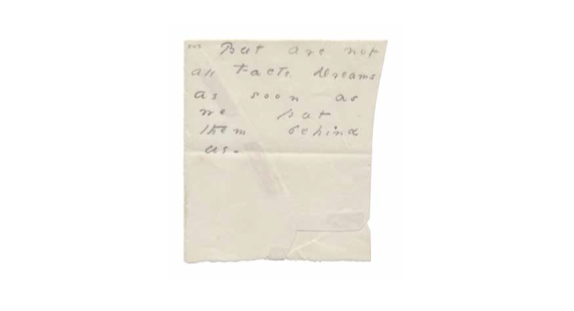
dickinson3

A third selection from Emily Dickinson’s newly published “scraps”:

But are not

all   Facts   Dreams

as    soon    as

we      put

them     behind

us—

More in this series here and here.

(From The Gorgeous Nothings by Emily Dickinson © 2013 by Christine Burgin and New Directions. Transcription images copyright © 2013 by Jen Bervin and Marta Werner. Reprinted by permission of New Directions Publishing Corp.)

Would Math Exist Without Us?

Mathematician Edward Frenkel argues yes:

When Pythagoras discovered his theorem there were, of course, inferences from physical reality, and a lot of mathematics is drawn from our experience in the physical world, but our imagination is limited and a lot of mathematics is actually discovered within the narrative of a hidden mathematical world. If you look at recent discoveries, they have no a priori bearing in physical reality at all. The naive interpretation that mathematics comes from physical reality just doesn’t work.

The other interpretation that mathematics is a product of the human mind also has serious issues, because it seems clear that some of these concepts transcend any specific individual. Take Evariste Galois, who was killed in a duel at the age of 20. He came up with a beautiful theory on symmetry called Galois theory. His contemporaries didn’t get it but this theory now forms the core of modern mathematics. But what if the work had been burned? Would we never have known Galois theory? No. Someone else would have discovered it because it is inevitable.

The Land Without Internet

Chris Beam visits Aba County, a rural part of Sichuan province where rather than censor the Internet, the Chinese government has turned it off altogether :

Aba was first stripped of its connection in 2008, after riots in Tibet led to unrest in this place known for its wide grasslands and Buddhist monasteries. Both mobile phone signals and the Web have been erratic ever since, coming back for months at a time only to disappear again, usually after a Tibetan monk sets him or herself on fire in protest. For example, the Internet returned last December and January and then, according to residents, disappeared again in February. With politically charged “incidents” occurring as recently as September, no one knows when—or if—the information blackout will end for good.

Beam’s hosts explain what life is like for them:

Over tea, [22-year-old Shuangquan Zou] told me that he arrived in Aba last year and found the transition jarring. He had missed some big announcements—his friends threw a huge graduation party without him, because he never saw the invitation—and had trouble keeping in touch. Relationships, he explained, become stratified by communications tools: There are close friends and family, whom you call; less intimate friends, whom you text; then still less intimate ones, whom you message on QQ or WeChat. Removing social media doesn’t mean you start texting and calling those less intimate friends. It just means you lose touch.

Ask Rick Doblin Anything: How To Experience Psychedelics?

In our second video from MAPS founder Rick Doblin, he explains how patients should primarily guide themselves through a psychedelic experience, rather than rely too much on someone else (though it is important to have a sober sitter present to protect the person from the outside world). Doblin also shares an illuminating story about an Israeli who suffered PTSD after witnessing 10 people killed in a terrorist bombing:

From his bio:

Rick Doblin, Ph.D., is the founder and executive director of the Multidisciplinary Association for Psychedelic Studies (MAPS). He received his doctorate in Public Policy from Harvard’s Kennedy School of Government, where he wrote his dissertation on the regulation of the medical uses of psychedelics and marijuana and his Master’s thesis on a survey of oncologists about smoked marijuana vs. the oral THC pill in nausea control for cancer patients. His undergraduate thesis at New College of Florida was a 25-year follow-up to the classic Good Friday Experiment, which evaluated the potential of psychedelic drugs to catalyze religious experiences.

His professional goal is to help develop legal contexts for the beneficial uses of psychedelics and marijuana, primarily as prescription medicines but also for personal growth for otherwise healthy people, and eventually to become a legally licensed psychedelic therapist. He founded MAPS in 1986, and currently resides in Boston with his wife and three children.

Doblin’s previous answer about the myths surrounding psychedelics is here. Our extensive coverage of the spiritual and therapeutic benefits of psychedelics is here (or, in chronological order, here).