Detecting Anti-Semitism

photo (33)

There’s an app for that:

German police have developed a smartphone app that allows them to identify far-right rock songs by playing just a brief sample. … The interior ministers of the country’s 16 regional states will meet this week to discuss a new method dubbed “Nazi Shazam,” in reference to the mobile phone-based music identification service Shazam, which can identify music bands and song titles from a short sample picked up via the phone’s microphone. The new software would let police quickly identify neo-Nazi rock music.

“The whole situation sounds pretty insane to an outsider,” Victoria Turk says, “but apparently far-right music is a big problem in Germany, where it’s considered a ‘gateway drug’ into the neo-Nazi scene”:

The Guardian reported that in 2004, far-right groups even tried to recruit young members by handing out CD compilations in schools. That sort of action is illegal in Germany, where neo-Nazi groups are outlawed and the Federal Review Board for Media Harmful to Minors is tasked with examining and indexing media – including films, games, music, and websites – that may be harmful to young people. Just last year, the board indexed 79 songs for being too racist or neo-Nazi-ish, which means that under-18s can’t buy them. It’s also illegal to make those songs accessible to under-18s, hence the need to track music being played where young people might be present. With the app, a police officer’s smartphone microphone could detect the illegal track and help launch a quick investigation.

Alex Madrigal worries how similar technologies could be used in the US:

Perhaps you’ve heard of ShotSpotter? It’s a system that police have deployed in Oakland and many other places that provides “gunfire awareness” to police. Basically, a series of microphones listen for loud noises and use algorithms to provide police with all kinds of information. … Let’s imagine that police in one city or another start to correlate certain rock or hip hop groups with an increase in gunfire incidents in an area. Perhaps they might make the predictive leap to saying, “If we hear this kind of music at this time of night, we’re X percent more likely to see a gunfire incident.” After all, many people already think there’s a connection between Chicago’s homicide rate and Drill, the rap music that rose from the city’s South Side. Put machine intelligence (Shazam for Neo-Nazi music) and persistent surveillance (ShotSpotter) together, and you would have a powerful system that presents some very difficult problems for fairness and civil liberties.

In some countries, as the above photo from a reader demonstrates, detecting anti-Semitism doesn’t need an app:

Driving to a concert in Beirut tonight, we encountered this car. My wife took the picture. Bizarrely, next to the swastika is a for-sale sign.
Quote For The Day

“While the earnings of a minority are growing exponentially, so too is the gap separating the majority from the prosperity enjoyed by those happy few. This imbalance is the result of ideologies which defend the absolute autonomy of the marketplace and financial speculation. Consequently, they reject the right of states, charged with vigilance for the common good, to exercise any form of control.

A new tyranny is thus born, invisible and often virtual, which unilaterally and relentlessly imposes its own laws and rules. Debt and the accumulation of interest also make it difficult for countries to realize the potential of their own economies and keep citizens from enjoying their real purchasing power. To all this we can add widespread corruption and self-serving tax evasion, which have taken on worldwide dimensions. The thirst for power and possessions knows no limits. In this system, which tends to devour everything which stands in the way of increased profits, whatever is fragile, like the environment, is defenseless before the interests of a deified market, which become the only rule,” – Pope Francis.

Yes, It Gets Worse

US-POLITICS-CPAC

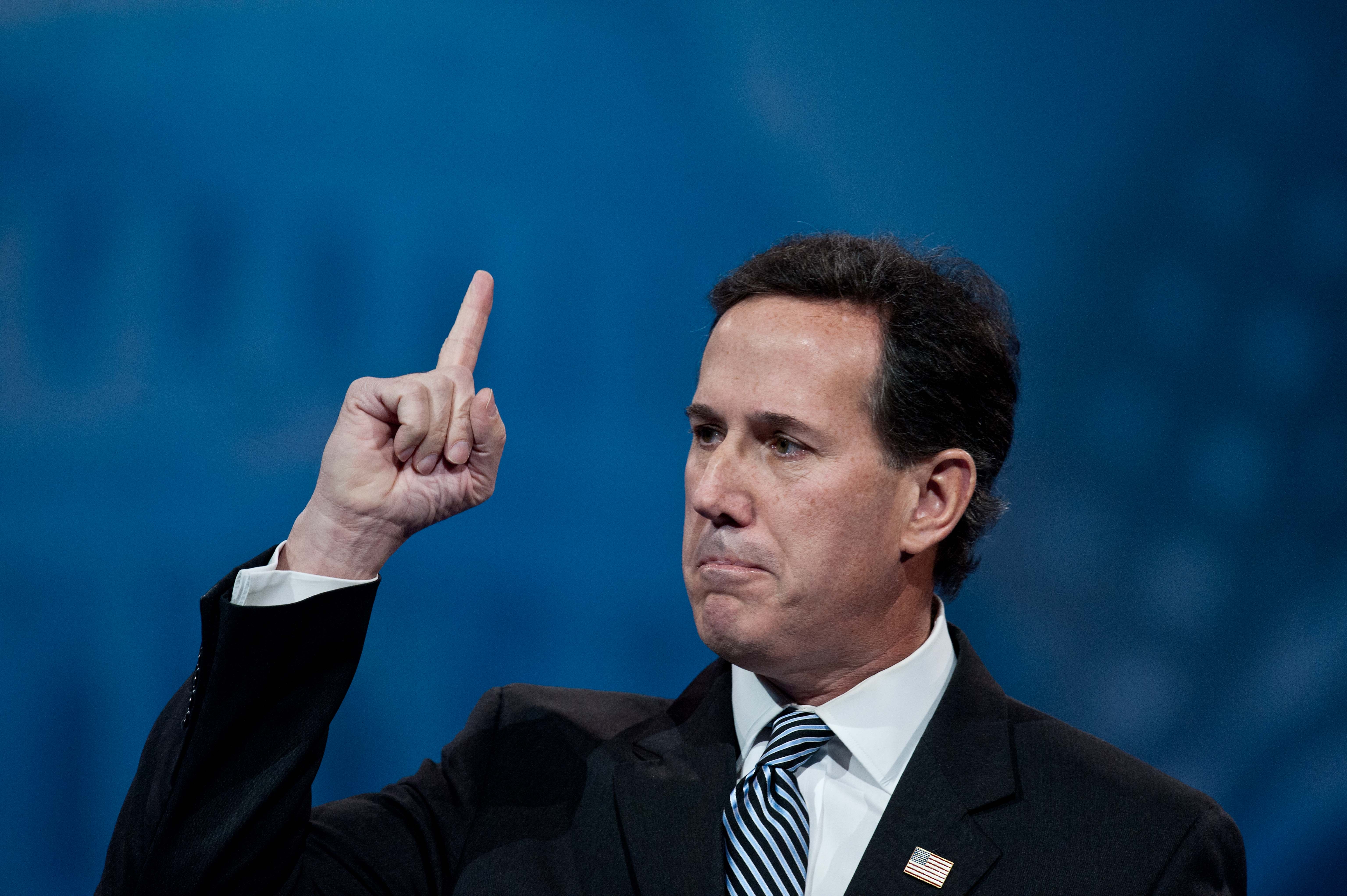
Rick Santorum, a Catholic fighting against universal healthcare, compares the Affordable Care Act with … apartheid:

[Mandela] was fighting against some great injustice, and I would make the argument that we have a great injustice going on right now in this country with an ever-increasing size of government that is taking over and controlling people’s lives — and Obamacare is front and center in that.

I just don’t know what to say about that. I really don’t. Except that Santorum’s mind is simply unhinged, and that the reflexive need to describe anything that this president has done as pure evil has become a kind of sickness of the mind and soul on the right. It has abandoned any connection to the real world. It lives in a narcissistic, warped, ideological echo-chamber of victimhood and utter obliviousness to the real tragedies of human history.

(Photo: Former US Republican Senator from Pennsylvania Rick Santorum speaks at the Conservative Political Action Conference (CPAC) in National Harbor, Maryland, on March 15, 2013. By Nicholas Kamm/AFP/Getty Images.)

Obama’s Nuclear Focus

David Kenner contends that the president’s foreign policy is best understood as a drive toward nonproliferation:

Obama’s non-proliferation agenda got off to a fast start in its first year, as the administration negotiated the New START treaty; held the Nuclear Security Summit, which included delegations from 47 countries across the world; and released a new Nuclear Posture Review, which called for reducing the role of nuclear weapons in U.S. national security strategy. In some of the global hotspots that concerned the United States, the focus on nuclear non-proliferation also took precedence over concerns about human rights or democracy promotion.

In Russia, Obama prioritized non-proliferation over concerns about Vladimir Putin’s crackdown on his domestic political opponents. “The nuclear issue is really important to his background,” Michael McFaul, the current U.S. ambassador to Moscow, told Mann for The Obamians. “He thinks you need a New START treaty, no matter whether the Russians are a democracy or an autocracy, because these are dangerous weapons and we’ve got to control them-and in a way, that’s a legacy from this 1980s era.” …

With the wind at the back of the president’s nuclear agenda, the stakes could extend far beyond Damascus or Tehran. The one notable exception to Obama’s non-proliferation agenda — so far – has been Israel, where this administration’s refusal to push for nuclear disarmament has led to charges of hypocrisy among both Arabs and Iranians.

Zachary Keck adds that it looks as though, despite some scary cases, nukes are not spreading very quickly:

[T]here has been an undeniable decline in the number of states interested in acquiring nuclear weapons.

Harald Muller and Andreas Schmidt have documented this well. In their comprehensive study of states with nuclear weapons activities between 1945 and 2005, they find that “states with nuclear weapons activities were always a minority, and today they are the smallest minority since 1945.” Specifically, in 2005 they identified 10 states as having nuclear weapons activities (including those with nuclear weapons), which constituted less than six percent of UN members. Today the only non-nuclear weapon state (NNWS) that might be interested in an atomic weapon is Iran.

The fact that states have by and large been uninterested in nuclear weapons is somewhat perplexing from a historic perspective. After all, what other revolutionary military technology hasn’t elicited strong interest from most states competing in the international system? At the same time, when one examines the properties of nuclear weapons more closely, the lack of interest is easier to understand. Nuclear weapons have basically served one purpose for states possessing them; namely, they have deterred others from challenging that state’s survival and other fundamental interests. But the nuclear era has also been characterized by a sharp decline in warfare and today fewer states face fundamental external threats to their existence. Given the high costs of building and maintaining a nuclear arsenal, it makes little sense to acquire nuclear weapons without such an existential threat.

The Story Behind A Shirt

This embed is invalid


Planet Money had t-shirts made so they could better understand where such clothing comes from:

The Planet Money men’s T-shirt was made in Bangladesh, by workers who make about $3 a day, with overtime. The Planet Money women’s T-shirt was made in Colombia, by workers who make roughly $13 a day, without overtime… With a long tradition of apparel manufacturing and better technology, the Colombians can make T-shirts much, much faster than the Bangladeshis can. In Bangladesh, on one sewing line for our T-shirt, 32 people can make about 80 shirts per hour. One sewing line in Colombia has eight people and can make about 140 T-shirts per hour. The two lines aren’t perfectly parallel — the Bangladeshi workers are completing a few more details of the shirt than the Colombians are. But the difference is striking nevertheless.

Yet Colombian manufacturers are losing business. Why? Labor costs, mainly:

Colombia’s economy has been growing like crazy for the past decade, and wages have been rising. That’s good for the country as a whole, but it may wind up driving away the T-shirt industry. ”There is a saying that is going to sound horrible,” Crystal’s CEO, Luis Restrepo, told me. “Our industry follows poverty.” It’s an industry “on roller skates,” he said, rolling from Latin America to China, to Bangladesh — wherever costs are lowest.

No Shelter For Gay Syrians

Haley Bobseine documents their plight, which includes horrific threats from both sides of the civil war:

As the violence in Syria continues unabated, many have retreated into their ethnic and religious communities for protection. Unlike other minority groups — such as Christians, Kurds, and Alawites — sexual minorities, notably gay men, do not enjoy the protection of any political, ethnic, or religious institutions. For gay Syrians, nowhere is safe: Across the country, they have been the target of attack by pro-regime militants and armed Islamist militias alike — at times because of their sexual preference; at other times simply because they are perceived as weak and easy to extort in the midst of a chaotic war …

Gay Syrians still in the country must not only evade discovery themselves — the capture of one of their acquaintances can also present a mortal threat. Amir recounts how one of his gay friends, Badr, was kidnapped this summer by Jabhat al-Nusra, which extracted information from him about other gays before executing him. “Several days later, Jabhat al-Nusra gathered people in the square and denounced another guy as a faggot,” says Amir. “They chopped his head off with a sword.”

Last month, Hannah Lucinda Smith interviewed gay Syrian refugees living in Beirut:

Life as a gay man in Beirut, where the gay scene is far more visible than in Syria, may be easier in many ways, but the city’s open and, at times, extravagant scene can also come as a culture shock. “Although Syria and Lebanon are neighboring countries, they are very different socially,” [psychologist] Patricia [el-Khoury] told me. “These guys have suddenly found themselves in a completely different environment. They are in a freer place, but often they are not prepared for it, so there is a tendency to go to extremes. There is a lot of prostitution on the gay scene in Lebanon, as well as drug use.”

What Climate Change Will Change

NASA’s Tom Wagner has a good primer:

Brad Plumer provides more details by digging into the new climate change report from the National Research Council:

The upshot? Earth is already seeing some abrupt changes, like the fast retreat of summer Arctic sea ice. There’s also a real risk that other rapid and drastic shifts could soon follow if the Earth keeps warming — including widespread plant and animal extinctions and the creation of large “dead zones” in the ocean. But other apocalyptic scenarios once thought plausible “are now considered unlikely to occur this century.” That includes shifts in Atlantic ocean circulation patterns that could radically alter Europe’s climate, as hyped in the disaster flick “The Day After Tomorrow.” Also unlikely this century: Collapsing ice sheets in West Antarctica that would push sea levels up very quickly, as well as sudden methane eruptions from the Arctic that could heat the planet drastically. Those problems are left to future generations.

What The Hell Is Happening In Ukraine? Ctd

As the tug of war over Ukraine continues to unfold, Raymond Sontag wonders why Western leaders were so surprised that a country decided to balk at EU membership:

The problem is that many in the West see “balance of power” and “spheres of influence” as antiquated and less-than-legitimate concepts and therefore largely ignore them. Rather than viewing international politics as driven by competing interests, they see it as driven by the process of ever more countries adopting Western-style democracy. Accordingly Western leaders assume that East European states integrating with the West is a natural process in the post-Cold War world and that anything running counter to this integration is a perversion of that process. This disregard for traditional power politics and the assumption that European integration is a natural development are significant blind spots for Western leaders. And these blind spots hamper their ability to realize the very worthy goals of European integration and democratization.

Larison argues that Western analysts have the opposite problem:

This may apply in some cases, but my impression is that American and European advocates for the eastward expansion of Western institutions and alliances are only too happy to see everything in eastern Europe and the former Soviet Union in terms of balance of power and spheres of influence. Many Westerners may ridicule the concepts by name, but they think in these terms just as much as anyone else. If that were not the case, there would not have been so many overwrought Western reactions to Ukraine’s decision.

If Ukraine turns down a deal with the EU that wouldn’t have given it very much in the near term, many Westerners treat this as an extremely meaningful event rather than the perpetuation of the status quo that it actually is. As Western institutions seek to expand their sphere of influence, Westerners are annoyed that there is any resistance to this, and they complain about Russian efforts to retain influence with lectures about the obsolescence of spheres of influence.

Tim Snyder zooms out and suggests that “the desire of so many to be able to have normal lives in a normal country is opposed by two fantasies, one of them now exhausted and the other extremely dangerous”:

The exhausted fantasy is that of Ukraine’s geopolitical significance. Ukrainian president Viktor Yanukovych seems to believe, and he is not alone, that because Ukraine lies between the European Union and Russia, each side must have an interest in controlling it, and therefore that smart geopolitics involves turning them against each other. What he does not understand is that these are two very different sorts of players. For the EU even to reach the point of offering an association agreement, creative European leaders (Carl Bildt of Sweden and Radek Sikorski of Poland) had to make an insistent push to gain support from member states, and hundreds of constituencies had to be satisfied. Yanukovych seems to have thought he could simply ask the EU for cash, on the logic that Putin was offering him the same. There is a point where cynicism turns into naïveté. …

The dangerous fantasy is the Russian idea that Ukraine is not really a different country, but rather a kind of slavic younger brother. This is a legacy of the late Soviet Union and the russification policies of the 1970s. It has no actual historical basis: east slavic statehood arose in what is now Ukraine and was copied in Moscow, and the early Russian Empire was itself highly dependent upon educated inhabitants of Ukraine. The politics of memory of course have little to do with the facts of history. Putin unsurprisingly finds it convenient to ignore Russia’s actual regional rival, China, and play upon a Russian sense of superiority in eastern Europe by linking Kiev to Moscow.

A School Without Walls

This embed is invalid


Emily Bazelon thinks American parents and educators could learn a thing or two from an outdoor school in Switzerland for children ages four to seven, profiled in the new documentary School’s Out: Lessons from a Forest Kindergarten:

It’s autumn. A few kids splash through a muddy creek. One boy falls down in the water, gets up, squawks, keeps going. A larger group sits and jumps in a makeshift-looking tent that consists of a tarp hung over a pole, with low walls made from stacked branches. A teacher tootles on a recorder. Later, the teacher describes the daily routine: Singing, story time, eating, and “then the children can play where they want in the forest.” … This is so intuitive to me, given my own kids’ need to move their bodies every other minute, that begging for more outside time is my main refrain at my 10-year-old’s school. I’m mystified by the Atlanta superintendent who said, in scrapping recess, “We are intent on improving academic performance. You don’t do that by having kids hanging on the monkey bars.” Actually, yes you do.

Rupert Neate talked to an educator in Germany, which has 1,500 such schools, about safety concerns:

Ute Schulte-Ostermann, president of the German Federation of Nature and Forest Kindergartens (BVNW), says there have been no serious injuries beyond the occasional broken leg in the organization’s 20-year history. “There are far fewer accidents than at regular indoor kindergartens because we have fewer walls and softer floors — leaves and mud,” she says. Schulte-Ostermann, who is also a teacher trainer at Kiel’s University of Applied Sciences, says life outdoors toughens the children up, reducing incidents of colds and flus. Head lice outbreaks are also significantly reduced because the children are not confined in an enclosed space. There is however, a much greater risk of contracting Lyme disease from tick bites. Schulte-Ostermann says the risks are outweighed by the “massive” mental and physical benefits of playing outside. “Children who have attended a Waldkindergarten have a much deeper understanding of the world around them, and evidence shows they are often much more confident and outgoing when they reach school.”

Public Pensions On The Chopping Block, Ctd

A reader writes:

I have mixed feelings on the bankruptcy situation in Detroit. On the one hand, I don’t want retired public workers to be thrust into poverty because their pension vanished or was severely cut. On the other hand, it has always bothered me when some retiring public employees were able to game the system by working tons of overtime the last three years on the job to up the salary on which their pension was then based. I also feel for the current residents of Detroit who are currently paying the pensions for a pool of retired public works that is vastly disproportional to the current size of the city.

In the end, it will all depend on how humanely and rationally the cuts to the pensions are made. Go back and recalculate the pensions based on non-overtime and bonus pay. Figure out a minimum pension amount for everybody and then apply a percentage cut on pension amounts over the newly set minimum. I’d even say they should reduce the pension amounts less than other kinds of debt, but there will have to be some cuts, especially for those who are living well on the defaulting city’s dime.

A critic of the cuts points out:

Your post didn’t mention the big, glaring issue behind these pension cuts:

1.  Public school teachers weren’t covered by Social Security until the late ’60s.
2.  Firemen and policemen still aren’t covered by Social Security.

Which means that these former municipal employees aren’t getting a pension in addition to Social Security and living the high life – the pension, for many of them, is all they have.

Another elaborates on the Social Security factor:

Those who want to cut pensions should consider a few things. First, pension plans are usually presented in the recruitment phase as an incentive to work for an employer. Pension benefits are part of an employee’s compensation. Many who earn pensions are not paid especially well, despite the whopping, headline-catching pensions of former fire and police chiefs and other top city, county, and state officials. The average worker gets something like half their average salary at full vesting after 25 to 30 years, with the benefit pro-rated based on their years of service and typically a three-year average of their top salary. Pension benefits are taxable like any other income.

At the same time, the Social Security Administration imposes on pensioners the Windfall Elimination Provision, which reduces Social Security benefits by 60 percent if a person has a pension. This is probably fair if a pensioner has worked many years for the pension, but in many systems you can vest in the pension plan for partial benefits at, say 10 years. By doing so, you forfeit 60 percent of your Social Security benefits even if you worked much longer at a Social Security-eligible job.

Cutting benefits across the board punishes people who had no say in how municipal or county or state budgets were planned and executed. Many pensioners will be reduced to penury if broad cuts in pensions are permitted by the courts when local governments are so badly managed that they wind up declaring bankruptcy. Better to cap pension benefits at the higher end while leaving lower-end pensions minimally impacted. Penalizing pensioners for the incompetence or misbehavior of others is the height of unfairness.

An expert on the subject sounds off in detail:

As a law student currently staring down the barrel of a bankruptcy exam, I have to take issue with Heather Long’s characterization of the “best interest of creditors” test. Although Section 943(b)(7) says that the plan must be in the best interest of creditors, this test isn’t as rigorous as it sounds. In other sections of the Bankruptcy Code (the sections applying to private parties) the “best interest of creditors” is determined by reference to what the creditors would get in a Chapter 7 liquidation proceeding – that is, if all the debtor’s assets were sold, how much would the creditors get? Usually this isn’t much – if it’s anything at all – since secured creditors are allowed to take the full value of their secured claim, and very often so much of the debtor’s property is used as collateral for secured debt (by security agreements placing a lien on all the debtor’s unencumbered property, or on the debtor’s inventory or equipment) that there’s virtually nothing left to sell. Even then, there are priority claims – listed in Section 507(a) – that must be paid in full to the extent possible before any general unsecured creditors get paid. Except for benefit-plan contributions to be paid out for services rendered in the 180 days before filing [under Section 507(a)(5)], pensions are not priority unsecured debts and can only be paid after priority debtors are fully satisfied.

What this means is that the “best interests of creditors” in most private bankruptcy plans is “the creditors receive more than nothing.”

Now, I could be wrong – the part of Chapter 9 incorporating provisions of Chapter 11 by reference specifically excludes Section 1129(a)(7), which specifically states that the plan must be better than Chapter 7 for each particular creditor, and replaces it with the much vaguer 943(b)(7), so there is room for the court to improvise there. On the other hand, the idea that “the best interests of creditors” test requires a comparison with a hypothetical liquidation is firmly entrenched in the precedent of the Bankruptcy Courts.

Bottom line: “Best interest of creditors” may prove to be of much less value to Detroit’s pensioners than it sounds.