Liberalism, Conservatism, Skepticism

Thanks to the Washington Post, Tom Maguire and Hanna Rosin, we have a glimpse of what might have actually happened to UVA’s “Jackie”:

A group of Jackie’s close friends, who are advocates at U-Va. for sex-assault awareness, said they believe that something traumatic happened to her, but they also have come to doubt her account. A student who came to Jackie’s aid the night of the alleged attack said in an interview late Friday night that she did not appear physically injured at the time but was visibly shaken and told him and two other friends that she had been at a fraternity party and had been forced to have oral sex with a group of men. They offered to get her help and she said she just wanted to return to her dorm, said the student, who spoke on the condition of anonymity because of the sensitivity of the subject.

That’s a horrific story, if it pans out. The failure of the school to investigate more assiduously remains salient. The climate for young women on a campus where many readily believed the gang-rape-broken-glass-“grab it by its leg” version does not cease to be a pressing issue. The truth could be damning enough.

So why did an inflammatory, lurid, and apparently fallacious story get into print – with only one source and no corroboration – breaking most basic journalistic rules in a serious publication? Rich Bradley is surely right: it was a too-good-to-check story that echoed what many truly wanted to hear. It managed to suggest that the “rape culture” we are now told is endemic is even worse than you could possibly imagine, and ignored in plain sight. It implicated individuals in various stigmatized groups (among many journalists and activists) – i.e. the dreaded evil trifecta of “white”, “men” and “Southern”. Its details – from the shattered glass and the beer bottle sodomy – had an irresistible allure. Questioning it was like questioning whether Saddam Hussein actually did have WMDs – it seems as if you are excusing an evil figure, or being terminally naïve, or minimizing the danger. We believe what we want to believe – and, in our public debates, we also keep searching for the perfect anecdote or fact or story to refute our opponents for good and all.

Both sides do this. Republicans couldn’t accept the already-damning and uncontested facts about Benghazi – that the danger to the consulate was under-estimated, security was lax, and people died as a consequence. They had to make the story fit a bigger narrative – of treachery and betrayal at the highest levels, a story that could dispatch Obama and Clinton in one news cycle swoop. And so they have made an ass of themselves as much as Rolling Stone has. I’ve done this too – in 2002 and 2003, when I simply did not see what was in front of my nose on Iraq. So I don’t think that the lesson of this latest embarrassment is that we do not have a grave problem of campus rape; or that anything more than a tiny fraction of those claiming rape are fraudulent. I think the lesson is to be more skeptical of things you want to believe than of almost anything else.

This is difficult, especially when you believe you are in the vanguard of social justice – and the ends can justify the means. It is much easier, for example, to believe that the vicious murder of Matthew Shepard vindicates a worldview where every straight man is a gay-basher until proven otherwise, and that the hatred of gays is close-to-pathological in its fury. It is much harder to absorb a still-terrible but much more complicated story of a horrible mixture of homophobia, the meth subculture and petty criminality.

This is why liberalism matters as much as progressivism, which is on my mind a little as the demise of TNR has sunk in. For many, TNR’s legacy of airing internal dissent, its controversial questioning of progressive shibboleths, its inclusion of some conservatives in its ranks, its constant sallies against liberals as well as conservatives, and its airing of taboo subjects, make it a risibly racist/sexist/homophobic/classist institution that deserves to die. I dissent. What it long represented was the spirit of liberalism in the American tradition – a spirit of fearless inquiry, serious argument, and a concern for the truth. That TNR failed in some of these attempts does not damn it. Not to try to confront feelings with reason, or ideology with fact is a far worse inclination. In fact, as so many instant hysterical and self-serving stories flicker across our screens and phones, we need TNR’s beleaguered liberal spirit as badly as we always did. We need it among publications on the right as well as the left. In these polarized, self-cocooning days of Facebook “likes” and doxxing, of intensifying groupthink and moral posturing, of Twitter lynch-mobs and instant fads, we need  more voices willing to question their own “side”, more turds in more punchbowls, more writers willing to be open to facts that undermine their own ideology, to express skepticism precisely in those areas where dogmatism is creeping in.

We try to do that every day here at the Dish – because, in part, I was trained and influenced and formed by some of the best minds in this great liberal tradition in American letters, and because I have tried to learn from my own errors. It isn’t easy and it isn’t fool-proof. But that tradition must not die; or, sooner rather than later, our democracy will.

(Thumbnail image cropped from a photo by Bob Mical)

God, Aliens, And Us

7309213060_d585413262_b

If intelligent life was discovered elsewhere in the universe, could monotheistic faiths successfully adapt? Damon Linker is pessimistic:

Think of it as a theological Copernican Revolution. Just as the scientific Copernican Revolution destabilized and downgraded humanity’s place in the cosmos by substituting heliocentrism for a geocentric view that placed the Earth and its inhabitants at the center of creation, so the discovery of advanced life on other planets would imply that human beings are just one of any number of intelligent creatures in the universe. And that, in turn, would seem to imply either that God created many equally special beings throughout the universe, or that God cares for us more than he does for those other intelligent beings.

How the latter view could be rendered compatible with basic tenets of monotheism (including divine omnipresence, omnipotence, and omnibenevolence) is beyond me. Did God create those other intelligent creatures, too, but without an interest in revealing himself to them? Or did they, unlike human beings, evolve all on their own without divine origins and guidance?

How believers answer those questions will be a product, in part, of what the extraterrestrials look like. If the aliens have symmetrical body structures — two legs, two arms, two eyes, two ears, two nostrils — then it may be plausible to assume that they were created in the image and likeness of the same God as we were. But if they look nothing like us at all, the case for separation between “our” God and these alien intelligences would grow much stronger.

Noah Millman, however, offers a more sanguine take:

Religions do not grow and shrink in response to reasoned analysis. Their origins are mysterious and their subsequent trajectories are the function of too many variables to be easily teased out. Why did Mohammed’s conquests lead to the formation of a new world religion, while Genghis Khan’s did not? Why did Jesus beat out Mithra in the contest to succeed Roman paganism? Why was there any such contest in the first place? What, for that matter, do the Abrahamic religions offer that is so appealing that they continue to grow at the expense of non-Abrahamic traditions that, objectively speaking, require much less of a leap of faith, much less suspension of disbelief in the objectively absurd?

I don’t know the answer to these questions. But they have more bearing on the prospective future of Christianity – and what that future will look like – than the possibility that Christianity will seem absurd in the face of this or that scientific development. Even so revolutionary a development as the encounter with extraterrestrial intelligence.

(NASA’s Hubble shows the Milky Way is destined for head-on collision)

The Science Of Sibling Rivalry

Peter Toohey mulls it over:

[Animal behaviorist Scott] Forbes describes how herpetologists, ornithologists, and mammalogists found that “infanticide – including siblicide – was a routine feature of family life in many species,” most commonly seen in birds. Some birds lay two eggs “to insure against failure of the first egg to hatch. If both hatch, the second chick is redundant to the parents, and a potentially lethal competitor to the first-hatched progeny.” The healthy older chick often kills the younger to eliminate the competition, and some parents actually encourage siblicide when the death of the nest-mate doesn’t naturally occur.

After all, if resources are scarce, it’s better that the strongest offspring survive and that their potential efforts go to ensuring that happens. (It’s the old story of genetic replication again: Surviving offspring are more likely to have the strongest genes, and they are the ones that have the best chance of reproducing later and passing those genes on.) Forbes thinks that such extreme jealous reactions are not common in the human species, but “the more modest forms of sibling rivalry that are ubiquitous in species with extensive parental care – the scrambles for food and begging competitions – resemble more closely the dynamics that occur in human families.”

Update from a few readers:

That Youtube video of the two kids just sent me back about 30 years.

My older daughter and her brother had been fighting a lot one day and my husband made them sit on the couch and hold hands for five minutes. Somehow holding hands didn’t seem quite as hard to get done as hugging, but after about two minutes the giggles started and by the time the timer went off, they became again the power of two against the power of parents and ran off to play … not nearly as dramatic but just as successful. The two of them still talk about it once in a while. I have to admit my husband was much more creative in making certain that our kids suffered the consequences of their actions much better than I did.

Another is dismayed:

That gruesome Youtube of children forced to hug each other made me ill.  The boy was obviously overtaxed and needed rest.  The daughter has obviously learned her parents’ game well enough to work the problem.  But there is no love here. Neither child cares about the other; in the end, they only want to make it stop.  And the parents are nasty control freaks who have no empathy for either child.  That was billed on Youtube as “funniest punishment ever.”  It was actually one of the most manipulative and unkind representations of parenting I have ever seen.  I wonder what messes these children will become as adults, but I can guess.  The daughter will be able to game any situation and be a master of manipulation and control, having learned well from her parents.  The boy will finally catch on to how to work it, especially when he gets some testosterone and becomes aggressive, but he will always be a needy, dependent mess underneath.

When a hug is punishment, then black is white and up is down.

Painting In The Present

2777734591_df45247676_b

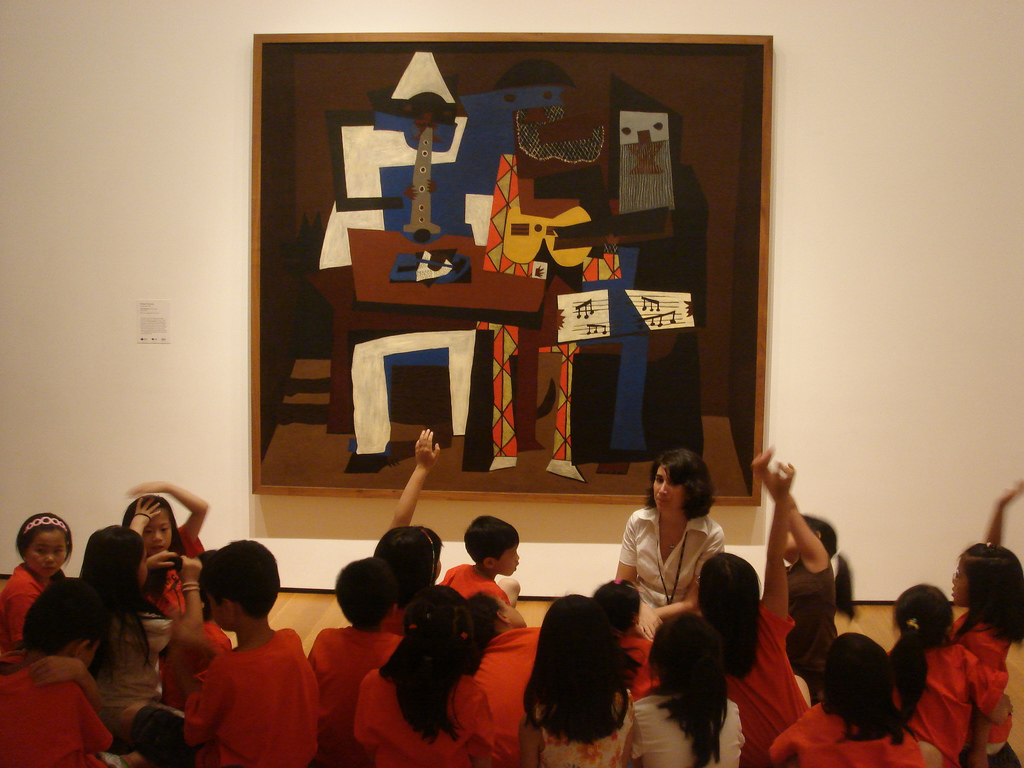
Jed Perl recently visited two exhibitions of Picasso’s work – one in Paris, one in New York City – leading him to consider why the artist still resonates so powerfully:

Progress, at least in modern art, has often been related to ideas of purification, simplification, and reduction. Picasso was never committed to any of that, at least not for long. Sometimes he simplified, but as frequently he complicated. For Picasso, Cubism was as much complication as simplification, as much a matter of feeling as of form, the world comically and tragically disassembled and reassembled. Neoclassicism’s porcelain-perfect verisimilitude was as natural an outcome as the abstract web of the 1928 design for a monument to Apollinaire. If Picasso’s work strikes with particular urgency now, it is because his skepticism about the promise of progress and his heartfelt and disorderly humanism accord with our moment, when we often feel that the best we can do is to take things as they come, the tragic and the comic bewilderingly mixed. Like Picasso, we do not see catharsis in the old modern dream of progress.

A product of modernism, Picasso trumped modernism. By rejecting the idea of art as having a past or a future, he has somehow managed to stay with us in the present. Going through the rooms full of Picassos in New York and Paris, confronting at every turn the faces and figures of his lovers and friends and mythological imaginings, we find ourselves happily besieged by humanity in all its crazy, wonderful, awful profusion. For those who had imagined that Picasso would recede with the modern century, there is quite a shock in finding that he is right here beside us as we stand blinking in the harsh light of the day after modernism died.

(Photo by Antonio Rubio)

“Beginning In Damnation, Bound For Deliverance”

Kathryn Schulz profiles Cheryl Strayed, author of the memoir Wild (recently made into a motion picture, seen above), which recounts her experience living alone in the woods for three months. Schulz connects Strayed to a tradition of religious pilgrimage – “the Muslim walking to Mecca, the Buddhist to Bodh Gaya, the Hindu to Puri, the Catholic to Lourdes”:

Religious pilgrims walk outdoors, but their fundamental journey is inward, undertaken to improve the state of their soul. So, too, with Strayed. The subtitle of Bill Bryson’s book is Rediscovering America on the Appalachian Trail. The subtitle of hers is From Lost to Found on the Pacific Crest Trail.

Like Dante, then, Strayed is on a spiritual journey, beginning in damnation, bound for deliverance. That makes Wild a redemption narrative — and that, in turn, helps explain its popularity, because redemption narratives are some of the oldest, most compelling, and most ubiquitous stories we have. We enshrine nature writing in the canon — you were probably assigned Thoreau and Emerson et al. in high school — but it is redemption narratives that dominate our culture. Among other things, you can hear them in religious services all across the land and in AA meetings every day of the week.

Wild embodies this ancient story. Or, more precisely, it embodies the contemporary American version thereof, where the course is not from sin to salvation but from trauma to transformation: I was abject, dysfunctional, and emotionally shattered, but now I see. This version has more train-wreck allure than the traditional one (being a mess is generally more spectacular than merely being an unbeliever), and it is also more inclusive. Identifying with it requires no particular faith, beyond the faith that a bad life can get better.

Unbelievers In The Pulpit, Ctd

A reader adds to the conversation:

There’s a book about The Clergy Project called Caught in the Pulpit: Leaving Belief Behind. One of the interesting bits about it was that the more the people in The Clergy Project studied their religion the more their doubt increased to the point of them becoming agnostic or atheist. It turns out that seminary not only produces preachers but atheists as well. Ironic.

At any rate, I have a problem with David Watkins’ characterization of clergy who stay in their positions despite their loss of faith. He leaves out an important group who stay in out of fears both financial and social. There’s the stress from living a lie, lying to your congregation, lying about what you believe and who you are. Then there’s the fact that if outed your career is ended and you may not have any recourse to alternate employment. Being outed can also end your socializing with people you have associated with for years. David Watkins seems to play down the suffering of those forced to live a lie in order keep their livelihood, family, and friends.

Another zooms out:

I’m not at all surprised that clergy have become atheists. I wonder how many unbelievers are in the pews. Because I am one of them. I’m a regular churchgoer and give substantial time and treasure to the church. Yet if someone pressed me on my beliefs, I would have to say I’m an unbeliever.

So why do I still go? Several reasons: My wife and kids are active in church groups. I enjoy attending church. I like what Christ has to say. Further, liturgy is very comforting to me and I value the weekly space that going to church provides me. It is more than belief, it is my cultural touchstone. All in all, I would miss the time I spend with my Christian community.

Poetry In Detail

Jessica Sequeira talks with Adam Feinstein, author of the biography Pablo Neruda: A Passion for Life, about the poetic disposition:

JS: Perhaps there is some relationship between poetic intelligence and attention to detail, which doesn’t always seek a grander narrative.

AF: There are poets with autism; Donna Williams is a good one. And some of them do use metaphors, which are a move from specific to abstract. People with autism aren’t supposed to be good at metaphors, but some are. But yes, you’re right that attention to detail is very common with them. They can’t see the wood for the trees, but they’re very good at seeing the trees.

I have two memories involving my son. I was doing some work on the computer and he came in and pointed at the screen. I couldn’t see what he was looking at; he was just pointing. I asked, “What’s there, Johnny? What is it?” I blew the little picture up and there was an ice cream, a tiny dot. He made out what it was, which I couldn’t until I blew it up. He loves ice cream. He hadn’t seen the overall picture, just the tiny bit. There was another example of that. The front page of the Guardian had a story about a bus bomb in Jerusalem or Tel Aviv, looking at the aftermath of the explosion. Again, he pointed. I thought, “You’ve gone all political on me or something. What’s happening here?” And there was a tiny piece of string. A tiny, tiny piece of string lying on the floor of the bus. Their minds work in different ways.

The Art Of Democracy, From Athens To America

The_Nightwatch_by_Rembrandt

Victoria Coates asserts that throughout history “democracies have demonstrated a special capacity to produce extraordinary self-referential works of art.” Her examples:

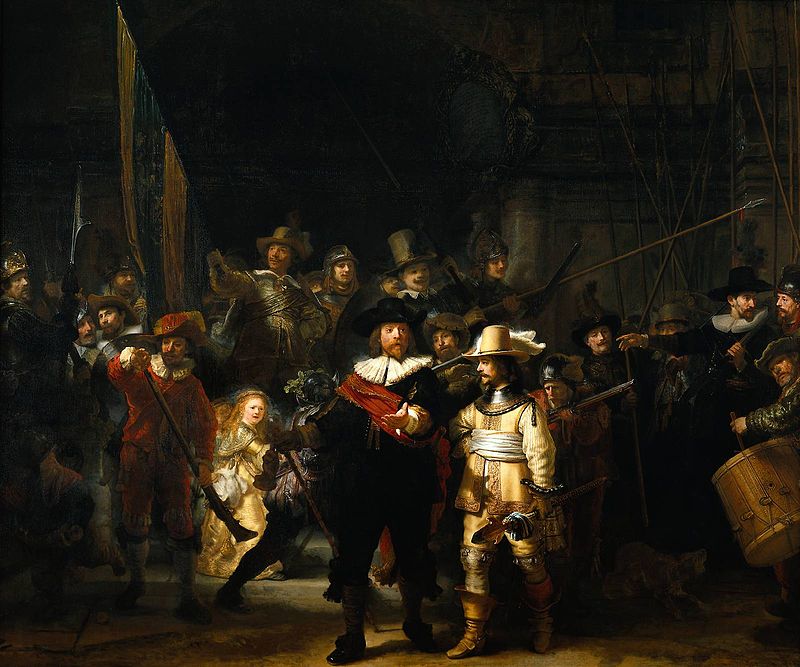
The Parthenon and David are examples from a larger series of works of art and architecture inspired by democracy. There is the bronze portrait of Brutus that legendarily portrays the founding hero of the Roman Republic’s stern features. St. Mark’s Basilica in Venice is a splendid jewel adorning a city-republic that built its own solid ground and grew fabulously wealthy through maritime trade. Rembrandt’s Night Watch honors the citizen militias that proudly defended the liberty of the Dutch Republic, which, like Venice, reclaimed land from the sea and prospered far beyond its size. InThe Death of Marat, Jacques-Louis David memorialized the tragic sacrifice of the revolutionary “Friend of the People” in the turmoil surrounding the first effort to establish a French republic. By salvaging the marble sculptures from the decaying Parthenon and putting them on permanent display in London, Thomas Bruce, Seventh Earl of Elgin converted the work of Phidias into a proclamation that the British constitutional monarchy was the worthy modern heir of democratic Athens.

Albert Bierstadt’s Rocky Mountains, Lander’s Peak conveys the huge potential of a young democracy in the untamed spaces of the New World, even while a brutal civil war threw the whole American project into doubt. Claude Monet offered his Nymphéas (“Water Lilies”) to the French Third Republic to commemorate the hard-won victory of his friend, Prime Minister Georges Clemenceau, over imperial German aggression. Finally, Picasso’s harrowing Guernica is a stark reminder of the existential threats to democracy, such as Fascism, that gathered in the twentieth century.

Each object is part of its own nationalistic narrative and gives us a snapshot of a particular point in the trajectory of the state. All of them provide tangible pieces of historical evidence that are in some ways more reliable than texts (although texts abound in this line of study) and offer powerful insight into successive efforts to establish and sustain a democracy. They are not isolated aesthetic objects; part of their value as historical evidence derives from their active roles in the public life of the communities that produced them.

(Rembrandt’s The Night Watch, 1641, via Wikimedia Commons)

Different Ways Of Being Damned

In a memoir of hell’s place in her evolving Christian faith, Meghan O’Gieblyn reminds us of how the concept has changed over time:

Christian theology, as it has developed over the centuries, has functioned like a narrative gloss, smoothing the irregular collection of biblical literature into a cohesive story written by a single, 640px-Hell-fresco-from-Raduildivine author. As time went on, Satan, Lucifer and Beelzebub were consolidated into a single entity, the personification of all evil. Likewise sheol, Gehenna, hades and tartarus came to be understood as physical representations of the darkest place in the universe. By the time the King James Bible was published in the 16th century, each of these words was translated as simply “hell”.

The various depictions of hell over the centuries tend to mirror the earthly landscape of their age. Torture entered the conception of hell in the second century, when Christians were subjected to sadistic public spectacles. Roman interrogation methods included red-hot metal rods, whips and the rack. Dante’s Divine Comedy has traces of the feudal landscape of 14th-century Europe. Lower hell is depicted as a walled city with towers, ramparts, bridges and moats; fallen angels guard the citadel like knights. The Jesuits, who rose to prominence during a time of mass immigration and urban squalor, envisioned an inferno of thousands of diseased bodies “pressed together like grapes in a wine-press”. Today, biblical literalists believe hell exists outside of time and space, in some kind of spiritual fifth dimension. Contemporary evangelical churches don’t display paintings or stained glass renderings of hell. It’s no longer a popular subject of art. If hell is represented at all, it’s in pop culture, where it appears as either satirically gaudy – like animated Hieronymus Bosch – or else eerily banal. In Gary Larson’s comic The Far Side, Satan and his minions are depicted as bored corporate drones who deal with the scourge of the post-industrial Earth.

(Image: А fresco detail of hell from the medieval church St. Nicolas in Raduil village, Bulgaria, via Wikimedia Commons)