Face Of The Day

emb-3

Christopher Jobson captions:

When scouring through the minute details of artist Cayce Zavaglia’s embroidered portraits (previously), it’s difficult imagine each work is scarecely larger than 8″ x 10″. Her process, which she refers to as both “thread painting” and “renegade embroidery,” begins with a photoshoot of each subject, namely friends, family, and fellow artists. Roughly 100-150 photos are winnowed down to a single selection which she then begins to embroider with one-ply embroidery thread on Belgian linen.

(Image: Cayce Zavaglia’s “Florence,” 2014, courtesy of Lyons Wier Gallery, New York)

A Short Story For Saturday

This weekend’s short story, Julie Hayden’s “Day-Old Baby Rats,” was recommended by a reader. Hayden died too young at age 42, and this selection comes from her only collection of stories, The Lists of the Past, published in 1976. Writing about the story, S. Kirk Walsh describes how “Hayden’s nameless protagonist embodies the acute loneliness of living in Manhattan — how the distorted lens of irrational fears and past traumas can transform the city into a dangerous landscape, seemingly impossible to navigate.” How it begins:

DOWN NEAR THE RIVER a door slams; somebody wakes up, immediately flips over onto her back. She dreamed she went fishing, which is odd because she’s never fished in her life. She thought someone was calling her “baby.”

There’s a lot of January light crawling from beneath room-darkener shades, casting mobile shadows on walls and ceiling. The mobile is composed of hundreds of white plastic circles the size of Communion wafers. As they spin they wax and wane, swell and vanish like little moons. Their shadows are like summer, like leaves, the leaves of the plane tree at the window, which hasn’t any, right now, being in hibernation.

Though the crack between window and sill, air that tomorrow’s papers will designate Unsatisfactory flows over one exposed arm, making the hairs stand up like sentries. Long trailer trucks continue to grind along the one-way street, tag end of a procession that began at 4 a.m. with the clank and whistle of trains on dead-end sidings, as melancholy as though they were the victims they had carried across the Hudson. The trucks carry meat for the Village butcher shops, the city’s restaurants—pink sides of prime beef that you cannot purchase at the supermarket, U.S.D.A. choice or commercial, pigs, lambs, chickens, rabbits, helped off the trucks by shivering men who warm their hands over trash-basket fires.

In the apartment across the hall the baby is bawling, “I want my milk.”

Read the rest here. Peruse previous SSFSs here.

Beauty In The Eye Of The Digital Artist

Josh Dickey lifts the curtain on “beauty work” in the movie industry, which he describes as “a digital procedure of sorts, in which a handful of skilled artists use highly specialized software in the final stages of post-production to slim, de-age and enhance actors’ faces and bodies”:

As Photoshop is to magazine photography, digital beauty has become to celebrities in motion: a potent blend of makeup, plastic surgery, muscle-sculpting, hair restoration, dental work and dermatology. Even the most flawless-in-real-life human specimens are going under the digital knife. Because they can. Because in this age of ultra-high definition, they have to. …

The technique made its “out” debut when Lola [Visual Effects] aged Brad Pitt backwards for Benjamin Button in 2008. As it turned out, the most striking visual in David Fincher’s epic wasn’t Button the shriveled, elderly man-child. It came toward the end of the film, when Pitt emerged into the golden light of a dance studio as a naturally radiant, strapping 20-something — this, at a time when Pitt, in his mid-40s, was just beginning to age into his real-life role as the sexiest man alive.

Dickey writes that, though few performers cop to it, beauty work is de riguer in Hollywood:

A recent comedy hit featured a top actress in her 40s who required beauty work on every single shot she was in — some 600 total. With artists working around the clock, seven days a week, the beauty work alone took close to three months.

The payoff? Nearly everything written about the film remarked at how fit and young the actress looked. No one suspected it was anything but good genes and clean livin’.

The Consolations Of Poetry

From the Poetry archives, this essay from the late, great American philosopher, Richard Rorty, stands out as a lovely paean to verse. When Rorty learned he had the inoperable pancreatic cancer that would take his life, he reflected on what especially resonated in his reading:

Some months after I learned the bad news, I was sitting around having coffee with my elder son and a visiting cousin. My cousin (who is a Baptist minister) asked me whether I had found my thoughts turning toward religious topics, and I said no. “Well, what about philosophy?” my son asked. “No,” I replied, neither the philosophy I had written nor that which I had read seemed to have any particular bearing on my situation. I had no quarrel with Epicurus’s argument that it is irrational to fear death, nor with Heidegger’s suggestion that ontotheology originates in an attempt to evade our mortality. But neither ataraxia (freedom from disturbance) nor Sein zum Tode (being toward death) seemed in point.

“Hasn’t anything you’ve read been of any use?” my son persisted. “Yes,” I found myself blurting out, “poetry.” “Which poems?” he asked. I quoted two old chestnuts that I had recently dredged up from memory and been oddly cheered by, the most quoted lines of Swinburne’s “Garden of  Proserpine”:

We thank with brief thanksgiving

Whatever gods may be

That no life lives for ever;

That dead men rise up never;

That even the weariest river

Winds somewhere safe to sea.

and Landor’s “On His Seventy-Fifth Birthday”:

Nature I loved, and next to Nature, Art;

I warmed both hands before the fire of life,

It sinks, and I am ready to depart.

I found comfort in those slow meanders and those stuttering embers. I suspect that no comparable effect could have been produced by prose. Not just imagery, but also rhyme and rhythm were needed to do the job. In lines such as these, all three conspire to produce a degree of compression, and thus of  impact, that only verse can achieve. Compared to the shaped charges contrived by versifiers, even the best prose is scattershot.

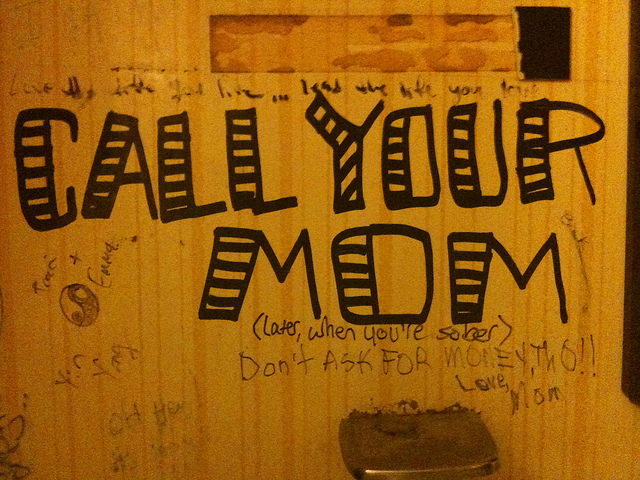
Taking A Stand On The Can

4999435769_d937a7a842_z

Julie Beck looks at latrinalia, or bathroom graffiti:

While it would be impossible to come up with a comprehensive unified theory of why people write poop jokes and names with hearts around them while they’re on the pot (other than the perhaps scientifically unsatisfying “Because it’s fun”), there are several factors that seem to be at play. One is that bathroom graffiti is a forum for anonymous, often-inappropriate expression, not unlike an Internet comments section, except with the added bonus of creating something tangible that exists in the real world. Plus, as Matthews notes, “It’s still illegal. It’s deviant, but it’s a low-cost deviant thing to do.” There’s a low likelihood of getting caught, and it’s usually something that can be washed off, or painted over.

Toilet graffiti also offers an interesting contrast to the way people typically behave in the bathroom. The unspoken rules of keeping to oneself, not making eye contact, and avoiding talking to strangers, all contribute to a sometimes-tense environment with the goal of shifting focus away from what’s actually happening behind stall doors. But the graffiti on the stall doors does not ignore it one bit. It crudely acknowledges and pokes fun at what we all go to the bathroom to do, and flouts the politeness surrounding it as well.

(Photo by Flickr user liquidsunshine49)

A Child’s Uncertain Identity

Erin Siegal McIntyre tells the gripping story of a child caught between two sets of parents, Timothy and Jennifer Monahan of Missouri, who adopted her from Guatemala, and Loyda Rodríguez and Dayner Hernández, who say she was abducted from their home when she was a toddler. Though Guatemalan officials have ordered that the girl, known as Karen to her American parents, be returned to her Guatemalan family, she remains in the US. From McIntyre’s recounting of the legal quagmires surrounding the case:

The Monahans made it clear that they didn’t believe the results of the DNA test that showed a match between Karen and Loyda Rodríguez. They implied that the little girl in their home wasn’t the same child whose DNA had been tested in 2007. In Guatemala, Jennifer Monahan said, “DNA is sort of viewed as a title, and we strongly feel that Karen isn’t property.” … [The Monahan’s lawyer Jared] Genser … declared that the Guatemalan court ruling had no jurisdiction in the US.

Yet the original issuance of Karen’s orphan immigrant visa, necessary to enter the US, and her American citizenship both depended on the authenticity of certain identifying documents—the same documents that had been voided by the Guatemalan judge. Essentially, US citizenship had been granted to a girl whose identity was in dispute.

When asked what they would do “if it is proven that Karen is Mrs. Rodríguez’s daughter,” Timothy Monahan answered, “It’s really very difficult to say.” He added that they’d been “trying to work with authorities all through this process.” But Guatemalan authorities said they’d never been contacted by the Monahans.

The same day the Monahans made their TV appearance, thousands of miles south, two women intimately involved in Karen’s adoption were sentenced in court for human trafficking, document fraud, and criminal enterprise related to the buying and selling of the child. [Guatemalan adoption lawyer Susana] Luarca’s nursery director and the lawyer who facilitated Karen’s adoption were both found guilty of all charges, and were sentenced, respectively, to sixteen and twenty-one years in prison.

Keep reading about the case here.

The Trouble With Marrying Your Best Friend

Mark Judge ponders the state of male friendship after reading Edward Sellner’s The Double: Male Eros, Friendship, and Mentoring – from Gilgamesh to Kerouac, a book that elucidates the concept indicated by it’s title – “an idea out of Jungian psychology … a male with whom a man can share a special kind of love and intimacy”:

Saying that you love another man has become problematic today, not because of the gay rights movement, but because of our sexually infantile culture. If one man expresses love for another, there are instant jokes and comment threads on the Internet making the usually sophomoric gay jokes. But in countries outside of America, it’s not unusual at all for men to express love for each other. In The Double, Sellner quotes a researcher who traveled to India in the 1950s, where he found it was common that a man “would be married twice in his life, first to his buddy, then to his wife.” Sellner then offers this lovely observation: “the double is manifest in a variety of ways, and there is an element of eros, that spiritual power of connection, in all male relationships of intimacy – not only those which are explicitly homosexual – or there wouldn’t be the natural attraction, warmth, or sustainability that characterizes them.”

In modern Western societies, a man’s expected relationships are laid out in a specific way. He will form male friendships in school, probably even have a double in high school and college. But then he’s supposed to get married – to his “best friend” – and spend the rest of his life going to work and watching football in his suburban man cave. If he gets into trouble financially, or with drugs and alcohol, he becomes the problem of his wife, who is instantly shifted into the position of caretaker. Of course, spouses should take care of each other. But today we have spouses who are emotionally and spiritually overburdened because they become each other’s sole support system. It’s no wonder that many crack under the pressure.

The Un-tortured Artist

Harold Bloom once snarkily quipped that John Updike was “a minor novelist with a major style.” After reading Adam Begley’s biography, Updike, Daniel Ross Goodman seems to agree, noting the writer’s “lack of intense passion.” He speculates the deficit “was because Updike did not experience the deep suffering of many other literary geniuses”:

Updike was not forced to labor for a lifetime before achieving literary success, as George Eliot did. He did not face death threats (Salman Rushdie), outrage directed at him from his own ethnic group (Roth), devastating poverty (Edgar Allan Poe), crippling physical illness (Anton Chekhov), disabling mental illness (David Foster Wallace), relentless addiction (John Cheever), or a lifetime of being forced to conceal his gender (the Brontë sisters) or sexual orientation (E.M. Forster). Nor was he ever the tortured artist á la Franz Kafka, David Foster Wallace, or Virginia Woolf.


Wallace was a prodigy, but the battles he waged with his personal demons rendered his career more compelling and, on a certain level, more approachable.

While Updike was not born into literary nobility, he did not exactly grow up in a culturally impoverished family. His mother was well-read and was herself an aspiring writer who encouraged John’s artistic pursuits. Nonetheless, Begley expends copious amounts of energy recounting Updike’s alleged “challenges” and “setbacks”: he got into Harvard quite easily, but was rejected by Princeton (boo-hoo); he had to move away from his hometown (who doesn’t?); some of his stories were rejected by The New Yorker. (Whose aren’t? Well, Updike’s, that’s whose. After sending many stories to The New Yorker during college, when he graduated, not only did his stories begin to be accepted by the storied magazine, but he was given a job at the magazine. No modern writer, not even F. Scott Fitzgerald, Begley admits, landed such a plum position so early in his life.)

Updike’s setbacks were not in the league of David Foster Wallace’s clinical depression, Roth’s hellish marriage, Cheever’s alcoholism, or Shakespeare’s loss of a son. Nor did Updike ever truly grapple with the classical writerly tortures: writers’ block, tortured artistry, failed ambitions, unpopularity in his lifetime, lack of critical success, or any sort of literary demons. Updike’s literary setbacks were those of a lottery winner who stubs his toe on the way to the bank and then has to wait in line before he can cash his check.

Previous Dish coverage of the much-discussed Updike biography here.

Between Words

In a long interview about her writing, the Nobel Prize-winner Herta Müller articulates the importance of what her characters don’t say:

Silence is also a form of speaking. They’re exactly alike. It’s a basic component of language. We’re always selecting what we say and what we don’t. Why do we say one thing and not the other? And we do this instinctively, too, because no matter what we’re talking about, there’s more that doesn’t get said than does. And this isn’t always to hide things—it’s simply part of an instinctive selection in our speech. This selection varies from one person to the next, so that no matter how many people describe the same thing, the descriptions are different, the point of view is different. And even if there is a similar viewpoint, people make different choices as to what is said or not said. This was very clear to me, coming from the village, since the people there never said more than they absolutely needed to. When I was fifteen and went to the city, I was amazed at how much people talked and how much of that talk was pointless. And how much people talked about themselves—that was totally alien to me.

For me, silence had always been another form of communication. After all, you can tell so much just by looking at a person. At home we always knew about each other even if we didn’t talk about ourselves all the time. I encountered a lot of silence elsewhere as well. There was the silence that was self-imposed, because you could never say what you really thought.