Misshapen Cities

Another strike against Manhattan: Henry Grabar flags new research suggesting that circular cities are superior to their elongated counterparts. He notes a paper by MIT scholar Mariaflavia Harari, who “analyzed more than 450 Indian cities to elucidate what influence, if any, a city’s shape would have on indicators like rent, wages and commute time”:

What she found is that “compactness” — in her paper, the nearer, basically, that a city’s shape is to a circle — is a kind of urban amenity, like a subway line or a Manhattan movie theater, that people will pay for. All else being equal, India’s compact cities have lower wages, higher rents and shorter commutes. “One standard deviation deterioration in city shape, corresponding to a 720 meter increase in the average within-city round-trip,” Harari writes, “entails a welfare loss equivalent to a 5 percent decrease in income.”
An instructive comparison is between Kolkota (Calcutta) and Bengaluru (Bangalore). Among the country’s largest cities, these are on opposite ends of Harari’s measurement system: giraffe-like Kolkota has the “worst” geometry, squat Bengaluru the “best.” According to Harari, “if Kolkota had the same compact shape that Bengaluru has, the average trip to the center would be shorter by 4.5 kilometers and the average trip within the city would be shorter by 6.2 km.” Just a couple of miles difference, right? But the average commute speed in India is 12 km per hour, and is forecast to fall to 9 km per hour within the decade. For the average person, on an average potential trip, compactness could save an hour a day

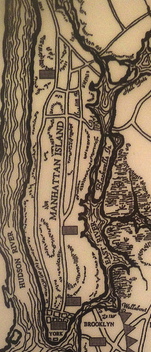
(Map of Manhattan via Flickr user Nick Normal)

The Culture Wars And … Manners, Ctd

Alyssa Rosenberg revisits the debate over manners:

Civil disobedience often tests the desire of powerful organizations to be seen as legitimate and bound by clear rules and standards — it is, essentially, a test of manners and norms. There is something radical about making such a request for civility and good manners upward, and to turn powerful people’s sense of their own sophistication and goodness against them.

Asking someone who would not use racial slurs against Jews or African Americans why he or she is uncomfortable extending that same courtesy and consideration to Native Americans will force a genuinely good-hearted, thoughtful person to confront his or her contradictions. Asking someone like physicist Matt Taylor whether he considered the feelings of his female colleagues and science fans everywhere before putting on that stupid bowling shirt would probably make him think twice.

At the same time, she concedes that these “conversations and requests for polite considerations will not work with all people, and they are certainly not a solution to the significant structural problems of race, class, gender, sexual orientation and gender identity that confront us today”:

But fighting the big fights takes tremendous energy. If we can save each other some of the constant little stings that sap our resources, I’m all for adding etiquette to the list of demands.

Drum, meanwhile, recommends that we “recalibrate our cultural baselines for the social media era”:

People can respond so quickly and easily to minor events that the resulting feeding frenzies can seem far more important than anyone ever intended them to be. A snarky/nasty tweet, after all, is the work of a few seconds. A few thousand of them represent a grand total of a few hours of work. The end result may seem like an unbelievable avalanche of contempt and derision to the target of the attack, but in real terms, it represents virtually nothing.

The culture wars are not nastier because people on the internet don’t have to face their adversaries. They’re nastier because even minor blowups seem huge. But that’s just Econ 101. When the cost of expressing outrage goes down, the amount of outrage expressed goes up. That doesn’t mean there’s more outrage. It just means outrage is a lot more visible than it used to be.

Angela Merkel: The Real Conservative

GERMANY-VOTE-MEDIA

I’ve long been fascinated by Angela Merkel, and not entirely sure why. She’s been German Chancellor for nine years now, is the most powerful politician on the continent, and has approval ratings of over 70 percent. And yet she somehow eludes easy characterization and her studied affect of dullness deflects any serious scrutiny. And so she has hovered around the edges of my brain – a Thatcher who is also an un-Thatcher, a woman in power for a decade who somehow doesn’t prompt the polarization and drama of the Iron Lady.

George Packer’s long but rich profile manages to crack this puzzle a little. Merkel’s strain of tedium is mostly of the good kind. She’s so thoroughly a pragmatist that she has largely overcome the left-right ideological battle in Germany. And, partly because she was in East Germany at the time, she missed the culture war battles of the late 1960s and 1970s. And so she has risen above the fray – while never veering very much from the dead center of German politics. And yet, she is also a brilliant, revenge-seeking pole-climber of the first order (and I mean that very much as a compliment). This story is eye-opening:

Angela was physically clumsy—she later called herself “a little movement idiot.” At the age of five, she could barely walk downhill without falling. “What a normal person knows automatically I had to first figure out mentally, followed by exhausting exercise,” she has said. According to Benn, as a teen-ager Merkel was never “bitchy” or flirtatious; she was uninterested in clothes, “always colorless,” and “her haircut was impossible—it looked like a pot over her head.”

A former schoolmate once labelled her a member of the Club of the Unkissed. (The schoolmate, who became Templin’s police chief, nearly lost his job when the comment was published.) But Merkel was a brilliant, ferociously motivated student. A longtime political associate of Merkel’s traces her drive to those early years in Templin. “She decided, ‘O.K., you don’t fuck me? I will fuck you with my weapons,’ ” the political associate told me. “And those weapons were intelligence and will and power.”

She bided her time but delivered a ballsy coup de grace to her party leader Helmut Kohl. And I loved this story of how she actually won the Chancellorship after a close election which her main rival, Gerhard Shröder, assumed guaranteed his victory over the schlubby, gray woman seated next to him:

On Election Night, Merkel, Schröder, Fischer, and other party leaders gathered in a TV studio to discuss the results. Merkel, looking shell-shocked and haggard, was almost mute. Schröder, his hair colored chestnut and combed neatly back, grinned mischievously and effectively declared himself the winner. “I will continue to be Chancellor,” he said. “Do you really believe that my party would take up an offer from Merkel to talk when she says she would like to become Chancellor? I think we should leave the church in the village”—that is, quit dreaming. Many viewers thought he was drunk. As Schröder continued to boast, Merkel slowly came to life, as if amused by the Chancellor’s performance.

She seemed to realize that Schröder’s bluster had just saved her the Chancellorship. With a slight smile, she put Schröder in his place. “Plain and simple — you did not win today,” she said. Indeed, the C.D.U. had a very slim lead. “With a little time to think about it, even the Social Democrats will come to accept this as a reality. And I promise we will not turn the democratic rules upside down.”

Two months later, Merkel was sworn in as Germany’s first female Chancellor.


In this deft political style and in her post-ideological politics, she reminds me of Obama but with far less rhetorical skill and far more political success. Packer is too kind, I’d say, about the consequences of her austerity program for the entire euro zone, but he captures something deeper about Merkel’s significance. The country’s strength perhaps needs this undemonstrative figure wielding it; it defuses opposition and calms neighbors’ fears. But her stolidity, complacency and risk-aversion at the helm of a satisfied and prosperous country also taps a deeper German longing and an old German past:

“West Germany was a good country,” Georg Diez, a columnist and author, told me. “It was young, sexy, daring, Western—American. But maybe it was only a skin. Germany is becoming more German, less Western. Germany has discovered its national roots.”

Diez didn’t mean that this was a good thing. He meant that Germany is becoming less democratic, because what Germans fundamentally want is stability, security, economic growth—above all, to be left in peace while someone else watches their money and keeps their country out of wars. They have exactly the Chancellor they want.

She is the very model of a modern German politician, a woman whose empiricism and skepticism makes her arguably the leading conservative figure of our age. And by “conservative”, I don’t in any way mean “Republican.”

(Photo: Photos of German Chancellor and Christian Democratic Union (CDU) candidate Angela Merkel are seen on the front pages of German newspapers on September 23, 2013, a day after general elections. By Barbara Sax/AFP/Getty Images.)

“Straight Inmates Fake Being Gay To Live There”

Ani Ucar reports on the gay wing at LA’s Men’s Central Jail “an exceptionally rare, if not unique, subculture, the only environment of its kind in a major U.S. city”:

Nothing like it exists in America’s 21 largest urban jails, all contacted by the Weekly, where officials described in far more modest terms their own steps to deal with and house gay inmates. San Francisco has a transgender housing area, but gay inmates live among the general population. In New York’s Rikers Island, whose similar gay wing was shuttered in 2005, a jail spokesman laughed out loud, saying that whoever decides which men get placed in L.A. County’s gay jail wing “must have really good gay-dar.”…

MCJ’s gay wing was set up in response to a 1985 ACLU lawsuit, which aimed to protect homosexual inmates from a higher threat of physical violence than heterosexuals faced. But something unexpected has happened. The inmates are safer now, yes. But they’ve surprised everyone, perhaps even themselves, by setting up a small and flourishing society behind bars. Once released, some re-offend in order to be with an inmate they love. There are hatreds and occasionally even severe violence, but there is also friendship, community, love — and, especially, harmless rule-bending to dress up like models or decorate their bunks, often via devious means.

Mark Joseph Stern comments:

The gay wing, of course, is still a jail, and most inmates yearn for their eventual release. Many were disowned by their families after coming out and turned to drugs to cope. About 150 of the 400 inmates take self-improvement classes to help them stay clean when their sentences end, but a number of repeat offenders wind up back behind bars. Life in the gay wing isn’t a happy ending, nor is it necessarily a new beginning. But in America’s cruel, overcrowded prison system—where brutality and sexual violence toward LGBTQ inmates is horrifically common—the gay wing serves as a tiny bright spot of hope.

Obamacare’s Auto-Renewal Mess

It could create a backlash:

Unless people provide updated information and have their eligibility re-determined, most who received subsidies for marketplace coverage in 2014 will automatically receive the same dollar level of subsidies in 2015.  (These subsidies consist of advance payments of premium tax credits, which are paid to insurers on enrollees’ behalf to help cover the enrollees’ premiums.) But since many factors that affect the level of people’s subsidies change from year to year, a high percentage of people who auto-renew will receive advance premium credits that turn out to be too low or too high.  To avert such problems, consumers need to return to the [Federally Facilitated Marketplace] (rather than auto-renewing) to receive an updated eligibility determination.  That is the only way to ensure they receive the correct level of benefits.

Adrianna McIntyre is concerned:

According to Gallup, only seven percent of newly-insured exchange enrollees plan to shop around. An overwhelming 68% plan to keep their current plan; the remaining 25 percent expect to find coverage elsewhere, drop coverage, or aren’t sure. Call me a skeptic, but I’m hard-pressed to believe two-thirds of exchange enrollees fully understand the volatile nature of subsidies and want to keep their current plans anyway.

Hence, the administration considering changing enrollees’ plans for them:

Under current rules, consumers who do not take action during the open enrollment window are re-enrolled in the same plan they were in the previous year, even if that plan experienced significant premium increases. We are considering alternative options for re-enrollment, under which consumers who take no action might be defaulted into a lower cost plan rather than their current plan.

Suderman opposes this move:

It’s not just auto-reenrollment. It’s auto-reassignment, at least for those who pick that option. Basically, if you like your plan, but don’t go out of your way to intentionally re-enroll, the kind and wise folks at HHS or state health exchanges might just pick a new plan—perhaps with different doctors, clinics, cost structures, and benefit options—for you. And if you want to switch back? Good luck once open enrollment is closed. There’s always next year.


Why Being Trans Could Cost You The House

Christin Scarlett Milloy couldn’t get a mortgage approval, because she couldn’t get a photo ID, because she’s transgender:

I sat on the phone and patiently explained why I can’t provide photo ID. Because I don’t have any. Because the government has destroyed all my previous ID documents and refused to replace them on several occasions. Because I am transgender. Yes, really. No, I don’t think it’s fair, either. Yes, a lot of people are surprised it’s so hard for us, but there it is. No, I really don’t have anything at all. Mmm, OK. Call me back. Goodbye.

We looked into other ways I could prove my identity. It turns out, there aren’t any. What if I show the dozens of letters back and forth between me and the government, where officials explain that my identity is not in question, but they still won’t send me new ID, because I refuse to check “male” on the application form? Apparently that doesn’t count.

How about expired government-issued ID? Back from a simpler time, when the government and I agreed on what my gender should be. I have that; it even has my photo and my old name on it. (Old-name ID presented alongside a legal ”change of name” certificate is considered valid to identify a person by their new name.) But alas, it’s against the rules to accept expired ID, even under exceptional circumstances.

Update from a reader:

Thank you for continuing your coverage of trans related issues. However, don’t you think that the headline that you wrote is over the top? Would you lend money to someone that did not have a proper ID? Seriously. Trans or not, that is nuts. It sounds like real estate lending pre-2008.

Calling Out The Smears Of Media Matters

Steve Jimenez is not interested in allowing the liberal media monitor to slime his book on the Matthew Shepard murder while offering no substance to back up their claims. In Out magazine, he challenges their assumptions:

In its attacks against me and my book, Media Matters relies frequently on the claim that “investigators… have denounced the book as ‘fictional.’ ” Although two police officers, Dave O’Malley and Rob DeBree, have quarreled with some of the findings of my 13-year bookofmatt-jimenez_0investigation, Media Matters fails to mention that several key law enforcement officials involved in the Shepard case agree with my conclusions. In September 2014, veteran prosecutor Cal Rerucha, who won life sentences for Shepard’s assailants, was quoted in The Casper Star-Tribune stating unequivocally, “If methamphetamine [hadn’t been present] in this case, we wouldn’t have had a murder.” The newspaper also noted, “[Rerucha] remains adamant that Shepard’s death wasn’t a hate crime.” He has repeatedly gone on record praising me and my work. In 2004, O’Malley, a police commander at the time of the murder, urged prosecutor Rerucha not to talk to ABC News 20/20 for a story I produced about undisclosed aspects of the Shepard case — “because of all the good that’s been done in Matt’s name,” according to Rerucha. In essence, O’Malley tried to enlist Rerucha in covering up the truth.

Lieutenant Ben Fritzen of the Albany County Sheriff’s Office, who was a lead detective on the Shepard case and took killer Aaron McKinney’s recorded confession, has also stated on the record that the homicide was driven by drugs and money, not anti-gay bias. Former Laramie officer and state drug enforcement agent Flint Waters, who arrested McKinney’s accomplice Russell Henderson on the night of the crime, agrees with Rerucha and Fritzen. Is Media Matters saying these and other law enforcement officials interviewed for my book have been “discredited” and “debunked,” too?

There’s one way to find out, isn’t there? In the piece, Steve dares someone from Media Matters to debate him in public on the facts behind the case. Will they? And if they won’t, will they retract the smears and apologize?

Illiberal Feminism Strikes Again, Ctd

A reader very close to the controversy writes:

I saw your blog post about the feministic censoring of my debate in Oxford. I thought you might be interested in my piece about this debacle published in this week’s Spectator. The terrible irony of my having effectively been banned by “pro-choice” students is that I intended to make a very pro-choice speech … now published here.

Another dissents:

Oy, Andrew, your framing of this situation. Like the group who shut down the debate, you have a salient point but undermine it with utter, contemptuous bullshit lines like this:

But men, it seems, are not allowed to debate abortion at all, according to a fem-left group at my alma mater. Because: men. Even pro-choice men.

Come on, you know the impetus behind why they’re upset is bigger than such an idiotic reduction. As a straight man who is also pro-choice, I’m not at all hesitant to say that while I might debate the topic off the cuff with other men, if a woman’s voice is available, I’m going to cede to that voice. The reason should be obvious given that as a man I have no way of knowing the anxieties and issues that go along with childbearing and the general reproductive issues that women face. Similarly to that being that I’m not African American or Asian American, I’m not going to go diving into any debates that concern those groups.

Another responds to that kind of that argument:

Men are not allowed to speak about matters related to the female body? That drives me crazy. Question for these women: how many of them have male doctors who advise them on their health, including pregnancy and abortion?

Another dissenter of sorts:

As a feminist, I share your belief that anti-feminist ideas should be openly engaged and debated, not censored and suppressed, on college campuses. But the ferocity of your response got me thinking. You say that “free speech should be absolute.” But in universities, as everywhere else, there are always ideas that are beyond the pale.

What changes over time is that some ideas break out of that closet, and others get pushed back into it. For myself, I’m not sure it’s such a bad thing that advocacy of slavery, Jim Crow and genocide have been pushed into the closet.  I am glad that arguments for inter-racial marriage and gay marriage broke out of it.  I am horrified that arguments for torture and ethnic cleansing (just this week!) have broken out of it too.

Some ideas still need to be branded taboo. So it is reassuring to me that you will see campus debates on the proposition that the president should be impeached, but not on the proposition that the president should be shot. You will see proponents of fundamentalist religion, but no one given a stage to declare that priests should be allowed to rape little boys. I’m ok with that.

I guess what I’m saying, Andrew, is that the argument over what ideas should be off-limits is itself one of the most vital arguments a society has with itself. I realize that this position locks us in a conundrum of sorts. But it does give me a lot more sympathy for someone who genuinely believes that pro-life arguments are as odious and threatening as pro-torture or pro-rape arguments, and wants to shut them down.

My point is that a free society will always veer on the side of being able to debate anything. Taboos are dangerous. They can cut us off from various arguments that deserve to be heard, if only to be dismissed. Rendering them unmentionable can give them an allure they would never have in the light of day. Another reader:

I’ve been following your posts on feminism with a lot of interest, and I’ve noticed a trend in some of the responses from readers that I wanted to highlight, ones that take a particularly unfair and pernicious strategy for engaging in debate, and it occurs with great frequency in the context of identity politics. These responses take the form of “I know you think what you’re doing is OK, but it’s not for some unspecified reason that you can’t understand because you are not the correct gender/race/religion. Because of this, you should refrain from expressing an opinion and solicit feedback from those who do possess the relevant identity.”

This is one of the more frustrating rhetorical strategies to encounter, because it doesn’t actually constitute an argument. People who argue this way don’t really seem interested in debate so much as having others agree with their point. They believe they’re self-evidently correct, and that if you just think about it long enough you’ll figure it out for yourself. It’s condescending, self-righteous and lazy, and it flies in the face of intelligent, open discourse.

I strongly believe in social, political and legal equality regardless of gender, race, or any other factor. I consider myself a feminist, and I try to go out of my way to treat the women in my life decently and respectfully. I’m also straight, white, male and Jewish, but that doesn’t mean I’m either unwilling or incapable of listening to and understanding other perspectives. What I’m not willing to do is engage in a debate where the other party refuses to even formulate the terms of the exchange, and you shouldn’t either.

At some point, this is an argument about citizenship. I believe in equal citizenship on an open society. That means we interact solely because we are human in a certain polity. No one is excluded from the debate because of their identity; and no one is given special privileges because of it either. So, yes, straights get to debate the rights of gays. That’s how we’ve gotten this far – and have it stick. Another zooms out:

Of course there has been this illiberal strain in feminism for as long as people have been calling themselves feminist – but I also think that by and large it has been overblown by your coverage. Yes, feminism has shades and facets – some much more militant than others.  And yes, there is certainly a backlash against the concept of “mansplaining”, but by and large that’s been directed at male politicians and others who have tried to put forth some truly myopic advice to women on the topics of how to avoid being raped and that they can “shut all that down” to keep from getting pregnant.  Or use why they didn’t use their teeth to ward off a lecherous comedian who drugged and orally raped them.  You know, that sort of idiocy.

In my experience as a 39-year-old white man, I’ve been involved in countless discussions in many of the feminists sites I like to frequent (as I do a vast number of specialized sites to get a more robust understanding on a lot of issues from a lot of directions), and my opinions have been met largely with rigorous and lively debate with the participants even when in disagreement with much of the consensus there.  Most of the people I’ve talked to feel that shutting down discussion like in the article you posted earlier is detrimental to all sides of a debate, and that feminism belongs to and is the responsibly of everyone.

For example, I agree that there is too much focus on culture and society rather than chemical and physical understanding of gender differences.  Both play a major role, but only one can really be modified with any real efficacy.  So, having seen how effective modifying cultural norms have been for other political ventures like gay marriage/rights and marijuana laws, by and large this is the way that many feminists feel they have a chance to make a real progress.  I get this, but also think that if you try to take physiological differences out of the equation it makes changing the culture difficult because it’s important to understand how the culture evolved this way in the first place.

Like many of your readers, I find it fairly odd that you seem to have serious blinders on this topic.  It’s starting to feel like an axe to grind, and that’s not like you when discussing non-Palin matters …

One more reader:

I spent a whole dinner party in Cambridge last night trying to keep my cool, infuriating especially because by the end it was clear that I was the leper, with death stares from the wife, merely from failing to go along with the vapid indignation. Talking with her afterwards it was clear her issues are motivated by sexual violence that occurred to her as child and for which she still bears true trauma. Likely she always will. If that’s the deeper issue more broadly, it deserves my compassion, but it will force me to engage every debate on the proposed policy prescriptions. Not one good idea last night. Just people patting themselves on the back for being aware of sexual video games.

To your credit, Andrew, your eloquence on marriage is something feminism should be learning from. Yours was a discriminated class just ten years ago. The focused efforts at something so basic as marriage changed everything and quickly. Real change to real policies affecting real people.

The problem with feminism today, by contrast, is no clear outcome worth fighting for, so no real change. And nothing I’m hearing from the proposed first female president is inspired either.

Obama should feel great shame that so many young men are in prison for non-violent crimes and he has done nothing to address the issue as a policy matter. Where is the left’s answer there? By contrast, Gamergate and Hollaback are a cruel joke.

Scientific Paper Of The Day

Screen_Shot_2014-11-21_at_10.19.51_AM.0.0

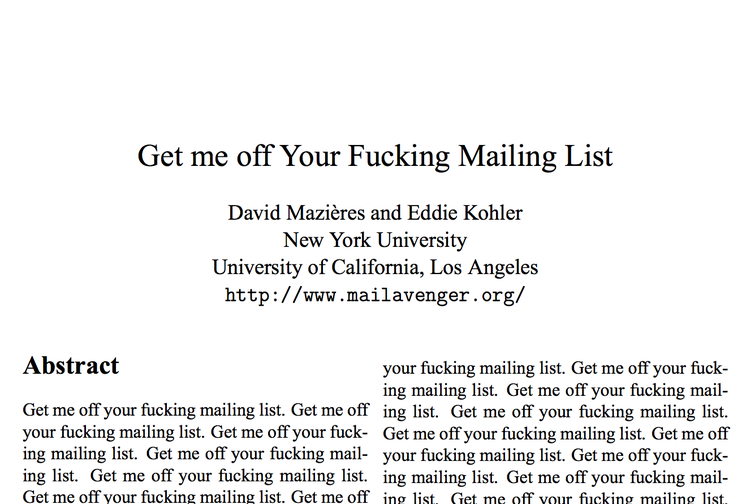
Joseph Stromberg flags the above document (pdf):

According to the blog Scholarly Open Access, this PDF made the rounds, and an Australian computer scientist named Peter Vamplew sent it to the International Journal of Advanced Computer Technology in response to spam from the journal. Apparently, he thought the editors might simply open and read it. Instead, they automatically accepted the paper — with an anonymous reviewer rating it as “excellent” — and requested a fee of $150.

This incident is pretty hilarious. But it’s a sign of a bigger problem in science publishing. This journal is one of many online-only, for-profit operations that take advantage of inexperienced researchers under pressure to publish their work in any outlet that seems superficially legitimate. They’re very different from respected, rigorous journals like Science and Nature that publish much of the research you read about in the news. Most troublingly, the predatory journals don’t conduct peer-review — the process where other scientists in the field evaluate a paper before it’s published.