When Literary Fame Comes Late

In a conversation about the novelist John Williams – most famous as the recently rediscovered author of Stoner – Charles J. Shields and William Giraldi compare his posthumous reputation with that of Herman Melville, riffing on why his writing resonates now:

Charles J. Shields: The literary parallel that comes to my mind is what happened to Melville. He died in such deep obscurity that more than one New York newspaper began his obituary with a sentence like, “The current reading generation will not be familiar with the name Herman Melville, but there was a time when the writer’s work was on everyone’s lips.” The Melville Revival didn’t occur until 45 years after his death. Williams didn’t die unknown of course in 1994, but he saw nothing during his lifetime like the attention that’s been given to his novels recently. And I bring up the Melville-Williams connection for another reason, too. You mention “the architecture of an expert craftsman.” As an experiment, I broke one of Melville’s shorter chapters in Moby-Dick into free verse — it read and sounded gorgeous. Williams was that sort of craftsman, too. … What’s your opinion about why Williams is being carried into the pantheon dead instead of living?

William Giraldi: Our need for beauty and wisdom is such that we will find it: sooner or later, one way or another, beauty and wisdom will have out.

Williams’s fate was such that he couldn’t be granted the laurels he deserved while living, and that’s a familiar enough story among great artists. Would he have been less resentful in life, less prone to drain the bottle and smoke his lucks black, had he been awarded the fame that his tremendous talented warranted? Impossible to say, since fame is its own kind of noose. I like your correlation to Melville because in many ways America was unready for Melville’s cosmic vision; it took the cataclysm of the First World War to bring Melville’s far-reaching mythos back into our grasp. Although nothing on that scale has happened to precipitate this Williams revival, I do think that entire zip codes of readers are thirsting for the purity and depth of Williams’s prose, for his expert craftsmanship, his gorgeous storytelling. Discerning people everywhere are fed up with electronic inanity, with the sovereignty of cyberspace. They feel blitzed by it all and are seeking the sane and lasting pleasures in the breed of literature Williams created, in those perfect sentences you mentioned.

Previous Dish on Williams’ Stoner here, here, and here.

The Little Stories Of YouTube

syt2

Mark Slutsky describes his absorbing website, Sad YouTube, as being comprised of “[m]oments of melancholy, sadness and saudade from the lives of strangers, gleaned from the unfairly maligned ocean of YouTube comments.” In an interview, he expands on why he started the site and what might be its deeper meaning:

How did the idea for the site come? Was there a crystallizing moment? How long have you been running the site?

For a long time, I had noticed that there was something … else going on in the YouTube comment section. Something besides the usual racism, insults, obscure shout-outs and general noise.

Particularly on videos of old songs (either legitimate music videos or fan-uploaded audio tracks with slide shows or home-made clips accompanying the music), people had been leaving little stories. Memories they associated with the music, stories with such touching specificity and seeming honesty that they stood out among all the other comments. It intrigued, and honestly, delighted me in a perverse way, that in that part of the Internet universally acknowledged as the garbage heap of our civilization, I was finding such moments of beauty.

I knew that these comments were ephemeral; they’d either be driven so far down the page by the “bad” ones that no one would ever find them, or the video they were associated with would be deleted—either way, they’d be lost. So I started Sad YouTube in the fall of 2012 to preserve them.

You write, “I almost feel like you could write a Studs Terkel oral history of America culled entirely from YouTube comments on pop songs.” That’s fascinating. Could you talk a bit about that? What’s the value of an oral history? What can it capture or dramatize that others documents cant?

There’s a truth to oral histories that you don’t find anywhere else. You get stories, details and emotions you don’t find in any other form of history. Very few of the comments I’ve chosen tell stories significant or dramatic enough, at least from the outside, to make it into the news, let alone the history books. But each one conveys something about what it felt like to be alive at the time. Or what it feels like to be alive at all.

A Poem For Saturday

Dish poetry editor Alice Quinn writes:

Last week I introduced Sharon Olds at a benefit for Red Hen Press in Pasadena. At Knopf in 1983, I was her editor for The Dead and the Living, her second book of poems, winner of both the Lamont Prize from the Academy of American Poets and the National Book Critics’ Circle award. On the plane to LA two days before the event, I reread a number of her splendid books, all devotedly published by Knopf. Stag’s Leap, from 2012, her compelling collection centered around the end of her marriage—part elegy, part dirge, part paean to all it was—was awarded both the Pulitzer Prize and Britain’s T.S.Eliot Prize. We’ll post several poems from that book this weekend and in the days ahead, including a poem especially apt for Thanksgiving.

“The Last Hour” by Sharon Olds:

Suddenly, the last hour
before he took me to the airport, he stood up,
bumping the table, and took a step
toward me, and like a figure in an early
science fiction movie he leaned
forward and down, and opened an arm,
knocking my breast, and he tried to take some
hold of me, I stood and we stumbled,
and then we stood, around our core, his
hoarse cry of awe, at the center,
at the end, of our life. Quickly, then,
the worst was over, I could comfort him,
holding his heart in place from the back
and smoothing it from the front, his own
life continuing, and what had
bound him, around his heart—and bound him
to me—now lying on and around us,
sea-water, rust, light, shards,
the little eternal curls of eros
beaten straight out.

(From Stag’s Leap: Poems by Sharon Olds © 2012 by Sharon Olds. Used by permission of Alfred A. Knopf, an imprint of the Knopf Doubleday Publishing Group, a division of Random House LLC. All rights reserved.)

A New Hearing Hack


Phantom Terrains is an experimental tool that makes Wi-Fi audible by streaming digital signals to a listener’s hearing aids:

Each Wi-Fi element – such as router names, data rates and encryption modes – are assigned their own tones, which are sent to a phone and picked up using his hearing aids. The foreground and background layer of sound are built up through the strength of the signal, direction, name and security level on these networks. For instance, distant signals sound like click and pops, while stronger networks play a looped song.

Frank Swain, who was inspired to create the project after receiving a diagnosis of hearing loss, describes what it’s like to use the platform:

In essence, I am listening to a computer’s interpretation of the soundscape, heavily tailored to what it thinks I need to hear. I am intrigued to see how far this editorialisation of my hearing can be pushed. If I have to spend my life listening to an interpretative version of the world, what elements could I add? The data that surrounds me seems a good place to start. …

“On a busy street, we may see over a hundred independent wireless access points within signal range,” says [sound artist and project co-creator Daniel] Jones. The strength of the signal, direction, name and security level on these are translated into an audio stream made up of a foreground and background layer: distant signals click and pop like hits on a Geiger counter, while the strongest bleat their network ID in a looped melody. This audio is streamed constantly to a pair of hearing aids donated by US developer Starkey. The extra sound layer is blended with the normal output of the hearing aids; it simply becomes part of my soundscape. So long as I carry my phone with me, I will always be able to hear Wi-Fi.

Listen to a Phantom Terrains “data walk” above.

It’s Not Easy Seeing Green

Chris Mooney reviews research suggesting that “we tend to focus far too much on outward symbols (like Prius driving) in judging whether people are energy conscious. As a result, these powerful symbols bias us into overrating certain kinds of seemingly green behavior, and underrating other behaviors that may be quite green, but don’t seem that way to us at first glance”:

[R]esearchers showed as much with a pretty unforgettable research design. In one of the experiments reported in their paper, they asked Swiss research subjects to evaluate the energy consciousness of two drivers, one of whom drives a Prius, and one of whom drives an SUV. But the Prius driver drives his more fuel efficient car 28,700 km per year, and the SUV driver only drives his less fuel-efficient car 11,400 km per year, as follows:

If you carefully do the math, you’ll see that at least as the scenario is described here, there is only one possible conclusion: the Prius driver uses significantly more fuel per year. Yet overwhelmingly, when given this information, people rate the Prius driver as more energy conscious — a phenomenon that recurred across several different experimental designs. “It is something on the order of 80 or 90 percent of people who are going for the wrong answer” in one of the designs, says study author Michael Siegrist. “So it is a very large effect.”

The Dish Mug Is Here!

bowie-mug

[Re-posted from yesterday]

A reader recently wrote:

I haven’t bought a t-shirt because that’s not so much my thing. I eagerly await a coffee mug though. A mug with a beagle on it would make my mornings brighter.

We looked and labored over a dozen different mug options and chose what we think is the perfect one:

mugs

This navy-colored coffee mug is very high quality, holds a generous 15oz, and, during our caffeine-addled test phase, it proved very durable. So the sturdy mug should last a long time in any Dishhead’s kitchen or office (and yes, it’s microwave and dishwasher safe – we tested that too). As a serious coffee-addict, I love it.

The Dish mug can be yours for $15 plus shipping and handling. Just click here [sold out] and follow the simple prompts to order yours today. We only have a limited number of mugs for sale, so get yours before someone else does. And send us a photo when it arrives; you might see it on the blog.

Update from a reader:

Hubby has been told that it better be going in my stocking this year.  Thank you!

Another:

Love them – will give as gifts! Hope you have the web address on there so friends who don’t know you will check out the Dish.

Sharing Is Staring

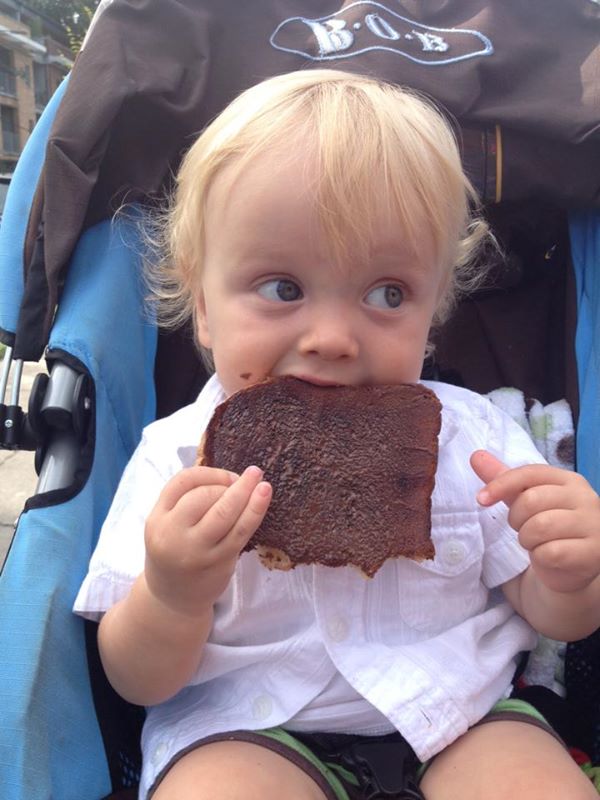
Priya Kumar explores the pros and cons of sharing baby photos on social media:

It’s tempting to suggest that parents shouldn’t post baby pictures online, but this ignores the very real benefits they experience from doing so. Sharing pictures online helped the mothers I toastinterviewed feel connected with family and friends, which is especially important for parents whose friends and family don’t live nearby. They received social support and validation, which is helpful when dealing with loss of sleep and the overwhelming responsibility of caring for a tiny human being. For those who cherished their experience of motherhood, sharing pictures online created a record of those memories. Also, family and friends constantly ask to see more baby pictures, so parents may feel some pressure to share them online.

At the same time, mothers recognized that by sharing pictures online, they were making decisions on behalf of their children that couldn’t be easily reversed. Eventually, their children would grow up and develop opinions about what they wanted their parents to share and not share online. Rather than seek to control their children’s digital footprints, parents can engage in what we call privacy stewardship. This means that parents should consider what types of information they feel are and are not appropriate to share about their children online and then communicate their preferences to family and friends.

(Photo by Betsy Bodenner)

A Woman’s Place In The House

Marcotte spotlights the gender breakdown in Congress:

As reported by both Nia-Malika Henderson of the Washington Post and Rachel Maddow this week, Republicans announced the chairmanships for next year’s House committees. Twenty out of 21 of the spots are going to men. The only woman is Rep. Candice Miller, who will be heading the Committee on House Administration.

Compare this with the list of chairmanships for the Democratic-controlled Senate in 2013, where women chaired six out of 20 committees, including really big ones like the Senate Budget Committee.

The Democrats also fail as spectacularly as the Republicans on the racial diversity front, but the fact remains that they are the more female-friendly party not just in electoral representation but also when it comes to putting women in leadership positions in Congress.

It’s true, as my colleague Jessica Grose has argued, that it’s overly simplistic to assume that women are “a uniform voting block with uniform ideas about what is best for them.” There are plenty of female Republicans, both voters and politicians, who don’t feel like this election was “bad for women.” However, it’s also true that numbers like this matter. Democrats have more women in leadership in part because they just have more women altogether, as our chart showing the growth of female representation in Congress demonstrated. But also because the party puts women in positions of power, a move, whether meant consciously or not, that likely encourages more women to run for office as Democrats.

Passing On Peril

James Poniewozik defends his decision to avoid a certain trope:

We all have our not-for-me markers with fiction: mine is kids in peril. It’s not that I can’t appreciate, even enjoy a series based on it; Broadchurch, about the aftermath of a child’s murder, was one of the best things I saw on TV last year. But when I’m off the TV-critic clock, these shows need to clear a much higher bar for me. …

It’s one of fiction’s jobs to face the worst of experience, not to leave an unexplained hole in place of terrible crimes, illnesses and accidents that–would that it were otherwise–do happen. Stories that handle the material with respect and awareness of its lasting consequence do a service; beyond the general role of art to reflect human experience, they provide a kind of emotional disaster preparedness.

But it’s also not anyone’s job as a viewer, or as a human, to face the worst in fiction, much less repeatedly. Again, I get why someone might make this argument. Like real-life violence–see the debate over watching terrorist beheading videos–the outrage that a fictional atrocity provokes makes people want to react morally one way or another. Either it must be a violation to portray this thing, and to watch it; or it must be an obligation, a mark of bravery, to bear witness. The counter-moralizing response to the one I talked about above is: you owe it to others–to real people who suffer and die–to confront this stuff. If you avoid certain kinds of dark material, you’re avoiding life, you’re in denial, you’re a wimp.

I have to side with the wimps here.