Terror, Terror Everywhere

Screen Shot 2014-11-19 at 12.49.04 PM

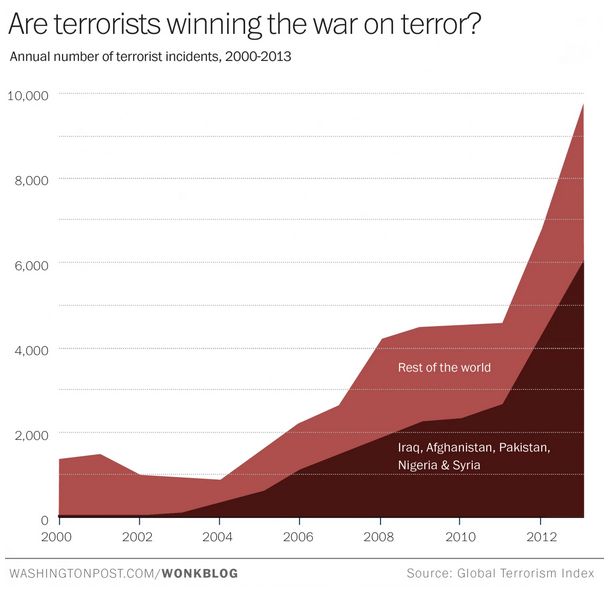
Ingraham introduces the Institute for Economics and Peace’s latest Global Terrorism Index, which counted 10,000 terrorist incidents worldwide in 2013, most of them in Iraq, Afghanistan, Pakistan, Nigeria and Syria. As his chart illustrates, that compares to just 1,500 incidents in 2000. Why the dramatic increase? Well, you know:

The report suggests that U.S. foreign policy has played a big role in making the problem worse: “The rise in terrorist activity coincided with the US invasion of Iraq,” it concludes. “This created large power vacuums in the country allowing different factions to surface and become violent.” Indeed, among the five countries accounting for the bulk of attacks, the U.S. has prosecuted lengthy ground wars in two (Iraq and Afghanistan), a drone campaign in one (Pakistan), and airstrikes in a fourth (Syria).

The same five countries account for a full 80 percent of deaths from terrorism last year. Adam Taylor expects the report to generate some controversy because of how it distinguishes “deaths from terrorism” from other deaths in conflict zones:

The report explains that it is not including deaths in Syria caused by conventional warfare, for example. However, in a complicated civil war such as Syria’s, the line between conventional and nonconventional warfare often gets blurred.

As the report itself notes, “Terrorism has been deployed as a tactic by some of the rebel forces to bring about a political, economic, religious, or social goal rather than purely military objectives.” Perhaps even more controversially, the IEP finds that only four terrorist organizations — the Islamic State, Boko Haram, the Taliban and al-Qaeda — had asserted responsibility for more than 66 percent of the deaths. The United States has been involved in the military battle against all of these groups.

Juan Cole criticizes the study for how it decides which incidents are “terrorism” and which are not:

Let’s just take Mexico. Between 2006 and 2013, roughly 10,000 people a year were killed in drug gang violence (substantially more than have died annually in terrorism in Iraq in recent years). The IEP report counts those as homicides, not terrorism. But many of these killings are committed for political reasons– to control a city like Ciudad Juarez, e.g. Moving drugs on a large scale cannot be an enterprise divorced from politics. … Let’s face it, if Mexico were a Middle Eastern country its drug war would be depicted as terrorism and it would join the five countries listed above at the head of the class, with a third more deaths than Iraq every year.

Keating wonders if the index is blurring the line between “terrorism” and civil war:

While these five countries dominate global terrorism, the report also notes that there were nine additional countries last year that had more than 50 terrorism deaths, bringing the total number to 24—the highest in 14 years. These were: Algeria, Central African Republic, China, Egypt, Lebanon, Libya, Mali, Sudan, and South Sudan. Algeria is on that list largely because of one horrific incident. Lebanon’s terrorism is closely tied to Syria’s. CAR, Libya, Mali, Sudan, and South Sudan are all experiencing various states of intrastate warfare. So the issue here may be less a global increase in terrorism than a set of worsening civil wars (one war in particular) in which the traditional tactics of terrorism—kidnappings, suicide bombings, etc.—are employed by the combatants.

And Kathy Gilsinan highlights another important finding from the report, about how to stop terrorism:

[A]s the U.S. winds up its war in Afghanistan—a country that saw a 13-percent increase in terrorism-related fatalities last year—and considers the extent to which it wants to intervene militarily to halt the spread of ISIS, it’s worth asking: How does terrorism actually end? The question is one that the Rand Corporation addressed in a 2008 study that the Global Terrorism Index authors cite. That report examined 268 terrorist groups that halted their attacks between 1968 and 2006. In only 7 percent of those cases, the report found, military intervention brought about the end of a terrorist group.
Face Of The Day

IRAQ-CONFLICT

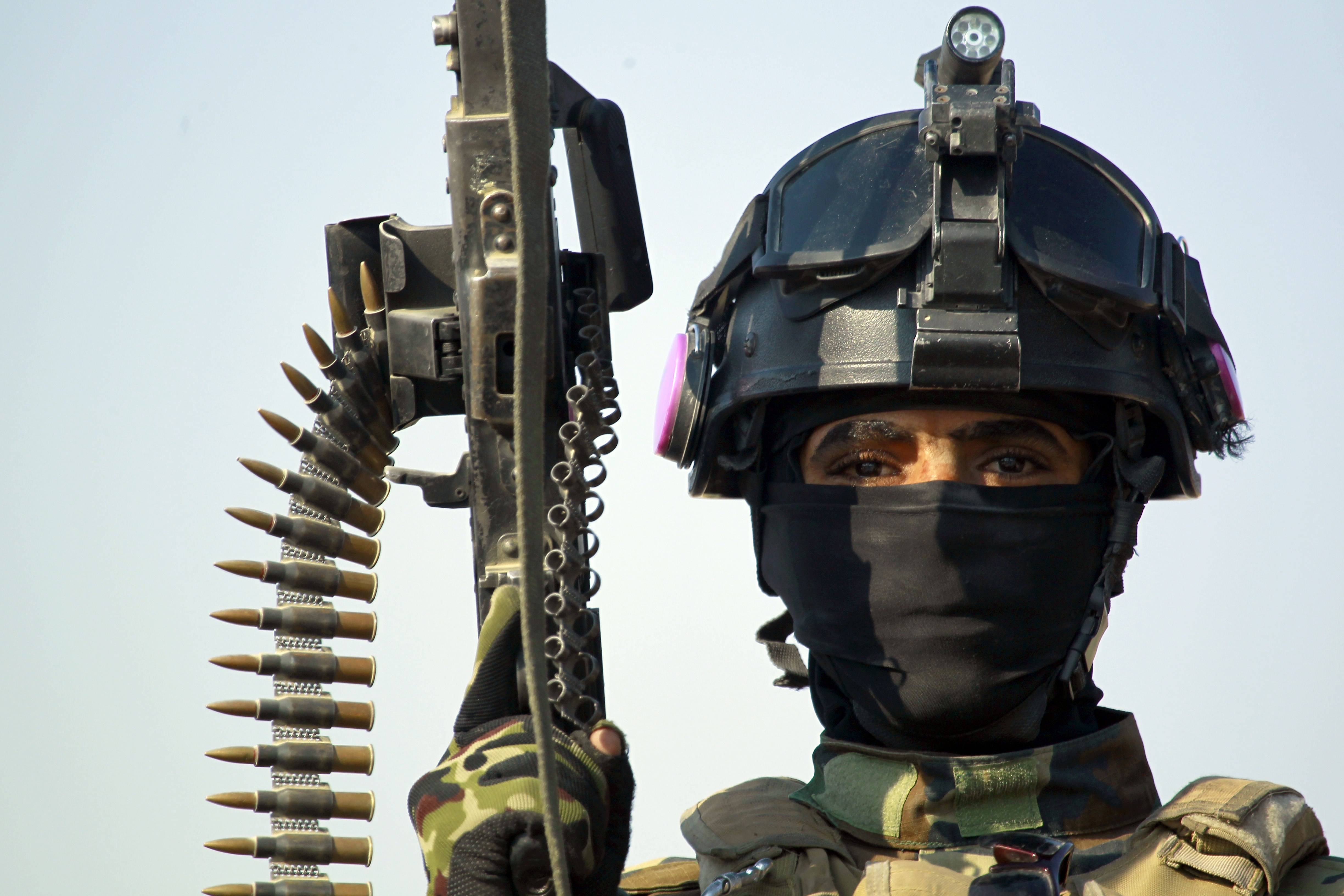
A member of the Iraqi police special forces holds his weapon as he rides a car during a parade in Iraq’s holy city of Najaf before heading to fight Islamic State (IS) group jihadists on November 19, 2014. The previous week Iraqi forces broke a months-long siege on the nearby Baiji oil refinery, the country’s largest, and joined up with elite troops who had been holding off IS onslaughts for months. By Haidar Hamdani/AFP/Getty Images.

How Clinton Undercuts Obama

Beinart takes note of Hillary’s silence on Barack’s upcoming immigration actions and the deal with Iran. He suspects she is “avoid inheriting Obama’s baggage in 2016”:

But whether or not keeping her distance is good politics for Clinton, it’s bad politics for Obama. By distancing herself from Obama’s efforts, she encourages Democrats in Congress to do the same, especially those in more conservative states or dependent on more hawkish donors. And given the furious opposition Obama’s efforts will spark among Republicans, a public split among Washington Democrats will make it harder for him to prevail.

All of which shows why it’s important that Clinton face a primary challenger. It’s the only way that progressives, who overwhelmingly support Obama on immigration and Iran, can influence her behavior.

Slavery Is Still With Us, Ctd

Rick Noack discusses the above map, indicating the portion of the global population currently enslaved, as per a recent report:

About 60,000 people suffer under modern-day slavery in the United States. According to the authors of the report, in the U.S. “men, women and children are exploited as forced laborers, and in the commercial sex industry — In 2013, potential modern slavery cases were reported in fifty states.” The report explains that slaves are forced to perform domestic work and home healthcare, they work in the food industry, as well as in construction, agriculture, nursing, factories and garment-manufacturing, among other sectors.

Neighboring Mexico struggles with about 270,000 slaves, and Japan surprises with a staggering 240,000 enslaved people — a number that is the highest in any developed country. Japan is primarily confronted with sex slavery, a problem which has not been tackled seriously enough in the past by the country’s government, as rights groups have repeatedly criticized.

Larry Elliott comments on the findings as they relate to Britain:

Modern slavery is a live political issue in the UK, with a bill on the issue moving through parliament and David Cameron highlighting it in his speech to the Conservative party conference this year.

“But there’s still more injustice when it comes to work, and it’s even more shocking. Criminal gangs trafficking people halfway around the world and making them work in the most disgusting conditions,” Cameron said. “I’ve been to see these houses on terraced streets built for families of four, cramming in 15 people like animals. To those crime lords who think they can get away with it, I say ‘no, not in this country, not with this party’

And The Economist hones in on Mauritania:

Biram Dah Abeid…, a self-proclaimed descendant of slaves who was runner-up in Mauritania’s presidential election in June, albeit with only 9% of votes to the incumbent’s 82%, was detained along with a clutch of fellow members of his Initiative for the Resurgence of the Abolitionist Movement.

On paper, Mauritania abolished slavery in 1981, though without passing legislation to punish slave-owners. In 2007 it made slave-owners liable to prosecution. But Mr Abeid, who says that half of Mauritania’s population are descendants of slaves (or are still slaves), insists that the law continues to be flouted. Amnesty International, among other advocacy groups, has protested against his recent arrest. The Walk Free Foundation, an Australia-based lobby that published its latest global slavery index on November 18th, reckons that around 150,000 people out of Mauritania’s total population of 3.8m are still enslaved.

Previous Dish on modern-day slavery here.

Platonic Procreation

As Kaitlin Mulhere reports on how asexual college students across the country have made gains for greater visibility, evolutionary psychologist Michael Woodley suggests that geniuses tend toward asexuality:

[Geniuses] are, he says, often asexual, as their brains use the space allocated to urges such as sexual desire for additional cognitive ability. “You have a trade off between what Freud would have referred to as libido and on the other hand pure abstraction: a Platonistic world of ideas,” he said. The evolutionary reason for this may lie with the theory that geniuses have insights that advance the general population. “It’s paradoxical because you think the idea of evolution is procreation, and that might be true in a lot of cases,” he explains. “But what if the way you increase your genes is by benefitting the entire group, by giving them an innovation that allows them to grow and expand and colonise new countries? ”The lack of common sense is in keeping with the idea that a genius exists as an asset to other people, and so: “They need to be looked after,” he says. “They are vulnerable and fragile.”

Lots of previous Dish on asexuality here.

Coloring Our Perception

Erika Hall presents her findings on people who use “African-American” versus “black”:

[A]long with colleagues Katherine Phillips and Sarah Townsend, I conducted a series of studies to determine whether white Americans perceived African Americans more favorably than blacks. In one study, we randomly assigned white participants to associate words with either blacks or African-Americans. Specifically, they selected 10 terms out of a list of 75 (e.g. aggressive, ambitious) that they felt best described each group. The participants that evaluated blacks chose significantly more negative words than those who evaluated African-Americans. Notably, whites did not associate more negative words with “Whites” than with “Caucasians.” …

Naturally, we were interested in nailing down the “Why?” question.

Perhaps, each term evoked different individuals. For example, if White Americans were told that an African-American man was at the door, would they expect a refined gentleman who looked like former U.S. Secretary of State Colin Powell? If they were told that a black man was at the door, would they expect a more thuggish man who looked like a character from the hit crime series, the Wire? We wondered whether whites perceived blacks as lower socioeconomic status than African-Americans, and we speculated that whites’ feelings toward blacks (vs. African-Americans) could be explained by this factor.

Should concludes with the question, “How many of our youth would have been more rightfully vindicated in the justice system if they were first identified as an ‘African-American’ rather than ‘Black’ suspect?” Meanwhile, Lori L. Tharps insists on capitalizing the “b” in “black”:

Black with a capital B refers to people of the African diaspora. Lowercase black is simply a color.

Linguists, academics and activists have been making this point for years, yet the publishing industry — our major newspapers, magazines and books — resist making this simple yet fundamental change. Both Oxford and Webster’s dictionaries state that when referring to African-Americans, Black can be and often is capitalized, but the New York Times and Associated Press stylebooks continue to insist on black with a lowercase b. Ironically, The Associated Press also decrees that the proper names of “nationalities, peoples, races, tribes” should be capitalized. What are Black people, then? …

If we’ve traded Negro for Black, why was that first letter demoted back to lowercase, when the argument had already been won?

Shuttering The World’s Coal Plants Isn’t Enough

Ross Koningstein and David Fork worked on Google’s defunct RE<C project, “which aimed to develop renewable energy sources that would generate electricity more cheaply than coal-fired power plants do.” Their reflections on the failure of RE<C are worth reading in full, but here is one of their more alarming findings:

We decided to combine our energy innovation study’s best-case scenario results with [climate change expert James] Hansen’s climate model to see whether a 55 percent emission cut by 2050 would bring the world back below that 350-ppm threshold. Our calculations revealed otherwise. Even if every renewable energy technology advanced as quickly as imagined and they were all applied globally, atmospheric CO2 levels wouldn’t just remain above 350 ppm; they would continue to rise exponentially due to continued fossil fuel use.

So our best-case scenario, which was based on our most optimistic forecasts for renewable energy, would still result in severe climate change, with all its dire consequences: shifting climatic zones, freshwater shortages, eroding coasts, and ocean acidification, among others. Our reckoning showed that reversing the trend would require both radical technological advances in cheap zero-carbon energy, as well as a method of extracting CO2 from the atmosphere and sequestering the carbon.

Those calculations cast our work at Google’s RE<C program in a sobering new light. Suppose for a moment that it had achieved the most extraordinary success possible, and that we had found cheap renewable energy technologies that could gradually replace all the world’s coal plants—a situation roughly equivalent to the energy innovation study’s best-case scenario. Even if that dream had come to pass, it still wouldn’t have solved climate change. This realization was frankly shocking: Not only had RE<C failed to reach its goal of creating energy cheaper than coal, but that goal had not been ambitious enough to reverse climate change.

What they recommend going forward:

Consider Google’s approach to innovation, which is summed up in the 70-20-10 rule espoused by executive chairman Eric Schmidt. The approach suggests that 70 percent of employee time be spent working on core business tasks, 20 percent on side projects related to core business, and the final 10 percent on strange new ideas that have the potential to be truly disruptive.

Wouldn’t it be great if governments and energy companies adopted a similar approach in their technology R&D investments? The result could be energy innovation at Google speed. Adopting the 70-20-10 rubric could lead to a portfolio of projects. The bulk of R&D resources could go to existing energy technologies that industry knows how to build and profitably deploy. These technologies probably won’t save us, but they can reduce the scale of the problem that needs fixing. The next 20 percent could be dedicated to cutting-edge technologies that are on the path to economic viability. Most crucially, the final 10 percent could be dedicated to ideas that may seem crazy but might have huge impact.

Our society needs to fund scientists and engineers to propose and test new ideas, fail quickly, and share what they learn. Today, the energy innovation cycle is measured in decades, in large part because so little money is spent on critical types of R&D.

(Video: NASA shows “exactly how carbon pollution travels across the planet over the course of a year, moving away from the largest polluters and across the atmosphere.”)

More Guns ≠ Less Crime?

Ingraham flags a new study that calls the core belief of gun-rights advocates into question:

The notion [that more guns mean less crime] stems from a paper published in 1997 by economists John Lott and David Mustard, who looked at county-level crime data from 1977 to 1992 and concluded that “allowing citizens to carry concealed weapons deters violent crimes and it appears to produce no increase in accidental deaths.” Of course, the study of gun crime has advanced significantly since then (no thanks to Congress). Some researchers have gone so far as to call Lott and Mustard’s original study “completely discredited.” …

Now, Stanford law professor John Donohue and his colleagues have added another full decade to the analysis, extending it through 2010, and have concluded that the opposite of Lott and Mustard’s original conclusion is true: more guns equal more crime.

“The totality of the evidence based on educated judgments about the best statistical models suggests that right-to-carry laws are associated with substantially higher rates” of aggravated assault, robbery, rape and murder, Donohue said in an interview with the Stanford Report. The evidence suggests that right-to-carry laws are associated with an 8 percent increase in the incidence of aggravated assault, according to Donohue. He says this number is likely a floor, and that some statistical methods show an increase of 33 percent in aggravated assaults involving a firearm after the passage of right-to-carry laws.

The Word Of The Year

Oxford picked “vape”:

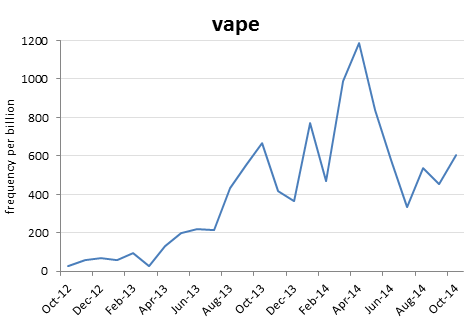
VapeVape, a verb meaning to inhale and exhale the vapor produced by an electronic cigarette or similar device, beat out everything from bae to normcore. It was coined in the late 1980s when companies like RJR Nabisco were experimenting with the first “smokeless” cigarettes. But, after years of languishing, the word is back, needed to distinguish a growing new habit from old-fashioned smoking. According to Oxford’s calculations, usage of vape, which as a noun can refer to an e-cigarette or similar device, more than doubled between 2013 and 2014.

Edwin L. Battistella mulls our love of new words:

Clippings frequently rub me the wrong way for some reason. When I am in a conversation where someone used words like cray, vacay, and bro, the usages somehow feel much too familiar, like a telemarketer addressing me by my first name. Abbreviations can be annoying too, as if the speaker assumes I am as immersed in some topic as they are and know all the shorthand. IMHO.

I’m enamored of blends though, and I smile at the recollection of the first time I came across the word hangry in a tweet from a former student. To me blends are verbal magic tricks: words sawed in half and magically rejoined. I always think of publisher Bennett Cerf’s description of Groucho Marx as someone who looks at words “upside down, backwards, from the middle out to the end, and from the end back to the middle. Next he drops them in a mental Mixmaster, and studies them some more.” Groucho would have loved the Urban Dictionary’s blend bananus, for the brown part at the end of a banana. When I finished my book on the language of public apology I toyed with using the word regretoric in the title, but wiser editorial heads prevailed. The best blends have a playful punning to them, in which the remnants of the old words encapsulate the new meaning perfectly (the worst blends are like Frankenstein’s monster, like schmeat, a finalist in 2013.). I’ll leave it to you to judge the blends in this year’s finalists: slacktivism (from slacker + activism), normcore (from normal + hardcore), budtender (from bud + bartender).