Mencken’s Kind Of Misanthropy

Hal Crowther wonders what made the famous journalist such a notorious grump:

It’s precarious trying to isolate, precisely, just what it was about his time that most infuriated Mencken. … An educated guess is that the thing he loathed most was optimism. Animal dish_mencken optimism — animal spirits — he endorsed and enjoyed. Food and drink, sexual attraction, good music (as he defined it), good company, and good conversation were essential to his well-being. This was no sour ascetic or life-denying hermit. What he detested was delusional optimism, as he saw it — organized religion with its promises of ecstatic afterlife, the cult of human progress, American exceptionalism, popular beliefs in the essential goodness of humankind and the benevolence of representative democracy. It was this doctrine of the Ascent of Man, of cultural, moral, spiritual, and supernatural uplift, that never failed to raise his hackles and provoke his most venomous rhetoric.

Crowther goes on to imagine what Mencken would have made of society today:

[I]f he were here today to instruct us, as was his habit, he would point to the dreadful symmetry of our follies as he chronicled and predicted them. We were on the winning side in two wars, and each of them was followed by Red Scares and communist witch hunts, the notorious Palmer Raids in 1919–1921, and the equally notorious reign of Senator Joe McCarthy after World War II. These paranoid periods were characterized by jingoism, censorship, grotesque hypocrisy, and the righteous suspension of most of the liberties of which America loves to boast. Mencken would have nodded his head, ruefully, at the Patriot Act and the war on terrorism with its constitution-defying domestic spying, all spawned by the bombings of September 2001. Coddle them and they love freedom, he would have said; kick them and they destroy it.

(Photo via Flickr user mistermencken)

How Off Were The Polls?

Wang does some calculations:

In close Senate races, Republicans outperformed polls by an average of 5.3 percentage points. Prime examples of that effect could be seen with Republican wins in Kansas and North Carolina, two races that went against pre-election polls.

In gubernatorial races, Republicans outperformed polls nearly 2 percentage points on average. This was enough to put Paul LePage of Maine (tied), Rick Scott of Florida (tied), and Bruce Rauner of Illinois (Quinn +2.0%) over the top.

Silver ponders these polling misses:

Poll BiasInterestingly, this year’s polls were not especially inaccurate. Between gubernatorial and Senate races, the average poll missed the final result by an average of about 5 percentage points — well in line with the recent average. The problem is that almost all of the misses were in the same direction. That reduces the benefit of aggregating or averaging different polls together. It’s crucially important for psephologists to recognize that the error in polls is often correlated. It’s correlated both within states (literally every nonpartisan poll called the Maryland governor’s race wrong, for example) and amongst them (misses often do come in the same direction in most or all close races across the country).

This is something we’ve studied a lot in constructing the FiveThirtyEight model, and it’s something we’ll take another look at before 2016. It may be that pollster “herding” — the tendency of polls to mirror one another’s results rather than being independent — has become a more pronounced problem. Polling aggregators, including FiveThirtyEight, may be contributing to it. A fly-by-night pollster using a dubious methodology can look up the FiveThirtyEight or Upshot or HuffPost Pollster or Real Clear Politics polling consensus and tweak their assumptions so as to match it — but sometimes the polling consensus is wrong.

Joshua Tucker speculates about why the polls were wrong:

We are living in an era where poll response rates are dropping precipitously, at least for traditional phone-based surveys. This point was dramatically illustrated in a recent Pew Report showing that response rates had fallen from 36 percent in 1997 to 9 percent in 2012.

… [T]here are good reasons to think it is harder to reach young people today using telephone surveys. But of course pollsters know this, and so adjust the weights of their surveys accordingly. But with fewer young people in their surveys — combined with the possibility that the young people you can reach by phone are not representative of young people generally — the work that has to be done by these weights grows. Now, not wanting to get a mistaken estimate because of this bias, I wonder if the polling overcompensated in terms of weights in this regard because of the voting patterns observed in the 2012 presidential elections.

Wang identifies a different culprit:

Recently it’s been suggested that the polling industry has struggled lately to reach a representative swath of voters. Low response rate, increasing use of mobile phones, and hard-to-reach demographics have all been cited as possible biases. However, those difficulties would tend to undersample Democratic voters, which was not the problem this year. Instead, inaccuracy may have come from what David Wasserman at The Cook Political Report called “epic turnout collapse” in 2014. And estimating the precise effects of turnout is an older, unsolved problem that looms large for pollsters in every midterm election.

A Reid Swayed By The Wind?

Ed Morrissey doesn’t see any reason for Senate Democrats to keep Harry Reid as their leader after last night’s defeat:

[T]wo members of Reid’s caucus already have reasons to switch sides, and keeping Reid around will almost guarantee that Republicans will pressure Mitch McConnell to make the Democratic wilderness as miserable as Reid made the Republican wilderness. If that happens, both Angus King and Joe Manchin will certainly bolt, and Democrats may face another round of key retirements in the next two years, which will eat into their ability to regain the majority in 2016. McConnell doesn’t have any incentive to make that situation on Reid any easier, and plenty of incentive to force Reid out. McConnell may want to return to normal order, but not with Reid across the table from him. If McConnell wants to play hardball, all he needs to do is insist that Democrats shun Reid entirely — no leadership position, no ranking-member position on committees — for the next two years, in exchange for returning to the pre-Reid Senate environment.

But Susan Ferrechio gets the sense that none of Reid’s colleagues are prepared to challenge him:

If Senate Democrats move to oust Reid, the likely successor would come from the lower ranks of the leadership. Majority Whip Dick Durbin of Illinois, Democratic Policy Committee Chairman Chuck Schumer of New York and Conference Secretary Patty Murray of Washington are among the Democrats who might vie for the post. But those who know Reid best say there probably won’t be a challenge, because Reid, a former boxer who rose to power from a small town in the Nevada desert, would be too tough to beat. “If a Democrat wants to take him on, then they should know they are in for a no-holds-barred fight,” Eric Herzik, chairman of the political science department at the University of Nevada, Reno, told the Examiner.

In any case, Roger Pilon bets Reid is wishing he hadn’t “gone nuclear” right about now:

And where will those remaining Democratic senators who voted for Harry Reid’s nuclear option be sitting? Why on the minority side, watching Republicans enjoy their newly acquired power to block controversial Democratic nominees by the vote of a mere majority—all because of Harry’s hubris. But it wasn’t Harry’s alone. As the Wall Street Journal editorializes this morning, after his victory speech following his 2012 re-election, President Obama walked off the stage and made separate calls to Nancy Pelosi and House Democratic campaign chairman Steve Israel, telling them “he would spend the next two years helping Democrats retake the House in 2014.” In politics as in life, hubris has its price. We will now have a proper vetting of the president’s nominees, and that is good.

But Danny Vinik encourages Reid to play some hardball of his own and filibuster the shit out of everything, to give the Republicans a taste of their own medicine:

Reid has a history of supporting the filibuster when in the minority and criticizing it when in the majority. There’s no reason to expect that to change with McConnell as majority leader. And that’s a good thing. If Republicans are going to reap the political benefits of indiscriminant filibustering, then Democrats should do so as well.

The advantage of filibustering is that it allows a party to block progress without taking all of the blame for it, for the simple reason that most of the publicand, surprisingly, most of the mediadon’t realize that filibusters are basically thwarting majority rule. Presidential vetoes, on the other hand, are easy for the public and media to understand and easy to appropriate blame. If Democrats relinquished the tool now, they’d give up a chance to make the same sort of gains. It’d be the equivalent of unilateral disarmament.

Correction Of The Day

From the NYT:

To the Editor:

I was grateful to see my book “This Is the Story of a Happy Marriage” mentioned in Paperback Row (Oct. 19). When highlighting a few of the essays in the collection, the review mentions topics ranging from “her stabilizing second marriage to her beloved dog” without benefit of comma, thus giving the impression that Sparky and I are hitched. While my love for my dog is deep, he married a dog named Maggie at Parnassus Books last summer as part of a successful fund-raiser for the Nashville Humane Association. I am married to Karl VanDevender. We are all very happy in our respective unions.

ANN PATCHETT
NASHVILLE

The Question Of Scotland Isn’t Settled, Ctd

PUBLIC-SPOM-Wave-22-General-election-VI

A recent survey finds that two-thirds of Scots want another referendum on independence from the UK within the next 10 years, while 58 percent want one in the next five. This confirms Larison’s suspicion that we haven’t seen the last of the Scottish secession movement:

One might have thought that the referendum had been decided by a large enough margin to quash such sentiments, but that has clearly not happened. As I guessed it might, the ‘No’ victory seems to have just put off a final reckoning on the future of the U.K. rather than putting a stop to the independence debate. Whether independence for Scotland makes any more or less sense for the country in five or ten years’ time, the question is not going to be “settled” anytime soon. All indications are that the referendum campaign has significantly changed the political landscape in Scotland with consequences for the entire U.K., and the independence question seems likely to keep roiling British politics for the foreseeable future.

Pointing to another poll suggesting that the Scottish National Party could take all but four of Labour’s Scottish seats in next year’s parliamentary elections, Keith Humphreys speculates on the SNP’s potential to cause “an earthquake in British politics”:

First, the SNP has a reasonable chance of becoming a kingmaker in the UK general election of 2015. Particularly in the event of a Scottish Labour wipeout, it’s not unlikely that neither of the major parties will have enough seats in Westminster to secure a majority. Unlike in prior cycles, the Liberal Democrats, who have been bleeding support for years, may not be able to make up the difference, leaving the SNP with the opportunity to enter a coalition government. It’s obvious what price they would ask for this, though it’s unclear if either major party would be willing to pay it or would instead choose to muddle through as a minority government.

Second, if the SNP control Scotland, the West Lothian question becomes more important. Even if they are not included in the UK government, being able to vote as a bloc on English policies could give the SNP a free hand to extract concessions simply by making mischief wherever possible (e.g., when the ruling party can’t get all its ducks in a row on some English-specific issue). If the Scottish MPs were Labour, this problem could be minimized by the party leadership, but SNP members of the UK parliament would not owe anything to either major party leader.

Check out the Dish’s complete coverage of the independence vote here.

A Bad Night For Personhood

Fetal personhood ballot measures were defeated by solid margins yesterday in two states:

In Colorado, Amendment 67 — which sought to update the state’s criminal code to define fetuses as children — failed by a large 64 percent to 36 percent margin. It marks the third time that Colorado voters have rejected personhood. Meanwhile, in North Dakota, an effort to overhaul the state’s constitution to protect “the inalienable right to life of every human being at any stage of development” looked like it was poised to pass. Personhood proponents were hopeful that the conservative state would hand them their first major victory, galvanizing the push for similarly restrictive laws in other states. But Amendment 1 was defeated by similarly wide margins as the initiative in Colorado.

Noting that voters have turned down personhood in five separate ballot initiatives since 2008, Kliff reminds us that nobody is really sure what effects these laws would have:

Because no state has ever granted personhood rights to unborn fetuses, it’s really unclear how any specific amendment would work in practice. This was especially true with the North Dakota amendment, which didn’t give any particular rights to fetuses but instead required “the right to life of every human being at any stage” to be “recognized and protected.”

Supporters of both the Colorado and North Dakota initiatives argued that existing protections would still allow for legal abortion. Roe v. Wade, for example, protects legal, elective abortion during the first trimester of pregnancy. Choose Life North Dakota said that protection supersedes any state laws. But opponents argued that the amendment was written too broadly and that personhood laws would make abortion illegal. The director of North Dakota’s only in vitro fertilization clinic said that he would close his practice if Measure 1 passed. Embryos are sometimes discarded in treatment, and his lawyer warned that the practice could put workers at risk of legal action.

Even major pro-life advocates are wary of such laws:

Large pro-life groups like Americans United for Life and the National Right to Life Committee have not endorsed personhood ballot initiatives. Part of this is politics: some worried that the amendments (which opponents call draconian abortion bans) will fail so badly they’re not worth the effort, and that they will only prove an embarrassment. And there are also some policy disagreements about what it would actually mean to give personhood rights to fetuses and whether that could have unintended consequences, such as disallowing certain types of birth control. This was what Colorado’s new senator, Cory Gardner, a Republican, was getting at in March when he withdrew his support for Amendment 67.

Marcotte is particularly relieved that Coloradans shot theirs down:

Since the law would have made it a matter of homicide to cause a miscarriage, it could have been used to prosecute women who had miscarriages by accusing them of somehow failing to do more to care for their fertilized egg babies. “If you get a prosecutor who wants to make a statement about unborn life,” Aya Gruber, a law professor at the University of Colorado told Politico, “Absolutely, you could have prosecutions for miscarriages. This law allows it. It allows it!”

At the same time, 53 percent of Tennesseean voters approved an amendment to their state constitution that will make it easier for lawmakers to place restrictions on abortion. Amelia Thompson-Deveaux calls the amendment “the culmination of 14 years of work” by pro-life advocates:

They began organizing in 2000 when the Tennessee Supreme Court struck down several abortion restrictions on the grounds that they violated women’s right to privacy. That decision has until now kept Tennessee from passing anti-abortion laws like the ones that have closed abortion clinics in neighboring states. It’s been an expensive fight — in the last three weeks of October alone, the amendment’s opponents spent more than $3.4 million. Now the protections that have shielded the state’s seven abortion clinics will disappear.

Landrieu The Longshot

Residents of Louisiana can expect another month of nonstop political ads:

Landrieu officials say they believe she can win given her history of consolidating support and beating her opponents in runoffs — in 1996 she was down by 11 points in the general election and went on to win by 1 point. In 2002, she was down by three points in the general election and won the runoff by 3 points. But the national political headwinds in this election could hurt her. President Barack Obama and his signature health care law remain largely highly in the state. Landrieu will have to bridge the racial divide to gin up support among whites, who have been unenthusiastic about her reelection bid, and rally a significant number of black voters to win.

Republican operatives have long thought their best chance at ousting Landrieu was through a runoff. A recent NBC/Marist poll showed that in a head-to-head match up Cassidy would get 50 percent of the vote while Landrieu is expected to draw just 45 to 46 percent.

Harry Enten doesn’t like Landrieu’s chances:

The problem for Landrieu is that Louisiana’s political environment in 2014 doesn’t look at all like it did in 2002. The state was only about 8 percentage points more Republican than the country in the 2000 presidential election. In the 2012 presidential election, it was about 21 percentage points more Republican than the nation. Moreover, the combined Democratic candidates’ vote in the 2002 Senate election in Louisiana was 47.9 percent versus 50.6 percent for the Republicans. In other words, it was a much closer primary than what occurred on Tuesday. If Landrieu is able to gain 3.8 percentage points in December, like she did in 2002, she’d still only take 47.3 percent of the vote in the runoff.

No matter how you look at it, Landrieu is in deep trouble in a month.

Nicholas Lemann notes that after yesterday’s elections, Landrieu is the only Democratic senator remaining in the Deep South. He mulls over this state of affairs:

To attract white votes, which winning statewide office necessarily entailed, a Democrat required either Olympic-level political skill (think of Bill Clinton in Arkansas) or the trust that comes from bearing a famous political-family name (think of Al Gore in Tennessee, or, almost, Michelle Nunn in Georgia, or, for that matter, Landrieu) or a powerful orientation toward delivering for the folks back home mixed with a partial disavowal of the national Democratic Party. Landrieu had all three in some measure, and still perceived every campaign as a political near-death experience.

Political realities can and do change. Formerly Confederate states such as Virginia, North Carolina, and Florida are regularly capable of casting their electoral votes for Democratic Presidential nominees, and it’s not impossible that Tennessee, Arkansas, and Georgia might, as well. Even Louisiana went Democratic in the 1996 Presidential election. Those who care about how this goes in coming years should take note, though: if there is a future for Southern Democrats running statewide, it will belong to people who don’t get angry on television and who don’t yell at Republican Presidents or applaud Democratic ones. Republican candidates can get away with all of that; Democrats can’t.

A Victory For What?

That’s my question after this relentlessly negative and vacuous campaign. And the striking thing about it is that it’s hard to detect an issue or platform around which the GOP constructed a victory. I watched Kevin McCarthy on Fox last night attempt to describe what his party now wants to do with its majority in both House and Senate – and it was so pathetic even the Fox News crowd could barely hide their dismay. He said he wanted to kickstart the economy. No serious ideas as to how, except  the same tired 1980s boilerplate. Tax reform? I’m all for it – but we shouldn’t kid ourselves it was an issue of even faint relevance in this campaign. Immigration? Again, it’s much much easier to say what they don’t want to do, rather than what they do.

Foreign policy? It will be fascinating to see if the Republican party really wants to fight another Iraq War – and what would happen to its unity if it tried. On Iran, they simply want to scupper the only conceivable way forward absent another war. Obamacare? McConnell seems to be arguing against an attempt at repeal – merely a series of nitpicks to try and unravel it. If I could see any constructive policy agenda, I could have a serious opinion about it. But I don’t. I see pure negativity and bile against the president. And it seems to me that that is not a strategy to win over a majority for the presidency in 2016.

National Review today actually urges the GOP majority to do nothing for the next two years but prep for 2016. I kid you not. They worry about the “governing trap.” Here you see the cynicism that has pulsed through the right for the last six years, in which everything is about politics and nothing is about governance:

A prove-you-can-govern strategy will inevitably divide the party on the same tea-party-vs.-establishment lines that Republicans have just succeeded in overcoming. The media will in particular take any refusal to pass a foolish immigration bill that immediately legalizes millions of illegal immigrants as a failure to “govern.”

Fourth: Even if Republicans passed this foolish test, it would do little for them. If voters come to believe that a Republican Congress and a Democratic president are doing a fine job of governing together, why wouldn’t they vote to continue the arrangement in 2016?

And that would be just terrible, wouldn’t it?

In some ways, this election also strikes me as a vote by the elderly almost entirely against the Obama coalition and what it represents for America, rather than for anything. You can see it in this screenshot from NBC News:

us_age_trend_cc_561_1_1ecd2d7c1de506201727d540941b9e50.nbcnews-ux-720-440

That’s a staggeringly high percentage of the vote for the over-60s. If anyone doubts the potency of Fox News’ relentless campaign to remind anyone over 50 that the world is coming undone and Obama is entirely the reason, then those numbers should be definitive. So what this represents is a backlash against a change that is coming anyway – a vote by the older generation against the America that the younger generation seems to represent and want. Or a rising up of white America against the browns and blacks. This is too crude, of course. But it captures something important about this moment of vacuous retrenchment.

Sane conservative pundits remind us that 2016 will be different. And it will. The Clintons remain the favorites to recapture the White House next time around, with a coalition that was still in place this year but representing a much smaller a slice of the electorate. But this only means that the polarized paralysis of the last four years is likely to become a durable fixture of our politics for quite some time. The GOP’s dominance in the House means any Democratic president will be constrained and harassed and pilloried. And I don’t see any Republican candidate on the horizon capable of putting together the kind of triumph that Obama secured in 2008.

So this is a victory in favor of more governing paralysis. Most voters don’t really want that; but their actions belie it. History twists and turns, of course, and any number of events or surprises could upend our expectations for the better. But yesterday, it seems to me, was the definitive moment when Obama’s promise to forge a pragmatic purple center ceded to the grim, polarized reality of a deeply and evenly divided country. This was the GOP’s strategy from the start; but it leaves them with a strangely ill-defined, if emphatic, victory.

Southern Democrats: An Endangered Species

Southern Democrats

Nate Cohn spotlights the Dems’ huge problem in the South:

The inability of Southern Democrats to run well ahead of a deeply unpopular Mr. Obama raises questions about how an increasingly urban and culturally liberal national Democratic Party can compete in the staunchly conservative South. It raises serious doubts about whether a future Democratic presidential candidate, like Hillary Clinton, can count on faring better among Southern white voters than President Obama, as many political analysts have assumed she might.

The Democrats running in the South on Tuesday night were not weak candidates. They had distinguished surnames, the benefits of incumbency, the occasional conservative position and in some cases flawed opponents. They were often running in the states where Southern Democrats had the best records of outperforming the national party. Black turnout was not low, either, nearly reaching the same proportion of the electorate in North Carolina, Louisiana and Georgia as in 2012.

Joel Kotkin examines the demographics of last night’s electorate:

The Republicans actually won among white voters under 30, 53% to 44%, even as they lost 30- to 44-year-olds, 58 to 40. If these trends hold, the generation gap that many Democrats saw as their long-term political meal ticket may prove somewhat less compelling.

If they are losing the middle and working classes, and even some millennials, what are the Democrats left with? They did best in states like California and New York, where there is a high concentration of progressive post-graduates and non-whites, and where many of the sectors benefiting most from the recovery have thrived, notably tech, financial services, and high-end real estate.

Yet these areas of strength could also prove a problem for the Democrats. A party increasingly dominated by progressives in New York, Los Angeles, the Bay Area and Seattle may embrace the liberal social and environmental agenda that captivates party’s loyalists but is less appealing to the middle class. Unless the Democrats develop a compelling economic policy that promises better things for the majority, they may find their core constituencies too narrow to prevent the Republicans from enjoying an unexpected, albeit largely undeserved, resurgence.

(Screenshot from the Upshot’s detailed maps of yesterday’s results)

Where Did Obama Go Wrong? Ctd

Several readers sound off on my big Obama post from yesterday:

Right the fuck on, Andrew. When I was canvassing for the president in my swing area of California’s Inland Empire in 2012, an older white blond retired policewoman was our precinct captain. I’ll never forget her speech at the end of our last convening, “and aside from politics, this president just strikes me as a decent man who is trying and I think he deserves our help.”

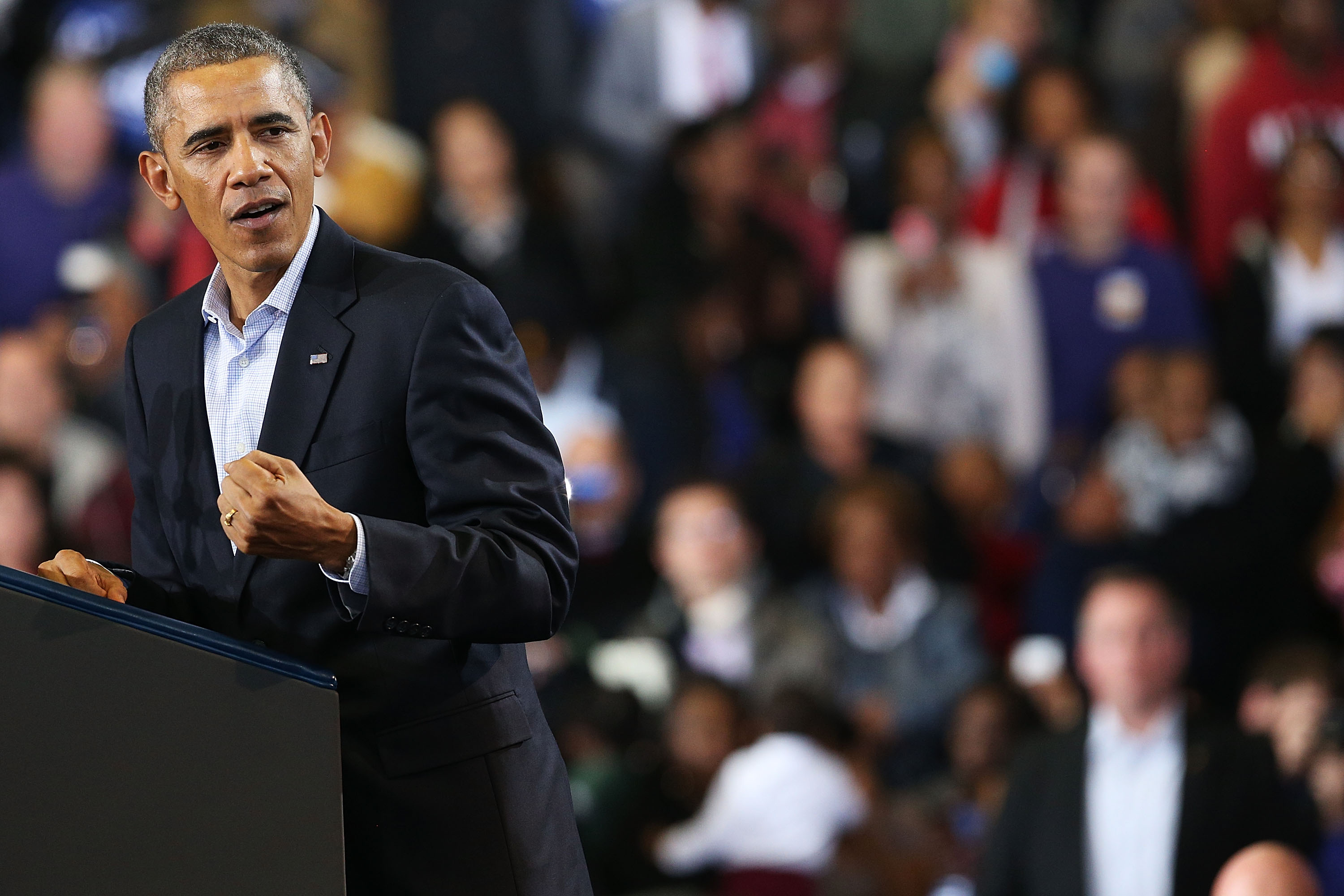
President Obama Attends Rally For The Re-Election Of Connecticut Gov. MalloyI hear few people talk about what Barack Obama deserves, but I’m glad that every once in a while someone does. I have owned a home for a couple years now (thanks Obama economy!) and I have roommates. Just balancing the interests of four people under one roof is EXHAUSTING. The fact that this president has passed laws that have helped my working-class family while dealing with pressures from 350 million people is a staggering thought that too many people don’t have. I appreciate you talking about what President Obama deserves. There are all too many out there, who don’t lead shit, who would blisteringly criticize any train of thought that humanizes the president or paints him in a sympathetic light. Those cats never got my sister health insurance though.

Another reader:

Two things. Obama didn’t really “go wrong” or suddenly become unpopular. There is a great piece from Media Matters that points out that Obama’s approval ratings have held steady for years. Not only didn’t his approval numbers drop this month or this year, or the last few years, but at times have gone up slightly. No matter. The press for some reason latched on to this narrative, and so it is.

So, what is really happening? TheScreen Shot 2014-11-05 at 12.01.47 PM national divide is vivid. Where are Obama/Dems losing? Alabama, Mississippi, South Carolina, Arkansas, Tennessee, Georgia, Louisiana, Texas, Kentucky, etc. You have written about this before – about our “Cold Civil War” and the Southernization of Republican politics. But this obvious fact seems impolite to mention in most venues. America is hip-deep in its long regional/ideological divide, and increasingly so. Attempting to analyze today’s likely results rationally – was it Ebola or the botched roll out of Obamacare? – misses the point entirely. Alabama wasn’t going to vote differently today if Obamacare had rolled out smoothly. Texas, Mississippi or South Dakota wouldn’t vote differently if the stock market under Obama had increased from 7,949.09 to 17,366.24, a growth of 218% in less than six years (it has), or unemployment fell below 6% (it has), or average gas prices were $3/gallon (it is), or GDP was growing at 3.5% (it is).

In the meaningful sense, this isn’t a divided country “across the dinner table.” This is a regional division, and it is growing.

Another:

I work on Wall Street and am one of those dreaded one-percenters.  I have always supported Obama and I still do.  But I am utterly confounded by the lack of support for an administration that has presided over an insanely successful economic recovery.  In 2008-9, we were on the verge of a true disaster, which could easily have resulted in Depression-era unemployment and devastation, and would have if the Republicans in Congress had their way.  This latter statement is not conjecture: does anyone else recall that the markets dropped over 7% when the House Republicans blocked the bailout?  And austerity programs have been proven to be abject failures.  The recovery here has many issues, the most worrying is the wealth gap.  But I am not aware of any time in history when consumer sentiment surveys are at seven-year highs, and the president’s popularity is at close to a six-year low.  Simply put: what the fuck is going on?

But several readers are critical of the president:

You are right to pinpoint the events of the fall of 2013 as the key turning point. You mention healthcare.gov and Syria as the two key developments at that time – yet each of those failures resonated with those who had already decided that they disapproved of the president, the Tea Party and the necons, respectively. The third major development of the fall of 2013, which you do not mention explicitly, was the Edward Snowden story. I think you underestimate its impact by dismissively lumping it with other complaints about the “disillusionment of some on the left.” Obama’s defense of the NSA’s illegality was of a different order than his support for the health insurance industry or his rejection of populism on Wall Street. The Snowden revelations, in my opinion, led, for the first time, to the disillusion of key parts of his coalition: it is that defection, not the energized opposition of those who were already inclined to oppose him anyway, that pushed his approval ratings irreversibly under water.

Another is succinct:

During a campaign, Obama is a great communicator. In office, he’s a rather poor one. Since he took office, he’s ceded the messaging initiative to the GOP, has failed to respond effectively, and it has hurt him, badly.

Another elaborates along those lines:

Where did Obama go wrong? One word: messaging. You’ve hit on this before, and at several points during his administration you’ve laid out the case for his presidency better than he or his team ever has.

Letterman touched on this point by mentioning these three factors: cost of gas, unemployment, stock market. When was the last time you went into Election Day with all three of those trending towards the good and the incumbent administration getting beat up? For whatever reason, possibly it just isn’t native to his skill set, Obama has never done a good job of selling his achievements or the general trajectory of “where we were vs. where we are” that defines his presidency. I’d say it was because he no more elections to run, but he didn’t sell this well during his first term either.

And so in the absence of a sales pitch in defense of himself, the Fox megaphone and its subsidiaries resonate even louder, and the reasonably smaller (not to discount any one) missteps or problems during his presidency seem bigger than they would otherwise be. His response to Syria was off somewhat? How much weight are we supposed to give that? Add in a few new and largely unsolvable hysteria issues (Ebola, ISIS) in the run-up to the election, and here we are.

For the record, you keep asking what this election is supposed to mean. From a mandate standpoint, there isn’t one. But when the GOP owns both houses, it means an invocation of the dare we’ve secretly been muttering to ourselves for some time now: Fine, You Do Something. With full control of Congress, and under the constraints of the veto pen, show us just what it is you claimed you would have done the last six years, if only you’d had the means.

One more reader:

As a classic liberal in FLA’s bloody-red spleen (Lake County), I can honestly say that I am not the least bit surprised how things went down yesterday. Of course I am disappointed that Proposition 2 did not pass and I’m pretty bummed that Rick Scott still has a job, but I’m not shocked at all. I watched the variety of ads that all of this new dark money bought and I sized up the people next to me at the voting booth. I knew that I was voting to stop the bleeding and I waited until midnight before I checked the results.

Reading Democrats’ reactions this morning is a different story. Blaming the President exclusively for the party’s weakness has me utterly bewildered. How limp-dicked has my party become? Obama’s administration has really let me down in a lot of ways (protecting the FBI, keeping Guantanamo open, drone assassinations, sucking up to Wall Street), but to say that the White House lost the mid-terms for Democrats is proof that my party has also lost its mind. Everyone knows the GOP’s playbook and now we also know how effective it can be when the populist side of the Left is ignored for political strategy as well as the need for big money in elections.

We are in for a bumpy ride but at least now Republicans will have to own their legislation and the Democrats can figure out who the fuck they are.

(Map of the 2014 Senate results from Politico. Photo by Spencer Platt/Getty Images))