Two Steps Forward, One Step Back

Synod On the Themes of Family Is Held At Vatican

[Re-posted from earlier today]

The inevitable media headline from the final Relatio of the Synod on the Family will be: “Bishops scrap welcome to gays.” And this is literally true. The astonishing mid-term Relatio’s language of outreach, inclusion and welcome shrank last night into much more arid, cold and unsparing prose.

We don’t yet have an official English translation of the critical paragraphs, but the gist is clear. Gone are the paragraphs that extol the “gifts and qualities” of gay people; gays are no longer to be “welcomed” in a “fraternal space” but merely “accepted with respect and sensitivity”; the church should no longer “value” homosexual orientation; it should merely accept people with “homosexual tendencies.” Of the three paragraphs in the mid-term report, the two with the most positive language have been excised completely; and the remaining one reaffirms the tone and language of Benedict XVI and John Paul II. Here it is – in my unofficial Google-enabled version:

55. Some families live with members with homosexual orientation. In this regard, our view of the pastoral care appropriate to this situation refers to what the Church teaches: There is no foundation whatsoever to assimilate or to establish  same-sex unions as even remotely analogous to the plan of God for marriage and the family. “Nevertheless, men and women with homosexual tendencies must be accepted with respect and sensitivity. In their regard should be avoided every sign of unjust discrimination” (Congregation for the Doctrine of the Faith, Considerations Regarding Proposals to Give Legal Recognition to Unions Between Homosexual Persons, 4).

Notice the very Ratzingerian foot-stamping:

There is no foundation whatsoever to assimilate or to establish same-sex unions as even remotely analogous to the plan of God for marriage and the family.

It’s not exactly subtle. My marriage, according to this version of the text, is light years away from the marriage of my own sister. There isn’t even a remote analogy between her family and mine. In fact, there is no foundation whatsoever to compare the two relationships in any way. Let me simply respond by saying what most Catholics who have encountered these relationships in our own lives would say: it is indeed hard to read this and believe it. This is not because I differ one iota from the church’s view that the life-long, procreative marriage between a man and a woman is a precious, beautiful and unique thing. Two men or two women cannot replicate it, if only because of basic biology. The sacrament of matrimony is a celebration of this unique institution – and cannot be re-fashioned into something else without diluting its central truth.

But where I differ from the old guard is in their refusal to see anything good or precious in the mutual love, responsibility and sacrifice that are as integral to same-sex unions as they are to heterosexual ones. To see nothing worthwhile there, nothing to value, nothing to affirm seems, well, untrue to the reality more and more of us live. As Cardinal Marx of Germany said earlier this week:

“Take the case of two homosexuals who have been living together for 35 years and taking care of each other, even in the last phases of their lives. How can I say that this has no value?”

He cannot, which is why this paragraph – along with two others on the pastoral care of divorced or re-married people – failed to win the 2/3 majority vote for it to be part of the official text.

But it was included anyway – with the vote tallies appended. And there you see why it is not wishful thinking to believe that something profound has indeed occurred so far in this Synod. Neither of the two previous popes would ever have allowed the original language to even see the light of day – Ratzinger as arbiter of church doctrine for decades could sniff heterodoxy on this like a beagle with a distant potato chip – and stamp it out with relentless assiduity. Both John Paul II and Benedict XVI would have excised the outreach to gay people altogether. And the idea of a transparent vote tally – revealing a vigorous internal division on these questions – would have been unthinkable.

The true headline of this past remarkable week is therefore: the Vatican hierarchy cannot find a consensus on the question of pastoral care for gays, the divorced and the re-married, and the Pope is happy for this fact to be very, very public. These remain open questions for a year of continued debate and discussion before the second stage of the Synod this time next year and the Pope’s subsequent summary. That these are open questions is the real result of this Synod.

I also think its worth reading Pope Francis’ concluding speech to the Synod, which was granted a four minute standing ovation. It is a beautiful text – certainly more so than the unavoidable consensus-speak of what might be called the interim communiqué. Here is Francis’ Obama-style weighing of two different temptations to avoid:

A temptation to hostile inflexibility, that is, wanting to close oneself within the written word, (the letter) and not allowing oneself to be surprised by God, by the God of surprises, (the spirit); within the law, within the certitude of what we know and not of what we still need to learn and to achieve. From the time of Christ, it is the temptation of the zealous, of the scrupulous, of the solicitous and of the so-called – today – “traditionalists” and also of the intellectuals.

The temptation to a destructive tendency to goodness [it. buonismo], that in the name of a deceptive mercy binds the wounds without first curing them and treating them; that treats the symptoms and not the causes and the roots. It is the temptation of the “do-gooders,” of the fearful, and also of the so-called “progressives and liberals.”

Avoiding both these temptations is the goal – which has to be accomplished pastorally and with prudential judgment. In his speech, Francis nods to the traditionalists by quoting Benedict XVI verbatim, but then says this:

We will speak a little bit about the Pope, now, in relation to the Bishops [laughing]. So, the duty of the Pope is that of guaranteeing the unity of the Church; it is that of reminding the faithful of  their duty to faithfully follow the Gospel of Christ; it is that of reminding the pastors that their first duty is to nourish the flock – to nourish the flock – that the Lord has entrusted to them, and to seek to welcome – with fatherly care and mercy, and without false fears – the lost sheep. I made a mistake here. I said welcome: [rather] to go out and find them.

It’s hard not to see a little playfulness here. After all, the word “welcome” was one of the most contentious of the Synod, in so far as it was extended to gay people. And if the final Relatio turned that “welcome” into the more neutral “accept”, Francis turns it into something more radical still: to go out and find the lost sheep.

Just as vital in Francis’ vision is the open, tough and lively dialogue that this Synod represents. Nothing like this has been experienced since the Second Vatican Council. And in his concluding speech, Francis reveled in the turmoil:

It has been “a journey” – and like every journey there were moments of running fast, as if wanting to conquer time and reach the goal as soon as possible; other moments of fatigue, as if wanting to say “enough”; other moments of enthusiasm and ardor. There were moments of profound consolation listening to the testimony of true pastors, who wisely carry in their hearts the joys and the tears of their faithful people. Moments of consolation and grace and comfort hearing the testimonies of the families who have participated in the Synod and have shared with us the beauty and the joy of their married life. A journey where the stronger feel compelled to help the less strong, where the more experienced are led to serve others, even through confrontations. And since it is a journey of human beings, with the consolations there were also moments of desolation, of tensions and temptations.

The church is not a political party, voting on a platform, and shifting from one convention to the next. Its core doctrine is unchanged and unchangeable. But it has evolved and grown and changed in the way it has encountered the world throughout history. It has absorbed and assimilated new ways of thinking and newly discovered truths about humankind and attempted over the centuries to integrate them into its internal dialogue. So you have to look at a Synod like this one and not get too caught up in developments from last Monday to Sunday. You have to look beneath that surface to the tectonic shifts beneath. And the real shift, I’d argue, has been the glasnost of Francis – which may or may not lead to perestroika. The intellectual life of the church was a dark and stifling and deadly silent place until very recently. There is now a crack in the window, where light has been let in, and words said that can be excised from the final text but not expunged from the collective consciousness. And at the end, no consensus on the most contentious questions at hand. And a year to debate them further.

Those knots? They keep unraveling.

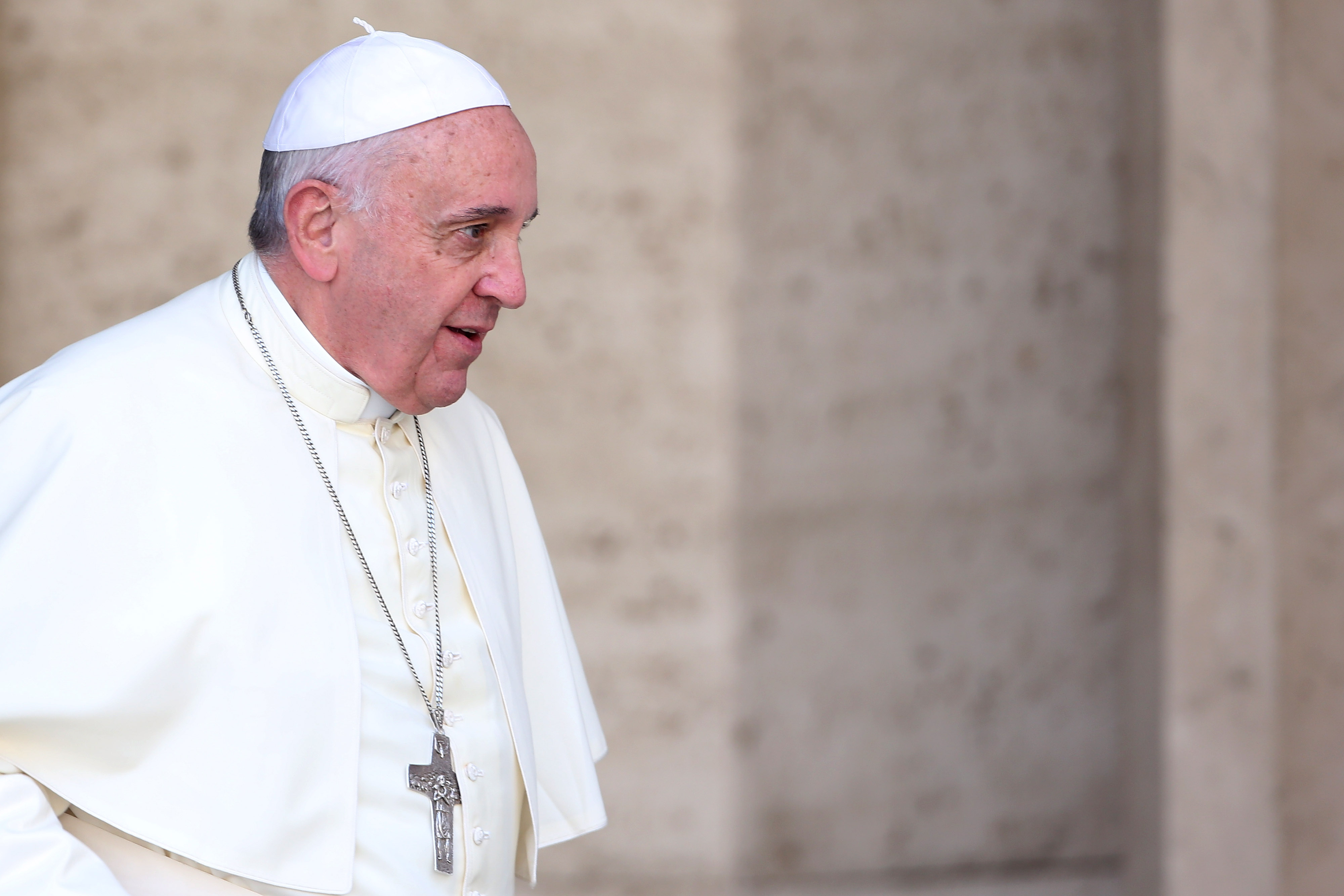
(Photo: Franco Origlia/AFP/Getty.)

“A Poet Of In-Betweenness”

In an interview worth reading in full, Henri Cole recalls the crucial encouragement he received from Seamus Heaney about his poetry:

I remember once talking to him about my book The Visible Man—it had just been published and I was feeling apologetic about the erotic content. He told me the poems were a record of something in “the arena of human emotion.” The most important thing was to contribute to the arena of human emotion, he insisted. I’ve never forgotten this. And to hear it from the son of a cattle farmer was unexpected. It seemed the most patient and generous response to a book others had dismissed as aberrant. It pushed me forward. He describes himself as being a poet of in-betweenness—in between Catholic and Protestant, in between England and Ireland, in between rural and city life, and so on. He is proof that in-between is a good place for poetry. In my own writing, I am in between the North and the South, in between formalism and free verse, in between vernacular and high speech, and, as a gay man, in between genders. Heaney’s example made me want to fly beyond all the identity markers others assign to me.

Faces Of The Day

dish_david

Photographer David Stewart captured shots of British life:

‘Thrice Removed’ is the name of a photography book and project by British photographer David Stewart, which developed from David’s personal observations of relationships in families, society and life in general, featuring a series of somehow inter-related characters. Even though these pictures often seem rather dark, there always is an underlying, essentially British humor that can be seen in the details, revealing more and more, the closer you look at it.

See more of his work here.

(Photo: “Hugh and Chicken in profile” from Thrice Removed by David Stewart)

The Waning Evangelical Vote

Robert Jones notes that “the number of white evangelical Protestants nationwide has slipped from 22 percent in 2007 to 18 percent today.” He thinks “the fact that there are currently five Southern states—Arkansas, Georgia, Kentucky, Louisiana, and North Carolina— where polling shows that the Senate race margins are less than five percentage points indicates that 2014 may be the year that the underlying demographic trends finally exert enough force to make themselves felt”:

Compared to 2007, just after the 2006 midterm elections, the five southern states where there are tight Senate races have one thing in common: the proportion of white evangelical Protestants has dropped significantly.

1. In Arkansas, where Republican and freshman Representative Tom Cotton is locked in a tight race with two-term Democratic Senator Mark Pryor, the white evangelical Protestant proportion of the population has dropped from 43 percent to 36 percent.

2. In Georgia, where Democratic candidate Michelle Nunn is battling Republican candidate David Perdue for retiring Senator Saxby Chambliss’s seat, white evangelical Protestants made up 30 percent of the population in 2007 but that number is currently down to 24 percent.

3. The proportion of white evangelicals in Kentucky has plunged 11 points, from 43 percent to 32 percent; here Senate Minority Leader Mitch McConnell faces the Democratic Alison Grimes, the secretary of state.

4. In Louisiana, where Republican Representative Bill Cassidy is up against three-term Democrat Mary Landrieu, white evangelicals have slipped from being 24 percent of the population to 19 percent.

5. Likewise, North Carolina has seen a dip in the white evangelical proportion of its population, from 37 percent to 30 percent; here incumbent Democrat Kay Hagan battles Republican Speaker of the North Carolina House Thom Tillis.


Compassion Is A Muscle

Researcher Helen Weng suggests that certain forms of meditation amount to “weight training” in empathy:

In a study my colleagues and I conducted at the University of Wisconsin-Madison’s Center for Investigating Healthy Minds (directed by Dr. Richard J. Davidson), participants were taught to generate compassion for different categories of people, including both those they love and “difficult” people in their lives. Doing these kinds of exercises is a little like weight training – the compassion “muscle” is strengthened by practicing with people of increasing difficulty, like increasing weights over time.

After only two weeks of online training, participants in our study who practiced compassion meditation every day behaved more altruistically towards strangers compared to another group taught to simply regulate or control their negative emotions. Not only that, the people who were the most altruistic after receiving compassion training also were the individuals who showed the largest changes in how their brains responded to images of suffering.

These findings suggest that compassion is a trainable skill, and that practice can actually alter the way our brains perceive suffering and increase our actions to relieve that suffering.

Looking Past Despair

In a series of exchanges with Sayed Kashua, an Israeli-Palestinian writer who expatriated to the US this summer, Etgar Keret explains why he maintains hope that change will come to Israel:

It’s easy for me to understand why so many Israelis have chosen despair. The history of this conflict is endlessly depressing. We’ve seen so many missed opportunities, shows of distrust, and lack of courage on both sides throughout the years, occurring almost as persistently as a force of nature. But, even if everyone is to blame for the failure, we Israelis—sorry for dragging you into this, too, Sayed, but a thousand green cards won’t help you; to me, you’ll always be an Israeli—are the only ones capable of beginning a process that will rescue us from this inhuman situation. Israel is the stronger side in this conflict, and, as such, it is the only side that can truly initiate change. And to do that it has to part company with that despair, which, like many other kinds of despair, is nothing but an ongoing self-fulfilling prophecy.

And I believe that it will happen.

I believe that this despair is temporary, and that even though there are quite a few political elements that would rather see us despairing, and even though it sometimes seems as if enormous forces are working to convince us that hope is just another word in our national anthem and not a powerful force that can lead to change, people feel deep down that the terrible situation we find ourselves in is not really the only dish on the regional menu. When I look around, apart from the minority of Jewish messianists cavorting on the hilltops and in the Knesset, I don’t see people who are happy with the existing situation and are willing to accept it. Only some of them have a moral problem with the occupation, but even the ones who don’t realize that until the Palestinian people have a country no one’s going to have an easy time of it here. War is expensive, as our Minister of Defense reminded us recently, and each person in this country is personally invested in the next war, with a son, a father, a brother, or a friend who will go into Gaza for the umpteenth time. And the fact that all those people who are not happy still haven’t found an effective plan of action or a worthy leader they can follow is only a temporary situation. Yes, this temporary situation is terrible, but, paradoxically, the worse it gets, the more inevitable change becomes.

A Poem For Sunday

14511414531_0d6227e3d6_o

Dish poetry editor Alice Quinn writes:

James Laughlin, the founder and publisher of New Directions from 1936 until his death in 1997, was also a prolific poet, who established his style with some guidance from William Carlos Williams, one of his most distinguished authors. In Peter Glassgold’s introduction to The Collected Poems of James Laughlin, 1935-1997, the omnibus volume he has edited, I learned that Laughlin dubbed it “typewriter metrics.” Glassgold describes it thus: “The lines in any given stanza could not vary in length more than one typewriter character.” Laughlin said that he was after “an effect of tension from the war between the strictly artificial pattern and the strictly natural spoken rhythms.”

The poem below was written in the mid-30s, around the time he took a trip to Key West to try to talk Elizabeth Bishop into joining his list. She didn’t say yes, but there’s an enchanting picture of her on the steps of a brothel where they were treated to tea, and, as Laughlin recalled, “Oreo cookies, my favorites.”

“What My Head Did to Me” by James Laughlin:

I guess I like myself
pretty well anyway I
wanted a statue of my-
self so I had a woman

make one it was a head
and she modelled it in
clay then one night I
dreamed I’d killed my

very best friend and
there was my head right
there ready to tell on
me when the police came

I tried to destroy the
face so they wouldn’t
know it was me but my
hands stuck tight in

the clay I couldn’t
tear them loose and
there I was when the
police came held by my

own head with the body
of my friend multi-
plying itself like
endless mirrors down

the street that’s the
thing my head did to
me but of course it
was only a dream see.

(From The Collected Poems of James Laughlin, 1935-1997, edited with an introduction and notes by Peter Glassgold © 1995 by James Laughlin. Used by permission of New Directions Publishing Corporation. Photo by Lori Leaumont)

Quote For The Day

“That music you hear in the distance?  It’s St Augustine, St Teresa, Teilhard de Chardin, Pascal, Kierkegaard and Simone Weil all singing together, and what they are singing is that, as Christ commanded, we are supposed to love God with our minds, as well as with our hearts and our souls and our strength.  It is an illusion to think that there is any necessary conflict between a Christian commitment and free, adventurous thinking.  No-one ever does their thinking on a blank sheet of paper. Every intellectual of every kind is in a conversation with some set of ideas, doctrines, ways of seeing the world, and that’s what makes their own thinking serious.  The Christian conversation with Christian ideas, and with every other kind of idea, need not be defensive or imprisoning.  Why is there a stereotype that says you have to choose between faith and thought?  Two reasons, I think.  One, that people think belief means entering a kingdom of fixed answers — when, in my experience, it really means living with more and more questions.  Two, that people imagine religion must shrink as science grows bigger.  But they don’t do the same thing, or occupy the same space.  There is plenty of thinking room for both.  The great contemporary American novelist Marilynne Robinson says there is nothing like a subscription to Scientific American to fill you with wonder at Creation,” – Francis Spufford, in a recent interview.