MoDo-Proofing Edibles, Ctd

The free market is responding to customers like Maureen Dowd who can’t handle their dosage:

New on the shelves in Colorado’s recreational pot shops is the “Rookie Cookie,” a marijuana-infused confection that contains 10 milligrams of marijuana’s psychoactive ingredient. That’s a low enough dose that most adults wouldn’t be too impaired to drive a car.

Then there’s a new marijuana-infused soda that’s 15 times weaker than the company’s best-known soda. The Dixie One watermelon cream soda contains 5 milligrams of THC — half of what the state considers a serving size — and is billed as “great for those who are new to THC or don’t like to share.”

But Sullum warns that it “would be a mistake to mandate a one-size-fits-all approach”:

Currently the maximum amount of THC per package for recreational products is 100 milligrams, or 10 standard servings. Gov. John Hickenlooper has suggested each package should contain just “one dose.” But one dose for whom? Ten milligrams may be plenty for an occasional user, but it is way too low for many regular users. As [Michael Elliott of the Marijuana Industry Group] puts it, “A lot of consumers are saying, ‘I don’t want to get diabetes trying to get everything that I want. I don’t want to have to eat 10 candy bars to get the 10 doses of marijuana that I want.” Such a mandate would impose extra packaging expenses on manufacturers (and ultimately on consumers) while decreasing customer satisfaction. It makes more sense to offer a variety of potencies to suit the needs of different consumers.


The GOP’s Lock On The House

GOP House

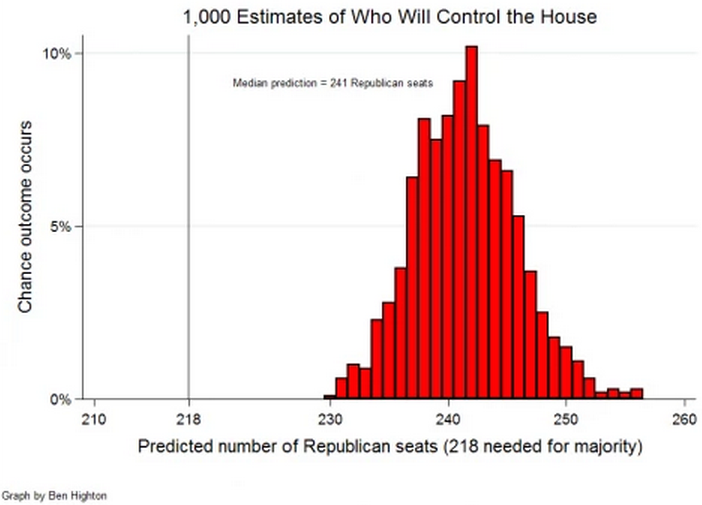
Ben Highton gives “the Republicans a better than 99 percent chance of continuing to control the House after the 2014 elections”:

In fact in our 1,000 simulations of party control this week, the Republicans won a majority of the 435 seats in every single one. … Even for those interested in specific House elections, there is not a lot of uncertainty.  By our estimates, in 408 of the 435 House elections, one party is favored to win with chances that exceed 90 percent.  The Republicans have better than a 90 percent chance of winning in 231 races and the Democrats have a better than 90 percent chance of winning in 177.  The overall lack of competitiveness is striking, if not entirely surprising.

A Premature Peace Prize?

Although much of the recent criticism of Malala Yousafzai’s Nobel win has been lazy and predictably contrarian, Tabish Khair makes a convincing case that the committee should have waited to honor the young advocate:

What kind of burden rests on her 17-year-old shoulders now, I wondered? Is it fair to put that sort of burden on such a young person? Is it fair to award the prize for what might be achieved, rather than what has been achieved – because, unlike [Global March Against Child Labor founder Kailash] Satyarthi, Malala has not had the time to organize anything of substance, despite her brave personal example and her visibility as a symbol. To date, Satyarthi and his organization are credited with rescuing and educating about 100,000 such child laborers in India. She has not had the time to rescue 100,000 children from the darkness of Taliban and its ilk.

Now she might never get that chance. The adulation of well-meaning but largely ignorant people has put her beyond the pale. One original reason why she became such a fresh and enabling symbol – unlike the thousands of men or women who share her opinions in Delhi or Karachi or New York – was that she was “in the field.” Real change – in Pakistan or elsewhere – will be brought by people in the field, as Malala was when she was shot, as the anti-polio workers and hundreds of educators continue to be. …

Now, I realize, Malala has been taken over by the superior circles. I won’t call it the West. I call it the superior circles – people with lots of good opinions, and the inability to operate in the field.

Update from a reader:

Tabish Khair seems to be nitpicking. A girl who had been shot by the Taliban and lived to become an activist might have been an internet sensation for a few days, a la #saveourgirls. The Nobel selection process has brought lasting attention to her cause. Those “people with good opinions and the inability to operate in the field” are called rich people and their support can buy many supplies and operatives. Whether that support is due to the merits of the cause or the cachet of a Nobel is irrelevant.

Putting Our Kids In A Panopticon

Maria Guido laments the lack of privacy among children today:

I never really thought about the concept of toddlers and privacy, but if I stop and examine how I feel about it, is it ridiculous to say that I believe they should be afforded some? I think all parents love to peek in on their sleeping children or sneak up and look in unnoticed when their child is lost in play. I certainly understand why parents would be drawn to making a habit of it by ogling a video monitor nightly. But there are things I remember about my childhood – and a lot of my best memories were solitary ones. …

Recently, New York City Mayor Bill DeBlasio vowed to end the cell phone ban in schools to a collective sigh of relief from parents everywhere.

He admitted that his own son violates the ban and called it a “safety issue” for parents to be able to keep track of their kids. Raising children in the city is potentially worrisome, but is having a direct line to your child at all times really a safety issue? When I was growing up and a parent had to reach a child in an emergency, they called the school. Perhaps we have more emergencies now, or are we just so used to being on top of our children that we truly believe they can’t make it to school and back without being able to reach us, immediately?

In our attempts to protect our children, we may be crippling them instead. Learning how to move through the world without a direct line to your parents is an important skill for older children. We’re demanding our kids be reachable at all times for their own good. Or is it for our own good?

The above video illustrates how some parents can’t let go even after their kids go to college.

Is Amazon A Monopoly? Ctd

Readers continue the thread on the mega-company:

As a measure of how Amazon is getting its fingers into an ever-widening area of retail, consider this: My Audi TT had a headlight go bad, which required replacing the entire headlight module.  Cost from a dealer? $1200. Cost from Amazon? $600.  (Directly from Amazon, not from a reseller.)

Car parts for a 12-year old, low volume model?  Wow.

A business professor writes:

Two key points about Amazon’s market position are being consistently missed, even in the business press:

1. While Amazon shows accounting net losses, they have generated net positive cash flows for the last three years running from $574 million up to $2.8 billion. Accounting income is largely a fiction these days, aimed as much at minimizing taxes as anything. The ability to generate a positive cash flow through creative means (including “innovative” financing) is what drives most really big businesses. A key part of this strategy is keeping accounting profit so low that competitors cannot fly this close to the ground without crashing.

2. Amazon, like Walmart who mastered the art before them, is a “penny scraper.” Sam Walton realized that if you scraped a few extra pennies per transaction out of suppliers, customers and employee pay, profit becomes irrelevant. Multiplied by millions of transactions daily, these pennies add up to billions of dollars over a single year if you are big enough.

Another focuses on books:

It’s hard to like Amazon.  Their size is genuinely troubling, and they treat many of their employees quite badly.  I’d rather work in a Walmart than an Amazon warehouse.  And it’s easy to love old school publishers, who champion great books, and so much of what’s best in our culture.

But the traditional publishers are doing a terrible job with ebooks.  There are publishers of tech books who do a great job with ebooks, who manage to distribute books without Amazon (even to Kindle owners), and who have found good ways to minimize piracy.  The traditional publishers can’t even copy those existing and proven business models.

The best example of a small publisher that gets ebooks right is probably the Pragmatic Press.  If I buy an ebook book from them, I can download epub, mobi, and pdf versions.  The files I download have my name all over them, which discourages me from pirating them.

They’re good at delivery. I have my Prag press account synced to my Dropbox, so the files appear there automatically.  When corrections are made (which happens often with geek books), updated versions appear automatically.  They also offer automatic delivery to Kindles via email, although I don’t use that.  I just copy the files to my device manually.

It’s really nice to have both PDFs and mobi files of tech books because sometimes the formatting is important it tech books.  This would be a huge advantage for other types of books too – poetry, for example, which has never worked well for me on Kindles.

When the Prag Press sells me a book, they get to keep all of the money.  And they have a relationship with me that they control, which lets them market to me directly.  They send me notifications of new books and discount codes.  This stuff works; I buy books in response to their emails several times a year.

I just bought an ebook as a text for a free online programming class, and I was really unhappy that I had to buy it through the Kindle system (the publisher is more traditional), not because I have a political axe to grind, but because it’s a worse experience.

Everyone who loves books wants literary publishers to succeed.  But they want to respond to ebooks by using some other company (Amazon) as if it were just another bookstore to sell their stuff.  It’s just not a viable approach.  They’ve outsourced their response to massive tech trends to Amazon, and they’re surprised that Amazon has set things up on favorable terms for Amazon.

And another counters many of the previous readers:

I’m glad there’s pushback against the notion that Amazon is a monopoly, but it needs to be mentioned that the fallback view, that Amazon is a monopsony, is also demonstrably false. What is the definition of a monopsony? As your readers say, its “a market form in which there is only one buyer for goods”. A monopsony means that sellers are forced to agree to the terms of the buyer, because there is no one else to sell to.

But the current dispute with Hachette proves that Amazon is not a monopsony, since Hachette is refusing to agree to Amazon‘s terms, and is instead insisting that Amazon agree to its terms. If Hachette had been forced to quickly give in to Amazon, that would serve to prove that Amazon is effectively a monopsony. That they aren’t even entertaining the notion of doing so, but willing to suffer whatever consequences come their way, demonstrates that Amazon can’t force its suppliers to accede to its demands.

And this isn’t the first time. In 2010, Amazon got in similar disputes with the Big 5 publishers, who were demanding agency pricing on ebooks, and guess who was forced to give in to the other sides’ demands? Right again, it was Amazon who folded. Later the Justice Department sued and the courts agreed that those publishers, along with Apple, had engaged in an illegal collusion conspiracy to force Amazon to accept their demands. Again, more evidence that Amazon is not a monopsony, but strong evidence that the major publishers constitute a cartel-monopoly that can force even giant retailers like Amazon to accept their terms.

Following that lawsuit, the major publishers have been required to renegotiate their contracts with Amazon. They are allowed to demand agency pricing, but not to do so as collusion. And that’s exactly what Hachette is doing. They are from all accounts demanding agency pricing on ebooks, and not giving an inch, even when Amazonmakes things more difficult for buyers to order or ship Hachette books. Hachette is the smallest of the major publishers, but it seems reasonable to infer that they would not be taking this hard line unless they felt confident that they would be backed up by the others when it is their turn to negotiate new agreements with Amazon. If that is how it turns out, Amazon will likely be forced to concede to the big publisher’s demands. Which simply isn’t how a monopsony is supposed to work.

If one examines the publishing industry honestly, massive consolidation of publishers into a few major corporations has created an effective monopoly cartel that has successfully forced all the players in the market to accept its demands and pricing. And when it comes to authors, they have also created uniformly non-competitive standard author contracts that only the biggest selling writers are able to get around, which pay the same royalties and have the same highly restrictive provisions. That has made them an author’s monopsony, meaning that most authors have no choice but to sell their works on those same terms.

Only Amazon has created a means to break that cartel-monopsony, by allowing authors to self-publish through their Kindle Direct Publishing program (which has since been copied by Apple, Barnes and Noble, Smashwords, Kobo, and others). And that makes the major publishers and best-selling authors mumble vague threats about the end of literature and the demise of publishing. As if letting authors bypass the monopsony cartel on publishing that has been enjoyed by the major publishers for decades now is somehow a bad thing for writers.

It’s not that Amazon is some angel here, but their disruptive digital technologies have been proven to be a boon to authors and are helping to break up the monopolies and monopsonies of the publishing industry.

Update from another:

I can’t add much to the monopoly thread regarding Amazon, but you have to wonder if the actually sellers being lorded over by Amazon are very happy about not getting a fair shake online when it comes to being found when someone does a search for the products you sell and being absolutely squashed by Amazon’s ability to own the search results.

The Audi TT headlight is a good example. The actual seller/supplier not only sells that headlight for half the price and squat for profit, but then more than likely pays Amazon a percentage for that privilege. Amazon effectively controls their ability to make money. I’m sure there are some who would have no business, but when the profit margins are shit, and Amazon is potentially making more off the sale than they do, where’s the motivation? Where’s the fairness? You’re part of a mega-chain gang, just working to get through the day, but probably not getting ahead.

I used to buy bee pollen from a company in Arizona for $17 a pound. Search results came up with Amazon’s price as $10 per pound. This is a niche market, where that $7 of profit would make a huge difference. I used to buy directly from the supplier to be the nice guy. If you think about the labor and time invested in collecting and packaging bee pollen, not including the efforts of the bees of course, it makes you wonder how this outfit survives.

Amazon is probably great for the consumer, but they’ve effectively killed consumer loyalty when it comes to actually being loyal to a business and their business model. Buying their product from Amazon shows loyalty to the product, maybe. But wholly at the expense of the supplier.

I’m not sure Amazon has a monopoly, but certain they’ve created an unfair advantage. How can you compete with their pricing and stay in business. Amazon is the 1% and their vendors are victims while the business profit margin gap is widening.

One more:

Your reader wrote, “I’d rather work in a Walmart than an Amazon warehouse.” I don’t know if this person has experience working in either, but I tend to think “not,” because there is no comparison.

I just finished 6 weeks of working in an Amazon Warehouse in Tennessee near Nashville. The starting pay is $11.00, plus 50 cents an hour for working the night shift (6:30pm to 5:00am, four ten-hour shifts per week). About four weeks in, there was a big meeting where they announced our pay was going up 25 cents per hour based on a survey of similar businesses in the region.

This would NOT happen at Walmart. Walmart starts at minimum wage (the federal $7.25 here in Tennessee) and good luck actually working full time (they send you home before 40 hours to avoid paying full-time benefits).

I’m not going to lie and say that working in the warehouse was easy, or that the $11.75 per hour I was getting was great and working nights was awful. I quit as soon as I could. And yes, they monitor your production to the minute and require you to hit a certain rate (it depends on your job; mine, in the “Sort” department was one of the “better” jobs in the warehouse). But I met a lot of people who have worked there since it opened and liked it very much.

Most of the horror stories you hear are from seasonal temps who work there during the busiest, craziest time of the year, don’t get proper training and never have a chance to figure out what was going on. It may suck for them, but I was able to earn a basically living wage (supplementing my wife’s income) and sustain us until I found something better. I didn’t have to deal with shitty customers, the managers treated me fairly. I would have stayed there had I not gotten a significantly better-paid job that allows me to sleep normal hours.

(Full disclose: the Dish gets about 3 percent of its annual revenue from Amazon’s affiliate program, detailed here.)
The Best Of The Dish Today

It was to be expected that the response from the old guard in the Vatican to the ground-breaking Relatio to mark the middle of the Synod on the Family in Rome would be, well, not too enthused. It’s important to remember that almost all the cardinals and bishops wielding authority in the church were appointed by Popes John Paul II and Benedict XVI whose core themes were the banishment of real dialogue in the church and absolutism on the questions of family and marriage and homosexuals. They were as adamant about shutting down the discourse begun in the Second Vatican Council as Francis quite clear is about re-opening the conversation. And so the protector of Catholic doctrine – Cardinal Gerhard Müller – has just spluttered the view that the document is “an undignified and shameful report.” And lurid conspiracy theories are in play:

In one full day, Sunday (or in 2 days, 48 hours, if all hours of Saturday are included, with no time for meals or sleep), the rapporteur and his secretaries gathered the views of all the Fathers, identified and separated those portions that had more widespread support and thus represented a truly Synodical opinion, wrote, and translated this 6,000-word report? Has the Vatican suddenly become the most efficient bureaucracy in the history of the universe? Or was it all simply prepared and translated beforehand, to create “facts on the ground” that could not be reversed and created pressure on the Synod Fathers during this second week? 

There is, of course, an alternative view: that for the first time in a long time, the leaders of the church were asked to listen to the testimony of actual Catholics living real lives in the modern world; to see once again the sensus fidelium so long dismissed by the last two Popes, to resuscitate the idea of the church as being an “expert in humanity.” Paul Elie:

For several decades, if not longer – for the whole lives of those of us who are younger than fifty, at the very least — the church’s claim to be expert in humanity has been belied and undermined by the church leadership’s flagrant indifference to the experience of humanity outside the bounds of the church, as found in the family in particular.  I mean families broken and reconstituted; families envisioned, imagined, fashioned, and maintained on the ground out of necessity; families whose members cherish one another as family first of all, putting the family bond above differences that might divide them. At the same time, the church’s claim to be “expert in humanity” has been compromised drastically by its leaders’ willingness to use the world’s most cynical expertise to deny their own failure to protect the rights of children entrusted to them by families beyond numbering.

Now all of a sudden in Rome here are the princes of the church willing to learn as well as teach – willing to learn from people with experience of divorce, of companionship outside of marriage, of homosexuality. For the church, this synod is summer school held a few weeks late, the first course in a remedial education in human nature – a first step on the path toward its becoming something like “expert in humanity” once again.

There will be backlash; there will be outrage; there will be intrigue. But the words issued today cannot be taken back, however hard some try. I simply pray that this wonderful Pope lives long. We so need him. The world needs him – and what he has to say.

Our coverage of this remarkable day in the history of Christianity began with my take, with further reactions collected here, and the theocon meltdown here. Jesse Helms’ state of North Carolina saw its first same-sex marriages today as well. Yes, if you’re wondering if I’m a little bewildered by hope, you’re not wrong. Meanwhile, Israel’s continued annexation of other people’s land drew an unprecedented rebuke from the British parliament; David Remnick stood up against the scourge of sponsored content; and the incoherent, impossible air war against the latest group of Islamist fruitcakes turned into even more of a real Turkey. Plus: more evidence of the fathomless heterosexuality of our president; and a correction of the day for the ages.

The most popular post of the day was Yes, This Is A Pastoral Revolution; followed by Correction of the Day.

Many of today’s posts were updated with your emails – read them all here.  You can always leave your unfiltered comments at our Facebook page and @sullydish. 22 more readers became subscribers today. You can join them here – and get access to all the readons and Deep Dish – for a little as $1.99 month. And drop us an email; we love hearing from new subscribers. The latest:

I’m writing in to say that I’ve just subscribed to the Dish, having been an avid reader of your publication for the past few years. What made me hop off the fence was your recent post detailing your financials for the past few months. It’s way too rare that institutions are willing to talk about these things, and I really appreciate how transparent you’re being with your readers.

I mean, the reason I’m subscribing is also because I consistently find that, while I occasionally disagree with your views, I cannot help but respect the humility and honesty with which y’all approach writing. I want to help y’all continue to do what you do. But seeing the raw numbers and hearing you talk about where you want to go from here is powerful incentive to pitch in.

See you in the morning.

Choosing Death

Meet terminally ill cancer patient Brittany Maynard:

Gene Robinson defends Maynard’s decision to end her life on November 1:

Many people would call this suicide, pure and simple. But life is much more complex, and the human spirit much more creative, than such a judgment would suggest. Perhaps more than anything, what people fear most—aside from the pain of a terminal illness—is the loss of control. Call it pride and the desire for autonomy over one’s life if you will, but to those who advocate for the right to end one’s life, it is the right to “die with dignity.” That’s what Brittany wants. I think she deserves that right. And I think it is a thoroughly moral choice.

Brittany Maynard is not mentally ill. She is not suffering from depression. No amount of therapy—whether psychological or physical—will change the fact that without intervention, she will die a horrible death. She seems to have worked through the “stages of dying” made famous by Dr. Elizabeth Kubler-Ross, and reached the final stage of accepting the fact of her imminent death.

J.D. Tuccille supports the Oregon law that allows Maynard to make this choice:

Well-spoken and obviously thoughtful, Brittany Maynard has literally become the poster child—and video child (see [above])—of the movement dedicated to expanding options available to people otherwise facing an unpleasant end. Specifically, this works out as the ability to seek medical assistance free of legal penalties for those who offer help. In Oregon, the Death with Dignity Act, enacted in 1997, “allows terminally-ill Oregonians to end their lives through the voluntary self-administration of lethal medications, expressly prescribed by a physician for that purpose.” Doctors participate only at their own choosing—they’re not compelled to help patients end their lives.

Which is to say, this is about the final choice that anybody can make, and freeing others to choose to offer assistance in achieving the chosen goal. That’s about as libertarian as it gets.

Ross Douthat reflects on why such laws haven’t become more widespread:

Many liberals seem considerably more uncomfortable with the idea of physician-assisted suicide than with other causes, from abortion to homosexuality, where claims about personal autonomy and liberty are at stake.

Conservatives oppose assisted suicide more fiercely, but it’s a persistent left-of-center discomfort, even among the most secular liberals, that’s really held the idea at bay. Indeed, on this issue you can find many liberal writers who sound like, well, social conservatives — who warn of the danger of a lives-not-worth-living mentality, acknowledge the ease with which ethical and legal slopes can slip, recognize the limits of “consent” alone as a standard for moral judgment.

Jazz Shaw appreciates the complexity, presenting views on both sides:

This is a subject which we’ve had to deal with in our family and one that I’ve personally debated for a long time. It’s not an easy question for many people, though the spiritual and social dilemmas surrounding it can lead to battles which come off as unseemly when dealing with a young person facing their own mortality. …

With or without government permission or medical help, many people are going to make this choice when faced with the ultimate question. They have to struggle with asking whether life is indeed so precious that a few more hours or days of it are worth the cost if that time is spent medicated beyond conscious activity while loved ones weep at their bedside. Those who determine that is is not and who can’t obtain competent medical advice will choose a gun in their mouth, a noose, a car “accident” or some cocktail of pills and alcohol which they cobble together themselves, often with disastrous results in failed attempts. So I’m not going to judge either Maynard or [fellow cancer patient Kara] Tippetts and can only hope that others will spare me such judgement should I wind up facing the same, awful decision point.

Harold Pollack finds that “the mass appeal of assisted suicide reflects an incredible failure of our health care system”:

We do not provide proper palliative care. As Atul Gawande relates in his beautiful new book Being Mortal, we do not reliably address people’s deepest needs when they face life-ending or life-altering illnesses of many kinds. We can do a better job of relieving people’s symptoms and protecting them from pain. We can protect families much more effectively against catastrophic medical expenses and hard caregiving burdens. We can work more effectively to ensure that every patient can make the most of their remaining days. We can more effectively promise that someone will die with dignity without the need to take precipitous measures while they still believe they can.

The Institute of Medicine’s recent report, Dying in America: Improving Quality and Honoring Individual Preferences Near the End of Life, provides many practical suggestions of how these challenges might be more effectively addressed. For example, Aetna expanded its hospice and palliative care benefit by allowing people to still receive curative therapies while enrolled in hospice, and by slightly relaxing its eligibility standards for hospice services.  Such “concurrent care” models allowing people to receive improved attention to quality of life issues and symptom relief, even as they might choose fairly aggressive treatment of a life-threatening or life-ending condition.

Recent Dish on end-of-life concerns here and here. Update from a reader:

My mother died from glioblastoma, the same brain cancer that is killing Maynard. It is as horrific a disease as one can imagine. My mother seemed to lose another piece of herself each day. So I can understand Maynard’s decision to end her life before the worst of the disease affects her.

But, when I brought in home hospice the last week of my mother’s life (and I so regret not doing it sooner), they told me they would treat any symptom that could possibly cause her discomfort. And they did. That week she did not suffer. Witnessing her natural death and caring for her was one of the most profound experiences oft life. It was not a burden; it was a gift and I will always have the comfort of knowing I did this for her.

I respect and understand Maynard’s decision but I urge anyone else considering assisted suicide to speak with hospice first and learn what they can do for you.

Face Of The Day

Police Move In To Clear Away Hong Kong Protest Sites

Pro-democracy protesters use umbrellas to protect themselves from police’s pepper spray on a street outside of Hong Kong Government Complex on October 14, 2014. Protesters took over Lung Wo Road after police cleared off the barricades on Queen’s Road. Protesters continue to call for open elections and the resignation of Hong Kong’s Chief Executive Leung Chun-ying. By Anthony Kwan/Getty Images.

The Running Of The Indies

Danny Vinik examines the ideology of Larry Pressler, a former Republican campaigning as an independent in the South Dakota Senate race:

At first blush, it may seem like Pressler is living up to his independent candidacy. And technically that is true: On some issues, he supports the GOP. On others, he’s closer to the Democrats. But this is only the case because the Republican Party has swung so far to the right. With the exception of supporting same-sex marriage and a pathway to citizenship, Pressler’s Democratic positionsslightly more revenue in return for significant spending cuts, a moderate increase in the minimum wage, and reforming Obamacarearen’t very Democratic. In fact, Pressler’s platform is mostly a mix of centrist and Republican positions. In years past, that would make him a Republican, not an Independent.

Francis Barry entertains the prospect of a Senate with three or four independents:

King, Orman and Pressler have all said they are open to caucusing with either party. If neither party wins outright control of the Senate, King – along with Orman and Pressler, if they win – would become the Capitol equivalents of LeBron James: highly prized free agents. (Sanders, by contrast, would sooner denounce maple syrup than join forces with Republicans.)

The independents would have enormous leverage to extract financial benefits for their states and political benefits for themselves. While King and Orman might prefer aligning with the Democrats, and Pressler would lean toward the Republicans, all would be able to play the parties against each other. Constantly.

Perhaps, but the independent candidates will have to win first. Enten takes a closer look at the Kansas race, which may be moving back towards the GOP:

In Kansas, Republican Sen. Pat Roberts faces a strong challenge from [Independent Greg] Orman. Orman, though, may have peaked too soon. Roberts recorded his first lead in two polls released last week, and a newPublic Policy Polling (PPP) survey puts Orman only up 3 percentage points. That’s down from a 10 percentage-point lead in PPP’s two prior polls. FiveThirtyEight still gives Orman a 58 percent chance of winning, but the race appears to be trending back toward the fundamentals (i.e. Kansas is a red state), and the GOP has a large advertisement advantage heading into the final few weeks of the campaign.

Tom Jensen of PPP identifies a major reason Republicans might still pull off a win in Kansas:

There’s still one big data point in Kansas pointing to the possibility of Roberts ultimately coming back to win this race. By a 52/35 margin, voters in the state would rather Republicans had control of the Senate than Democrats. And among those who are undecided there’s a 48/25 preference for a GOP controlled Senate. If voters make up their minds based on the national picture in the closing stretch it could mean voting for Roberts even if they don’t really care for him personally.

A Massacre In Mexico

Mexican Federal Forces Takes Over Security In Iguala and Tixla

Nick Miroff reports on the aftermath of a horrifying mass disappearance in Iguala, where “43 student teachers appear to have been rounded up after a day of protests, then marched into the hills and apparently massacred by local police and gang members, who prosecutors say control the city and its officials.” The discovery of at least 28 bodies, “so butchered and burned that Mexican authorities say it could take two months for DNA testing to determine if they’re the missing students”, has sparked protests throughout the country:

Iguala — in one of Mexico’s poorest and most troubled states, Guerrero — is the place where the country’s radical protest traditions have collided tragically with a new reality of gangster-run local governments. It’s not to say that local police wouldn’t have roughed up protesters, or possibly worse, in the past. But in Iguala, where prosecutors say police act under the orders of the gangsters, there was no restraint. Where crime bosses rule — the local capo goes by the nickname “El Chucky” — there was apparently no patience for pesky protesters and other such democratic nuisances. What has been so shocking to Mexicans is that the traffickers would treat them just as any other criminal rivals. One grisly image circulating social media shows a dead student whose face has been removed.

Claudia Romero stresses that this was not an isolated incident:

[T]he state of Guerrero is only one of several Mexican states where organized crime is fighting a turf war. The government of Iguala, moreover, is not Mexico’s only bureaucracy paralyzed by corruption. Police brutality is nothing unique to this case, either. Murders, disappearances, torture—these are weapons law enforcement across Mexico has turned on peaceful protesters. Ayotzinapa calls to mind other similar cases, including; Aguas Blancas, Acteal, and Tlataya, where corrupt police in league with the mafia have effectively criminalized social protests.

“It’s not always clear,” Kathy Gilsinan adds, “whether the local government is working for the drug cartels, or the other way around”:

InSight Crime’s David Gagne suggested on Thursday that Guerreros Unidos was likely “acting as ‘muscle’ for corrupt local officials,” since the cartel itself had little incentive to target the students. “Oftentimes criminal groups can take actions that authorities cannot,” InSight Crime’s co-director Steven Dudley told me. As to who exactly is working for whom in Mexico’s criminal-political nexus, Dudley said, “The short answer is, we don’t know. And the longer answer is, it changes all the time.”

Leon Krauze blames President Enrique Peña Nieto for failing to address Mexico’s serious corruption problem:

In lockstep with his party’s long held tradition, Peña Nieto has mostly turned a blind eye to numerous allegations of corruption at both the municipal and the state level. In the months before the kidnapping of the Ayotzinapa students, Jose Luis Abarca, the allegedly corrupt mayor of Iguala, had numerous and serious complaints filed against him. Federal authorities merely stood by. Now, the man is on the run, along with his chief of police. I’d be surprised if they’re heard from again and amazed if they’re ever prosecuted and sent to jail.

The US, Carimah Townes argues, doesn’t have clean hands here either:

Though Mexico is well-known for government corruption and systemic violence, the U.S. cannot be absolved of its involvement. The U.S. has contributed billions in financial aid to Mexico’s military under the Merida Initiative, with very little oversight. Indeed, due to concern over the U.S.-Mexico partnership and little knowledge of how the money is actually spent, Amnesty International stated, “In August [2012], despite the failure of Mexican authorities to meet human rights conditions set by the US Congress as part of the Merida initiative, the US State Department recommended that Congress release the 15% of funds subject to the conditions.” The Washington Office on Latin America, also attributes the overall militarization of Mexico’s public security to a U.S.-backed remodel, under which law enforcement officials are military-trained.

(Photo: Abandoned clothing is seen near clandestine graves in the outskirts of Iguala on October 13, 2014 in Iguala, Mexico. Mexican authorities found four more graves containing human remains near Iguala where 43 students went missing after a confrontation with local police that left 6 dead last September 26. By Miguel Tovar/LatinContent/Getty Images)