In an interview, Swamplandia! author Karen Russell discusses why she taught Ray Bradbury’s The Martian Chronicles at the Iowa Writers’ Workshop. “The book feels subversive to me as an adult reader,” she explains:
[Stephanie Palumbo]: How does Bradbury use human activity on Mars as a metaphor?
KR: He’s writing against patriotism during the Cold War. Humans land on Mars and then destroy it. Not much time elapses between landfall on Mars and the annihilation of all Martians.
SP: There’s a haunting image in one story, where a little boy is playing with a white xylophone that turns out to be a Martian ribcage.
KR: The planet is basically wiped clean of its indigenous people. I was shocked by the descriptions of these ancient, bone-white cities on Mars, and it took me an embarrassing length of time to recollect that people can visit ruins anywhere on our planet, too. It’s a case where sci-fi holds up a funhouse mirror to our own history. In case we have amnesia about the horror of the frontier, here we see another frontier and xenophobia, paranoia, aggression, madness. But we see people be really good to each other too. Bradbury seemed to be such a humanist at the same time that he is calling us out on our most despicable qualities.
A reader relates to this post about autonomous sensory meridian response:
I probably won’t be the only Dish-head to write you about this, but ASMR is most definitely a physical sensation. It’s not a matter of belief. (Although it tends to attract people who believe in all manner of woo, like Reiki and chakras and so on.) It’s similar to a frisson, or the chills you experience when you hear a particularly moving piece of music. Or a piss shiver. They are all of a piece. I’ve experienced it my whole life, and yes, Bob Ross was the first trigger. For me, it’s a tingling sensation that starts at the nape of the neck and spreads to the scalp.
While it’s very pleasant, it’s not sexual. Many people who experience it, including myself, have some degree of anxiety and related insomnia. Listening to ASMR videos is very helpful for getting my mind to slow down so I can relax and go to sleep.
There is a very good (short) This AmericanLifesegment about ASMR here.
Another reader with ASMR grumbles:
Oh god, you did another post about ASMR and yet again managed to insert a non-existent sexual connotation (with the post title “Aural Sex”).
As someone with ASMR for 40 years, who like many others, only learned it was a “thing” that others had from a This American Life episode a few years ago, I cannot overemphasize how annoying and damaging it is to have ASMR related to sexual experiences. I’ve heard it referenced as a “brain orgasm” (what does that even mean?) among other attempts to describe what it is.
But it has nothing to do with sex. It’s a weird, unbelievably pleasant feeling that you get when experience certain things that trigger it, often watching videos of someone doing a monotonous task in a deliberate matter. I describe the feeling as like a rush of endorphins that start in the top-back part of my head and cascade down my spine like a warm waterfall.
So why is it so bad to connect it to sex? What’s the harm? Well consider this: ASMR is weird. It’s something that singularly hard to explain to people that don’t have it. You’re stuck with metaphors. And the easiest one for people who don’t have ASMR to jump to is basically that it’s just like porn. In fact consider this description:
A person loves going to their home office in the evening, locking the door, firing up the computer and searches for videos. He knows what he’s looking for; he has very specific tastes. He can only really get what he needs from certain videos; certain performers. He has them bookmarked. If he has time, he might spend 30 minutes or an hour watching… and the ultimate pleasure he gets is divine.
Am I talking about ASMR there? Or porn?
In many ways, having ASMR a much bigger challenge to admit to others than admitting you watch porn. With porn, you pretty much know that essentially every guy, and most women, watch it. Even if the people you are talking to doesn’t watch it; they get it , they understand it. But with ASMR, it’s much weirder and foreign to them. Is it any surprise they jump to the parallel to porn and assume it’s related to sex?
But it isn’t; and every time I see someone blithely making that connector or offering up a “lightly humorous headline like “Aural Sex” I just want to scream. Especially today… “NOT MY BELOVED DISH!”
But another loved the post:
Thank you! I have experienced ASMR for much of my adult life but never before knew what it was. Now I have a name for the pleasurable tingly feeling in the back of my head I experience from time to time, often in very casual and one might say inappropriate settings.
In fact I first noticed it in my freshman algebra class in high school. I was usually a little drowsy since it was just after lunch. The guy who sat behind me couldn’t keep his mouth shut, but he whispered since we were in class. His deep voice set me off nearly every day. At the time it freaked me out a little. Forgive me, but as a 14 year old in the rural Midwest I was not raised to believe homosexuality was normal or natural, and it worried me that I was getting such a kick out of this guy’s endless monologue.
Fast forward twenty years, and I’m both comfortably heterosexual and comfortable with homosexuals. Yet to this day men, or at least male voices, tend to set off my ASMR more than female voices, though both can do it. I figure it has something to do with the deeper tone, as lower female voices trigger it more often as well. I wouldn’t say it’s sexual necessarily, or at least not exclusively. It’s just an intensely physical pleasure. I’m sorry to learn not everyone experiences it.
Another reader who’s experienced ASMR:
When I was a student a (decidedly unsexy) philosophy prof used to trigger it. So did a young Chinese woman who worked in the youth hostel in Miami Beach in the late ’80s. I would sit listening to her ramble about China for hours, never feeling any sexual attraction to her. But she was fascinating both for platonic reasons and for the physical effects she had on me. It is these people’s detached, disinterested nature that makes me drop all my defences, which seems to be a necessary condition for ASMR in my case.
Sadly, I haven’t experienced it in a long time. Not sure if it’s because I’ve physically changed or because I don’t get out enough (I work from home) or because when you get older you confront fewer people like that.
PS: Had no idea there was a name for this thing. I’ve never known anyone else with it. Thanks so much for posting it. Guess I should subscribe now :)
One more reader:
Just by way of further illustration of the effect Bob Ross had on countless thousands (including many like me who had no intention of even trying to learn to paint). Back in Bob’s heyday, my best friend and I used to toke up, turn on PBS to Ross’ show, and listen – with the brightness control turned to complete darkness so that we could only hear, not see, what he was describing. Now THAT was a trip.
Since the 1960s, the political novel has gone abroad, into exile, journeying to those countries where politics is still a signifier for action. Nadine Gordimer, V.S. Naipaul, Doris Lessing, J.M. Coetzee, André Brink became its English-language masters. Even when American novelists picked up the intrigues of political commitment, they often exported their novels abroad. Joan Didion’s A Book of Common Prayer had to go to the fictional Central American country of Boca Grande, Don DeLillo’s The Names to junta-controlled Greece. Robert Stone’s Damascus Gate set its apocalyptic conspiracies in Jerusalem and Gaza and perhaps one of our finest political novels, Norman Rush’s Mortals, explored the desolation of political action in the dry, desert veld of Botswana. To be sure life is better, if perhaps more neurotic, on this side of a state of emergency and without the fear and upheaval, the violence and terror, of revolutionary politics. But how has it affected our political imaginations?
Julian Baggini identifies a “highly contagious meme [that] is spreading around the world,” one that “takes serious ideas and turns them into play, packages big subjects into small parcels, and makes negativity the deadliest of sins.” The culprit? What he terms “Generation TED”:
To be progressive and radical once meant being sceptical and opposed to large corporations. For Generation TED, however, this is outdated thinking that leads only to cynicism and inertia. It’s time to grow up and accept that to do good things in a capitalist world you often need to tap the wealthy. In reality, this has always been true: think of Engels supporting Marx, or Beatrice and Sidney Webb funding Fabian Socialism with inherited wealth.
The rejection of cynicism, however, sometimes looks less like realism and more like naive, starry-eyed optimism.
In its mission statement, TED says: ‘We believe passionately in the power of ideas to change attitudes, lives and, ultimately, the world.’ It goes without saying that this change is supposed to be for the better. Viewers get to choose which adjective best describes the video they’ve watched: beautiful, courageous, funny, informative, ingenious, inspiring, fascinating, jaw-dropping, or persuasive. ‘Bullshit’ and ‘misleading’ are not on the list. Generation TED believes that if you can’t say something nice, don’t say it at all.
He continues, “Generation TED does lack sufficient scepticism”:
Truly great ideas are sculpted with the chisel of critical thought, not created fully formed by spontaneous genius and good intent. We don’t need to wallow with postmodern irony in the contradictions and paradoxes of the modern world but nor should we ignore them. There are signs that Generation TED is learning this lesson. TED, for example, has added an asterisk to its strapline ‘Ideas worth spreading’, which leads to a series of wry footnotes including ‘and challenging’. It is as though even TED has realised that undiluted positivity is not enough and that critical, sceptical voices are needed too.
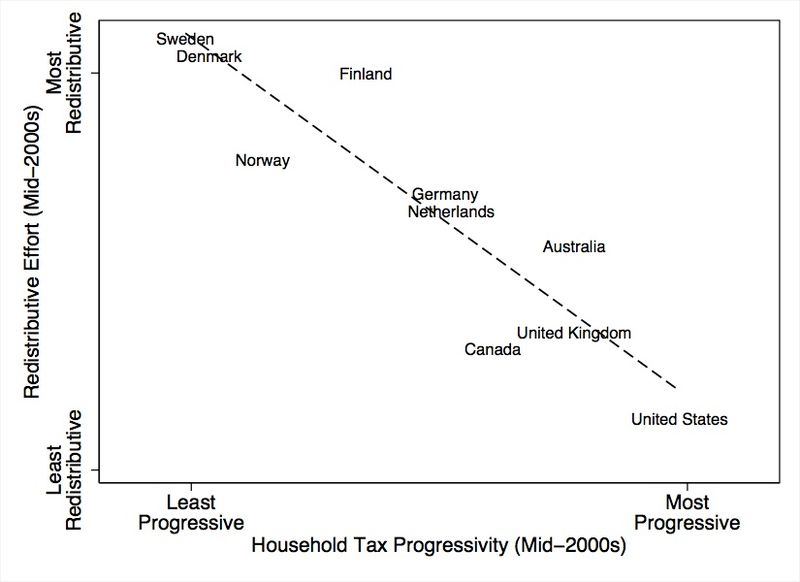
Cathie Jo Martin and Alexander Hertel-Fernandez note that countries with bigger welfare states tend to have less progressive taxation:
The reason Northern European countries with more regressive taxes achieve such high levels of labor market equality, despite less progressive tax systems, is that they spend money on increasing the skills and earning power of low-end wage earners.
Countries with the lowest levels of inequality have learned that policies to cultivate skills for all workers and to achieve full employment policies can accelerate economic growth while also reducing inequality. Large investments in human capital reduce societal conflicts over the distribution of resources, even while expanding the economic pie.
Countries like Denmark and Sweden also redistribute income, but this largely occurs through the funding of egalitarian social benefits — public health care, education — that also contribute to a productive, healthy workforce. Whereas these countries raise most of their revenue in a relatively more regressive manner, they use this revenue to fund social benefits that improve both the living standards and productive capacities of lower-class residents. In contrast, countries with the most progressive tax systems, like the United States, tend to raise most of their revenue through levies on the wealthy and on capital, and end up investing little in job training and other social benefits that reduce inequality.
“There’s a reason so many writers once lived [in Manhattan], beyond the convenient laundromats and the take-out food, the libraries and cafés. We have always worked off the energy generated by this town, the money-making and tower-building as much as the street art and underground cultures. Now the energy is different: the underground has almost entirely disappeared. (You hope there are still young artists in Washington Heights, in the Barrio, or Stuyvesant Town, but how much longer can they hang on?) A twisted kind of energy radiates instead off the soulcycling mothers and marathon-running octogenarians, the entertainment lawyers glued to their iPhones and the moguls building five “individualized” condo townhouses where once there was a hospital.
It’s not a pretty energy, but it still runs what’s left of the show. I contribute to it. I ride a stationary bike like the rest of them. And then I despair when Shakespeare and Co. closes in favor of another Foot Locker. There’s no way to be in good faith on this island anymore. You have to crush so many things with your mind vise just to get through the day. Which seems to me another aspect of the ad outside of my window: willful intoxication. Or to put it more snappily: ‘You don’t have to be high to live here, but it helps,'” – Zadie Smith.
D.L. Cade describes Elido Turco’s series Dream Creatures as “a study in mirrored tree bark images”:
Turco loves walking the mountain paths of his native Friuli with his wife, and for years he would use this time to try and find human forms and faces formed by the bark and roots of the trees in the forest. The catches, he admits, were few and far between until, one day, curiosity got the best of him and he decided to mirror an image on his computer. What he discovered was “a world of … fantastic creatures” the he had never realized existed. …
From the series’ description:
Silently, on tiptoe, within their universe I feel observed. A mutual understanding allows my presence in their world… an unreal world populated by entities created in the dense forests, in the shade of ancient trees and rocks.
Emblematic characters, grim, sinister, sweet, joyous… Each one with its own story to tell, so many stories and personalities engraved in the deep rough texture of their faces, expressions sometimes impenetrable.
Franklin Foer argues that the company is “the shining representative of a new golden age of monopoly that also includes Google and Walmart”:
We seem to believe that the Web is far too fluid to fall capture to monopoly. If a site starts to develop the lameness of an AltaVista or Myspace, consumers will unhesitatingly abandon it. But while that meritocratic theory might be true enough for a search engine or social media site, Amazon is different. It has a record of shredding young businesses, like Zappos and Diapers.com, just as they begin to pose a competitive challenge. It uses its riches to undercut opponents on price—Amazon was prepared to lose $100 million in three months in its quest to harm Diapers.com—then once it has exhausted the resources of its foes, it buys them and walks away even stronger. This big-footing necessitates a government response.
Yglesias counters that “having a lot of the market is not the same as having a monopoly”:
One important hint about Amazon’s non-monopoly status can be found in its quarterly financial reports. That’s where you find out about a company’s profits. In its most recent quarter, for example, Amazon lost $126 million. Losing money is pretty typical for Amazon, which is not really a profitable company. If you’d like to know more about that, I published 5,000 words on the subject in January. But suffice it to say that “low and often non-existent profits” and “monopoly” are not really concepts that go together.
Competitors hate Amazon because retail was an ultra-competitive low-margin game before Jeff Bezos ever came to town. To delve into this field and make it even more competitive and even lower-margin seems somewhere between unseemly and insane — but it’s the reverse of a monopoly.
While conceding that Amazon “does have something like a monopoly over the books market,” Annie Lowrey also fails to see how the term applies to the company overall:
Who is losing when Amazon is winning? Does the government really need to step in to protect Amazon’s rivals, provided that the market remains a market? Why is it wrong for Amazon to demand more and more from its suppliers? Is there any evidence that Amazon controls other markets like it controls the books market? All this is unclear.
She continues:
None of this is to say that Amazon should not face new regulations to force it to treat its workers better. None of this is to say that Amazon could not become a monopoly by pushing out or buying up more of its e-commerce rivals. None of this is to say that its harassment of Hachette is right or should be legal or should not face some serious pushback from the government and consumers. None of this is to say, either, that our legal framework should not view seemingly benign monopolies, like Google, with anything other than skepticism. But Amazon being a shitty, vicious competitor and Amazon being a monopoly are hardly the same thing.
Derek Thompson joins the “what monopoly?” chorus but acknowledges that Foer’s essay raises an interesting point that “there is something devilishly seductive to the conveniences of digital capitalism that makes life better for us as consumers and worse for us as workers”
Does buying diapers once from Amazon makes one morally complicit in the working conditions of its warehouse employees? What about subscribing to Amazon Prime? Having an Amazon credit card? These are harder questions, but they have nothing to do with Amazon’s mythical status as a monopolist. If the government thinks warehouse workers deserve higher wages and better conditions, we don’t have to go through the Justice Department’s anti-trust squad to improve their lot. We can just pass new laws. Don’t ask consumers to boycott a good deal.
Previous Dish on Amazon’s controversial business tactics here.
The morning of her death she
woke fierce, some dormant force revived,
insistent. For the last time
I sat my mother up, shifted the loose mass
of her body to lean against me. Her dried-up
legs dangled next to mine, triumphs
of will, all the mornings she forced
herself to spritz cheap perfume,
hoist each pendulum breast into
its halter, place the straps in the old
ruts. We were alone, petals
falling from bouquets crowded
around us. I pulled
some pillows behind me when I couldn’t
hold her any longer
and we rested there, the
body of my mother slumped
against my breast, the slow droop
of green stalks in their vases.
Her long-exhaled breaths
kept coming against her
resolve. And in the exquisite
pauses in between
I could feel her settle—
the way an infant
grows heavier and heavier
in your arms
as it falls asleep.


 The Dish