Pop Questions

What makes a pop song a hit? David Samuels talked to music exec Mike Caren, who maintains there are nine rules:

“First, it starts with an expression of ‘Hey,’ ‘Oops,’ ‘Excuse me,’” he begins. “Second is a personal statement: ‘I’m a hustler, baby,’ ‘I wanna love you,’ ‘I need you tonight.’ Third is telling you what to do: ‘Put your hands up,’ ‘Give me all your love,’ ‘Jump.’ Fourth is asking a question: ‘Will you love me tomorrow,’ ‘Where have you been all my life,’ ‘Will the real Slim Shady please stand up.’” He takes a deep breath, and rattles off another four rules. “Five is logic,” he says, “which could be counting, or could be spelling or phonetics: ‘1-2-3-4, let the bodies hit the floor,’ or ‘Ca-li-fornia is comp-li-cated,’ those kind of things. Six would be catchphrases that roll off the tip of your tongue because you know them: ‘Never say never,’ ‘Rain on my parade.’ Seven would be what we call stutter, like, ‘D-d-don’t stop the beat,’ but it could also be repetition: ‘Will the real Slim Shady please stand up, please stand up, please stand up.’ Eight is going back to logic again, like hot or cold, heaven or hell, head to toe, all those kind of things.”

The ninth rule of hit songwriting is silence. Why?

Because most people who are listening to music are actually doing something else, he explains. They are driving a car, or working out, or dancing, or flirting. Silence gives you time to catch up with the lyrics if you are drunk or stoned. If you are singing along, silence gives you time to breathe. “Michael Jackson, his quote was ‘Silence is the greatest thing an entertainer has,’” Caren continues. “‘I got a feeling,’ space-space-space, ‘Do you believe in life after love,’ space-space-space-space-space.”

Meanwhile, Gillian Turnbull, a music professor, worries that young music fans grow disenchanted when they can find any song they like on YouTube:

For older listeners, we reached a pinnacle in genre fragmentation in the form of satellite radio: if you like rock n’ roll—but not Bill Haley, Chuck Berry, or Little Richard—you can tune in to a station that only features Elvis. Perhaps you’re especially into 1970s proto-metal? There’s a station for that. In many ways, satellite radio is the ultimate expression of the increasingly narrow, and genre-defined, markets that new radio stations had to create through the 1980s and 1990s. By contrast, younger listeners mostly go to YouTube, at least to test out any music they might actually buy. They can go on an unexpected journey through related acts and styles, opening their minds to genre diversity far more than any radio station would allow.

Still, while exploration can’t be a bad thing, I’d argue that being unable to zero in on one style of music and dig into it deeply means that music is being treated too superficially. Maybe we’re obsessed with categorization, but I think categorization matters. Genre exists for a reason: we privilege difference; it is the means for personal and collective expression. My students come to class with a catalogue of Bee Gees and The Police swirling in their brains. They have encyclopaedic knowledge of Grateful Dead bootlegs. I hope they start digging more, learning what made genres sound like they did and their practitioners and listeners act like they did. I hope these kids create new genres and music subcultures, encouraging their peers to not treat music like it’s a throwaway product waiting to be replaced, but that it tells us everything about who we are and what matters.

Chart Of The Day

drinking

Christopher Ingraham captions:

Do you drink a glass of wine with dinner every night? That puts you in the top 30 percent of American adults in terms of per-capita alcohol consumption. If you drink two glasses, that would put you in the top 20 percent. But in order to break into the top 10 percent of American drinkers, you would need to drink more than two bottles of wine with every dinner. And you’d still be below-average among those top 10 percenters.

Fiction Of The Future

David Mitchell explains how he imagines worlds of what’s to come:

[W]hen you’re writing about the future, you simply try to work out what people in that future point will be taking for granted. In The Bone Clocks, there are two future sections. 2025 one is only about 11 years away—there’s just a few gizmos about the place and we’re basically there already. In the 2040s, however, more dramatic changes have taken place. There’s no more oil—or very little oil left. So you think about what people at that point will be taking for granted about travel, about the ability to hop on airplane and be hundreds of miles away in an hour or two. Or to have a conversation like this one, to speak across a continent—which, in the context of human history, is a profoundly bizarre thing to be doing. Animpossible thing to be doing, an unthinkable thing to be doing! We can take a device out of our pockets and speak to somebody in Auckland on it. And the miracle is that we don’t we see it as a miracle. We’ve only had this skill—to take out a smartphone out and call anywhere on earth—for 10 years, maybe 20. But, already, we take it for granted. It is part of what it means to live in our time.

When there is no more oil to power the system of power stations, which power the electric grid, which we power our devices on—we will no longer take it for granted that we can do it. It will be something that our grandchildren will marvel at—my grandfather lived in a world when you could phone someone in Auckland, my god! So that’s how you project yourself, narratively, into another time. You work out what people will be taking for granted, and what not.


Maternal Ambivalence, Ctd

In an essay recounting her experience volunteering as a Big Sister and then as a court-appointed advocate for foster children, Meghan Daum shares her reasons for wavering on biological motherhood:

They ran the gamut from “Don’t want to be pregnant” to “Don’t want to make someone deal with me when I’m dying.” (And, for the record, I’ve never met a woman of any age and any level of inclination to have children who doesn’t have names picked out.) Chief among them was my belief that I’d be a bad mother. Not in the Joan Crawford mode but in the mode of parents you sometimes see who obviously love their kids but clearly do not love their own lives. For every way I could imagine being a good mother, I could imagine ten ways that I’d botch the job irredeemably.

More than that, I simply felt no calling to be a parent. As a role, as my role, it felt inauthentic. It felt like not what I was supposed to be doing with my life. My contribution to society was not about contributing more people to it but, rather, about doing something for the ones who were already here. Ones like [children in the Big Brothers Big Sisters program] Maricela and Kaylee. I liked the idea of taking the extra time I had because I wasn’t busy raising my own child and using it to help them. It also helped that if anyone, upon learning my feelings about having children, lobbed the predictable “selfish” grenade, I could casually let them know that I was doing my part to shape and enrich the next generation.

What Did You Accomplish This Morning?

640px-JackLondon-office-1916

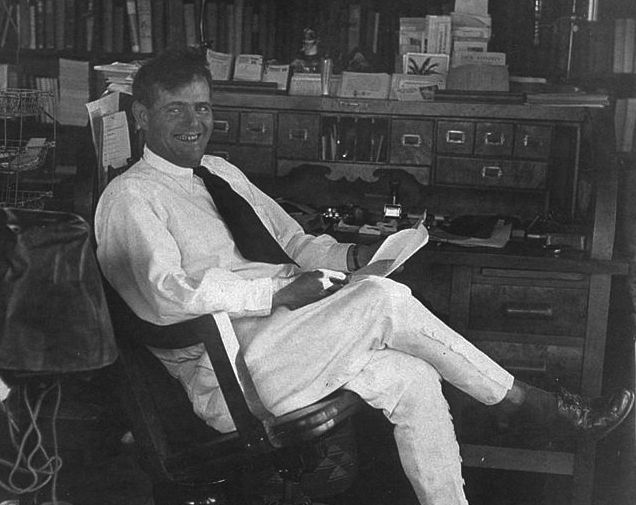
Probably not as much as Jack London – though the rest of your day may well be more productive than his. From James Camp’s review of a new biography of the writer:

Jack London’s writing routine was the single unchanging element of his relatively brief adult life. From the age of 22 until his death at 40, he wrote a thousand words every day, a quota he filled as a rule between 9 and 11 a.m. He slept for five hours a night, which left him with 17 hours of free time. But in his writing hours he was prolific: he produced short stories, poetry, plays, reportage, ‘hackwork’ and novels, many of them bestsellers. In 18 years, he published more than fifty books. ‘I’d rather win a water fight in the swimming pool,’ he said, ‘than write the great American novel.’

In his off hours, London ‘wanted to be where the winds of adventure blew’, as he wrote in John Barleycorn, his ‘alcoholic reminiscences’. He was a child labourer in Oakland at 14, a Bay Area pirate at 15, a transcontinental hobo at 16, an able-bodied seaman at 17, a New York State prisoner at 18, a California ‘work beast’ at 20 and a Yukon prospector at 21. He escaped penury at 23, when after a frantic apprenticeship he began selling short stories. The bulk of them were set in the Yukon or in the South Pacific and drew on the life he’d left behind. The Call of the Wild, published in 1903, made him a celebrity at 27, and subsequent additions to his CV – candidate for mayor of Oakland, no-good husband, doomed sea captain and arthritic debauchee – were a matter of public record. London’s life had a mythic quality in the eyes of his contemporaries. Earle Labor, his latest biographer, who was born in 1928, sees him in this way too. ‘The careers of few writers,’ he writes, ‘mirror so clearly the American Dream of Success and the corollary ideal of the Self-Made Man.’

(Hat tip: Micah Mattix. Photo of London in his office via Wikimedia Commons)

Piecing It All Back Together

In an engrossing account of a thalamic stroke she had at age 33, Christine Hyung-Oak Lee shares what she’s learned from seven years of recovery:

So much of memory, I … learned, is connected to emotions. That which makes me happy bypasses the process for short-term memory. I understand why it is I remember the intense events of my childhood. Why that day in the snow, being pelted by snowballs and not any other day. Why that Halloween, listening to my parents scream at each other, and not any other holiday. Why that plane ride leaving NYC for California and not any other. Why I forget all the names of all the doctors except for my neurologist, Dr. Volpi. Whose eyes were kind. Who was the first specialist on scene in the ER. Who was the one who told me I’d had a stroke. That moment.

So much of memory, I learned, is scattered in modules. Over the year, I tried to tell stories, anecdotes — and I could start a story, but I could not continue or end the narrative. Sometimes, when someone piped up and prompted me, Didn’t such and such happen next? I remembered the next part of the story.

I learned stories and memories are pieces of a puzzle, pieced together most likely by the thalamus. This means I couldn’t lie. Because I couldn’t lie, I couldn’t write fiction. But later, knowing this is how stories are told — knowing firsthand that stories are segments woven together — helps. It helps.

Face Of The Day

dish_detainee

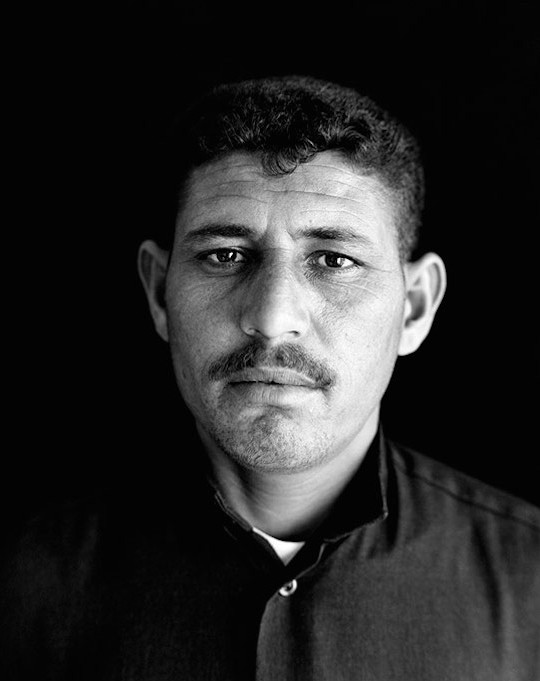
Chris Bartlett took the portraits of former Iraqi detainees:

There were close to forty former detainees who did not want their pictures taken, for those who agreed, Barttlet took the portrait in daylight on high quality film, with a deep black background and warm hued lights; an intentional difference from the small digital camera–which intensified the acidic yellows and electric greens of Abu Grahib– used to capture images detainees in crouching, cuffed, and hooded. “I wanted to put these people back in front of the camera and use photography as a humanizing force,” Bartlett says. …

When confronted with images of torture, Bartlett says, even the greatest liberal or humanist among us has the tendency to flinch and look away. “It’s such a disturbing and disgusting issue that people want to turn off from it.” Bartlett, who often works in high fashion photography, shooting subjects like candy colored Tory Burch handbags, said he wanted to take “very kind, respectful, beautiful, portraits to draw people into the subject and learn more about their stories.”

See more of Bartlett’s work here. His exhibition, “Iraqi Detainees: Ordinary People, Extraordinary Ordeals,” runs through this weekend in New York.

Associating Against Prejudice

Leon Neyfakh points to the work of Calvin Lai, a social psychologist who studies how to fight bias. Recently he tested a variety of strategies to get people to change how they view racial minorities:

The most effective, Lai found, involved exposing people to so-called counter-stereotypical images. In one intervention, which echoed the breakthrough study by Dasgupta and Greenwald from 2001, this took the form of showing people photos of widely admired black celebrities like Bill Cosby alongside notorious white evildoers like Charles Manson. In another effective approach, test subjects listened to stories, told in the second person, about a white assailant attempting to hurt them and a black man coming to their rescue. The emotional pull of the experience seemed to be key. Researchers found that making the story longer and more vivid—changing it from “With sadistic pleasure, he bashes you with his bat again and again” to “With sadistic pleasure, he beats you again and again. First to the body, then to the head. You fight to keep your eyes open and your hands up. The last things you remember are the faint smells of alcohol and chewing tobacco and his wicked grin”—was doubly effective at reducing bias.

Another approach that worked well when Lai tested it involved telling participants to imagine a scenario in which they were playing a game of dodge ball in which everyone on their team was black while everyone on the opposing team was white. A similar effective intervention also had participants imagine themselves navigating a highly threatening post-apocalyptic scenario, before being shown photos of their “friends,” who were mostly black, and their “enemies,” who were all white.