Paul’s Foreign Policy Predicament

Doves prefer Clinton to Paul:
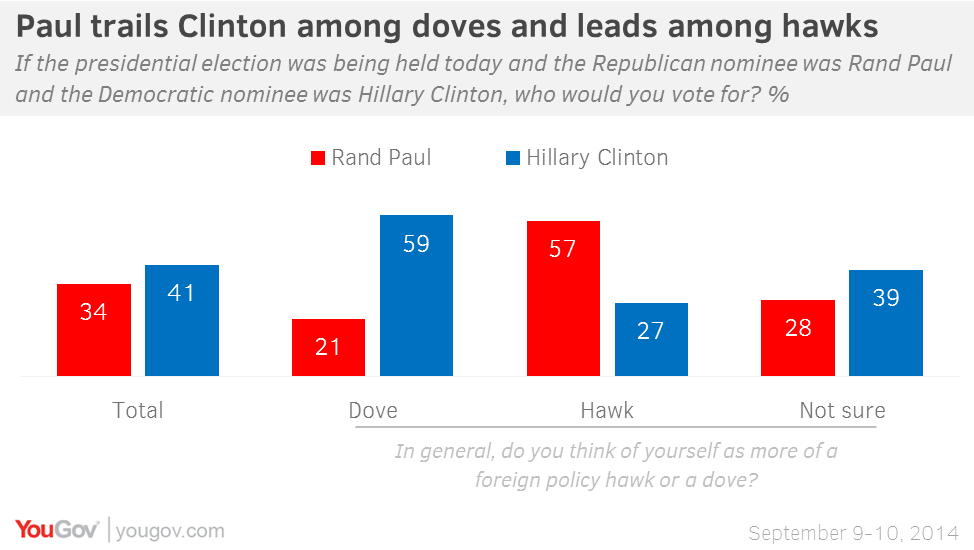
Paul Clinton

Larison analyzes the survey:

Doves clearly prefer Clinton despite the fact that a few more respondents (correctly) perceive her to be a hawk. However, Clinton also seems to benefit from the fact that 30% of respondents inexplicably perceive her as a dove, and only 27% perceive Paul that way. For all of the attention paid to Paul’s foreign policy views in political media over the last few years, his position is not very well-known or clear to the public at large, since 24% identify him as a hawk and 49% aren’t sure what to call him. Oddly enough, that might be just what Paul wants, since it gives him room to move back and forth between hawkish and dovish stances.

If public opinion or his conscience are guiding him toward military confrontation with ISIS, and if his better judgment guides him away from the available alliances on the ground, he is rapidly backing himself into the trap of Clintonian foreign policy. That means airstrikes and harassment, carried out indefinitely.

An airstrikes-only approach provides all the satisfaction of conflict, and little risk of major casualties for U.S. forces, which quickly swing public opinion against a president and his party. But in recent times, this policy has always had one of two endings. When President Obama and Hillary Clinton did it in Libya, this “smart power” strategy resulted in a stateless region of chaos; the Libyan government can hardly meet safely in the territory it claims to rule. When Bill Clinton did it with his no-fly zone in Iraq, it settled into a kind of stalemate. It was a relatively light drain on U.S. budgets, but it was also vaguely humiliating. A domestic uprising against Saddam never materialized to justify our policy. And American hawks could put pressure on the president for a more robust policy of regime change. What’s the point of military engagement, they’d ask, if victory isn’t on the table?

But Weigel finds that Paul’s anti-war supporters trust him:

The crisis in Iraq, which has caused a surge in the numbers of Republicans ready to send ground troops back into the Middle East, has not really rattled Paul’s people. He has what very few political figures still have; his supporters assume that he simply must agree with them, no matter what he says.

Boys Forced To The Altar

Nina Strochlic considers the sad fate of the child grooms in the developing world:

They are often forced to drop out of school and take menial jobs to support their new family. This perpetuates the cycle of poverty that led to their marriage in the first place. Generation after generation will struggle to lift themselves out of this tradition.

In fact, 156 million men alive today were married as children, according to the most recent UNICEF data. Despite that massive figure, there is scant research or work being done to address the issue of child grooms, meaning there are tens of millions of young boys and men who are almost virtually invisible in research, advocacy, and on-the-ground prevention work.

“There is a very strong voice of men in the community saying, ‘Because of child marriage I don’t have good job, I’m a conditional laborer, I can’t have a good education.’ That’s why this is creating a strong background for the cycle of poverty,” says Sabitra Dhakal, who’s leading the Tipping Point movement in Nepal. “Child marriage is not only a bad practice for girls, it is really a bad practice for boys too.”

Forget Footnotes

Tim Parks has an axe to grind over the academic staple:

[I]t’s time to admit that the Internet has changed the way we do scholarship and will go on changing it. There is so much inertia in the academic world, so much affection for fussy old ways. People love getting all the brackets and commas and abbreviations just so. Perhaps it gives them a feeling of accomplishment. Professors torment students over the tiniest details of bibliographical information, when anyone wishing to check can simply put the author name and title in any Internet search engine. A doctoral student hands in a brilliant essay and the professor complains that the translator’s name has not been mentioned in a quotation from a recent French novel, though of course since the book is recent there is only one translation of the novel and in any event anyone checking the cited edition will find the translator’s name in the book.

There is, in short, an absolutely false, energy-consuming, nit-picking attachment to an outdated procedure that now has much more to do with the sad psychology of academe than with the need to guarantee that the research is serious. By all means, on those occasions where a book exists only in paper and where no details about it are available online, then let us use the traditional footnote. Otherwise, why not wipe the slate clean, start again, and find the simplest possible protocol for ensuring that a reader can check a quotation. Doing so we would probably free up three or four days a year in every academic’s life. A little more time to glean quotes from Barthes, Borges, and Derrida…

“Uber For My Uterus”

That’s what Kat Stoeffel calls a new program from Planned Parenthood. Marcotte explains:

Now, patients in Minnesota and Washington will be able to talk to a nurse online and even get their birth control medication mailed to them at home in an unmarked package. In October, the program will be expanded to STI consultation, and even mail-order medications for chlamydia. There’s even a phone app!

“The service is expected to be especially appealing to clients living in rural areas who don’t have ready access to a clinic,” writes Dan Browning at the Minneapolis Star Tribune. But it’s not just access that’s likely appealing to those people. The Planned Parenthood website highlights that the service is “discreet.” This is great for those who would rather not be seen going into a family planning clinic or picking up a package with the iconic round birth control pill dispenser at the pharmacy. Discretion can also be critical for young people living at home who don’t want their parents to know that they’re sexually active. (For STI services, the promise of discretion is likely an even bigger draw.)

Tara Culp-Ressler cites an example:

Right now, since women need to visit a doctor’s office in person to obtain a prescription for birth control, they can end up in a tight spot if they can’t get an appointment in time, especially if they live in a rural area. [Sarah Stoesz, the president and CEO of Planned Parenthood in MN, ND, and SD] told the Tribune that the first woman to take advantage of Planned Parenthood Care ran out of birth control pills and couldn’t see her regular physician soon enough; fortunately, she discovered this new option online.

When Rape Allegations Are False

https://twitter.com/JessicaValenti/status/513036486602924032

Cathy Young tackles an uncomfortable truth:

False rape accusations are a lightning rod for a variety of reasons. Rape is a repugnant crime—and one for which the evidence often relies on one person’s word against another’s. Moreover, in the not-so-distant past, the belief that women routinely make up rape charges often led to appalling treatment of victims. However, in challenging what author and law professor Susan Estrich has called “the myth of the lying woman,” feminists have been creating their own counter-myth: that of the woman who never lies. More than a quarter-century ago, feminist legal theorist Catharine MacKinnon wrote that “feminism is built on believing women’s accounts of sexual use and abuse by men”; today, Jessica Valenti urges us to “believe victims en masse,” because only then will we recognize the true prevalence of sexual assault.

But a de facto presumption of guilt in alleged sexual offenses is as dangerous as a presumption of guilt in any crime, and for the same reasons: It upends the foundations on which our system of justice rests and creates a risk of ruining innocent lives.

Young illustrates how the issue is so damn complex:

Not all reports classified as unfounded are necessarily false. In some cases, women who were victims of rape were disbelieved, pressured into recanting, and charged with false reporting only to be vindicated later on—the kind of awful story that adds to people’s skittishness about discussing false accusations.

Some police departments have been criticized for having an anomalously high percentage of supposedly unfounded rape charges: Baltimore’s “unfounded” rate used to be the highest in the nation, at about 30 percent, due partly to questionable and sometimes downright abusive police procedures, such as badgering a woman about why she waited two hours to report a street assault. By 2013, an effort to provide better training and encourage full investigation of all complaints reduced that rate to less than 2 percent.

Megan McArdle insists that good stats are incredibly hard to find:

What we know is that we don’t know. We should not presume that every rape victim is telling the truth because it would make it easier for victims to come forward. Nor should we presume that every rape accusation has a 50 percent chance of being false. We should look at the facts in each case and judge them with the knowledge that some women do lie about rape — for revenge, to cover up some problem in their own lives, to get attention and sympathy from others. And also with the knowledge that men lie, too, violating their victims a second time in order to cover up their crimes. And that while men have gone to jail for rapes they did not commit, many other men have avoided the jail time they deserved for terrible crimes against women.

That’s not a very satisfying answer, because rape is inherently a hard crime to prosecute. If someone comes into a police station with their face bashed in, you can be pretty much certain that unless they’re a professional boxer, a crime has occurred. If a rape kit shows evidence of sexual intercourse, however, all that tells you is that … something happened. Because this is something that a lot of people do to each other voluntarily, you cannot proceed immediately to the arrest. Usually there are only two witnesses, telling different stories. Often drugs or alcohol were involved, and intoxicated people make lousy witnesses.

Previous Dish thread on the controversial topic here.

Legal Weed Heads East

Matt Ferner flags a poll from last week showing that an astonishing 65 percent of likely voters in DC support the city’s legalization initiative:

The NBC4/Washington Post/Marist poll’s finding that district voters support legalization by almost a 2-1 margin “is the highest support ever for a marijuana legalization ballot initiative,” Adam Eidinger, chair of D.C. Cannabis Campaign, the group backing the legalization measure, said in a statement. “It vindicates the work of this campaign so far, but we still have more work to do turning out the vote come Election Day.”

Only 33 percent of likely voters oppose legalization, which puts the scolds on the Washington Post’s editorial board in the distinct minority. Meanwhile, WaPo’s Aaron C. Davis and Peyton M. Craighill register a “major shift toward support [of legalization] among African Americans”:

The District’s black residents, who now account for half its population, once opposed marijuana legalization, partly out of fear it could lead to addiction among black youths. But as new studies have suggested otherwise, that attitude has evolved. One study last year showed that blacks account for nine out of 10 arrests for simple drug possession in the District, while another showed that was the case even as usage likely varied little among races. According to the poll, 56 percent of likely African American voters say they would vote for legalization, a near identical number to a broader question about support for legalization asked in a Washington Post poll in January. Together, the polls confirm a complete reversal of opinions among African Americans from four years ago. Then, 37 percent were in favor of legalization and 55 percent opposed.

But Jacob Sullum warns that even if Initiative 71 were to pass, Congress could still get in the way:

Legalization of the cannabis industry would be left to the D.C. Council, which could be overridden by Congress. Congress also could block implementation of Initiative 71, as it did for years with Initiative 59, the medical marijuana measure that D.C. voters approved in 1998. The last congressional effort to stymie marijuana reform in D.C., led by Rep. Andy Harris (R-Md.), consisted of an amendment that would have barred the District from spending public money “to enact or carry out any law, rule, or regulation to legalize or otherwise reduce penalties associated with the possession, use, or distribution” of a controlled substance. The House approved Harris’ amendment in June, but it was dropped from the final version of the spending bill. Harris plans to try again if Initiative 71 passes.

As Matt Connolly notes:

A full-scale legalization effort, complete with dispensaries like those seen in Washington and Colorado, could provoke the ire of national conservatives again. It’s a fight D.C. is used to having, and its outcome might depend on how the other states with legalization measures – Oregon and Alaska for recreational, Florida for medical – end up voting.

Know dope.

The Michael Moore Of The Right?

In an interview conducted as he awaits sentencing for violating campaign-finance law, Dinesh D’Souza reveals the inspiration behind the “documentaries” he’s produced, such as 2016: Obama’s America (trailer above) and America: Imagine the World Without Her:

I went back and watched Roger and Me, which I think is [Michael Moore’s] best film. It’s got an interesting premise: General Motors closes down a big auto plant that his dad happened to work at, and he’s going to go find the CEO of General Motors and demand to know why. Now, it fails intellectually, because there is an obvious reason why General Motors might want to close that plant—i.e., it’s not making money. And one possible reason it’s not making money is General Motors has been paying people like his dad way too much and can make cars much cheaper in North Carolina or other countries. You can’t proceed without confronting that argument. But Michael Moore’s presumption is that the CEO of General Motors, Roger Smith, is just a mean guy who wants to deprive working people of their livelihood. So intellectually, it’s ridiculous.

But visually, cinematically, narratively, it works. This clownish Michael Moore showing up everywhere, the cops in dogged pursuit. All of that works. What Michael Moore understands is that a movie traffics in the language of emotion. The intellect is subordinate to that.

On the Obama question, D’Souza is actually copying Moore’s intellectually ridiculous oeuvre.

He starts, as Moore does, with a crude reductionist idea of a public figure – Obama as seeking revenge on a colonial America – undergirded by nothing but D’Souza’s own pop-psychologizing of Obama’s relationship with his own father. Everything else needed to explain the actions of a center-left president (who has waged more wars in more places than most American presidents) is moot. For D’Souza, a crude narrative of racial revenge is all that’s really necessary to understand the Obama presidency – and he then simply adds layer upon layer to this caricature, which feeds paranoia and conspiracy theories and glib ideology as powerfully as Moore once did.

D’Souza once believed in making serious arguments for a more conservative view of the world. It’s telling about his own evolution – and the degeneration of public discourse in America – that he has largely given that up in favor of really lucrative propaganda designed to monetize the polarized red state masses. He’s another example of the power of the right-wing media-industrial complex. Its ability to reward its propagandists with fantastic monetary awards without any need to engage critics has transformed conservatism in this country – for the gridlocked, ideological worse.

Is The Border Crisis Over? Ctd

Border Crossings

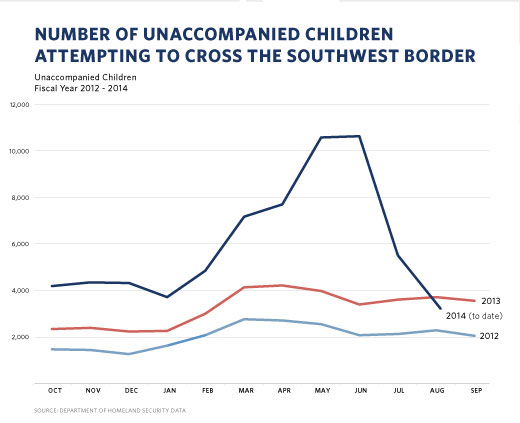
Dara Lind relays further evidence that the answer is yes:

[T]he fact that, as of August, fewer children are arriving this year than arrived at the same time last year indicates that this isn’t just a seasonal slowdown. It really looks like the flow of children into the country has slowed down to nearly manageable levels for the time being.

Indeed, the US government is no longer overwhelmed by the flow. Border Patrol officers are legally required to turn unaccompanied children over to the Department of Health and Human Services no more than 72 hours after they’re apprehended. At the worst parts of the crisis this summer, they weren’t even close to meeting that deadline — they took an average of more than three weeks. Now, according to Deputy Homeland Security Secretary Alejandro Mayorkas, they’re back to normal, turning kids over to HHS well within the 72-hour window.

In another post, Lind contrasts Ted Cruz’s border rhetoric with this new reality:

Cruz warned explicitly that promises of “future amnesty” would only make the problem worse. On June 30th, President Obama gave a Rose Garden speech explicitly promising to take further executive actions on immigration. Those promises included, in Cruz’ words, “plans to give amnesty to millions more who arrived in our country illegally.” Cruz said that because of those plans, Obama was responsible for the border crisis — and predicted that “the surge of unaccompanied children trafficked to the United States by drug cartels and transnational gangs will not ebb until Congress restrains the President from taking any further executive action.”

That’s not what happened. The surge has ebbed — largely due to law-enforcement efforts by US and Mexican authorities, and Mexican efforts to catch children traveling through Mexico before they arrive in the US.

Recent Dish on that ebb here.