Who Are Your Favorite Heretics?

Richard J. Mouw suggests that believers should all have a few because “it can be healthy for Christians who love ideas to be challenged regularly by perspectives that we can disagree with in productive ways.” One of his? The famed British philosopher Bertrand Russell, author of Why I Am Not a Christian:

For a while, especially when I was first learning the ropes in Anglo-American analytic philosophy, Bertrand Russell was one of my special favorite heretics. In his technical philosophical work in epistemology and logic, he changed his mind a lot, and showed no embarrassment about doing so. I admired that in him. But what I enjoyed even more were his popular writings, especially about religious matters.

Russell was boldly anti-religious. He saw no room for any substantive religious ideas in formulating an ethical perspective, or in investing oneself in social-political causes. But there were moments in his writings when he expressed a sense that to abandon religion is to lose something important—even if he was not clear exactly about what the loss amounted to. One of my favorite Russell passages in this regard occurs in the context of some autobiographical reflections. As a gift for him on his twelfth birthday, he recounted, his grandmother gave him a Bible, which he still possessed. In the flyleaf she had written a couple of her favorite biblical texts: “Thou shalt not follow a multitude to do evil,” and “Be strong, and of a good courage; be not afraid, neither be Thou dismayed. For the Lord Thy God is with thee whithersoever thou goest.” Then Russell makes this remarkable confession: “These texts have profoundly influenced my life, and still seemed to retain some meaning after I had ceased to believe in God.”

I find something admirable in that confession. It expresses a sense of loss, along with a corresponding sense of moral loneliness. Being one’s own autonomous moral legislator can be a lonely experience.
A Poem For Sunday

“The Day Lady Died” by Frank O’Hara:

It is 12:20 in New York a Friday
three days after Bastille Day, yes
it is 1959 and I go get a shoeshine
because I will get off the 4:19 in Easthampton
at 7:15 and then go straight to dinner
and I don’t know the people who will feed me

I walk up the muggy street beginning to sun
and have a hamburger and a malted and buy
an ugly NEW WORLD WRITING to see what the poets
in Ghana are doing these days
I go on to the bank
and Miss Stillwagon (first name Linda I once heard)
doesn’t even look up my balance for once in her life
and in the GOLDEN GRIFFIN I get a little Verlaine
for Patsy with drawings by Bonnard although I do
think of Hesiod, trans. Richmond Lattimore or
Brendan Behan’s new play or Le Balcon or Les Nègres
of Genet, but I don’t, I stick with Verlaine
after practically going to sleep with quandariness

and for Mike I just stroll into the PARK LANE
Liquor Store and ask for a bottle of Strega and
then I go back where I came from to 6th Avenue
and the tobacconist in the Ziegfield Theatre and
casually ask for a carton of Gauloises and a carton
of Picayunes, and a NEW YORK POST with her face on it

and I am sweating a lot by now and thinking of
leaning on the John door in the 5 SPOT
while she whispered a song along the keyboard
to Mal Waldron and everyone and I stopped breathing

– 1959

(From Lunch Poems, Expanded 50th Anniversary Edition © 1964, 2014 by Maureen Granville-Smith, Administratrix of the Estate of Frank O’Hara. Used by permission of City Lights Books, San Francisco)

“A Wildly Popular, Semi-Secretly Christian Rock Band”

That’s how Joshua Rothman pegs U2 in an essay exploring the faith behind their music:

In some ways, this seems obvious: a song on one recent album was called “Yahweh,” and where else would the streets have no name? But even critics and fans who say that they know about U2’s Christianity often underestimate how important it is to the band’s music, and to the U2 phenomenon. The result has been a divide that’s unusual in pop culture. While secular listeners tend to think of U2’s religiosity as preachy window dressing, religious listeners see faith as central to the band’s identity. To some people, Bono’s lyrics are treacly platitudes, verging on nonsense; to others, they’re thoughtful, searching, and profound meditations on faith.

Christianity Today regularly covers U2, not just as another Christian rock band but as one of special significance. In 2004, the magazine ran an article about Bono’s “thin ecclesiology”—his unwillingness to affiliate himself with a church—that sparked a debate about the health of organized religion. Rowan Williams, the Archbishop of Canterbury at the time, addressed the issue of Bono’s belief in a fascinating 2008 lecture about the place of organized faith in secular society. “Get Up Off Your Knees: Preaching the U2 Catalog” is one of several books exploring the theological ideas in Bono’s lyrics. Churches around the world have held “U2charists”—full services at which traditional church music is replaced with songs by U2. A few years ago, an Episcopal priest I know helped organize one at a church in New Jersey; the service, which featured a huge sound system, stage lighting, cocktails, and a bonfire, raised around forty thousand dollars for an orphanage in Cameroon.

Meanwhile, Nathan Hart looks at religion’s place in their just-released Songs of Innocence:

The power of Songs of Innocence is found within its sacramental atmosphere. There are holy moments throughout. With very personal and vulnerable lyrics, Bono has (probably temporarily) laid down his political megaphone. It feels less like a prophetic diatribe and more like a prayer of confession. For example, even in thinking about the very political “troubles” in Ireland on the closing track, he sings,

You think it’s easier to put your finger on the trouble,
when the trouble is you
And you think it’s easier to know your own tricks
Well, it’s the hardest thing you’ll ever do

Bono points his wagging finger away from the issue and onto himself. In other words, he’s saying, sin is not just something that has infected the big bad world out there, it is also the thing that has infected the self in here. I can’t recall any other U2 lyric that peers so honestly into the farthest corners of Bono’s own heart. Sure, he has been honest about his lustfulness and the origins of his messiah complex. But by vulnerably associating his own sinfulness with the very thing that he normally prophesies against, he offers us a lyrical sacramentology—a holy moment inviting divine redemption. Redemption comes in the same song, which later depicts a thrown lifeline, a rope, “something I could hold on to.” Then, redeemed, he can sing, “God now you can see me. I’m naked and I’m not afraid. My body’s sacred and I’m not ashamed.”

Faces Of The Day

dish_invisibles

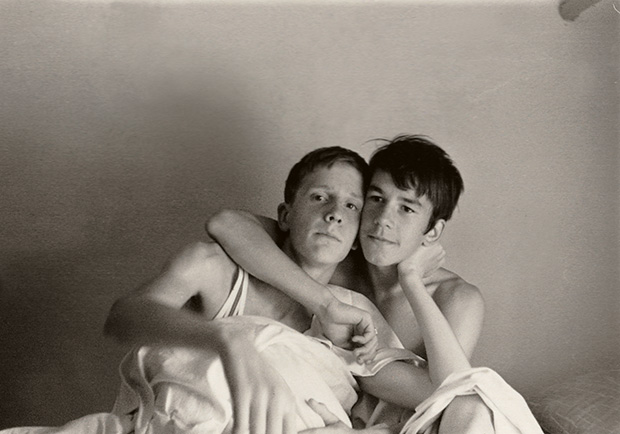
For his book The Invisibles: Vintage Portraits of Love and Pride, Sébastien Lifshitz collected portraits of gay relationships he found at yard sales and flea markets:

Lifshitz, who also made a documentary film on this subject, raises an important point when he reminds us that all of these photos are pre-digital era: “Because to obtain these images, they had to have gone to a small neighborhood photo lab to develop the film and then go back to pick up the prints. They, therefore, had to run the risk of exposing themselves socially. The need to keep a memory of their love was certainly stronger than the disapproval of some business or any concerns about what others might say.”


Lifshitz spoke about the collection in an interview earlier this year:

Who are the individuals featured in these photos?

I don’t know these people — they are anonymous to me. I can’t really even say that each person photographed into the book is gay, except when it’s obvious. What I like is that there are different levels of reading these photos — I would say three levels to be exact. The first one is the pictures of obviously gay single people or couples, the second is the pictures of people which can be seen as “undefined” (we’re not sure) and the third level is the ones that are obviously not gay but playing with a gay attitude (cross-dresser, some “garçonnes,” etc.). I love the ambiguity and diversity of these pictures. These photographs ask questions. I didn’t caption the photos because I don’t know quite anything about each of them (no name, no location mentioned most of the time). I wanted to expose them like the way I found them: without any information, like mysterious pictures.

The Buddhist As Novelist

Discussing her new novel, A Tale for the Time Being, Ruth Ozeki connects her Buddhism to her writing, noting in particular the way her “sense of self is a more shifting (shifty?) and pluralistic entity” than is typical:

A Tale for the Time Being plays very overtly with this notion of self or selves, which in Buddhism is called no-self, or anatman. Buddhism teaches that because everything is impermanent, there is no fixed self that remains unchanged in time. And Buddhism also teaches that there is not an independent self, that can exist separate from others. Thich Nhat Hanh calls this interbeing. So what we experience as the self is more like a collection of fluid, interpenetrating, interdependencies that change and flow through time. The title, time being, refers to just this, and the novel, with its two narrators Ruth and Nao, is a kind of overt performance of these Buddhist propositions of interbeing and time being.

I think in my previous work, too, the choice of narrative voice, or voices, is related to my pluralistic sense of self. This was true even before I knew much about Buddhism. I’ve never been able to write from a single point of view, or even stick to a single grammatical person. All my novels contain multiple narrators, some of whom speak directly, using the first-person pronoun “I,” and others less directly, using third- and sometimes even second-person pronouns. The use of these pronominal shifts and multiple POVs destabilizes the sense of there being a singular “author” running the show, in charge of the fictional world, and I like that ambiguity. In the past, I’ve tried to write in an omniscient voice, but the characters refuse to cooperate.

Does Terrorism Have Its Roots In Religion?

CJ Werleman fisks Sam Harris over his recent post emphasizing the connection between Islamic doctrine and jihadist violence, noting that “maturing counter-terrorism analysis has brought new information to light.” He uses the example of Anwar al-Awlaki to show the limits of Harris’ approach:

Harris’ contention that terrorists are motivated more by the writings of the Koran, rather than by economic, political, social, and military oppression, is based on feeling rather than fact. Harris is unable to explain the transformation of U.S.-born terrorist Anwar al-Awlaki’s views in the decades before his death, because there is no evidence to suggest that a religious awakening led to his adoption of a radically different theology. When the 9/11 attacks occurred, al-Awlaki told journalists: “There is no way that the people who did this could be Muslim, and if they claim to be Muslim, then they have perverted their religion.” Explaining the concept of Jihad, he said, “If there is an invading force from outside, then we would, too, struggle to defend ourselves, and that is where armed combat occurs. So actually, fighting is only part of a jihad, and it’s considered to be a defensive force in order to protect the religion.”

The U.S. government had determined al-Awlaki to be a moderate, and he even spoke at a lunch event at the Pentagon. By 2010, however, he had become increasingly disillusioned with U.S. foreign policy…. Al-Awlaki’s radicalization is consistent with the historical pattern of political activists adopting a belief in terrorism when political action fails to bring about change. “From the French anarchists who began bombing campaigns after the defeat of the Paris Commune, to the Algerian FLN struggling to end French colonialism, to the Weather Underground’s declaration of a state of war following state representation of student campaigns against the Vietnam war,” terrorism is nearly always rooted in political and economic oppression says NYU adjunct professor Arun Kundani.

Christopher Massie, however, points to others who think more like Harris:

[T]here are journalists and scholars who present compelling cases that ISIS’s actions are at least partly grounded in the teachings of Islam. In a September 1 story in The New Republic, Graeme Wood traced [ISIS leader Abu Bakr] al-Baghdadi’s appointment of himself as caliph, as well as the group’s “taste for beheadings, stonings, crucifixions, slavery, and dhimmitude, the practice of taxing those who refuse to convert to Islam,” to its “almost pedantic adherence to its own interpretation of Islamic law.” In an interview, Wood said that while he considers the political factors behind the group’s ascent “at least as important,” it is clear that “their beliefs are central to their self-conception” and are therefore vital to grasping the differences between ISIS and other jihadist groups. He observed that journalists who do not understand the way ISIS thinks “are missing a part of the story.”

David Cook, an associate professor at Rice University who studies Islam, is more emphatic: “To say that ISIS doesn’t have anything to do with Islam is just the statement of an ignoramus or an apologist. There is support for the things that ISIS does inside the Koran. There’s support for things like beheading and different exemplary punishments that you can easily find.”

Harris’ new book Waking Up is our latest Book Club selection, introduced here. Buy it here and join the discussion at bookclub@andrewsullivan.com.

The Things They Carried

dish_battle-kit2

Thom Atkinson photographed the battle kits of British soldiers over the course of 1,000 years:

The series, appropriately titled Soldiers’ Inventories, starts with the Battle of Hastings in 1066 and chronicles the gear soldiers carried into 12 other battles, from the battle of Waterloo to the war in Afghanistan. “Britain spends a lot of its time fighting people,” says Atkinson.

Each photograph is like a wartime version of Things Organised Neatly. Of course, the kits include things designed to kill people in ever more efficient ways. But they provide a glimpse into what the boredom and monotony of war, with things like playing cards, checkerboards, and iPads. To gather the objects, Atkinson visited living history communities, whose members collect such things for for reenactments. He would spend hours organizing the gear just so, beginning with bigger pieces like a musket or a jacket and filling in the holes with smaller objects. “It’s a lot like Tetris,” he says.

The above kit was fit for a knight during the siege of Jerusalem in 1244. See more of Atkinson’s work here.

Faith That Aches

This month saw the publication a new volume of poetry from Christian Wiman, Once in the West. Paul Otembra notices “the spiritual ache” coursing through the book:

The poems are continually looking for ways to make something of the frustrations and doubt. This is not the same as trying to make sense of them, and it is uncertain whether these poems believe that is even possible, let alone advisable. Instead, Wiman suggests “to make of the ache of inwardness— // something, / music maybe.” Everything here hinges on that qualifying “maybe.” It is not a shrug of surrender. It is recognition that the singing, while perhaps helpful, is not abundant compensation for suffering. All these poems can claim is to “sing a little nonce // curse / for the curse // of consciousness.” The songs are not plaintive. There is too much edge to the voice for that.

Putting these latest poems in the context of Wiman’s previous writing, Joe Winkler observes the way violence is a preoccupation of his theology:

He finds countless ways, metaphors from all sides of existence, to describe the violence of faith and the faith brought about by violence. Whether the physical violence common in his childhood town: shooting accidents, dead snakes, and birds he kills with a pellet gun, or the violence of “finding Jesus” in front of his church as a youth, or the wounds of belief, the scars of cancers, all of these varied forms of violence cohere into the ultimate wound, for Wiman,  the wound God’s presence or nonpresence leaves behind. For Wiman the violence of the whole of life can’t help but be meaningful, the way a scar is meaningful, a meaning only known to this person through the pain involved. For a few years now, this has been Wiman’s central obsession, a central viewpoint, this “holy flu” of God, the antinomy in which you cannot separate what we turn into opposite categories of evil and good or holy and secular.

You can read one of Wiman’s new poems, “The Preacher Addresses the Seminarians,” here. Literary Editor Matthew Sitman’s Deep Dish essay on Wiman is here, and our Ask Anything podcast with him is here.

Reading Into Your Self

Roxane Gay, who calls herself “the product of endless books,” shares the ones that shaped her the most:

The sweetest, most wide-eyed parts of me are made from the Little House on the Prairie books by Laura Ingalls Wilder. They were some of the first books I read, and as a young girl in Nebraska, I loved knowing there were interesting stories to be told about life on the plains. This is also where my imagination began to swell. I imagined making candy with snow and maple syrup. I could hear the timbre of Pa’s voice as he teased Half-Pint. I envied Mary’s grace under pressure. I loved Almanzo Wilder. I loved him fiercely, that country boy. When he began courting Laura, I imagined what it would be like to ride in his sleigh with him, my face chilled against the brisk winter air, the rest of me warmed beneath heavy blankets and the rushing blood of Almanzo next to me, the thrill of his hand in mine.

The sweetest, most wide-eyed parts of me are made from Anne of Green Gables and Anne of Avonlea, Lucy Maude Montgomery and Little Women, Louisa May Alcott.

I was a shy girl, but when I read, I was adventurous. Books made me bolder. I read stories, the titles of which I can no longer remember, about young girls embarking on thrilling adventures on wagon trains and fending for themselves, panning for gold. The Chronicles of Narnia made me believe I could slip into a wardrobe and emerge in a completely different world. Madeleine L’Engle’s A Wrinkle in Time helped me embrace my intelligence, showed me how I was not merely bound to this world, not at all. Charlie and the Chocolate Factory made me believe anything was possible if I allowed myself to believe.