The View From Your Window Contest

VFYWC_223

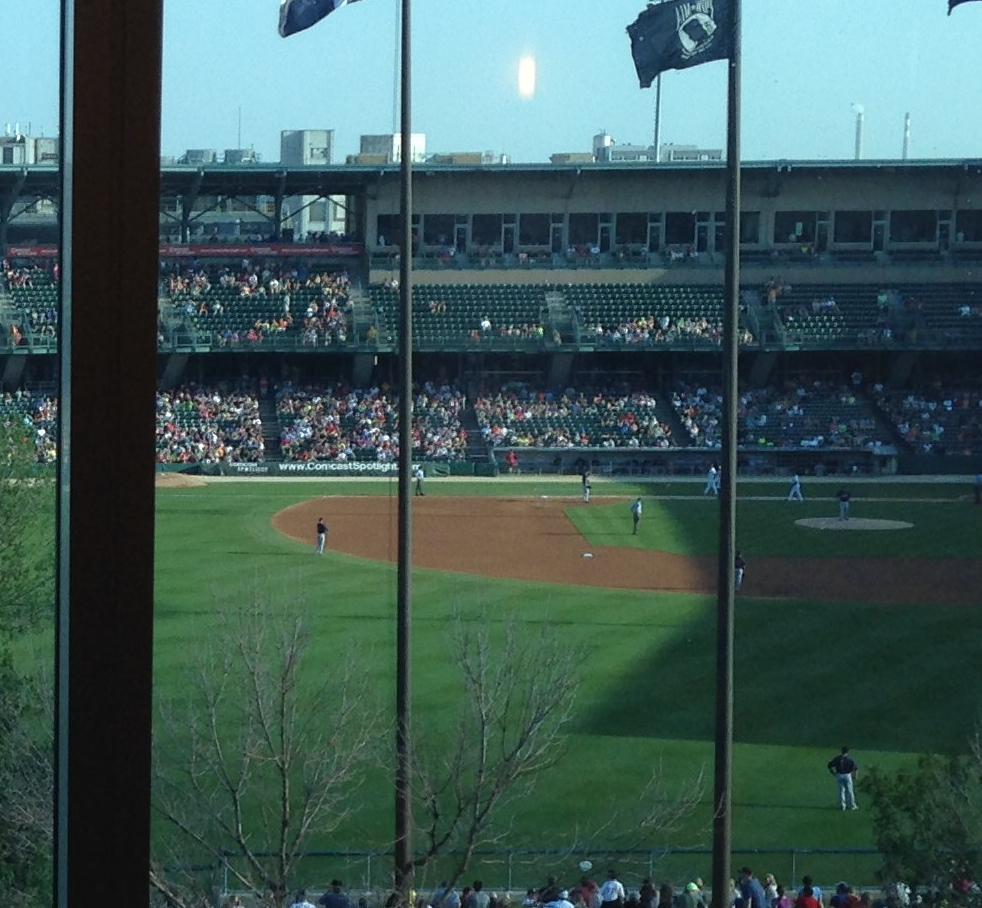
You have until noon on Tuesday to guess it. City and/or state first, then country. Please put the location in the subject heading, along with any description within the email. If no one guesses the exact location, proximity counts.  Be sure to email entries to contest@andrewsullivan.com. Winner gets a free The View From Your Window book or two free gift subscriptions to the Dish. Have at it.

Also, check out this extra-credit guess for last week’s contest, in which a reader didn’t just ID the city and hotel, but dug even deeper to determine the day, time and exact moment of the live baseball game being played in the background:

aaa

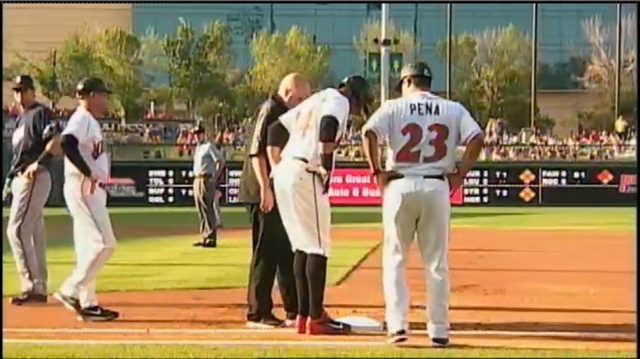
Turns out full replays of all minor league games are on MiLB.com. The view photo was taken during the Indianapolis Indians’ June 17th game against the Gwinnett Braves, in the bottom of the 1st inning. Indians player Chris Dickerson had just been hit by a pitch. Two Indianapolis coaches and a trainer are escorting him down the 1st base line to check on his injuries. In the view photo, Dickerson and the trainer are just behind the flag pole, but the two coaches (long white pants) are VFYWC-222-Ballgameclearly visible. The above picture is taken from the game video at 19m:13s, (a few seconds after the view photo) when the coaches, trainer (in black) and Dickerson arrive at first base. Notice the shadows and position of first basemen and umpire are exactly as in the view. Sure enough in the background is the window of the JW Marriott  our photographer of the view is no doubt in the window in the upper right. The video cameraman is also visible in the view photo  he is in red, behind 1st base in the visitors dugout. My best guess is that the view photo was taken at video mark 19m:05s. I’ll bet the video is trimmed to start at the nominal game time of 7:05. Aligning the video time with that start time, the view was taken at 7:24:05 pm. Cool.

After checking the original image’s EXIF data, our reader was within seconds of the exact time the photo was taken. Incredible.

Browse all our previous window view contests here.

Why Shame The Messenger?

In a review of Glenn Greenwald’s No Place to Hide, Andrew O’Hagan shakes his head that “crazily, it was often journalists who opposed Snowden’s actions and hated what Greenwald was writing”:

On the not at all ironically titled CNN show Reliable Sources, there was a discussion about the leaks with a dramatic onscreen graphic carrying the legend ‘Should Glenn Greenwald be prosecuted?’ Walter Pincus of the Washington Post felt it was all Julian Assange’s doing (which it wasn’t), while Andrew Ross Sorkin of the New York Times used his CNBC show to say he would arrest Greenwald for seeming to want to get Snowden to Ecuador.

Perhaps we should just be grateful that these commentators didn’t form the wellspring of journalistic endeavour in the darkest days of apartheid. But Greenwald brilliantly describes the period they have brought into being under Obama’s extended wing. We learn that journalism, perhaps in imitation of Western governance itself, has ripped up the rulebook since 2001. It’s less a question of ‘What’s the real story?’ as ‘Whose side are you on?’ That this should be a disaster for the generally liberal-minded will not occur to these bin-rakers and text-inspectors, who think warriors for digital privacy are not that different from the men who would cut off your head. Such commentators are building the dark places they claim to hate – they spread their own kind of terror and advocate their own intolerance – and for such people, no matter what cave or desert or studio they reside in, the truth is always the enemy.

Sacking Plastic Bags, Ctd

A researcher who studies the environmental effectiveness of recycling admits that he “can’t stand” the plastic-bag ban:

Part of the reason can be found in the quote you cited:

Although plastic bags’ manufacture is relatively energy intensive (according to the Australian government, a car could drive 36 feet with the amount of petroleum used to make a single plastic bag) …

Doesn’t the author realize that she has just refuted herself? The proper gist of that sentence is:

Plastic bag manufacture is remarkably energy-cheap (a car could drive 36 feet with the amount of petroleum used to make a single plastic bag).

Thirty-six feet is a little more than four parking spaces. What the writer is saying – and this is a fact – is that if you recycle your plastic bags, you literally burn more fuel driving across the parking lot to the recycling bin than you save by recycling!  It’s just another example of innumeracy that such an argument can actually be made in favor of the ban.

He adds:

The plastic bag ban is a valid policy approach for exactly one environmental hazard: litter, and specifically marine litter.  In that perspective, a sharp curtailment of use would be greatly welcome, as long as it is done with knowledge of the fact that many of the alternatives (paper bags, laundered reusable bags) are significantly more energy- and resource-intensive than plastic bags.

Anyway, in terms of the energy demands of a reasonably comfortable western lifestyle, bag choice is more or less trivial. If people are looking to reduce their carbon footprint, they should take those reusable bags and hoof it down the sidewalk instead of driving.

Another reader spots an apparent error in the history of plastic bags we referenced:

The chronology mentions reports of suffocation occurring in 1959, but I believe that had to do with the plastic used to cover dry-cleaned clothing.  The plastic used for that purpose was very flimsy and clingy, which is what caused the suffocation hazard.  There’s a scene in “Mad Men” in the first season where Sally is walking around in the plastic and Betty berates her not for wearing the plastic but for possibly wrinkling the clothes.

The Wikipedia entry for plastic bags says that the patent for the material was in 1965, so I don’t think plastic bags were ever in use prior to that time.  I don’t remember plastic bags on the scene until the early eighties.  Most grocery store paper bags that I remember from the sixties and seventies did not have handles.  I think those came later in response to the plastic.

Our reader appears to be correct. Jeffrey L. Meikle, in his American Plastic: A Cultural History, describes the suffocation deaths of 80 children as the “dry-cleaning bag tragedy of 1959.”

Gang Rule

Graeme Wood flags research from David Skarbek, author of The Social Order of the Underworld, suggesting that prison gangs play an indispensable role in maintaining order in California penitentiaries:

“Prison gangs end up providing governance in a brutal but effective way,” he says. “They impose responsibility on everyone, and in some ways the prisons run more smoothly because of them.” … For example, consider the Aryan Brotherhood – a notoriously brutal organization whose members are often kept alone in cells because they tend to murder their cell mates. You can take the Brotherhood at its word when it declares itself a racist organization, and you can do the same with the Black Guerrilla Family, which preaches race war and calls for the violent overthrow of the government. But Skarbek says that at lights-out in some prisons, the leader of each gang will call out good night to his entire cellblock. The sole purpose of this exercise is for each gang leader to guarantee that his men will respect the night’s silence. If a white guy starts yelling and keeps everyone awake, the Aryan Brothers will discipline him to avoid having blacks or Hispanics attack one of their members. White power is one thing, but the need to keep order and get shut-eye is paramount.

The Beauty Of Plumes

dish_smoke

Thomas Herbich captured the surprising elegance of cigarette smoke:

Over the last three months photographer Thomas Herbrich snapped some 100,000 individual photographs of smoke, looking for unexpected anamalies and fortuitous coincidences where familiar shapes emerged. It’s fascinating to see how the brain tries to create order out of chaos, just like looking up at the clouds, suddenly familiar patterns seem to stand out: faces, hands, or scrolls of paper.

Herbich spoke to D.L. Cade about the project:

I was very surprised by how extremely quickly smoke move[s]. It’s easier to photograph a racing car! The rising of cigarette-smoke is actually so quick that conventional flash equipment is too slow, as is the photographer – only a few milliseconds pass between recognition of the subject and the taking of the shot, a length of time in which the smoke has already changed again.

I therefore used a quick flash with a flash duration of 1/10000 sec. or faster – and took more than 100,000 digital photos in three months (which killed one camera). The “poor” photos were immediately separated out on the laptop and rejected. Only 20 or so of the photos actually made the shortlist.

See more of his work here.


A Poem For Saturday

Dish poetry editor Alice Quinn writes:

There is no one I would rather read on the subject of Frank O’Hara than John Ashbery. He introduced the Collected Poems of Frank O’Hara, which Alfred A. Knopf originally published in 1971, edited by Donald Allen. And now he’s written a short introduction to the 50th anniversary edition of Lunch Poems, which debuted as Number Nineteen in the legendary City Lights Pocket Poets series, and is now reissued with facsimiles of previously unpublished letters between O’Hara and his editor, Lawrence Ferlinghetti.

On the outside, though, the book looks exactly as it always has, and we learn in one of the O’Hara letters that the familiar—and to so many of us cherished—cover was the choice of the poet, “What color is lunch? Maybe some sort of lipsticky red? (My favorite colors are actually orange and blue.)” We also learn that he didn’t care about the chronological arrangement of the poems in his first major book but did want the date of composition listed after each poem “as it is in Allen’s [Ginsberg’s] Reality Sandwiches.”

“No other poetry collection of the ‘60s did more to shatter the congealed surface of contemporary academic poetry,” Ashbery writes. “Freed from his Museum of Modern Art desk job for an hour or so at lunchtime, O’Hara wanders the streets of midtown, free-associating about trips he has taken, including a recent one to Spain on MoMA business, on which I accompanied him, and to Paris, where he has many friends. . . .Frank’s disabused enthusiasm carries the reader to a marvelous half-fictive universe where we bump elbows with Lana Turner, Billie Holiday, Rachmaninoff, and the Mothers of America, whom he urges: ‘let your kids go to the movies! . . .They may even be grateful to you/ for their first sexual experience.’ Horrors! To compound this unthinkable suggestion, O’Hara even gets away with using the word ‘fuck’ more than once, and yet he’s no macho spewer of hard truths, but a kind, inquiring, deeply curious and attractive youngish man, passing a few minutes of speculative rumination before heading back to the office, like all of us.”

“Song (Is it dirty)” by Frank O’Hara:

Is it dirty
does it look dirty
that’s what you think of in the city

does it just seem dirty
that’s what you think of in the city
you don’t refuse to breathe do you

someone comes along with a very bad character
he seems attractive. is he really. yes. very
he’s attractive as his character is bad. is it. yes

that’s what you think of in the city
run your finger along your no-moss mind
that’s not a thought that’s soot

and you take a lot of dirt off someone
is the character less bad. no. it improves constantly
you don’t refuse to breathe do you

– 1959

(From Lunch Poems, Expanded 50th Anniversary Edition © 1964, 2014 by Maureen Granville-Smith, Administratrix of the Estate of Frank O’Hara. Used by permission of City Lights Books, San Francisco)


Feminism Meets Occupy Wall Street

Rachel Hills profiles feminist writer Laurie Penny, author of Unspeakable Things: Sex, Lies and Revolution:

[Penny] is skeptical of attempts to take the bite out of the gender equality movement. “I think the whole question [of rebranding feminism] is very indicative of how threatening a lot of people find feminism and gender liberation in general,” she says. “My first response to that is always that feminism is threatening to the status quo. It is a legitimately scary idea for people who are invested in things staying the way that they are. There’s only so far you can dress it up.”

But Penny seems unsettled by the increased acceptance of feminism by society at large:

Not for her is the “tepid and cowardly” mainstream feminism focused on getting more women into boardrooms, or stamping out sexy music videos. “Let others construct an unchallenging feminism that speaks only to the smallest common denominator,” she writes.

Tara Wanda Merrigan provides an overview of Penny’s arguments. A big one:

For her, Lean In and its “middle-class, aspirational” feminism isn’t enough, because “while a small number of extremely privileged women worry about the glass ceiling the cellar is filling up with water.” … [W]hile many mark feminist achievement based on how many female CEOs there are in the Fortune 500, those measures obscure the fact that women are still the majority of minimum-wage earners, which is unfortunate since economic success can be majorly empowering. Therefore, feminists ought to think about progress at the bottom rungs of the ladder as much as the top.

Kat Stoeffel interviews Penny, addressing the question of topics assigned to female writers:

[Q.] You write that women “are allowed to talk only about their gender” and men “are allowed to talk about absolutely anything except their gender.” As a woman writer, have you been nudged toward gender issues?

[A.] You would not believe the amount of times — still — various magazines ask me to write pubic hair. Do you shave or not? Should you shave or not? For a long time, my decision not to write about pubic hair was a feminist position in itself. It matters to me a bit. We can have an interesting conversation it. But this endless collapse of the political into the personal …

As somebody who cares about this issue but also cares about a lot of other things, too, it’s been a fight to carve out a position where gender and power are important and they stand in conversation with every other aspect of politics. My blog began as an attempt to position feminism in radical left politics. It’s an attempt to avoid feminism becoming an echo chamber, which I think some people would like it to become. I understand that pubes are a legitimate source of anxiety. But I don’t understand why I don’t get infinite requests to write about domestic work or the economic roots of sexual violence or the stuff that is not necessarily sexy in the same way but is still an intimate question about work and power.

Salon has an excerpt from Penny’s book. She certainly doesn’t pull punches:

The idea that there is any such thing as Everygirl, a ‘typical’ woman who can speak to and for every other person on the planet in possession of a vagina, is one of the major sexist fairy tales of our time. Patriarchy tends to see all women as alike; it would prefer that we were all interchangeable rich, pretty, white, baby-making straight girls whose problems revolve around how to give the best blow jobs and where to buy diet pills. No man would ever be expected to write a book speaking to and for all men everywhere just because he happens to have a cock. The original feminist statement that the personal is political has been undermined by the insistence, in every media industry still run and owned by powerful men, that all women’s politics be reduced to the purely personal.

Getting The Last Word

Roger Grenier contemplates how writers approach death:

With certain authors, including some of the very greatest, we cannot speak of a last work. With them an entire640px-Marcel_Proust_(Père_Lachaise) life’s work is constantly put back on the loom, and so is condemned to remain unfinished. Friedrich Nietzsche, Marcel Proust, Robert Musil are in this category. Nietzsche wavers between the desire to construct and a totally free form. Only death stopped Proust from pasting strips of paper onto his manuscripts and his page proofs. With Musil, we never stop digging away at the mass of unpublished pages that supplement The Man Without Qualities. Critics attribute his inability to finish to masochism. But is having more and more to say, trying to reach perfection, really masochistic?

Saint Bonaventure, the Franciscan philosopher nicknamed the Seraphic Doctor, supposedly had the unique privilege of continuing his memoirs after his death. François-René de Chateaubriand, the first great French Romantic, was jealous: “I don’t hope for such a privilege, but I would like to resuscitate at the ghostly hour—at least to correct my page proofs.”

This chimerical wish was provoked by Chateaubriand’s worries about his Memoirs from Beyond the Tomb. More than once, this monument, which he intended to be posthumous, was in danger of becoming antehumous, due to the financial problems that always plagued the viscount. He gave some readings from the Memoirs in February and March 1834, and accounts of those readings were published. One can find fragments of the memoirs in his 1836 “Essay on English Literature.” Yet he complained, “I prefer to speak from the bottom of my grave.” In 1836, he sold the Memoirs to a company that promised to publish nothing until after his death. The affair took a worrisome turn in October 1844. The company sold rights to Emile de Girardin to publish excerpts from the Memoirs in his newspaper, La Presse. An unhappy Chateaubriand later wrote about seeing his Memoirs reduced “to bits and pieces”: “No one can form an idea of what I have suffered in being compelled to mortgage my grave.”

(The grave of Marcel Proust, via Wikimedia Commons)

Have We Outgrown Growing Up? Ctd

A reader chuckles at the notion that high culture has ceased to exist:

Responding to A.O. Scott’s essay, Freddie writes:

There is no such thing as high culture. There probably never was but even if there was it died long, long ago. Outside of your fantasies, there is no group of intellectual elitists looking down their noses at the music or TV you like. Such people do not exist.

I find that amusing, considering this article from yesterday’s issue of the New Yorker on the resurgence of the Frankfurt School (probably history’s foremost critics of “low culture”). One passage:

Culture appears more monolithic than ever, with a few gigantic corporations – Google, Apple, Facebook, Amazon – presiding over unprecedented monopolies. Internet discourse has become tighter, more coercive. Search engines guide you away from peculiar words. (“Did you mean . . . ?”) Headlines have an authoritarian bark (“This Map of Planes in the Air Right Now Will Blow Your Mind”). “Most Read” lists at the top of Web sites imply that you should read the same stories everyone else is reading. Technology conspires with populism to create an ideologically vacant dictatorship of likes.

I agree with Freddie’s claim that lovers of pop culture are not “an oppressed and denigrated minority,” but to say that there is “no group of intellectual elitists looking down their nose at the music or TV you like” is just plain wrong. As a PhD student in Communications, I sit in classes with some of them on a daily basis.

Another is skeptical of the entire end-of-adulthood argument:

I’m sure A.O. Scott wrote that piece with the best of intentions, but it amounts to a navel-gazing bout of bullshit.

If we have reached the “death of adulthood,” it’s because “adulthood” has in large part been a mirage. You don’t magically become “adult” by dressing a certain way, or having a certain amount of money, or going to a certain club, or deciding that you need Brahms instead of early Beatles.

The older I’ve gotten, the more I’ve realized that the adults I trusted growing up weren’t mystical sages. They were winging it. Children need older authority figures, but those figures are only doing the best they can. As you age, you still put away “childish” (I would say immature) things – unreasonable expectations of fame or wealth, the ache and burning of teenage love, and most of all, the belief that being a certain age magically mutates you into a separate “adult” creature.

Count me in with Lewis. If you’re a 50-year-old guy worrying about the culture of being “adult,” you’re exhibiting the type of immature mindset of a 12-year-old, when you thought “acting grown up” was terribly important. I like Marvel movies; I’m also a divorced 30-something working a corporate day job in a law firm. I’m sure as hell not going to devote all of my time to reading Russian philosophers at night to satisfy someone else’s illusion.

Another is on the same page:

I think we’re finally allowed to admit that in a lot of ways, we never grow up. Think about it: do we ever stop behaving like we’re in high school? Workplace hierarchies are similar to the ways we grouped or were grouped as teenagers. There’s still bullying and peer pressure. We wear “uniforms” that fit the environment, and our time is scheduled when it isn’t outright micro-managed. On a personal level, we still have our cliques that include or exclude based on the same ridiculous set of preferences and prejudices that we picked up as older teens or young “adults.”

My parents, born of the Depression, were “grown ups.” But my memories of their lives, and the lives of their friends, aren’t so different from what I see in my peers or in the peers of my adult kids. The exterior that we’re willing to show has changed, and our parents and grandparents were willing to put up with a lot more discomfort than we are. But there was never an adulthood. There was just the extent to which people were willing to conform. Which today, isn’t so much.

Meanwhile, a 23-year-old reader notes that disposable entertainments have a long pedigree:

Every generation has produced pop culture that wasn’t considered respectable and wasn’t discussed or analyzed in a serious way. Bawdy saloon and beer-hall tunes thrived in the age of Wagner and Strauss, dime pulp novels outsold Fitzgerald and Faulkner, and five-cent peep shows brought in viewers in numbers that would rival any superhero movie today. I think we’re at a pop-culture moment where we no longer put away things we enjoy simply because we fear looking childish. I’m not ashamed to admit that I have been moved to tears both by Harry Potter and Wilfred Owen. To argue that a vast swath of Americans don’t value “pleasures based on work, ambiguity, or difficulty” because adults are reading The Hunger Games is to construct a straw man of staggering size.

I agree with Freddie that being an adult has to do with your ability to be a productive human who cares for others and is thoughtful and self-aware both about one’s actions and place in the world. As far as I’m aware, seeing The Avengers is not an impediment to that.

Face Of The Day

Muslims Protest IS Violence

A young man chants as Muslims gather for Friday prayers on the street outside the Mevlana Moschee on a nation-wide action day to protest against the Islamic State (IS) on September 19, 2014 in Berlin, Germany. Muslims across cities in Germany followed a call by the country’s Central Council of Muslims to protest against the ongoing violence by IS fighters in Syria and Iraq. By Sean Gallup/Getty Images.