Henry Farrell flags a paper (pdf) on sites that “allow users to ‘upvote,’ or ‘downvote’ posts and comments”:
[The researchers] use some complicated statistical and experimental techniques to reach two key findings:
(1) People who write low-quality posts are more likely to write again when they get negative attention. Furthermore, the quality of their posts deteriorates. This goes beyond the simple adage that you shouldn’t feed the trolls by giving them attention. The evidence suggests that negative feedback can perhaps actually create trolls. It also suggests that people getting negative feedback are more likely to give others negative feedback, too, spreading the infection.
(2) People who write high-quality posts are encouraged by positive attention to write more. However, they aren’t as encouraged by positive attention as bad posters are by negative attention. Furthermore, the quality of their posts does not go up. Broadly speaking, encouragement doesn’t seem particularly effective.
But, even with that key endorsement, Sam Wang calculates that No is favored to win:
There was some excitement over a YouGov/Sunday Times survey showing the “yes” vote leading by 2%. However, that now appears to be an outlier. The most recent five surveys, all completed in the last 10 days, show a lead for No by 4.0 ± 1.3%. As of today, that means a 95% probability that the referendum would fail in an election held today.
Felix Salmon, on the other hand, predicts that Scotland will vote Yes:
I still think the Yes campaign is going to win, just because, given the choice, nations tend to want independence. Especially when they’re voting for a peaceful divorce from a country (more realistically, a city) which doesn’t care about them and doesn’t share their values. Would Scotland be worse off as an independent country? Yes. Is that sufficient reason to vote no? No.
A.L. Kennedy is taken with the idea of independence:
[L]et’s repeat that question: “Should Scotland be an independent nation?”
That should—it is philosophical—has opened up areas of aspiration and communal possibility. It’s not about money, not about habit, it’s about—with one word—changing the course of a nation’s history and finally ending an empire. Which is to say, it’s about voting and effecting actual, real-world change. This may be a once-in-a-lifetime opportunity. Or it may lead voters—North and South of the border—to expect more from every appeal to their settled will, which is what a democratic election involves, after all: Politicians beg for power from the people, even if it often seems otherwise.
Daniel Berman rattles off the many mistakes of the Unionists. A biggie:
The NO campaign has not been lacking in dire warnings; the Scots have been threatened with the loss of everything from the Pound(the Bank of England has said there will be no currency union), to the BBC. Yet the effectiveness of these attacks has been undermined by the signs from Osborne and others that Westminster is willing to offer them whatever they want if they don’t leave. Would a government this desperate really treat Scotland like an enemy? At the same time, however, the threats have been sufficient and blunt enough to be interpreted as hostile, uniting many Scots in the view that the English see them as an “other” that all too many southern voters would like to see suffer. NO has done what the SNP’s best efforts have failed to do: made Scots feel like a distinct nationality, even if they remain, or wish to remain, within the borders of the United Kingdom.
Jordan Weissmann also examines Scotland’s oil reserves:
The Scottish National Party has optimistic estimates [about North Sea oil] based on the assumption that investing in better technology will let the industry drill more oil out of the ocean. Sir Ian Wood, a billionaire Scottish oil executive, has called those predictions a “fantasy,” and said that revenues from the North Sea “will simply not be there in 25 to 30 years’ time.” The U.K.’s Office for Budget Responsibility thinks output will be far lower than the nationalists hope.
As the Guardian soberly put it, “oil should be a crucial factor in weighing up how Scots vote on 18 September, but the scale and longevity of the country’s fossil fuel wealth remains a matter of debate.”
Matt Ford reads through Scotland’s draft constitution:
The U.S. constitution is heavily influenced by British democracy, but also by its perceived shortcomings. So is Scotland’s draft document. Instead of welding the elected House of Commons to a House of Lords, Scotland’s legislature would be unicameral and elected by proportional representation. Elizabeth II would reign as the first Queen of Scots in more than three centuries, but Scots would have a monarch as an expression of their sovereignty, not the other way around.
Scots law, long distinct from the Anglo-Norman legal tradition, would outpace it on human-rights protections, too. The Scottish constitution would explicitly forbid discrimination on the basis of age, disability, gender reassignment, marriage or civil partnership, pregnancy or maternity, race, religion or belief, sex, and/or sexual orientation. To safeguard these rights, the constitution would also enshrine total judicial independence. With few exceptions, U.K. courts cannot strike down laws passed by Parliament.
And Clive Crook fears that Scotland will come to regret independence:
The question Thursday is whether Scotland should stay in the U.K. for Scotland’s sake. It’s a close call. Though many small countries do well, they face risks that big countries can more easily absorb. One such risk is that they fail to get along with their bigger neighbors. An independent Scotland would need good relations with England more than England would need good relations with Scotland. That’s something Scots should keep in mind.
The main danger, in fact, is that the divorce they’re contemplating might turn bitter. This could happen easily, and if it did, Scotland would be the weaker party. As that became obvious, Scots might pine for the benefits of a tolerably, even if not blissfully, happy union.
Francis Wilkinson warns that, even if no serious challenger emerges, Clinton’s nomination won’t be a cake-walk:
A Clinton coronation, if indeed that’s what Democrats give us, will be boring for Democrats and catastrophic for the news media. More than 200 reporters obtained credentials to get a glimpse of Clinton politicking. If she doesn’t get viable competition from Democratic opponents, she may have to invent it. Otherwise reporters will rely on internal feuds and Republican attacks to produce the kind of conflict on which campaign narratives depend.
To get a sense of the anti-Hillary caucusers, Jay Newton-Small attended an speech in Iowa by Bernie Sanders:
Sanders’ event was a relatively low-key affair attended by more than 450 people–still a decent crowd, considering the next caucuses are more than 16 months away. Most who showed were left-leaning populists who supported John Edwards in 2008 and consider themselves solidly in the anti-Clinton camp.
“I like the issues Bernie’s hitting, his anger, because I’m angry,” says Mark Brooks, 62, an Air Force veteran who believes Clinton is too “corporate” to be a good president. “This isn’t the country I defended,” he adds.
Meanwhile, Ben Jacobs finds evidence of Martin O’Malley’s shadow campaign.
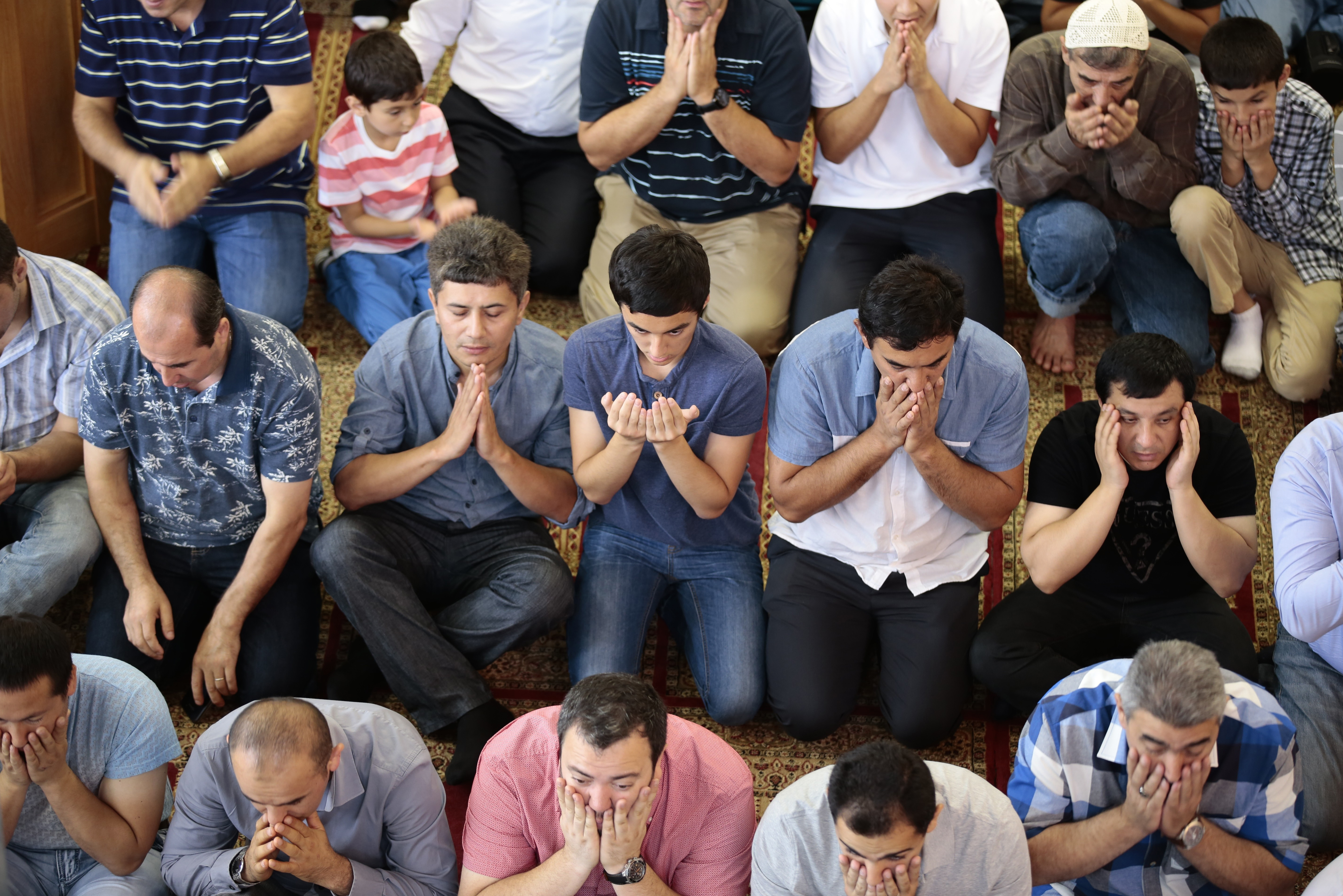
The Economist reminds us of “how well America is assimilating a religious minority that has often struggled to feel at home in Europe”:
[America’s Muslims] are almost as likely as other Americans to report a household income of $100,000 or more. The same cannot be said of the Pakistanis who came to work in the now-defunct textile mills of northern England or the Turks who became guest workers in West Germany. Many American Muslims arrived in the 1970s to complete their higher education and ended up staying. Muzammil Siddiqi, chairman of the Fiqh Council of North America, which issues fatwas, or religious opinions, to guide the behaviour of the country’s Muslims, is typical: he was born in India and holds a Harvard PhD in comparative religion. There is a stark contrast between this group and some of the more recent immigrants from Somalia, who have fewer qualifications and lower wages (as do African-American Muslims, who make up about an eighth of the total). This divide, if anything, makes America’s Muslims look more like the nation as a whole.
On various measures of integration, Muslims score fairly well. A Pew study from 2011 found that 15% of Muslims who are married or living with someone have a spouse of a different faith. This may sound low, but it is higher than the intermarriage rate for American Jews at a comparable moment in their history, and above that of modern Mormons. According to the Pentagon, there were 3,600 Muslims on active duty in the armed forces in January 2012, the most recent date for which numbers are available.
(Photo: Muslims living in New York City perform Eid al-Fitr prayer at Eyup Sultan Mosque on July 28, 2014. By Bilgin Sasmaz/Anadolu Agency/Getty Images)
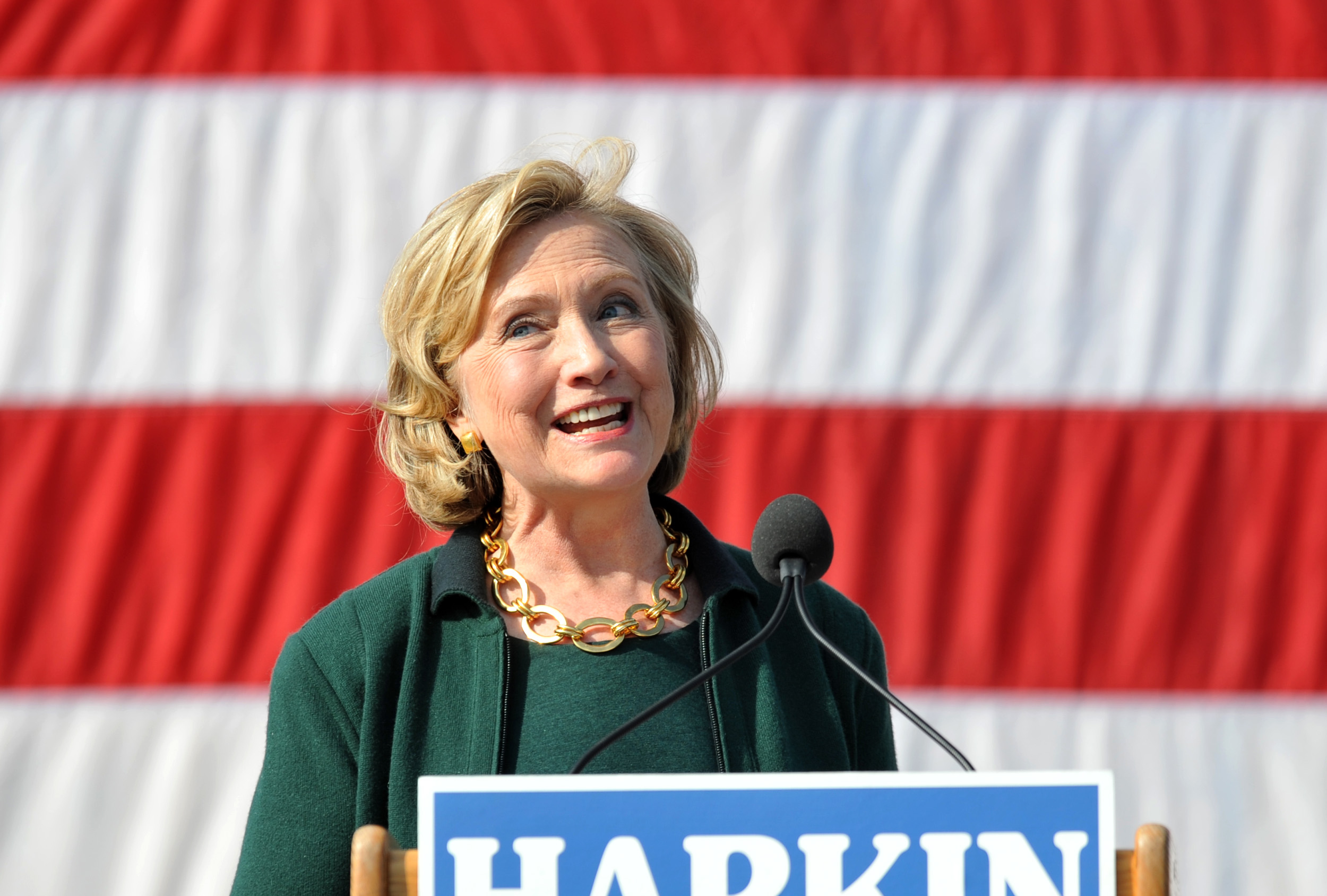
Jay Newton-Small captures the atmosphere at Iowa Sen. Tom Harkin’s Steak Fry, “a Democratic fundraiser that has become known as a presidential launchpad.” Clinton still won’t admit that she wants the presidency:
“Are you running?” reporters repeatedly shout at Hillary. She demurs. She even pretends not to notice when, the event having finally started down the hill, a speaker starts asking the crowd: “Are you fired up? Are you ready to go? Are you ready for Hillary? ARE YOU READY FOR HILLARY?” he screams as the crowd roars.
“Are you ready, Hillary?” a reporter yells. She ignores all this and chats away with Harkin and his wife Ruth.
Today’s Clinton campaign, like the one back [in 2008], is a tractor trailer moving down the highway, one whose driver — Hillary — can exert some control over its direction and speed, but whose stopping distance is measured in miles, and who can barely control the thing at all once it’s rolling downhill. So the question isn’t what she’s done to run; it’s whether she’s made any effort to hit the brakes, or whether anything has fallen unexpectedly across her path.
Noam Scheiber spots a big chink in Clinton’s armor:
The problem is the general caution that defines her political style.
Of Bill Clinton it was often said that if you put him in a crowded room, he would gravitate toward his harshest critic, determined to win them over. Hillary strikes you as the opposite—the sort who huddles with friends and allies while eying the detractor warily from a distance. The Harkin steak fry speech, and the political strategy it foreshadowed, was basically the rhetorical equivalent of this tic. Hillary’s impulse was to hold close the ideas that have served her well, year in and year out, while steering clear of any possible dissent from establishment opinion. Sensibility-wise, it’s about as far as you can get from where Democrats are these days.
Lexington wonders how Hillary would “govern America at a time of alarming and seemingly insoluble gridlock”:
In his own speech, Bill Clinton tackled this directly. The country was “less racist, less sexist and less homophobic” than it had ever been. It was more diverse than ever before, and more interdependent with the rest of the world (he painted word-pictures of Iowa farmers digitally studying world commodity prices in real-time). Yet more than ever before, Americans did not want “to be around people that disagree with us.” For this reason, it was vital to elect more politicians who went to work without “ears plugged up” and “blinders on”.
Is Hillary Clinton this kind of politician? The question is a serious one, and it is one she will need to answer if and when she decides to run for president. She cannot expect voters to elect her simply because it is “her time”, or because she would be the first woman president (though such arguments were made by a worrying number of those at the steak fry). The idea of being president is not enough to make Mrs Clinton president, in short.
Ana Marie Cox was alarmed by rhetoric of Hillary supporters at the event:
“It’s interesting, but it’s not the main reason I support her,” one male “Students for Hillary” member told me about the idea of a first female president. His companion, a female freshman, was even more cautious: “It’d be nice to see more women in politics,” she said, “But if you push hard for it, it becomes an issue you didn’t ask for.”
Such dry reasoning was unsettlingly common with the student contingent at the steak fry. Unprompted, they offered analysis rather than real reasons for their support. “The Democrats can’t eat their own,” said one of them, serious. “We’ve got to coalesce around Hillary because there’s really no one else, and we can’t let the Republicans win.” It sends a shiver up your spine when a guy who probably isn’t even shaving regularly basically quotes Mark Penn.
(Photo: Former Secretary of State Hillary Rodham Clinton speaks to a large gathering at the 37th Harkin Steak Fry, September 14, 2014 in Indianola, Iowa. By Steve Pope/Getty Images)
It’s what London cabbies get when they pass a grueling test that requires them “to learn by heart all 320 sample runs that are listed in the Blue Book, the would-be cabbie’s bible,” along with committing to memory “the 25,000 streets, roads, avenues, courts, lanes, crescents, places, mews, yards, hills, and alleys that lie within a six-mile radius of Charing Cross.” In a deep-dive look at the process of conquering “The Knowledge,” Roff Smith compares old-school cab drivers to those using modern technology to navigate the city:
Proponents of Uber say Sat Nav technology makes The Knowledge obsolete. Not surprisingly, London’s cabbies disagree.
They’re quick to point out that Sat Navs have a knack for getting things wrong, do not always pick the best or quickest route, and that having thousands of cabs idling curbside while their drivers punch in addresses for their Sat Navs will further clog London’s streets, where average speeds have already dropped below nine miles an hour.
It’s not simply a matter of speed, either, cabbies say. A driver who relies on Sat Nav doesn’t know the city. “I like to put it this way,” says 18-year veteran David Styles, who writes a blog about life behind the wheel: “When gentlemen have enjoyed supper at their club with their old regimental chums, they need a taxi to take them to the station. As they can generally afford to live in East Sussex, their station, Victoria, is only six minutes from Pall Mall. Depending on which entrance they want, they ask for The Shakespeare, Old Gatwick, or Hole in the Wall. Show me a Sat Nav which not only has that database but can be programmed in seconds, and I’ll buy shares in it myself.”
He continues: “And actors don’t want to arrive at the front of the theater. They want the stage door. And yes, we have to learn those too.”
Hail one of London’s iconic “black” cabs (which nowadays can come in any color) from anywhere you please within the greater London area, tell the driver where you want to go—it doesn’t matter whether it’s the Tower of London or some obscure pub in an outer suburb—and by the time you’ve climbed in the back seat and closed the door, he’ll have already calculated the most direct, swiftest route, without ever looking at a map.
“Over the past century, and especially the past four decades,” argues Paul Roberts, “we have created a sophisticated, self-feeding socioeconomic system that is marvelously efficient at catering to our desires.” He reflects on how an instant-gratification culture led us to an “Impulse Society”:
If we could step back a century, before the rise of the consumer economy, we would be struck not only by the lack of affluence and technology but also by the distance between people and the economy, by the separation of economic and emotional life. People back then weren’t any less wrapped up in economic activities. The difference lay in where most of that activity took place. A century ago, economic activity occurred primarily in the physical world of production. People made things: they farmed, crafted, cobbled, nailed, baked, brined, brewed. They created tangible goods and services whose value could be determined, often as not, by the measurable needs and requirements of their physical, external lives.
That relationship changed with the rise of the consumer economy.
Sophisticated, large-scale industrial systems assumed the task of making many of the things we needed, and also began to focus on the things we wanted. As the consumer economy matured, an ever-larger share of economic activity came from discretionary consumption, driven not by need but by desire, and thus by the intangible criteria of people’s inner worlds: their aspirations and hopes, identities and secret cravings, anxieties and ennui. As these inner worlds came to play a larger role in the economy—and, in particular, as companies’ profits and workers’ wages came to depend increasingly on the gratification of ephemeral (but conveniently endless) appetites—the entire marketplace became more attuned to the mechanics of the self. Bit by bit, product by product, the marketplace drew closer to the self.
I spent the last three days in Portland, Oregon, the kind of city I could easily live in: manageable, green, easy-going, mellow, polite. And I spent it with a few hundred entrepreneurs and activists, preparing and debating and sharing experiences about the burgeoning cannabis industry. It felt a lot like a gathering more than ten years’ ago of activists and ordinary gay folks, anticipating the possibility of civil marriage rights. It had the same energy, the same nervousness, and the same excitement. And, for me, the big reveal was the staggering level of innovation, imagination and technology that will transform the cannabis market as only American capitalism can.
And the people there defied every stereotype people want to apply to those of us who want to end the destructive, self-defeating Prohibition of a plant that is much less harmful than alcohol or tobacco. We’re long since past the age of Cheech and Chong; past the dumb giggles and condescending jokes, and mercifully beyond the boomer divide that still somehow sees this is as some kind of culture war issue, rather than a sane, pragmatic, gradual reform that will end persecution of so many, and improve the lives of countless more. So, yes, it did remind me of marriage equality – not least because the logic behind it is just as powerful and the opposition just as intellectually weak. If, like me, you’ve had the wind knocked out of you by Obama’s capitulation to neoconservatism, there are still some areas where the last six years can yield some durable domestic progress – and this is one of them. Unless, that is, Obama’s panicked blunder so emboldens the forces of reaction that it puts more of what we have achieved since the Bush-Cheney nightmare in jeopardy.
This weekend, we took our minds off the new Americanized war in the Middle East, and feasted on the poetry of Jericho Brown. I was gut-punched by this poem in particular. A secular meditation on prayer – from the Village Voice advice columnist! – is well worth re-visiting; I’ve rarely heard a homily that revealed and explained so much.
Tania Lombroza explains what experiencing awe does – and doesn’t – have to do with religious belief:
What we do know is that inducing experiences of awe can influence reported belief in God, potentially as a result of the need for accommodation that such experiences produce. One set of studies induced feelings of awe with videos of the natural world, and found that people subsequently reported greater supernatural belief. This was in part because awe made people less tolerant of uncertainty, and uncertainty is known to increase people’s confidence in agency and order.
But the picture is more complex. Endorsing a powerful and benevolent God may be one way to cope with uncertainty, but it isn’t unique. We know from related lines of work that science itself, especially scientific theories that offer clear structure and predictability, can also deliver many of the psychological benefits associated with belief in God, including a compensatory response to uncertainty. This suggests that experiences of awe could boost people’s confidence in science. In particular, awe could boost confidence in natural laws and orderly scientific theories — a prediction that, to my knowledge, has yet to be tested.
Certainly, people differ in the extent to which they experience awe, though there’s no evidence that this tendency is greater among believers than among atheists. But people may similarly vary in the extent to which awe induces uncertainty, and in the extent to which that uncertainty is found aversive. For some, uncertainty could prompt inquiry rather than disquiet, a scientific rather than a spiritual journey.
Alex Mar tours the Forensic Anthropology Research Facility (FARF) in San Marcos, Texas, America’s largest “body farm” for studying human remains:
The odor is strong as I walk among the cages, the air redolent with the heavy, sour-wet scent of these bodies letting go of their bile, staining the grasses all around them. I look at the sprawl, each individual in its strange shelter, shriveled and shocked-looking; each with more or less of its flesh and insides; each, in its post-person state, given a new name: a number. They died quietly, in an old-age home; they died painfully, of cancer; they died suddenly, in some violent accident; they died deliberately, a suicide. In spite of how little they had in common in life, they now lie exposed alongside one another, their very own enzymes propelling them toward the same final state. Here, in death, unintentionally, they have formed a community of equals.

 The Dish