A Poem For Saturday

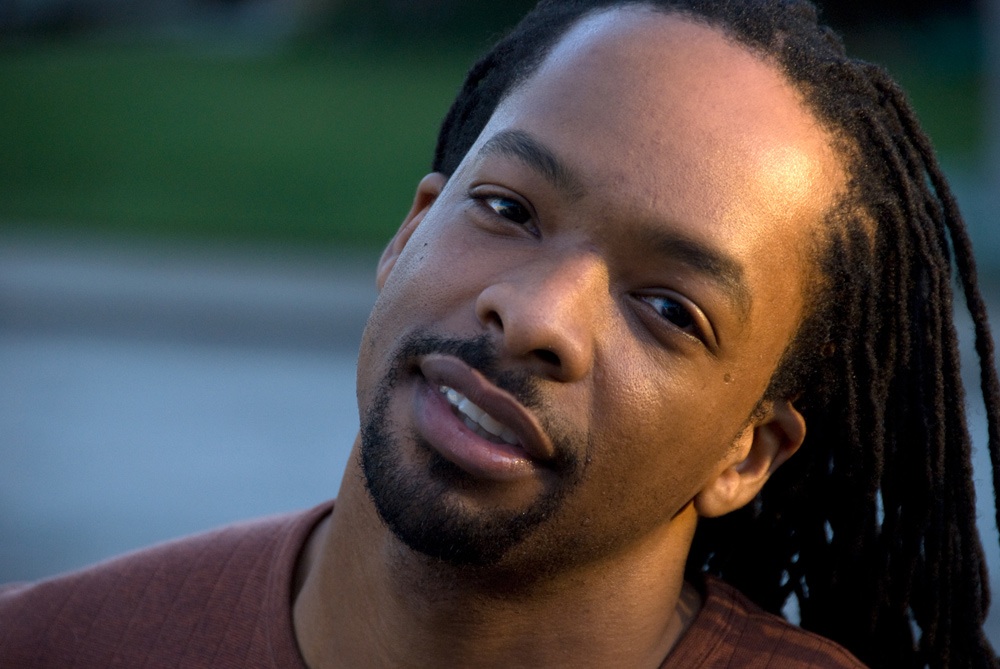
jericho_5

Dish poetry editor Alice Quinn writes:

Copper Canyon Press has just released a new book by Jericho Brown, welcomed by Pulitzer-Prize winning poet Yusef Komunyakaa, who is not given to exaggeration, as follows:

Jericho Brown’s The New Testament chronicles life and death, personal rituals and blasphemies, race and nation, the good and the bad, as well as illuminating scenarios of self-interrogation and near redemption. The lyrical clarity in this poignant collection approaches ascension. And here the sacred and profane embrace … The New Testament is lit by signifying, an anthem of survival and jubilation.

We’ll post three poems from this stunning book in the days ahead.

“Romans 12: 1” by Jericho Brown:

I will begin with the body,
In the year of our Lord,
Porous and wet, love-wracked
And willing: in my 23rd year,
A certain obsession overtook
My body, or I should say,
I let a man touch me until I bled,
Until my blood met his hunger
And so was changed, was given
A new name
As is the practice among my people
Who are several and whole, holy
And acceptable. On the whole
Hurt by me, they will not call me
Brother. Hear me coming,
And they cross their legs. As men
Are wont to hate women,
As women are taught to hate
Themselves, they hate a woman
They smell in me, every muscle
Of her body clenched
In fits beneath men
Heavy as heaven—my body,
Dear dying sacrifice, desirous
As I will be, black as I am.

(From The New Testament © 2014 by Jericho Brown. Used by permission of Copper Canyon Press. Photo of Jericho Brown by John Lucas)

Anti-Drug Propaganda

Leonid Bershidsky warns of its dangers:

Perhaps propaganda is the most dangerous drug of all. The U.S. Congress appeared to understand the potentially corrosive effects back in the 1970s and 1980s, when it banned the dissemination on U.S. soil of government-funded media such as Voice of America, partly in an effort to prevent domestic propaganda (the ban is no longer in force). The no-holds-barred war of lies between the governments of Russia and Ukraine shows propaganda machines maintain their deadly effectiveness even today.

Governments’ power to influence public opinion should be restricted as tightly as the most dangerous drugs, and free media – where they still exist – need to pay special attention to how they relay government messages. Otherwise, when officials grow older and decide something was done wrong, their wisdom will fall on deaf ears.

Drug Czar Michael Botticelli recently stated that the marijuana legalization movement “sends the wrong message, particularly to the youth of our country.” But Jon Walker believes the real problem is the message sent by the government’s draconian drug policies:

To begin with there is the fact that the federal government keeps marijuana a schedule I drug, classifying it as having no accepted medical value despite significant evidence that it provides relief to patients with a range of conditions. By doing this the federal government is telling our young people that it is okay to completely disregard science if you don’t like the results. It also lets young people know their government doesn’t thinks relieving the suffering of the sick should be a priority.

The government also continues to spend billions of dollars and has arrested millions of Americans in our decades-long marijuana prohibition war, yet it has completely failed to stop marijuana from being widely used. From this young people learn the important lesson that you should never admit you made a mistake, no matter how expensive or destructive that mistake has been.

Give Millennials A Break

A new Pew study finds that the Internet hasn’t totally eroded the reading habits of Generation Y:

Millennials, like each generation that was young before them, tend to attract all kinds of ire from their elders for being superficial, self-obsessed, anti-intellectuals. But a study … from the Pew Research Center offers some vindication for the younger set. Millennials are reading more books than the over-30 crowd, Pew found in a survey of more than 6,000 Americans.

Some 88 percent of Americans younger than 30 said they read a book in the past year compared with 79 percent of those older than 30. At the same time, American readers’ relationship with public libraries is changing—with younger readers less likely to see public libraries as essential in their communities.

Meanwhile, Susan J. Matt, author of Homesickness: An American Historydefends the 22 percent of adults in their 20s and 30s who live with their parents. The idea that young adults should leave home, she argues, only took off in the 20th century:

By mid-century, experts were arguing that tightly bonded families were out of place in America. Sociologist W. Lloyd Warner explained that because the economy required individuals to move frequently, “families cannot be too closely attached to their kindred. . . or they will be held to one location, socially and economically maladapted.” Those who tried to maintain strong kin ties were criticized. In 1951, psychiatrist Edward Strecker, preoccupied with the Cold War and the need for a mobile fighting force, accused American mothers of keeping their “children enwombed psychologically,” failing to “untie the emotional apron string … which binds her children to her.” He dubbed these women the nation’s “gravest menace.”

Today, we continue to believe young adults should leave home. When they don’t, their living choices are chalked up to poor employment prospects. While economic realities surely play a part in their residential choices, the media give short shrift to other motives. The idea that families might be drawn together by feelings of affection is left out of the equation, as is the possibility that this generation wants to become something other than mobile individualists. Yet there’s considerable evidence that millennials hold values that center more on family and less on high powered careers. A recent poll found them far less concerned with financial success than the population at large. They also are closer to their parents, whom they fight with less, and talk with more than earlier generations.

Why Marriage Equality Lags In China

Li Yinhe, a Chinese sociologist who keeps a popular blog on sex and family issues, compares attitudes toward homosexuality in China and the West:

In your blog you’ve advocated legalizing same-sex marriage. Is that a realistic goal in China?

The attitude toward homosexuality in China is not as absolute as in the West. At least in some earlier eras, there wasn’t an absolute opposition to it. In China it’s never been illegal or outlawed. During the Song dynasty there was a law against homosexual prostitution, but not against homosexuality in principle. It’s more something that might have been considered ridiculous but not a crime.

So the main thing was you do your duty—get married and procreate?

Yes, that’s the key. But maybe more, Chinese people’s view of sex is different than foreigners’. Chinese view it as purely a physical desire. Who your partner is—male or female—or how you express it doesn’t matter. Anal sex or things like that, they don’t think it’s bad. So from this point of view, homosexuality is not such a problem. I read a survey of attitudes about same-sex marriage in 2008: about 10 to 20 percent thought it was absolutely no problem and 10 to 20 percent thought it was absolutely wrong. But the rest—the majority—just didn’t care. By contrast, in the United States, 47 percent were in favor of same-sex marriage and 43 percent were against. Only 10 percent didn’t have a view. For the Chinese it was like this: It doesn’t have to do with me so I don’t care.

For Chinese who do oppose it, what are their reasons?

They think it’s unnatural because homosexuals can’t have children. But I think this view is slowly changing. The main hindrance is there are no rights groups. In the West, you might have members of parliament or prominent people who are gay or lesbian and they can raise the issue of same-sex marriage. In China, no one raises the issue. Most people don’t think it’s a big issue.

Raining On Your Food Parade

Andrew Simmons frowns at food festivals:

Some food festivals trumpet sustainability as a pillar of their mission, but this is self-evidently ridiculous. While biodegradable forks made from potato starch are popular, at the end of the day, napkins, plates, and discarded food billow out of garbage cans. Piles of trash sprout wherever attendees feel like starting them. Just because the heritage-breed pigs everyone’s tucking into were raised on chestnuts, doesn’t mean that the event is somehow expanding the crowd’s understanding of food systems. Responsible animal husbandry is great, but the very notion of encouraging a few relatively privileged people to dramatically overindulge—and then leave piles of garbage behind for janitors to clean up—seems unsustainable.

A Short Story For Saturday

This week we’re featuring another reader-suggested short story, John Cheever’s “The Death of Justina,” which was a recurring favorite in our recent “Reading Your Way Through Life” thread. It hooks you from the start:

So help me God it gets more and more preposterous, it corresponds less and less to what I remember and what I expect as if the force of life were centrifugal and threw one further and further away from one’s purest memories and ambitions; and I can barely recall the old house where I was raised, where in midwinter Parma violets bloomed in a cold frame near the kitchen door, and down the long corridor, past the seven views of Rome-up two steps and down three-one entered the library, where all the books were in order, the lamps were bright, where there was a fire and a dozen bottles of good bourbon locked in a cabinet with a veneer like tortoise shell whose silver key my father wore on his watch chain. Fiction is art and art is the triumph over chaos (no less) and we can accomplish this only by the most vigilant exercise of choice, but in a world that changes more swiftly than we can perceive there is always the danger that our powers of selection will be mistaken and that the vision we serve will come to nothing. We admire decency and we despise death but even the mountains seem to shift in the space of a night and perhaps the exhibitionist at the corner of Chestnut and Elm streets is more significant than the lovely woman with a bar of sunlight in her hair, putting a fresh piece of cuttlebone in the nightingales’s cage. Just let me give you one example of chaos and if you disbelieve me look honestly into your own past and see if you can’t find a comparable experience.

Keep reading here. For more, check out The Stories of John Cheever. Browse previous SSFSs here.

Have We Outgrown Growing Up?

A.O. Scott sounds the death knell for adulthood in American culture, arguing that shows like Girls, Broad City, and “a flood of goofy, sweet, self-indulgent and obnoxious improv-based web videos” signal that “nobody knows how to be a grown-up anymore”:

It is now possible to conceive of adulthood as the state of being forever young. Childhood, once a condition of limited autonomy and deferred pleasure (“wait until you’re older”), is now a zone of perpetual freedom and delight. Grown people feel no compulsion to put away childish things: We can live with our parents, go to summer camp, play dodge ball, collect dolls and action figures and watch cartoons to our hearts’ content. These symptoms of arrested development will also be signs that we are freer, more honest and happier than the uptight fools who let go of such pastimes.

I do feel the loss of something here, but bemoaning the general immaturity of contemporary culture would be as obtuse as declaring it the coolest thing ever. A crisis of authority is not for the faint of heart. It can be scary and weird and ambiguous. But it can be a lot of fun, too. The best and most authentic cultural products of our time manage to be all of those things. They imagine a world where no one is in charge and no one necessarily knows what’s going on, where identities are in perpetual flux. Mothers and fathers act like teenagers; little children are wise beyond their years. Girls light out for the territory and boys cloister themselves in secret gardens. We have more stories, pictures and arguments than we know what to do with, and each one of them presses on our attention with a claim of uniqueness, a demand to be recognized as special. The world is our playground, without a dad or a mom in sight.

Adam Sternbergh appreciates the prompt to reconsider what maturity means today:

The best part of any essay about changing cultural notions of adulthood is that it encourages us, again, to revisit what adulthood means, exactly. To some, it’s men in suits and smoking and not being able to do what you want anymore, because propriety. For others, it’s a continuing suspicion of cultural pleasure that would make the Puritans proud. To my eye, watching Seth Rogen grapple with responsibility in Knocked Up is a much more honest engagement with the meaning of maturity than watching Woody Allen grapple with a 17 year-old Mariel Hemingway in Manhattan, a presumably more “grown-up” film.

Alissa Wilkinson also sees Scott’s point:

Growing into a full humanity requires cultivating virtues that temper one another. Some are associated with adulthood—courage, tenacity, autonomy. Others are more closely associated with childhood—curiosity, humility, generosity. So, yes: only engaging in “juvenile” culture could shape us in bad ways. … But only engaging in “grown up” culture can, too, as can reflexively defending sophisticated products and rejecting simpler ones.

As Scott points out, the kind of culture creative output that results from our cultural shift doesn’t merely mean we end up with “juvenile” culture and fart jokes and boy-men and girl-women. It also means we end up with a lot of “childish” culture. Or maybe “childlike” is a better term. We get things that test the edges of the accepted in playful ways. We have stories that find wonder everywhere. We experience pleasing blows to our self-importance. And sometimes, if we are paying attention, we are even returned to a time when things like faith, and hope, and love came easily.
 

The View From Your Window Contest

VFYWC_222

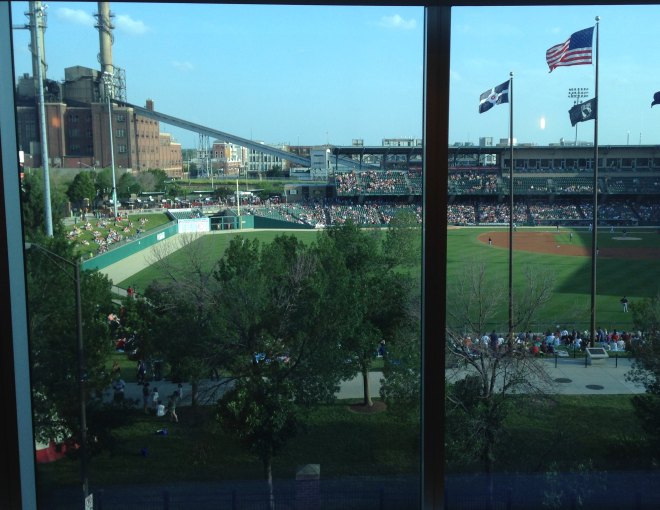
You have until noon on Tuesday to guess it. City and/or state first, then country. Please put the location in the subject heading, along with any description within the email. If no one guesses the exact location, proximity counts.  Be sure to email entries to contest@andrewsullivan.com. Winner gets a free The View From Your Window book or two free gift subscriptions to the Dish. Have at it.

Browse our previous window view contests here.

The Secrets To Happiness

Dave Roberts revisits an old Atlantic essay on the subject:

Gratitude and joy are emotions we can muster when we don’t feel threatened, when our lizard brain calms and our prefrontal cortex takes over. But it’s very difficult when our egos feel under siege. Relationships are more meaningful the more we open and extend ourselves (and are reciprocated), but our degree of openness is also our degree of vulnerability. Often we close off, deciding, consciously or not, that it’s not worth the risk of getting hurt; our lizard-brain fear overpowers us.

We cannot control this dynamic entirely. As the Atlantic piece explains, researchers believe that about 50 percent of our happiness is determined by our internal “set point,” which is shaped by genetics and early childhood and mostly fixed in place. About 10 percent is determined by circumstances. But that other 40 percent comes from how we react to circumstances, and over that we do have some control.

We can learn to detach from fear and anger, to let them go, to take deep breaths, return our focus to the present, and choose positive emotions. That, as I wrote yesterday, is what mindfulness is all about.