A hypnotic lesson in physics:
Category: The Dish
An Unhealthy Work Environment
Frakt and Carroll make the case against employer wellness programs:
More rigorous studies tend to find that wellness programs don’t save money and, with few exceptions, do not appreciably improve health. This is often because additional health screenings built into the programs encourage overuse of unnecessary care, pushing spending higher without improving health.
However, this doesn’t mean that employers aren’t right, in a way. Wellness programs can achieve cost savings — for employers — by shifting higher costs of care onto workers. In particular, workers who don’t meet the demands and goals of wellness programs (whether by not participating at all, or by failing to meet benchmarks like a reduction in body mass index) end up paying more. Financial incentives to get healthier sometimes simply become financial penalties on workers who resist participation or who aren’t as fit. Some believe this can be a form of discrimination.
Drum suspected as much:
For the most part, wellness programs are a means to reduce pay for employees who don’t participate, and there are always going to be a fair number of curmudgeons who refuse to participate. Voila! Lower payroll expenses! And the best part is that employers can engage in this cynical behavior while retaining a smug public conviction that they’re just acting for the common good. Bah.
How Apple Plugs Itself Into Our Lives
Nick Carr is uncomfortable with QuickType – a “predictive type” feature being rolled out with iOS 8:
It seems more than a little weird that Apple’s developers would get excited about an algorithm that will converse with your spouse on your behalf, channeling the “laid back” tone you deploy for conjugal chitchat. The programmers seem to assume that romantic partners are desperate to trade intimacy for efficiency. I suppose the next step is to get Frederick Winslow Taylor to stand beside the marriage bed with a stopwatch and a clipboard. “Three caresses would have been sufficient, ma’am.”
In The Glass Cage, I argue that we’ve embraced a wrong-headed and ultimately destructive approach to automating human activities, and in Apple’s let-the-software-do-the-talking feature we see a particularly disquieting manifestation of the reigning design ethic. Technical qualities are given precedence over human qualities, and human qualities come to be seen as dispensable.
Looking on the bright side of Apple’s announcements, Jonathan Cohn imagines that the Apple Watch could “make medical care more efficient and let us all stay a lot healthier”:
One of the biggest problems with health care today is the lack of ongoing, continuous care, particularly for people with chronic conditions. It means that doctors, nurses, and the rest of health care system spend a lot of time treating people with serious, sometimes urgent problems, rather than keeping them healthy in the first place.
Mobile devices that monitor and then transmit vital signs can help fix that, so that patients and their medical professionals would know when problems were starting.
Julia Belluz is skeptical of such claims:
This gadget and the new software will certainly make analyzing data easier, and it may even be more precise than other wearable technologies. But the claims to an Apple-shaped health revolution deserve some scrutiny: the evidence on existing wearables suggests that — like all other silver-bullet solutions for health — they haven’t yet figured out how to make habit change stick.
Neil Irwin, meanwhile, casts doubt on Apple’s new mobile payments service:
The core challenge Apple faces is that buying things with a credit card isn’t nearly as onerous a process as they make it out to be.
Drum is on the same page:
There really are issues with credit cards as payment devices. They’re fairly easily stolen and they’re pretty insecure. Still, these things are relative. As long as you use a credit card instead of a debit card, you’re not responsible for most losses, and various forms of modern technology have made credit cards much more secure than in the past. And as Irwin points out, they’re pretty easy to use. It’s just possible that the Steve Jobs reality distortion field could have convinced everyone otherwise, but I’m not sure Tim Cook is up to the task.
Leonid Bershidsky also deflates Apple Pay a bit:
The company’s partners, banks and credit-card companies, played along with Apple’s hype, because they support every player that puts effort into popularizing a technology whose use they are struggling to expand. Essentially, however, Apple is just a middleman and will have a role only so long as existing payments industry players need help spurring consumers to adopt contactless payment.
And Cass Sunstein raises a potential drawback to Apple’s mobile payments:
When payment becomes easier, and when people don’t see the money they’re handing over, they tend to spend a lot more. And as payment becomes more automatic, people become less sensitive to what they’re losing. Apple Pay users might find that their thinner phones are making their bank accounts thinner as well.
A little social science: People who use credit cards tend to give bigger tips at restaurants and spend more at department stores. They are also more likely to forget, or to underestimate, the amounts of their recent purchases.
Earlier Dish on this week’s Apple news here.
Dick Cheney Was Right About Iraq All Along
Really, he was! That is, if we point to 1991, when he said this:
What kind of government? Should it be a Sunni government or Shi’i government or a Kurdish government or Ba’athist regime? Or maybe we want to bring in some of the Islamic fundamentalists? How long would we have had to stay in Baghdad to keep that government in place? What would happen to the government once U.S. forces withdrew? How many casualties should the United States accept in that effort to try to create clarity and stability in a situation that is inherently unstable? I think it is vitally important for a President to know when to use military force. I think it is also very important for him to know when not to commit U.S. military force. And it’s my view that the President got it right both times, that it would have been a mistake for us to get bogged down in the quagmire inside Iraq.
But the new narrative emerging as Cheney pursues his “told you so” comeback tour is that he was right all along about how he had won the Iraq war and then Obama lost it. Weigel plumbs the depths of the derpitude:
Boy, the phrase “all along” is asked to do some heavy from-the-knees lifting there. All along? The timer starts four years after the start of the Iraq war, and two years after Cheney insisted, pre-surge, that Iraqi insurgent groups were in their “last throes”? Yes, that’s the new rule.
We are to analyze the situation of 2014 by crediting the Bush administration not for the Iraq war, but for post-surge Iraq. This has been the argument since 2011, when the Obama administration failed to extend the three-year status of forces agreement that (to the satisfaction of hawks) Bush had handed to him. The theme at the time, as Charles Krauthammer put it, was that Obama was“handed a war that was won,” and he blew it.
Dreher has no time for such nonsense:
Three out of four Americans in 2011 wanted the president to withdraw all US troops from Iraq. Read the Gallup poll; how soon, and how conveniently, we forget. You cannot keep US soldiers in a hopeless war with 75 percent of the country against that policy. Gallup’s poll numbers show that even though the percentage of Americans in 2014 who believe total withdrawal was the right thing is down to 61 percent, that’s still a strong majority. President Obama did what the Iraqis would allow him to do — it’s their country, after all — and what the American people wanted him to do.
This Bush prophecy business is b.s. through and through. It’s important to say that now, because Dick Cheney, one of the principal architects of one of the worst disasters in US foreign policy and military history, is now making an “I Told You So” tour, back in Washington (a standing ovation at AEI!) spreading his wisdom to appreciative conservative audiences. It’s like they let Bernie Madoff work on Wall Street again, or returned the FEMA portfolio to Brownie.
Correction Of The Day
“An earlier version of a summary with this article misstated the former title of Dick Cheney. He was vice president, not president,” – the New York Times.
Is The “Islamic State” Islamic?
Obama: The Islamic State is neither Islamic nor a state. Discuss. pic.twitter.com/VwW89Tm9D2
— Brett LoGiurato (@BrettLoGiurato) September 11, 2014
Last night, Obama made a point of stressing that ISIS is not Islamic. The usual suspects had a field day with that line, but Ramesh Ponnuru finds it sort of pointless:
I’m not sure what presidents think they are achieving when they make this assertion. (Bush did it too, all the time.) The alternative would be to say, “They claim to act in the name of Islam, something peace-loving Muslims say is a perversion of their faith,” or just to say nothing about the point. I can’t imagine that a non-Muslim-American president convinces anyone when he tells the world what true Islam is.
So why bother talking about it at all? Maybe it’s because, as Kelly Vlahos describes, America’s post-9/11 Islamophobia never went away and a new war with an “Islamic State” is only bound to make it worse:
According to [James] Zogby’s Arab American Institute, which has been polling Americans on their views of religious and ethnic groups since the 1990’s, Americans’ dislike of Arabs and Muslims skyrocketed after 9/11 and has hardly budged since. Unfavorable ratings for Muslims have declined from a peak of 55 percent in 2010 to 45 percent in July, but at the same time, favorable ratings have plunged, from 41 percent in 2012 to 27 percent in 2014.
Republican attitudes are clearly skewing the results. When narrowed, 63 percent of Republicans had unfavorable views of Muslims, while only 21 percent had favorable views in 2014. It’s not surprising, considering how Islamophobia has attached itself to Republican politics since 9/11. … Meanwhile, well-funded fringe groups like Geller’s American Freedom Defense Initiative, have attempted to purge Muslim-Americans who have dared to “infiltrate” the White House and other high profile positions throughout federal government. They might have gone too far in 2012, however, when they suggested long-time Hillary Clinton aide Huma Abedin had connections with the Muslim Brotherhood.
Another recent poll illustrates how the link between Islam and violence endures in Americans’ minds:
A Pew Research Center poll released just hours before Obama’s speech showed that 50 percent of Americans see Islam as a religion that “is more likely than others to encourage violence among its believers.” The figure’s up sharply from earlier this year and is the highest since Pew started asking that question in 2002. By contrast, 39 percent of Americans say Islam doesn’t encourage violence any more than other religions — down from 50 percent in February. … Not surprisingly, conservatives and Republicans are more apt to see Islam as a more violent religion. Two-thirds of Republicans believe this, while independents and Democrats are below 50 percent.
Igor Volsky and Jack Jenkins lay out some evidence in favor the president’s contention:
President Obama’s condemnation of ISIS is backed up by a global chorus of Muslim voices that are working to rebuke’s the group’s claim on Islam. Virtually every single American Muslim organization has publicly disavowed both the ideology and the practices of ISIS, and just hours before Obama’s address, dozens of Muslim American clerics and community leaders distanced their religion from the beliefs of the terrorist extremists. “ISIS and al Qaeda represent a warped religious ideology,” Faizal Khan, imam of the Islamic Society of America mosque in Silver Spring, said during a press conference with Muslim-American leaders from Indonesia, Pakistan, Ethiopia, Sudan and Trinidad. “Either we reject this violence in the clearest possible terms, or we allow them to become the face of Islam and the world’s perception of us for years to come.”
Why Not Webb?

Albert Hunt imagines that Jim Webb could pose a real challenge to Clinton. Some of the reasons why:
Clinton recently said she disagreed with Obama’s decision not to intervene in the Syrian civil war. Webb warns that the Syrian opposition includes not only elements friendly to the U.S., but also the radical Islamic State forces that have wreaked mayhem there and in Iraq, murdering thousands and beheading two American journalists. Syria, he has warned, is “Lebanon on steroids.”
Clinton has close ties to Wall Street, a source of campaign funds for her and the Clinton Foundation. Since leaving office, she has received large speaking fees from hedge funds, private-equity companies and big banks such as Goldman Sachs Group Inc.
Webb, 68, has long taken a populist, anti-Wall Street stance.
Millman suspects that Webb “would make a terrible primary challenger to Clinton” but hopes he runs anyway:
Webb is a pretty rare bird.
He’s an intellectual but not an ideologue. He’s a culturally right-wing personality who recognizes that on the most important issues facing the nation, we need to move to the left – and not just on economics and foreign policy; he’s been critical of Executive power, even with his own party’s man in office, and has taken a serious hard look at reforming our appalling prison-industrial complex. He’s a strong critic of the “Washington consensus” in foreign policy who cannot by any stretch of the imagination be called either naive or a neo-isolationist. (In a deep sense, he’ll always have the outlook of a Secretary of the Navy.) Most important, he’s a genuinely independent person, the exact opposite of the careerist climber. We desperately need more people like him in our politics.
And, I think it would be very helpful on foreign policy in particular for Democratic primary voters to recognize that Clinton is all the way on the bleeding right edge of her party.
Larison’s take:
Like Millman, I think Webb is an interesting and impressive figure, and I was very pleased when he knocked George Allen out of the Senate in 2006. During his one term in office, he did some important work on veterans’ issues, and he took a principled and correct stand against Obama’s illegal war in Libya. His response to Bush’s 2007 State of the Union address was the only one I can recall from the last decade that wasn’t immediately irrelevant. His decision to run for office as a Democrat in large part because of his disgust with the Iraq war and Bush administration incompetence was one of the more meaningful rebukes to the GOP back then, and if Republican leaders were smarter they would have learned something from it. It would be good for the country and the Democratic primary process if he ran against Clinton and put some obstacles in the way of her coronation, but I’m not sure that I see any incentives for Webb to do this.
(Photo by Jamie Rose/Getty Images)
A Reluctant Defense Of Circumcision
Rhys Southan offers one, writing that the practice “hurts some people, but we can’t pretend that it doesn’t bring joy to others”:
I agree with [philosopher Brian D.] Earp and [intactivist Matthew] Hess that this is honest and significant pain, not a laughable quirk to be mocked into hiding – and this is why I can’t fully side with the intactivists. If harm is in large part subjective – and to credibly amplify the voices of a tiny minority who regret circumcision, intactivists need to admit it is – cutting is bad only for the people who find it so. It’s dishonest to claim that the joy the Jewish practice of brit milah brings its practitioners counts for nothing when most people who are circumcised for religious reasons do not grow up to think of themselves as abused. The organisation Friends of Refugees of Eastern Europe (FREE), based in New York, says that it has circumcised more than 13,000 Jewish adults who were prohibited from infant circumcision in the Soviet Union. Many of them no doubt felt harmed by not having been circumcised in their infancy. Until far more Jews and Muslims step forward to protest their own circumcisions, to me it looks more hurtful to ban religious circumcision than to leave it alone.
The “joy” of others is a strange defense for the infliction of physical pain and permanent scarring on an infant’s body. But, look: I do not favor banning it for Muslims and Jews and others. I simply favor ending it as a routine procedure for most infant boys and raising some consciousness about the men whose own bodies were permanently altered without their consent.
The Quality Of Britishness
Several readers have made this point about Britishness:
I was born in the UK, in the south-east of England, and I’ve always lived here; but my perspective on Englishness or Britishness has a specific nuance that none of your correspondents so far have mentioned. It has to do with race; particularly how those, like me, who have mixed backgrounds, identify ourselves.
My dad came to the UK from Malaysia on his own to go to boarding school in England in the early ’60s. About five years before that he and some of his family escaped from persecution in China. He later went to university in Scotland, became a doctor, met my English mother, married, took British citizenship and settled here permanently. He’s not English; he’s a Chinese man who is British, and who has lived in both Scotland and England. And I’m not English either; if you’re talking about my race, I’m half-English, but I identify as wholly and proudly British, part of a country that embraces people whose origin is African, Pakistani, Chinese … and Welsh, Scottish, Irish and English.
I’m married to a man who was born in Wales and lives in England, with one Welsh and one English parent. How is he to choose whether he’s Welsh or English? He’s lived here in England longer, but the town of birth on his passport is on the other side of the Severn, and we spend a lot of time with family who still live there. There’s a simple answer: he’s neither. He’s British.
Separation of Scotland has more than political implications. For many of us who do not have any vote in the matter, it carries profound implications about our identity, and what our nationality means.
This strikes me as a really valuable point. Britishness surpasses nationalism as a kind of supra-nationalism. It leaves space for the other; it is a rubric – largely defined as well by the Crown – that has more virtues than might immediately appear. Maybe it takes the potential end of Britain to value it all over again. Another reader notes:
Just an observation about the uniqueness of British nationalism in the European landscape.
I am unsure of another European example of a country that has for the most part successfully integrated large disparate immigrant classes, and I have always wondered how much the concept of British helps with this. Concepts like German, French, Dutch, and the like all have the same problem of tribal affiliation. I could live in London for 25 years and never feel I am English (I know my heritage, and it isn’t English), but I would see no problem with becoming British. By accident or design, the United Kingdom created a national class that would seem to put it in a much better position vis a vis the US/Australia/Canada in terms of the movement of immigrants and all of the benefits and drawbacks contained therein and if the Kingdom splinters, I wonder if they will lose this as well.
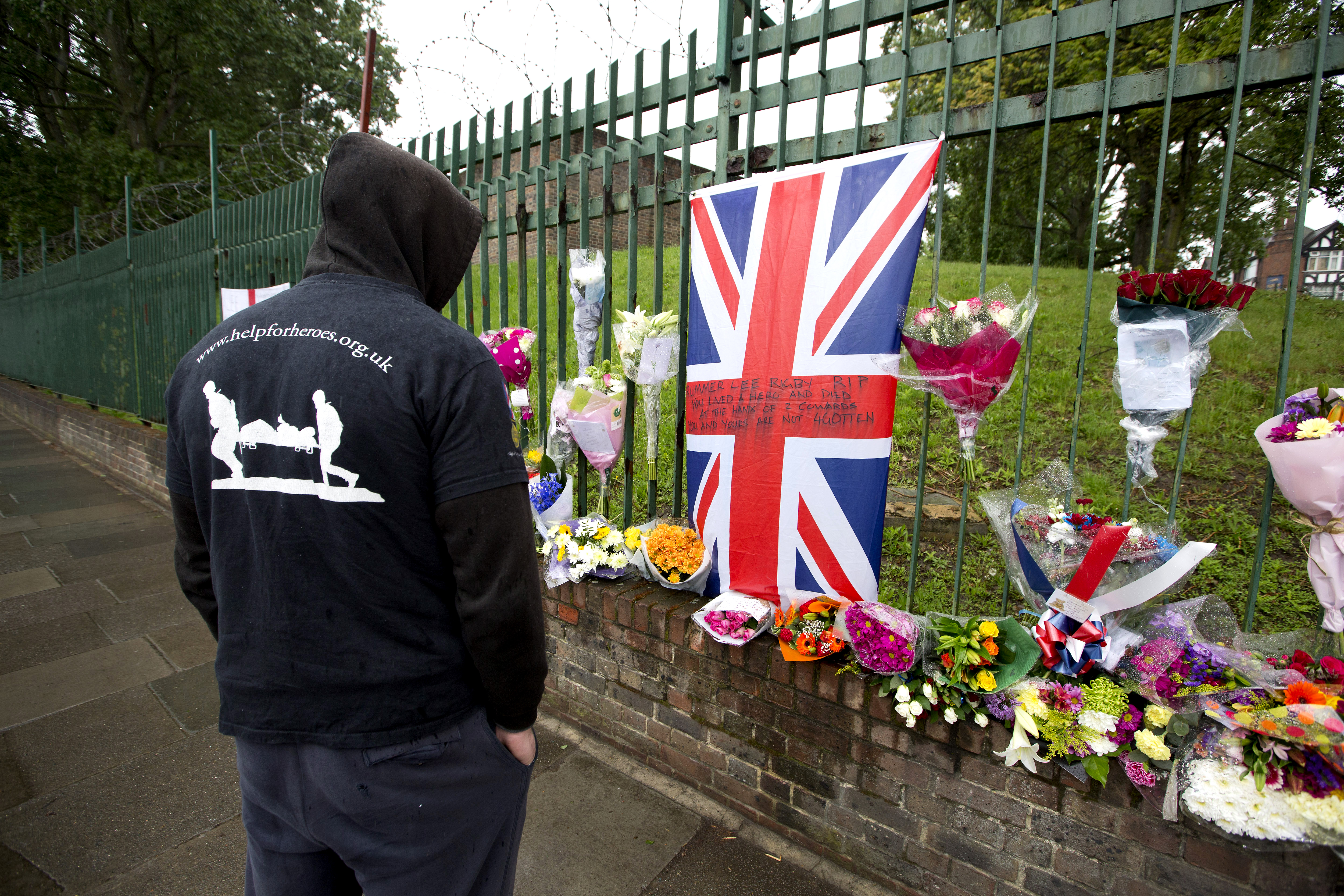
(Photo: A man wearing Help the Heroes tshirt looks at floral tributes left at the scene where Drummer Lee Rigby of the 2nd Battalion was killed outside Woolwich Barracks in London on May 24, 2013. By Justin Tallis/AFP/Getty.)
#WhyIStayed, Ctd
Ray Rice’s wife is defending Ray and blaming the media… http://t.co/kSpvYTA8lM pic.twitter.com/IszPl4TFyR
— TMZ (@TMZ) September 10, 2014
The conversation about domestic violence continues, with several reflections on Janay Rice. Robin Givens shares a personal experience:
People ask why I didn’t leave after the first time he hit me. But you feel such inner turmoil and confusion. You want it to be only one time. And for three days after that incident I did the right thing. I said: “Don’t call me. I never want to see you again.” But then you start taking his phone calls. Then he asks to see you in person, and you say yes to that. Then you have a big giant man crying like a baby on your lap and next thing you know, you’re consoling him. You’re the protector. One minute you’re running from him, the next you’re protecting him. And being a black woman you feel you want to protect your man. You think, the black man in America has it so difficult anyway, so now you’re turning them in. It feels like the ultimate betrayal.
Feminista Jones expands on the race angle:
These events have forced the country to face difficult truths about how prevalent domestic and intimate partner violence (DV/IPV) is in America.
According to the National Coalition Against Domestic Violence, an estimated 1.3 million American women experience DV/IPV each year. Women make up 85% of the victims of DV/IPV. Despite this, most cases are never reported to the police and most women are victimized by people they know.
And for Black women, it’s an even bigger problem: Black women are almost three times as likely to experience death as a result of DV/IPV than White women. And while Black women only make up 8% of the population, 22% of homicides that result from DV/IPV happen to Black Women and 29% of all victimized women, making it one of the leading causes of death for Black women ages 15 to 35. Statistically, we experience sexual assault and DV/IPV at disproportionate rates and have the highest rates of intra-racial violence against us than any other group. We are also less likely to report or seek help when we are victimized.
Emily Bazelon considers Janay Rice’s position:
As Jodi Kantor wrote in the New York Times, “it’s not at all clear that she views herself as a victim of abuse.” Palmer married Rice the day after he was indicted for hurting her. She has stood by his side at news conferences and rallied to his cause on social media. She tried to take the burden off Rice’s shoulders in the spring when she said, “I do deeply regret the role that I played in the incident that night.”
Rice and Palmer met in high school. They have a child together. She’s probably financially dependent on him. She has a lot of reasons to back him up. But that doesn’t mean prosecutors should take her statements at face value, Gandy said, or excuse Ray Rice because Janay Rice is still with him. Maybe she’s staying because she’s afraid to leave. When domestic violence ends in murder, it’s often after the victim tries to get out of the relationship.
Caitlin Dickson focuses on the impact of Rice’s firing on his family:
Almost everyone except Janay Rice applauded the move, though questions remained as to whether, contrary to what Goodell has said, the NFL saw the second video prior to its public release. But Monday’s news, and Janay Rice’s subsequent response, raised a different set of questions for domestic violence experts that highlight just how complicated the issue of domestic violence is.
While Rice inarguably deserved to lose his job, could the NFL have done more to ensure that he gets help? By suspending him indefinitely, did the NFL do more to disassociate itself from Rice’s heinous actions than to make the player, their employee, take responsibility for them? After all, the new domestic violence policy does not require offenders to go through any kind of counseling before they can petition for reinstatement after a year. What incentive does Rice have to change his behavior?
Dr. Benjamin S. Carson, the controversial GOP pundit flirting with a presidential run, describes another reason why some abuse victims stay:
There are situations in which domestic abuse is so violent and dangerous that nothing short of a total separation from the abuser is the only way of assuring the physical and emotional safety of the victim(s). But there are situations, especially where there is strong spiritual and community support, in which the best option may be counseling or mediation or other less drastic measures. This does not in any way excuse the act itself, but it may help prevent further harm: the harm caused by children growing up without a parent; the harm of losing economic opportunities that would help to strengthen the family; the harm to the community of destroying a family unit. While I firmly believe that individual freedom is essential to a healthy democracy, I also believe that a strong family is the foundational unit of a healthy society.
Often the knee-jerk reaction to the shock of violence and other betrayals of trust within relationships is for the aggrieved party to leave and never look back. In the heat of the moment separating two highly emotional people might be the best option until their emotions cool. But to imply that a woman or man is displaying weakness by staying in a relationship, or conversely, showing strength by leaving, is far too simplistic. Often it takes great strength to overcome difficult issues in a relationship. There should be a determination on the part of both parties– as well as sometimes courts, counselors, pastors and other community resources – as to whether the relationship is worth saving, and if so, what steps should be taken to try and heal the wounds and rebuild strong bonds of trust. When a family is involved the stakes are too high not to try.
 The Dish