Parental Whoa-vershare

by Phoebe Maltz Bovy

So the most egregious example of parental overshare that I’ve yet encountered has just appeared. Depressingly, it’s in the same publication as my own first published piece on the topic. It’s from a father who caught his 9-year-old son looking at porn:

His eyes darted back and forth, as if looking for an escape hatch inside his own head.  He was formulating a plan, something to get out of this situation, and then he stopped. His brow furrowed.

“Wait,” he said, sitting back upright. And then he followed up with possibly the sweetest thing he ever asked me, given the context. “What’s porn?”

I couldn’t help but smile. His defense hadn’t been self-preservation so much as it was genuine confusion. “It’s videos and pictures of people having sex,” I told him. He slumped back into embarrassment. “Oh. Then, yes. I looked at porn.”

Totes adorbs! Oh, and the author’s writing under what we can assume is his real name, and provides his son’s name and nickname. In case this wasn’t traumatizing enough for the kid, we also get specifics of his surfing habits:

My brain registered the title of a web page in the middle of the history list before my eyes really focused on anything.

8:41 PM    http://www.bimbos.com    Free XXX Vids: Sheila, The Queen of Ana…

I expanded the Page Title column to see the whole thing and was dismayed, but not surprised, to find that Sheila was not the Queen of Analogies. There were several more pages visited in rapid succession, all featuring women giving jobs that had nothing to do with our nation’s unemployment rates. Finally, the browser history showed, a Google search for “sex videos” had led to brief visits in the Internet’s nether regions before he’d apparently seen enough. I called his mother the next day.

What’s so jarring to me is now normal this sort of essay has become. No one bats an eye! Everyone’s happy to discuss their thoughts on this father’s approach to childrearing, happy to have the ‘so how does one address porn with young kids?’ conversation, and somehow missing that the most private moments of a specific child’s life are not fodder for an article in a much-shared publication. And the worst of it is, the father here totally got that this wasn’t a public moment. Recounting the talk, he writes, “‘So, I have to talk to you,’ I told him, once we were inside the car and away from other ears.” Other ears? Does the Atlantic‘s readership not count?

Inspired by this article, a parental-overshare checklist, to go through before pitching a story about your kid:

  • How would you feel if such an article existed about you? As in, from your childhood, by one of your parents? How would you have felt if you’d discovered such an article at 14, 17, 22?
  • Is what you’re sharing something you’d feel you had the authority to share, on that scale, about your best friend or partner?
  • Is there a way to address this issue without talking about your kid? Who is identifiable even if you’re a woman with a different last name from said kid? Who, even if reasonably unidentifiable (i.e. no first or last name given) will still read the article and know exactly whom “my daughter” refers to?

The Purpose Of Crime Stats

by Dish Staff

Dara Lind reveals it:

There’s often talk about the need for better statistics on officer-involved homicides as a matter of public transparency. But that’s not the primary reason that police departments collect statistics. The ostensible purpose of collecting statistics, for most police departments, is to guide internal strategy and help them figure out where to allocate resources. Furthermore, police use crime stats to look better in the eyes of the public, or on a federal grant application. That means they can be skewed, intentionally or not, by what will make the cops look best. That’s certainly true in the case of officer-involved shootings, but it’s true of other types of crimes as well.

Patrick Ball of the Human Rights Data Analysis Group says that cops want to record crimes that they know they can solve. Unsolved homicides look bad for police departments — and might hurt their ability to get federal funding. And “for non-fatal violations,” where there’s no body for the cops to explain away, underreporting is “much, much worse.”

One Perfect Thing

by Bill McKibben

home2_4

Always a bit disconcerting to find yourself part of a trend, but on a day when the most e-mailed story at the NYT is about older people getting rid of their clutter, Sue and I are…waiting for the delivery of a dumpster, so we can dispose of some of the detritus of 30 years of living on and off in the mountains of the Adirondacks. The sheer volume of useless junk that even a fairly resolute anti-materialist manages to acquire is staggering, and I can feel a weight lifting off me as it goes.

But it did get me thinking about the few possessions I truly love, and why. On my short list, most are built for use in the outdoors: my mountain bike, my cross-country racing skis, and near the very top of the list my solo canoe. It’s built by a neighbor, Pete Hornbeck, who has made a good living producing these small craft for decades. It’s light as a feather, sturdy, and stable even in a good chop–in other words, perfect for these Adirondack woods, where 3,000 ponds, streams and lakes are connected by short bushwhacking portages. You can plunk a backpack in the boat, paddle to the carry, and then sling the canoe over your shoulder like a handbag as you head off for the next body of water. And it’s no wonder it works so well: these are Kevlar (or carbon fiber if you’re rich) knockoffs of a classic wooden boat, the Wee Lassie, built for an early Adirondack guide and now enshrined in the boat room at the prize-winning regional museum.

My Hornbeck boat would itself be useless clutter in other parts of the country, and it got me wondering if other people had prize possessions, tuned to place and season, that warmed their hearts. Share yours by emailing dish@andrewsullivan.com. And now back to the serious business of discarding.

(Photo: Hornbeck Boats)

Fighting Disease Pays Dividends

by Dish Staff

Charles Kenny makes the economic case for eradicating Ebola:

There are straightforwardly selfish reasons for rich countries to work with poor countries to eradicate infectious diseases. While Ebola in its current form is an unlikely candidate as a serious health threat to Americans or Europeans, other diseases, from AIDS to West Nile virus, are reminders that infections that start or survive in the developing world can become considerable threats to the health of people in wealthier societies. Reducing the risk of such diseases has a global benefit.

The fight against smallpox is a case in point. Annual expenditure on the global smallpox eradication campaign from 1967 to 1979 was $23 million. Since eradication in 1980, the U.S. has recouped nearly 500-fold the value of its contribution to that effort in saved vaccination and treatment costs. And although smallpox remains the only scourge to have been intentionally wiped off the face of the earth (minus a few refrigerators), global progress against other infections has been dramatic enough to save considerable medical costs the world over. The U.S. doesn’t regularly vaccinate against tuberculosis, typhoid fever, yellow fever, or cholera because rates are low enough at home and in nearby countries that the the threat they pose is minimal.

Meanwhile, Laura Seay and Kim Yi Dionne rip to shreds Newsweek’s fear-mongering Ebola cover story:

The Newsweek story implies increased vulnerability to Ebola in the United States, which psychology research shows will likely amplify negative reactions to people heuristically associated with the disease — in this case, the many African migrants living in the Bronx (and potentially elsewhere in the United States) accused by Newsweek of liking bushmeat (never mind that Newsweek’s investigative reporters were never able to locate any for sale). The negative reactions to increased vulnerability include having more xenophobic attitudes. …

Fear-mongering narratives about Ebola circulating in the popular media can also have a serious effect on knowledge and attitudes about Ebola. Though there are no cases of person-to-person infection in the United States, a recent poll conducted by the Harvard School of Public Health reports 39 percent of Americans think there will be a large Ebola outbreak in the United States and more than a quarter of Americans are concerned that they or someone in their immediate family may get sick with Ebola in the next year.

Israel Gets Into The Demolition Business

by Dish Staff

One of Israel’s air strikes in Gaza this weekend leveled an entire apartment building:

The Israeli military said that it destroyed the building because it contained a Hamas command center, though spokesman Lt. Col. Peter Lerner “could not immediately specify which floor, or floors, of the building were the targets in the attack, or whether the intention had been to destroy the whole tower,” according to the Times. Residents denied that Hamas had been working out of the building. Residents said they received an alert from Israel 20 to 30 minutes before a drone dropped a “warning” rocket on their home. A warplane filled with non-warning weapons arrived shortly after. Text messages, voice mails, and leaflets distributed by Israel also warned that it would target anything “from which terror activities against Israel originate.”

Israel hit several other targets in Gaza over the weekend, including two homes and a commercial center. Ten Palestinians were reportedly killed in those attacks.

Netanyahu is now preparing his public for a war that continues into next month. A new ceasefire proposal may be in the offing, though that won’t be much comfort to the 106 Palestinians or the four-year-old Israeli child killed in the exchange of fire since the previous truce broke down last Tuesday:

Prime Minister Benjamin Netanyahu said Sunday Israel would not be worn down by persistent rocket fire, warning it would hit any place from which militants were firing, including homes. His remarks came as the air force stepped up its campaign against rocket fire, bombarding a 12-storey residential block. But by early Monday, there was increasing talk about a possible new ceasefire agreement which would see the delegations return to Cairo to resume discussions on an Egyptian proposal to broker a more permanent end to the violence.

“There is an idea for a temporary ceasefire that opens the crossings, allows aid and reconstruction material, and the disputed points will be discussed in a month,” a senior Palestinian official said in Cairo. “We would be willing to accept this, but are waiting for the Israeli response to this proposal,” he said, requesting anonymity because of the sensitivity of the negotiations. Another Palestinian official said Egypt might invite Palestinian and Israeli negotiating teams to return to Cairo within 48 hours.

Meanwhile, a new poll of Gazans has come out that illuminates the attitudes of the people who, in Israel’s view, abdicated their status as noncombatants when they voted for Hamas:

More than 90 percent of Gazans surveyed thought that resistance was either “well prepared” or “somewhat prepared” for the Israeli assault, and more than 93 percent opposed the disarmament of Palestinian militant groups, which Israel has said is a condition of any long-term truce. At the same time, despite an Israeli assault that has killed more than 2,100 Palestinians — overwhelmingly civilians — in the last six weeks, nearly 88 percent of those surveyed also supported a long-term truce, and another 10 percent supported an unspecified “medium-term” truce. …

The poll also surveyed opinions in Gaza regarding the Syria-based Wahhabi militant group Islamic State, previously known as the Islamic State of Iraq and the Levant, which Israeli leaders have repeatedly referenced in their offensive against Hamas. More than 85 percent of Gazans surveyed, however, said they oppose the group.

That last finding is particularly salient in light of the new propaganda meme Netanyahu has been pushing:

Max Fisher takes down that facile comparison:

The two groups are totally distinct. It’s not just that there is no known connection, operational or otherwise, between Hamas and ISIS, although there isn’t. They ultimately follow very different ideologies: Hamas will talk about Islamist extremism, but it is ultimately a Palestinian nationalist group first and foremost, one that is fighting to establish its vision of a Palestinian state. One of Hamas’s most important supporters historically has been the government of Iran, which is actively fighting against ISIS in Syria, where it has been sending arms, money, and men. If Hamas and ISIS were really the same thing, then presumably Iran would not fund one half of the group and then send Iranians to die fighting the other half. And Hamas leader Khaled Meshaal publicly rejected any Hamas-ISIS comparison.

ISIS, on the other hand, comes from the same ideological strain as al-Qaeda, a jihadist movement called Salafism, which rejects the idea of nationalism and seeks a pan-Islamic caliphate. Even within Gaza, the Palestinian territory that Hamas rules, there is sometimes-violent tension between Hamas and the local Salafist groups that follow something more akin to the ISIS worldview.

Unmasking “Jihadi John”

by Jonah Shepp

The UK intelligence agencies claim to have identified the ISIS militant who murdered American journalist James Foley in a video released last week:

According to The Times of London and other sources, “John” is believed to be Abdel-Majed Abdel Bary, a 23-year-old man from London, who went to Syria to join Islamist forces last year. His father, Adel Abdel Bary, is an Egyptian-born man who is accused of taking part in the 1998 U.S. embassy bombings in Tanzania and Kenya. He was extradited from the U.K. to the U.S. in 2012 and is currently awaiting trial. Bary was an aspiring hip-hop artist who performed under the name L Jinny when he still lived in London. His music has even been played on BBC Radio and there are several YouTube videos of his performances online. It’s believed those videos could have been used to match Bary’s voice to the voice of the man in the video of Foley’s beheading.

As Gary Sick put it in an interview the Dish referred to on Friday, “eventually … justice does catch up with these guys”. If Abdel Bary is indeed the man behind the mask, we hope this is the first step toward bringing him to justice.

Now seems like a good time for this small programming note: The Dish has tried to avoid referring to Foley’s murder as an “execution” or to his killer as an “executioner”, because these terms confer some degree of legitimacy on the act. An execution, properly understood, means the killing of an individual by a state within the confines of its laws. This killing clearly violated Iraqi, American, Islamic, and international law, to say nothing of human decency, and construing it as an execution gives the thugs who carried it out too much credit. As for its perpetrator, he is no dispenser of justice, but rather a depraved criminal who killed a man and made a snuff film.

Let’s never lose sight of the fact that these scumbags are criminals, not warriors. And justice can’t catch up with them soon enough.

The Next Newspaper Die-Off

by Dish Staff

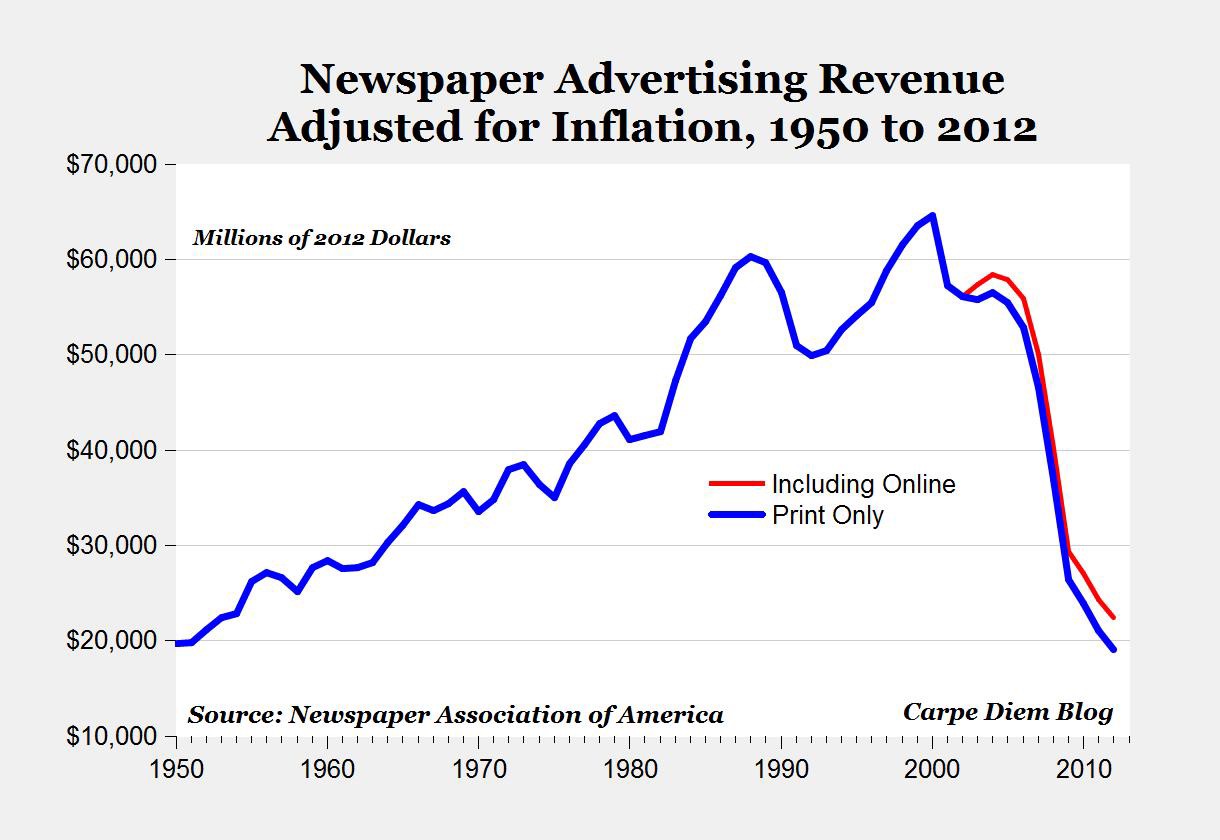
Newspaper Ad Dollars

Clay Shirky predicts that it will hit soon:

As Dick Tofel of ProPublica often points out, newspaper revenue has been shrinking since 2006, but the American economy has been growing since 2009. Between 1970 and now, the US has averaged only six years between recessions; the current period of growth crossed the six year mark this spring. We are statistically much closer to the next recession than to the last one, and in a recession, ad dollars are the first to go. Many papers will go bankrupt the way Hemingway’s Mike Campbell did: Gradually, and then suddenly.

The death of newspapers is sad, but the threatened loss of journalistic talent is catastrophic. If that’s you, it’s time to learn something outside the production routine of your current job. It will be difficult and annoying, your employer won’t be much help, and it may not even work, but we’re nearing the next great contraction. If you want to get through it, doing almost anything will be better than doing almost nothing.

(Chart from Mark Perry.)

It’s 2003 Again

by Jonah Shepp

What else can one possibly take away from this Noah Rothman exegesis of Peggy Noonan’s and Charles Krauthammer’s cases for expanding the new Iraq war to Syria? Here’s the crux of the argument:

The mission Krauthammer describes does not appear to require a significant American ground force, though it would be one which would only be effective in Iraq. The Islamic State’s stronghold in Syria will require an entirely different strategy, one far more robust and which may require putting American service personnel in harm’s way. But rolling back the Islamic State in Iraq is an acceptable short-term goal, and the American people should be informed that this is the mission in which their military is presently engaged. Those opposed to going to war to rid the world of ISIS worry that achieving that objective will require more commitment than most are willing to admit. And it is possible that the American national interests at stake in this region, while appreciable, are not threatened to the degree that would merit a return of tens of thousands of American troops to Iraq. At least, not yet.

These are worthwhile debates to have, and Americans need to have an honest discussion about this threat. It is a discussion that must be led by their president. It seems, however, that some conservatives are beginning to observe that those who object to a military solution to the Islamic State threat rest their argument on the claim that it heralds a new occupation of Iraq. This is a straw man argument. The vast majority of Americans of every political stripe do not want to reoccupy that country, and this is not on the table. Destroying ISIS, however, is.

Right, because we all remember what happened the last time right-wing hawks sold the American public on a war that they alleged would have no long-term consequences. After the past decade, I suppose I shouldn’t be all that surprised that the cheerleaders for this new war are demanding that their opponents make a probative case against intervention, while the neo-neocons’ contention that a light-touch war with no “significant” ground force is presented as obviously true. (By the by, how many soldiers constitute “significant”? 1,000? 10,000? 100,000? No one wants to say…) For more of the same, see Elliott Abrams here. Brian Fishman wishes advocates of an all-out, two-front war on ISIS would stop bullshitting the public already about what that would entail:

No one has offered a plausible strategy to defeat ISIL that does not include a major U.S. commitment on the ground and the renewal of functional governance on both sides of the Iraqi-Syrian border. And no one will, because none exists.

But that has not prevented a slew of hacks and wonks from suggesting grandiose policy goals without paying serious attention to the costs of implementation and the fragility of the U.S. political consensus for achieving those goals. Although ISIL has some characteristics of a state now, it still has the resilience of an ideologically motivated terrorist organization that will survive and perhaps even thrive in the face of setbacks. We must never again make the mistake that we made in 2008, which was to assume that we have destroyed a jihadist organization because we have pushed it out of former safe-havens and inhibited its ability to hold territory. Bombing ISIL will not destroy it. Giving the Kurds sniper rifles or artillery will not destroy it. A new prime minister in Iraq will not destroy it.

Please do not step in here with the fly-paper argument: that the conflict will attract the world’s would-be jihadis to one geographic area where we can target them all and thereby solve the problem. Notice that no authorities on jihadism ever make this argument. That is because they understand that war makes the jihadist movement stronger, even in the face of major tactical and operational defeats.

There is a case to be made for this war. It is not the case that its backers are making. They still seem to inhabit the same alternate universe as Donald Rumsfeld, in which the only limit to what American power can accomplish is the imagination of the Commander-in-Chief. I may not support all of Obama’s foreign policy choices, but I find it reassuring that he is nowhere near as prone as his predecessor was to flights of imperial fancy. As Fishman rightly points out, one cannot make the argument that the withdrawal of US forces from Iraq precipitated the current crisis without also acknowledging that the 2003 invasion set the ball rolling. The honest case for more intervention now, it seems to me, is that Bush’s Iraq adventure obligated the US to accept responsibility for maintaining the new Iraqi order we created and protecting the people of the Middle East from the jihadist menace our war unleashed.

But the usual suspects can’t make that argument, because to do so, they’d have to admit that they were wrong in the first place.

Inequality Is Only Growing Worse

by Dish Staff

Net Worth

Drum flags new numbers that put that fact in stark relief:

[N]ew census data shows that when it comes to net worth—which is basically total wealth—the biggest change has been at the bottom. Even after taking some lumps immediately after the recession, the well-off had recovered and even made some gains by 2011. But the poor have been devastated. Their median net worth has always been pretty close to zero, but by 2011 it had plummeted to $-6,029. On average, poor families were in the hole to the tune of $6,000, an astronomical and completely debilitating number to someone with barely poverty-level earnings.

Badger’s analysis:

The Census data suggest that the wealth gap in America has widened over the past decade, regardless of how you slice it. The gap between the bottom and top quintiles in America has widened, as has the gap between blacks and whites, and between workers with only a high school degree and those with much more. This implies that the returns to higher education in America are growing (in 2000, households headed by someone with a bachelor’s degree were worth 2.4 times as much as those with only a high school diploma; by 2011 the ratio was 3.4). And racial inequality in wealth is growing, too (in 2000, white households had a net worth 10.6 times larger than blacks; by 2011 it was 17.5).

Danielle Kurtzleben observes that the report “also found that the median net worth of the top 20 percent divided by the median of the second 20 percent was 39.8 in 2000. Today, it’s 86.8.”