Steven Chapman admits that “rates of violent crime are far higher among blacks than among whites” but he wants more attention to that fact that “these rates have dropped sharply over the past two decades”:
There’s another, bigger problem with the preoccupation with “black-on-black crime.” The term suggests race is the only important factor. Most crimes are committed by males, but we don’t refer to “male-on-male crime.” Whites in the South are substantially more prone to homicide than those in New England, but no one laments “Southerner-on-Southerner crime.” Why does crime involving people of African descent deserve its own special category?
The phrase stems from a desire to excuse whites from any role in changing the conditions that breed disorder and delinquency in poor black areas. It carries the message that blacks are to blame for the crime that afflicts them—and that only they can eliminate it. Whites are spared any responsibility in the cause or the cure.
Yglesias applies the language usually reserved for black-on-black violence to white-on-white violence:
[T]he disturbing truth, according to the FBI’s most recent homicide statistics, is that the United States is in the wake of an epidemic of white-on-white crime. Back in 2011, the most recent year for which data is available, a staggering 83 percent of white murder victims were killed by fellow Caucasians.
So it won’t surprise anybody to learn that I really, really don’t like Buzzfeed.
Sometimes, when I consider the Buzzfeed phenomenon, I think I’m living in some sort of fictional satirical world where Buzzfeed is a symbol of how far media can fall. It’s like living in a Douglas Copeland novel. Buzzfeed’s particular brand of lowest common denominator clickbait, their “14 Giraffes Who Totally Look Like Steve Buscemi,” their “25 Things Only People from [Insert Geographical Area Here] Understand,” their “Which of Fat Cat’s Minions from Chip’n’Dale’s Rescue Rangers Are You?” quizzes, their corpsefucking glurge, sitting side-by-side with their “branded content” like “12 Most Crunchtastic TV Moments Brought to You by Frito Lay,” subsidizing imperial stenographer Rosie Gray’s smears of Max Blumenthal (an actual journalist), powered by an aggregation model that comes pretty close to plagiarism even when it doesn’t devolve into the serial copy-and-pasting of Benny Johnson (thanks BlippoBoppo and CrushingBort), in an environment where they can memory hole 4,000 posts and think they don’t have to say anything in particular about it publicly, all lorded over by dumb-faced Ben Smith’s dumb face…. It’s bleak, man. I mean, I can see somebody getting a job offer from Buzzfeed and trying to rationalize it, telling themselves, “well, they’re not so bad….” Yes, they are. They are exactly that bad.
The thing is, I don’t know if there’s some more ethical path writers these days can walk and still end up being able to support themselves. It’s looking pretty grim out there for our professional online writers.
I’m someone who writes a lot of what I guess you would call media criticism. And that means that I’m frequently in the position of saying some not-very-nice things about people who write professionally online. But I criticize because I think that job is important; I happen to have some old-fashioned, corny ideas about the role that journalism and political commentary have to play in a democracy such as ours. We need professional writers– not just dedicated amateurs– to observe and comment on our society and our government, in order to ensure that both are functioning the way that they should, and to give our people information they need to make rational political choices. The problem is that the basic economics of that work have become so threatened that I don’t know what independent writers are supposed to do. I hate when talented people join up with outfits like Buzzfeed, which I think are genuinely making our country a stupider place. But I don’t see any clear path that people can take to preserve both their integrity and their ability to eat.
I could, if I was feeling masochistic, run down some of the publications that have recently shuttered or dramatically restructured in a way that has trimmed a lot of talented writers from their payrolls. Sports On Earth, for example, was a bright spot in the shouty, gimmicky world of online sports coverage, a place that provided steady work to talented writers like Tomas Rios and Jeb Lund, and which was willing to take a chance on genuinely unique work in a media world growing ever-more homogenous. Or look at the uncertain fate of The American Prospect, for decades an incubator of young liberal writing talent. TAP has prestige and it has a legacy, but you can’t pay the bills with either of those. NSFWCorp was always controversial, but everyone has to recognize that it was a bold attempt at producing real journalism with a new and unique funding model. But that model fell through. For awhile, there was a lot of hype about how hyper-local reporting would be the next wave in web publishing, but AOL’s massive Patch effort crashed and burned. Well, Patch is now a “new, nimble company,” and profitable– thanks in large measure to laying off 85% of its news staff. Even that mild success stems from putting a lot of people out of work.
There are way too many great writers– people like Lund and the brilliant and provocative Yasmin Nair and others– who don’t have a steady, secure gig that can keep them doing what they do best.
The basic economics of all of this are truly discouraging. Many people who are able to scratch out a living as professional writers have to do so with content mill writing, churning out four or five or six or more posts a day, sometimes for as little as $15 a post. Many have their pay tied to performance incentives, based on clicks, essentially mandating that people play the clickbait game if they want to pay the rent. The importance of Search Engine Optimization may be fading but the days of Please Facebook Favor My Post in Your Algorithm are in full bloom, and if anything that master is even less knowable than Google ever was. Freelancers might get $500 or $1000 for a strong, researched, reported story. That might sound like a lot, but when you’ve spot months conceiving, researching, reporting, and writing that piece, the math is dismal. Clearly, getting a job as an editor or staff writer at a deep-pocketed publication is best, and there’s no substitute for that kind of security. But I think people would be amazed at how little those positions sometimes pay, and they often require living in New York, DC, or Los Angeles, three ludicrously expensive places to live. I know people who work for well-known, national magazines, the kind of jobs thousands of young journos and writers want to work for, who still have to work on the side doing copy writing to make ends meet. And they’re the lucky ones.
There are some people who enjoy the blessing of working under a patronage model, where someone or some institution with deep pockets can afford to subsidize work that isn’t meant to pay for itself. But most writers simply have to chase clicks if they want to survive. What that means is that even the most independent writers tend to chase the same stories, writing post after post about Robin Williams or the ALS Ice Bucket Challenge, knowing that those stories can succeed because they have succeeded already. That makes online writing a brutally homogeneous affair. Choire Sicha– who I think has as much integrity as anybody, although I’m sure he’d roll his eyes at that– made the case recently, saying:
I do not read a lot of things anymore. A lot of us don’t, we sort of go where the tide takes us. I feel weird about that. I opened up my Digg reader the other day, because I was on blogging duty at work, and everything was so duplicative of each other. I was like, yeah, okay, there’s that piece of news filtering through all these different websites, all the same things… no wonder I don’t go to them. I need to make a new folder in my Digg reader, I guess, that’s “Things That Are Surprising and Interesting and Maybe Weird.” It’s sort of… it’s not… I don’t know, something’s wrong.
That is hardly an experience unique to him. I posted a photo of a cluster of Slate stories about Robin Williams to my Facebook, a half-dozen different angles from the same website about the same dead celebrity. But I could have done the same thing with any number of other websites.
You probably know the causes by now. Even if you don’t believe in the Peak Ad thesis, you’ve got the essential problem that with so many websites and the ever-growing number of ads on social media like Facebook and Twitter, all competing with the Google behemoth, you’ve got a nearly limitless supply of online advertising, inevitably pushing down the value of ads. Sites have responded by coming up with new and innovative ways to fool readers into thinking ads are legitimate stories. We laughed at the Atlantic Scientology fiasco, but they were just a little ahead of the curve. We’re starting to see more and more attempts at direct monetization, with paywalls and subscription services, which is great. I hope they succeed. But the idea that online content has to be free is so deeply baked into the culture that it’s going to take great effort to get people used to the idea of paying. I think that the widespread mockery of the New York Times Times Select experiment was a major failure by the industry to think long-term. Sure, it was a failed experiment, and there’s nothing wrong with saying so. But the deep mockery of the very idea of a paywall helped contribute to a precedent that is still alive today. I clicked on a Haaretz link yesterday and was deeply annoyed to find that it was paywalled. It took me a little bit to realize that, when I get angered by the idea of a newspaper asking me to pay for its content, I’m part of the problem.
The sad fact is that there may just be too many mouths to feed, right now, and not enough money to go around. But even so, I don’t know how you solve this problem on the supply side. People are either going to be willing to pay for what they read or they aren’t.
I don’t want to sound too pessimistic. There’s lots of great stuff getting written out there. And I’m hoping that a combination of various models and formats can sustain the industry moving forward. Paid, niche-audience newsletters like Michael Brendan Dougherty’s The Slurve, the patronage model of Pierre Omidyar and First Look Media, porous paywalls and gated content like at The New York Times, and hybrid models like this very website– these can all work alongside sites paid for by advertising. There are some great new independent publications out there, like Jacobin Magazine or Rachel Rosenfelt’s The New Inquiry, although I have no idea if they are self-sustaining or close to it. I’ve come to a point where I recognize that universal condemnations of clickbait content simply aren’t fair, if I want to continue to enjoy lots of free stuff to read online. The question becomes what the clickbait is subsidizing, and who, and what the percentages are. Under the steady leadership of Max Read, I think Gawker has done a good job with achieving that kind of balance, for one example, but it’s always going to be a negotiation, and a struggle. And while I admire what Andrew has built here, this is a model that simply can’t be replicated by most people. It’s a functioning, self-sustaining website, but it isn’t a model or a plan.
We’ll have to see where this all goes next. For myself, I am merely trying to be more understanding and less quick to judge, while remaining adamantly opposed to PR and advertising masked as journalism. I used to mock people who spent their lives writing the same “Top Ten Dumbest Things Said on Faux News This Week” piece over and over again, but I don’t anymore. I don’t bring my online life into my day-to-day life; I think a majority of my classmates and professors have no idea I write online. But I still get undergrads who seek me out on campus, who come to me looking for advice on how to break into online writing as a profession. I never know what to tell them. I have always written from the position of privilege of not needing to write to live. Sometimes I give them advice, sometimes I put them in touch with editors I’m friendly with. But for their basic questions about how to make it, I don’t really know how to respond. It’s a tough business, and an essential one, and I genuinely don’t know if it’s going to survive.
(And for Christ’s sakes, if you like a site, whitelist it on your AdBlock, OK?)
A Russian aid convoy bound for eastern Ukraine crossed the border today without the permission of the Ukrainian government, which is calling the act an “invasion”:
Russia’s Foreign Ministry said in a statement Friday morning that Moscow had run out of patience with “delays” and other “excuses” from Ukraine. It charged that Ukraine’s leaders were deliberately trying to slow-walk the delivery of aid to the war-torn region of Luhansk until “there is no one at all to provide help to.”
The decision to send in the aid without the consent of the Red Cross or Ukrainian authorities marked a dangerous new step in the four-month conflict. If Ukrainian forces fire on the trucks, they could trigger an all-out invasion by Russian forces that have accumulated by the tens of thousands across the border from eastern Ukraine. If they allow the trucks to disperse across the Luhansk region without any Ukrainian controls, Russia in effect will have imposed a cease-fire in the fight against pro-Russian separatists without Kiev’s permission.
That’s precisely what Ed Morrissey suspects the Kremlin is trying to do:
Russia tried a direct invasion last week in what appeared to be an attempt to start a shooting war. Although Russia later denied it, at first they confirmed the incursion, but didn’t follow up with military action when it came under Ukrainian fire. Prior to that, I warned that the aid convoy could be used to force the Ukrainian military into a unilateral cease-fire to prevent any Russian retaliation for convoy losses in potential firefights, and that seems to be at least one of the motives for running through the border now. Otherwise, why not wait for the inspections? …
Until the rebellion gets settled one way or the other, peace will not be forthcoming. The aid convoy only delays that resolution if Russia plans to use it as a barricade for the rebels, or as a beachhead for an occupation.
The Interpreterlive-blog passes along a report that most of the trucks had not been inspected by Ukrainian border guards:
“In total, 34 people and 34 vehicles were processed. The total weight was 268,020 kg. Vehicles were loaded to two thirds of their capacity. The average weight of one vehicle was 8,375 kg. 32 trucks carried food products (buckwheat, rice, sugar and water), 2 trucks carried medical supplies,” report border guards. … Andrei Lysenko, the spokesman for the Ukrainian National Defence and Security Council (SNBO), has told reporters at a briefing today that more than 90 trucks (note that only 34 passed customs clearance) have set off into Ukrainian territory today.
Jonathan Cohn reminds us that “this is how Democrats usually win on Medicare and Medicaid—by reminding voters of what they have to lose from proposed Republican attacks on the programs”:
This isn’t just some ad the Pryor campaign posted online, in order to gin up donations from liberals. Greg Sargent of the Washington Post reports that it’s airing across the state, at a cost that runs into hundreds of thousands of dollars. And while one ad does not a political trend make, you don’t have to squint to see signs that the politics of Obamacare are shifting. Bloomberg News just did a study of Republican television ads and discovered that mentions of Obamacare are way down from where they were a few months ago. Meanwhile, as Sargent has pointed out several times, Republican Senators and Senate candidates are struggling to explain their opposition to the law, even in conservative states.
First, he hones in on the most popular aspect of the Affordable Care Act: coverage for those with preexisting conditions, which has support across the aisle.
“We all agree that nobody should be denied coverage due to a pre-existing condition,” David Ray, a Cotton campaign spokesman, told TIME in an emailed statement.
Second, Pryor’s ad doesn’t use the term “Obamacare,” the Affordable Care Act’s nickname first coined by its critics. AKaiser Health Tracking poll released August 1 found that a little over half of the public—53%—have an unfavorable view of Obamacare. But when referred to by a different name, the law’s negative ratings can decrease, polls show.
Republicans are attacking Pryor for not mentioning Obamacare by name. Buetler scores that fight:
Republicans working to defeat Pryor … criticize Pryor for eschewing the label, because the label’s just about the only thing they’re comfortable assailing. In this way, they resemble Democrats six and eight years ago, running against the Bush tax cuts (for the rich), knowing that they had no intention of letting anything but the most regressive of those tax cuts expire.
In that sense, the GOP’s obsession with the moniker, and only the moniker, is excellent news for Obamacare’s political durability.
Pakistan may be on the brink of a political crisis after opposition leader Imran Khan suspended talks with the government in response to the appointment of a new police chief in Islamabad:
Khan, a famed cricketer-turned-politician, and fiery cleric Tahir-ul-Qadri have led massive protests from the eastern city of Lahore to the gates of parliament in Islamabad to demand the resignation of Prime Minister Nawaz Sharif, accusing him of rigging the vote that brought him to power last year. The protests have raised fears of unrest in the nuclear-armed US ally with a history of political turmoil, and after a request from the country’s powerful military the government convened talks with Khan and Qadri’s representatives early Thursday. Shah Mahmood Qureshi, a senior leader of Khan’s party, told reporters that the opposition presented six demands, including Sharif’s resignation. …
Later on Thursday, Khan told his supporters that the government had removed the Islamabad police chief for not using force against him, and warned that the new police chief, Khalid Khattak, would follow orders to disperse the protests, which have thus far been peaceful.
The army’s growing role in containing this crisis makes Michael Kugelman very nervous:
With Islamabad increasingly on the defensive, the military is gaining an upper hand. Consider Sharif’s decision last week to make the armed forces responsible for security of sensitive facilities in Islamabad during the protests. This can be interpreted either as a sop to the military or as an acknowledgment that the government can’t protect its own people — or itself. Additionally, Sharif’s Independence Day speech on Aug. 14, the first official day of the protests, was rife with praise for Pakistan’s military. That such praise came from a civilian leader as combative as Sharif is quite telling. Most significantly, on Aug. 19, as marchers entered the Red Zone, the government ceded full security of the area to the military. The government gave the military carte blanche to do what it so relishes: serve as the nation’s protector and savior.
Furthermore, with many Pakistanis cheering on a countermilitancy offensive underway in North Waziristan, the military’s star could continue to rise in the coming weeks. Possible retaliatory terrorist attacks in Pakistani cities could prompt more calls for the military to provide security, which would further embolden Pakistan’s most powerful institution.
Videos of masked militants beheading captive Westerners were a common feature of jihadist propaganda in the early years of the last decade, but such videos had scarcely been seen in a decade when the video of James Foley’s murder came to light this week. Katie Zavadski explains why:
According to University of Massachusetts, Lowell, professor Mia Bloom, the videos faded because they were frowned upon by higher-ups in organizations like Al Qaeda. Although Abu Musab al-Zarqawi, a high-ranking Al Qaeda in Iraq operative, was said to have personally executed Americans Nicholas Berg and Eugene Armstrong, Bloom says superiors, including Osama bin Laden and Ayman al-Zawahiri, looked down on the practice. “AQI got into a lot of trouble for those public beheadings,” she says, because they did more to alienate potential supporters than to recruit them.
“What’s interesting is that you saw a drop-off of these videos because they provoked somewhat of a backlash,” agrees SUNY Albany professor Victor Asal. While everyone knew these groups were doing horrible things, including beheadings, there was something particularly distasteful about videotaping their executions. By returning to these videos, ISIS is saying, “We will do what we want, how we want,” Asal says. “Be very, very scared of us.”
Adam Taylor explores ISIS’s macabre devotion to this particularly bloody method of murder:
The Islamic State may justify its beheadings with theology and history, but the use of the tactic is probably driven by more immediate factors. “I don’t think there’s anything inherently Islamist to these beheadings,” Max Abrahms, a Northeastern professor who studies jihadist groups, told The Post. “It’s important to recognize where Islamic State is coming from historically, in order to understand why it is beheading people — and why it’s using social media to broadcast it.”
In particular, Abrahms argues, the Islamic State may be seeking to differentiate itself from al-Qaeda in Iraq, a group he notes was “widely seen, even among jihadists, as a failure.” With high-profile beheadings, the Islamic State could be attempting to link itself to Khalid Sheik Mohammed, a Guantanamo Bay detainee and alleged Sept. 11 mastermind who is now thought to have killed Pearl.
Drawing on techniques from social network analysis, PRRI’s 2013 American Values Survey asked respondents to identify as many as seven people with whom they had discussed important matters in the six months prior to the survey. The results reveal just how segregated white social circles are.
Overall, the social networks of whites are a remarkable 93 percent white. White American social networks are only one percent black, one percent Hispanic, one percent Asian or Pacific Islander, one percent mixed race, and one percent other race. In fact, fully three-quarters (75 percent) of whites have entirely white social networks without any minority presence. This level of social-network racial homogeneity among whites is significantly higher than among black Americans (65 percent) or Hispanic Americans (46 percent).
This video of police shooting and killing Kajieme Powell has been making the rounds. Conor Friedersdorf can’t help but wonder whether deadly force was necessary:
A police officer might retort that law enforcement shouldn’t be obligated to take on any extra risk to their own lives in a dangerous situation wholly and needlessly created by a person menacing them. A citizen deliberately baiting police with a deadly weapon cannot expect restraint. Even a small knife can be deadly.
In the abstract, I can’t disagree with those principles—and if questionable police killings were confined to such circumstances, there’d be less cause than now to complain about overzealous law enforcement. Yet watching this video, it seems certain in hindsight that the threat could’ve been stopped with force short of at least nine and as many as 12 gunshots; and again, if they’d kept more initial distance between themselves and a man they knew to have a knife before they even arrived, perhaps no deadly threat would’ve materialized. If they’d stood well back and engaged, perhaps Powell would’ve kept coming with a knife until stopped.
But Beutler expects that you “won’t find many police who’ll say that what the police did to Kajieme Powell is a great or unjustifiable departure” from normal police protocol:
And if that’s a shock to you, then you’re a newcomer to a very basic argument: That if this is proper protocol, then the protocol is bad.
Powell had a knife — Police Chief Sam Dotson described it as a steak knife. But he was not wielding it in the way officers claimed (or in the way it may have felt to them in the moment). He was not two or three feet away, but perhaps eight or nine. He wasn’t charging hard or issuing threats. To the contrary, he was demanding to be shot.
But that doesn’t mean the police needed to oblige him. It’s hard to watch the video and not conclude that there should’ve been some safe way to preserve his life.
A reader agrees that there was another option:
With the growing examination of how the St. Louis police behaved in shooting Powell after he was wielding a knife, I thought that this video from a 2011 incident in London involving a man trying to attack the police with a machete could illuminate how this situation could have been handled differently.
Instead of calling in armed police and opening fire on a troubled man, the Metropolitan Police consistently retreated – or approached him from behind a wheelie bin – before eventually seizing their chance and disarming and arresting the man.
Along the same lines, Ambinder wants to train officers “to account for differences in the type of threat posed, and even differences in the aim points”:
Not a liberal complaint here: Cities themselves are asking the Justice Department to review use of force training. The shoot-to-kill and shoot-when-threatened-at-all training has resulted in a number of innocent people’s being killed. Mentally ill people have it worse.
There are ways to resolve violent conflicts without killing people. Figuring out how to more rapidly defuse dangerous scenarios and training officers to distinguish between scenarios are not easy, but they seem worth trying, no?
[L]ooking at it cold, it’s clear that the cops badly overreacted. But trying to think through it dispassionately, it’s a lot murkier than it seems. Is it really fair to expect cops to do a mental health exam of a man with a knife stalking around the street with people all around him, acting bizarrely, and refusing orders to drop the knife? I don’t know. If the cops had a taser, would they have had time to deliberate and get it out to use it, given how close the man was, and how irrationally he was behaving? I don’t know that either.
Allahpundit is sympathetic to the cops’ predicament:
The objections to what the cops did have less to do with legal culpability than with ways they might have avoided killing Powell. What about a taser? The problem there, said the police chief, is that Powell was wearing a sweatshirt. True, it was open at the chest, but that’s a small target to aim at. If they had hit him with the stun gun while he was advancing and the probes ended up embedded in his clothes rather than his skin, he might have kept coming with no time for the cop with the taser to reach for his gun. Okay, but there were two cops there; if the taser didn’t drop him instantly, the other officer had his gun already trained on Powell and could have taken him down. (If neither cop had a taser handy, why didn’t he?) …
My weak, easy hope when faced with a moral quandary like this is that technology will help solve it. Tasers will be refined, they’ll become cheaper and more reliable, and more cops will have them as a means to stop a violent perp without killing him. Of course, that’ll end up posing a different problem, as some irresponsible cops end up overusing the new technology. Better that than overusing a gun, though.
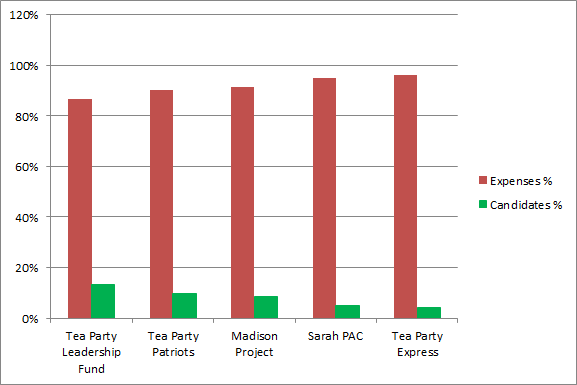
The problem is evidence indicates some Tea Party groups care far less about your ideals and far more about your money—taking it and making it their own. They’re an ideological Ponzi scheme; they use donations to generate more donations, by creating sensationalistic ad campaigns to persuade donors they’re getting value, and to scare or guilt them, and new donors, into sending more donations.
Christian Jarrett looks at research that finds “the stability of personality increases through youth, peaks in mid-life and then gradually reduces again into old age”:
The questionnaires measured the Big Five traits (extraversion, agreeableness, conscientiousness, neuroticism, and openness to experience) and also an honesty-humility factor. The researchers then looked to see how the “rank-order stability” of people’s traits (how their scores ranked compared to other people’s) varied across that two-year gap, and how this stability varied as a function of age.
The participants’ personalities showed “impressive” stability, as you’d expect since personality is meant to be a description of people’s pervasive traits. Extraversion was the most stable trait, and agreeableness the least. However, the key finding was that personality stability varied through the lifespan, increasing from the 20s to the 40s and 50s, and then declining towards old age, up to age 80. This broad pattern was found for all traits, except for agreeableness, which showed gradually reduced stability through life. For conscientiousness, openness to experience, and honesty-humility, trait instability had returned at the oldest age to the levels seen at the youngest age.
For the five traits that showed an inverted U-shape pattern of changing stability through life, [researchers Peter] Milojev and [Chris] Sibley found that the specific point of peak stability varied – extraversion and neuroticism showed highest stability in the late 30s, while the other traits (openness, honesty-humility, and conscientiousness) showed peak stability in the late 40s, early 50s.

 The Dish