To Russia Without Love

by Dish Staff

russia_favorability_rating_2014.0

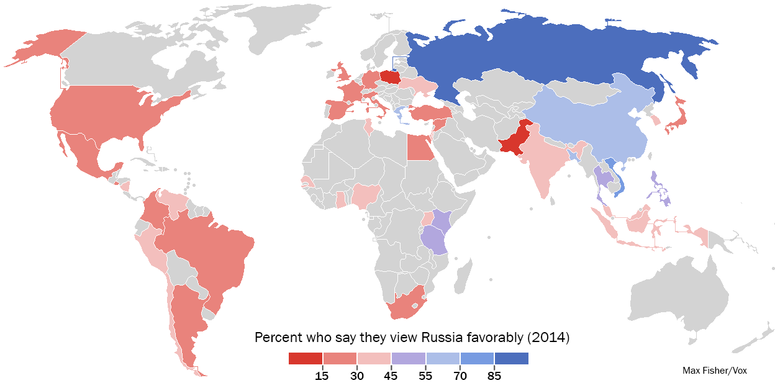
Max Fisher highlights a Pew study (pdf) released last month that documents attitudes toward Russia in countries around the world. As you can see from the map, the erstwhile superpower is not very well liked at the moment:

Russia is most unpopular in Poland, which, as a long-suffering Soviet puppet state, is exceptionally alarmed about Russia’s recent invasion of Crimea and its sponsorship of separatist rebels in eastern Ukraine. In Poland, only 12 percent say they have a favorable view of Russia, with 81 percent holding an unfavorable view. The rates are not much higher in the rest of Europe, which is part of why European leaders are becoming much more willing to impose tough sanctions on Russia, even at some cost to European economies.

But Russia is also deeply unpopular in the Middle East.

This is most true in Turkey, where only 16 percent hold a favorable view of the country, with 73 percent holding an unfavorable view. This may be a result of Russia’s sponsorship of Syrian leader Bashar al-Assad, who has been able to get away with slaughtering thousands of civilians in that country’s civil war in part because Moscow shields him from international action.

Jan Cienski zooms in on how Eastern European countries, most of which are notably absent from the Pew report, are responding to Putin’s aggression in Ukraine—or not responding, as it were:

Despite their common experience of spending a half-century under Moscow’s heel as part of the Soviet bloc, it has proven impossible for Poland to forge a regional alliance against Russia. Some countries are awake to the danger of Russian tanks and green-uniformed troops appearing on their own borders; others are still keen to cut commercial deals that require being in the country’s good graces.

“The Hungarians are still conducting a policy of rapprochement with Russia. The Czechs don’t care what is happening in Eastern Europe. The Bulgarians first joyfully accept, then doubt, then again accept [Russian proposals for the South Stream, a new natural gas pipeline running through Bulgaria to Southern Europe],” said Roman Kuzniar, national security advisor to Polish President Bronislaw Komorowski, in a recent radio interview. “The Baltic countries also do not have a common front. That shows how easily we are divided, even among countries which have a heightened geopolitical awareness.”

Europe’s Policing Lessons For America

by Dish Staff

Michael Bond criticizes American crowd-control techniques:

One of the most worrying aspects of this drama is what it reveals about US crowd-control methods. In Europe, many police forces have started to accept that the traditional model of public-order policing, which treats all crowds as potentially dangerous, often makes things worse. This model dates back to the French Revolution, which seeded the idea that crowds turn people into primitive, dysfunctional automata, and that the only way to deal with protestors is to attack, disperse or “kettle” them – a draconian form of containment.

Such tactics are slowly being abandoned in Europe because social psychologists have demonstrated time and again that they can have a dramatic and often catastrophic effect on how people in crowds behave. They have found that the way a protest is marshalled has a greater influence on whether it ends peacefully or violently than the actions of any hooligan minority within the crowd. This puts the police in a powerful position, even before they take aim with rubber bullets or tear gas.

He argues that Europe has this figured out. Matt Steinglass finds that Europe is transfixed by the events in Ferguson. One reason why:

The confrontation in Ferguson, as many observers have noticed, looks uncannily like the ones in Ukraine, Gaza and Iraq. There is clearly some kind of a global blowback going on, in which military techniques of forcible population control developed for use at the periphery of states’ areas of sovereignty are now being applied at the centre. Leonid Bershidsky, a brilliant Russian journalist and editor, laid out the similarities in a fascinating column yesterday in Bloomberg View. “Police officers around the world are becoming convinced they are fighting a war on something or other, whether that’s drugs, terrorism, anarchists or political subversion,” Mr Bershidsky writes. “This mindset contrasts with the public’s unchanged perception of what the police should be doing, which is to keep the streets safe, a conceptual clash that can lead to unexpected results.”

The difference between these two kinds of policing, Mr Bershidsky writes, can be modeled as the division between the London Metropolitan Police Force established in 1829, which conceived itself as fighting crime in concert with the populace, and the repressive colonial police forces the British Empire employed in “colonies of rule” such as Ireland and India, who conceived of themselves as keeping potentially hostile local populations in line.

Final Thoughts on Israel and Palestine

by Freddie deBoer

Activists Hold Palestinian Solidarity March And Rally

I want to put my discussion of Israel to bed for the week, as some emailers are complaining that I’m “fixated” on the issue. I’m writing about Israel and Palestine a lot in part because I’m getting the most emails on that question.

Many people who have written wonder, with various degrees of indignation, why I don’t perform the typical preemptive apologetics that so often come with criticism of Israel. Why don’t I take time to balance my complaints about Israel by mentioning all the bad things about Hamas? Where are my explicit denunciations of anti-Semitism? Why don’t I come out and say whether Israel should be wiped off the map? I don’t do these things for two reasons. One, because I think it’s in the best interest of everyone– including those committed to the defense of Israel’s government and policies– to return normalcy to this debate. On what other issue am I expected to explicitly disclaim attitudes that I don’t believe and haven’t mentioned? No, it’s true: I’m not anti-Semitic, I don’t think Jews secretly run the world, I don’t believe in Islamic governance either, and I don’t want Israel “wiped from the map.” But when did I suggest such a thing? Acting as if this issue has to be treated with kid gloves in a way that is wholly unique in American politics does no favors to either side of this debate. I have been counseled many times in my life to avoid this specific issue because of the potential professional consequences. I appreciate that people are talking out of a desire to help, and situations like that of Steven Salaita and Norman Finkelstein demonstrate the sense in this advice. But to not engage out of fear of the  consequences exacerbates the problem, and incidentally plays into the hands of anti-Semitic tropes. My country spends billions of dollars and an enormous amount of diplomatic capital on Israel, that makes Israel my business, so let’s hash it out. We are adults. We are capable of arguing as adults. So let’s just argue the way we usually do.

I also don’t seek balance because I don’t pretend that there is equality of blame in this issue. Many smart, decent people I know treat this issue with a “plague on both houses” attitude, talking about a “cycle of violence,” or “ancient grudges.” They speak as though this issue is so polarized and so complex that we can’t make meaningful judgments. I find that, frankly, bullshit. I’m not usually a big fan of Max Fisher’s work, but he had this perfectly right: the occupation is wrong, it is the problem, and Israel is to blame. Israel has been illegally and immorally occupying the Palestinian territories for almost 50 years. And Israel has the ability to end it. The Israeli government could unilaterally withdraw from the territories and leave the Palestinians to build their own state, or they could fully incorporate Palestinians into a  new unified Israeli-Palestinian state that recognized total and  complete political and social equality between all people. If you find those ideas radical, consider that they are merely what basic liberal democracy requires. I am completely agnostic on the notion of one state or two, but I know that what our most basic political ideals require is a world where we have achieved perfect political equality between Arabs and Jews. Israel is capable of creating such a world. Palestinians are not.

For those who fear Israel’s annihilation, I would say that while your fear is understandable, given the facts, it is not rational. No one disputes that Israel’s military capacity is incredible for such a small nation, and that’s true even setting aside its secret nuclear arsenal. The Western world is totally committed to the defense of the modern Israeli state. The United States would go to war to defend Israel’s right to exist. NATO is committed to Israel and the UN, for all its criticisms of Israel, would support an American defense of Israel. We’re talking about a commitment to defend Israel with nearly limitless military power. Do the Palestinians enjoy any such equivalent protection? Yes, you are entitled to consider the sweep of history when you think about Israel’s future, but you are also required to consider facts. And the facts tell us that the people who should truly fear annihilation are the Palestinians. They are the ones who are existentially threatened. They are a nation of refugees. They are a people without a state. To insist on this reality isn’t extremism. It’s just taking an honest look at the world around you.

What American defenders of Israel must recognize is that it is Israel’s diplomatic isolation that threatens it in the long term, not Hamas’s rockets. And the occupation will always isolate Israel, because the occupation is wrong. Some emailers have suggested that anti-Semitism is behind all of Israel’s international critics. To which I say, really? Criticism of Israel from South America is all anti-Semitism? From Western Europe? From sub-Saharan Africa? Did tens of thousands of South Africans march in protest of Israel’s assault on Gaza because of  anti-Semitism? America’s protection is powerful, but it is not limitless, and its hegemony is slowly crumbling. In the next century, Israel must secure its future not through the blessing of a superpower but by earning the reputation of a moral nation. That cannot occur while Palestine is occupied.

And more than securing Israel’s security, ending the occupation is a matter of securing Israel’s soul. What strikes me most about interacting with Americans on this issue, even political and informed Americans, is how many don’t fully comprehend the rise in ultra-conservatism and ethno-nationalism in Israel. People don’t want to think of Israel as that kind of country, and so they shut their ears to it. Yet the evidence grows every day; Netanyahu’s cabinet is virulently extreme, the fringe right-wing parties grow more powerful, the racism and bigotry of the street protests more and more explicit and unafraid. Look, just today, we learn that the Israeli government is targeting the family of Mohammed Abu Khder, the 16 year old Palestinian who was burned to death by Israeli terrorists. This is the type of ugliness, of nastiness, that is seeping into the firmament of Israeli society. This is what journalists like Gideon Levy and Max Blumenthal have been investigating in their work, and this is why they are considered so dangerous: because they threaten to expose to progressive people the reality of the growing reactionary nature of Israel’s internal politics.

50 years from now, and 100, there will still be Jews and there will still be Palestinians in this region. The question is, what form will their relationship take? Will an independent Palestine have been given complete self-determination and diplomatic recognition, a two state solution? Will it be a unified state that recognizes the complete equality of all of its citizens, regardless of their ethnicity or religion, a one state solution? Or will Israel continue to be an apartheid state, brutalizing a stateless people? The latter is the possibility that most threatens Israel’s future, make no mistake. And so the question is what future we, as a nation that subsidizes the occupation in every way imaginable, are willing to argue for, and how long we are willing to ignore what’s staring us in the face.

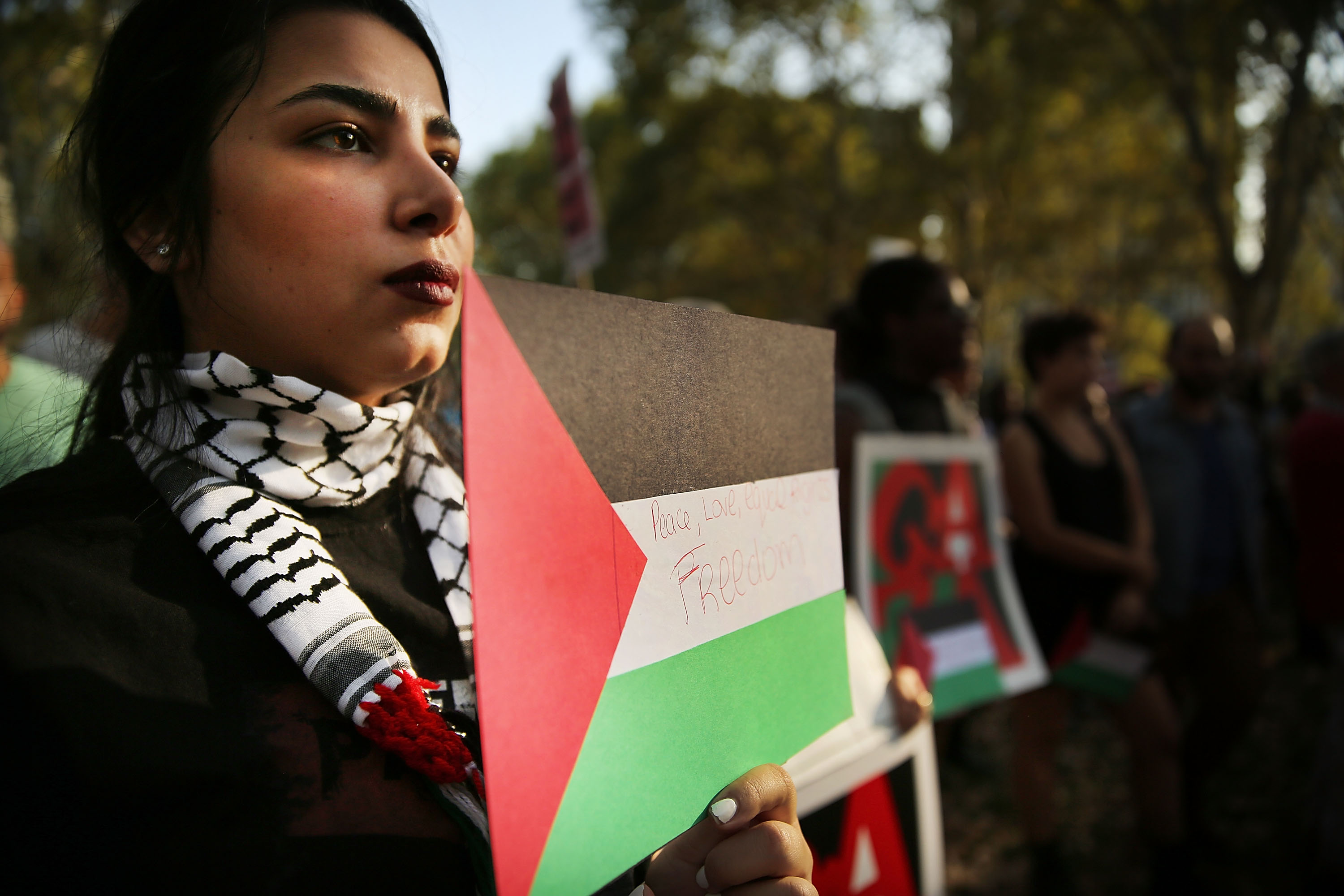
(Photo: A demonstrator prepares to march across the Brooklyn Bridge to protest against Israel’s continued military campaign in Gaza on August 20, 2014 in New York City. By Spencer Platt/Getty Images)
Foley’s British Executioner, Ctd

by Dish Staff

The ISIS jihadist who beheaded American journalist James Foley in a video released by the group on Tuesday has been identified:

As an international manhunt got under way on Wednesday, the English-speaking militant was identified to the Guardian by one of his former hostages as the ringleader of three British jihadists thought to be the main guards of foreign nationals in Raqqa, a stronghold of Islamic State (Isis) rebels. The militant who appeared on the Foley video, who called himself John and is believed to be from London, was said to be the main rebel negotiator during talks earlier this year to release 11 Islamic State hostages – who were eventually handed to Turkish officials after ransom demands were met.

The FBI, MI5 and Scotland Yard’s counter-terrorism command were all on Wednesday night racing to identify the militant who fronted the propaganda video that showed the brutal murder of Foley, the journalist who had been missing in Syria since 2012. Sources in Syria recognised the man as a point-man for hostage negotiations in Raqqa, where he is said to have held discussions with several families of jailed foreign nationals over the internet.

Josh Rogin and Eli Lake link Foley’s abduction and murder to a ring of foreign-born jihadists suspected in the kidnapping of other journalists in Syria. Several members of that ring were arrested and charged with false imprisonment shortly before Foley was kidnapped in November 2012:

The case fell apart because the two Western journalists who had been abducted in Syria in July 2012 and could identify the suspects did not appear to testify at the trial. One of them had testified against Shajul Islam at pretrial proceedings and said Islam was part of a cell of foreign-born extremists in Syria that included 10 to 15 U.K. citizens. Islam, through his lawyer, denied being involved in the abductions at the time.

One U.S. intelligence official told The Daily Beast that both U.S. and British counter-terrorism agencies have taken a keen interest in the suspected militants. “There is no official product on this yet for the intelligence community,” this official said. “But people who are out there and collecting on this believe the [Foley] abduction and the [Islam] trial are connected.”

The US had apparently tried to rescue Foley last month:

Details on the nature of the unsuccessful operation remained sparse late Wednesday. When American forces landed in eastern Syria — most likely in Raqqa province, where Foley is thought to have been held and killed — they came under heavy fire. The elite troops killed a number of militants, and one of the pilots involved in the operation sustained a minor injury when his aircraft came under fire, a senior administration official told Foreign Policy.

According to a defense official with knowledge of the situation, the operation occurred in early July. The same official added that the operation was based mostly on human intelligence — as opposed to satellite photographs and intercepted communications — and the military now believes the hostages had been moved from that location just days before the raid took place.

Obama denounced the killing in a press conference yesterday afternoon, calling ISIS a “cancer” but not committing to a particular course of action in response. After weighing the pros and cons of a retaliatory effort, Zack Beauchamp sees the president in a bind:

Obama’s Wednesday statement was two things: an emotional tribute to James Foley’s life, and a furious condemnation of ISIS and its goals. “Jim Foley’s life stands in stark contrast to his killers,” the president said. “[ISIS] has no ideology of any value to human beings. their ideology is bankrupt.”

What the presser wasn’t, however, was a policy address. Saying “the United States will continue to do what we must do to protect our people,” as Obama did, doesn’t say much about the choice between “hit them harder” and “don’t take the bait,” or any other clear US action or lack thereof. The American policy response is still just unclear. Regardless of what the US ends up doing, it should be clear that this isn’t an easy call for Obama. Sadly, it’s much harder to destroy ISIS than it is to condemn the atrocities they commit.

The Guardian weighs in on what Foley’s murder means in terms of the Anglo-American role in the fight against ISIS:

Bluntly put: if we target them, they will target us. The foreign secretary, Philip Hammond, was right to say on Wednesday that we – Americans and British in particular – have always been in their sights as one of the “far enemies” they reckon with. But fighter bombers over the Mosul dam, arms for the Kurds and help for the Baghdad government bring us more into the “near enemy” category, and that has consequences. Consequences in the region and, potentially, consequences at home in the United States and Europe.

We should not be alone in a contest with Isis. Regional powers should take on a greater role, perhaps even military, but certainly a more coherent diplomatic role. There should be a suspension of the rivalries which helped create the opportunity Isis seized.


The Other Shooting In St. Louis

Disturbing footage of Kajieme Powell’s death has emerged:

Lopez captions:

The newly released video begins before police arrive on the scene. A bystander has followed Powell after he took energy drinks and muffins from a market without paying for them, and can be heard chuckling over Powell’s erratic behavior. Powell is seen slowly pacing around the scene of the eventual shooting before police arrive. When the officers enter and draw their guns, Powell ignores warnings to put down his knife, and advances on them. He then repeatedly yells, “Shoot me!”

But Powell does not appear to be holding a knife high, and he looks to be walking normally — and to be further than two or three feet from the officers — when they open fire, killing him.

Ezra is deeply troubled by the video:

It is easy to criticize. It is easy to watch a cell phone video and think of all the ways it could have gone differently. It is easy to forget that the police saw a mentally unbalanced man with a knife advancing on them. It is easy to forget that 20 seconds only takes 20 seconds. It is easy to forget that police get scared. It is easy not to ask yourself what you might have done if you had a gun and a man came at you with a knife.

But there is still something wrong with that video. There is something wrong that the video seems obviously exculpatory to the police and obviously damning to so many who watch it. The dispute over the facts in the Michael Brown case offers the hope that there is a right answer — that Wilson either did clearly the right thing or clearly the wrong thing. The video of the Powell case delivers a harder reality: what the police believe to be the right thing and what the people they serve believe to be the right thing may be very different.

Excessive Restraint

by Dish Staff

Medical resident Ravi Parikh considers the cons of physically restraining patients:

In some situations, restraints may be ineffective and even harmful. Doctors and nurses often employ restraints when a patient is at risk for falling or delirious. However, evidence suggests that restraints do not reduce one’s risk of falling.  Likewise, a study in the Journal of the American Medical Association suggested that restraints increase the risk of delirium in the hospital by 4-fold, possibly by increasing patients’ levels of anxiety and stress due to involuntary immobilization.  Physical restraints and the resulting immobilization they cause are also associated with increased rates of pressure ulcersrespiratory complications—and even death via strangulation and aspiration. Even more disturbingly, a 2006 report by the U.S. Department of Health and Human Services concluded that hospitals failed to report more than 40 percent of deaths related to restraints to The Centers for Medicare and Medicaid Services (CMS).

Though these statistics may make the ICU seem like an asylum, it is not. The majority of patients I cared for in the ICU never required restraints. And for the others who were confused or agitated, our team could usually avoid restraints by adjusting or prescribing medication.

E.M. Forster’s Letters Of Rejection

by Dish Staff

The great gay, English novelist first went there to see a young Indian man, Syed Ross Masood, with whom he had fallen in love, prompting him to start writing A Passage to India – a novel it would take him nearly 11 years to complete. Why the delay? Damon Galgut speculates that he was hung up on the famous scene involving Adela Quested and Dr. Aziz in the Marabar caves, and that a second trip to India to see Masood, one in which Forster’s hopes for love were dashed and they abruptly parted way, gave him the material he needed to move beyond the writer’s block:

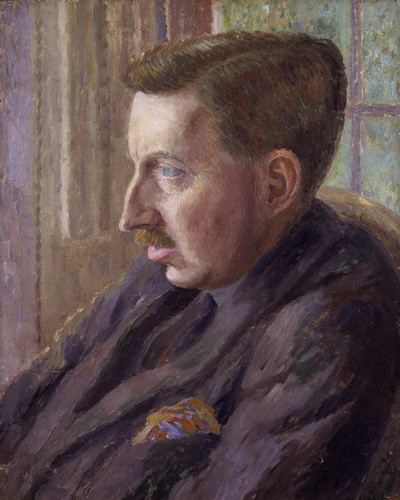
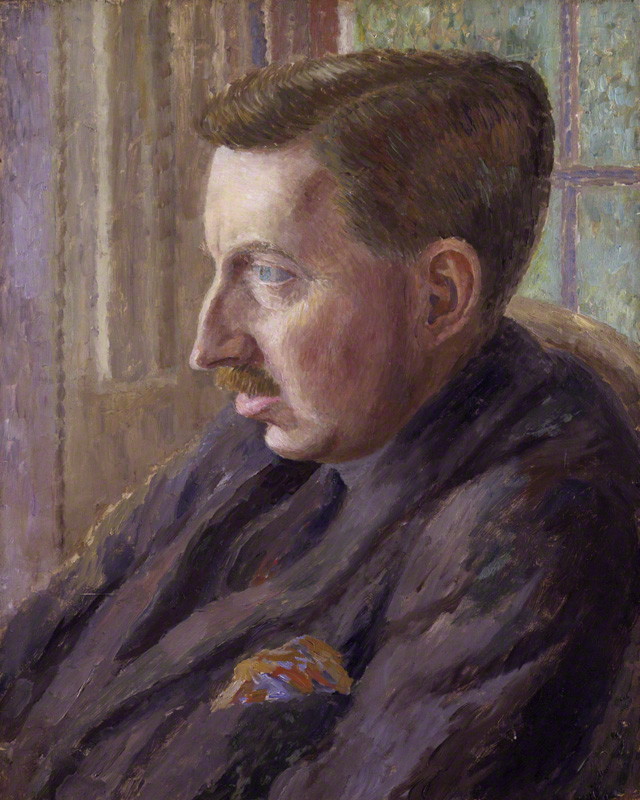
The impact of this parting goes almost entirely unremarked in his diaries and letters, and yet itNPG 4698,Edward Morgan Forster,by Dora Carrington must have been of huge importance to him. There are only faint but significant clues as to how he felt. In his diary on 27 January, the night before he leaves, he admits that he has had a “long and sad day”. Then we find this cryptic entry: “Aie-aie-aie – growing after tears. Mosquito net, fizzling lamp, high step between rooms. Then return and comfort a little.”

It seems that something happened between the two men that night. But what? He apparently never spoke about it to anybody else and the diary entry is frustratingly opaque. But it’s almost certain that this incident, whatever it was, involved Masood and some kind of rejection. Whether he tried to touch or kiss his friend, it’s clear that he made some sort of overture and was rebuffed. And the sparse, telegrammatic style of the words indicate – in his case – how deeply felt they were.

It was in this state of mind that he set off to the caves the next morning.

In fact, the visit had been organised by Masood, perhaps as some kind of consolation, though he didn’t get up to see his English friend off. In his journal Forster tersely notes: “Left at 6.30. After one glimpse the raw greyness.” His mood, one senses, was saturated with the feeling of loss – and he carried this feeling with him into the caves a few hours later.

Is it too fanciful to imagine that everything Forster must have been experiencing that day – a confusion of love, sadness, disappointment and possibly anger – was projected on to the caves, and took form in the imagined attack? It’s never explicitly stated in the novel, but it’s obvious that Miss Quested is attracted to Aziz. If the assault is a fantasy, it’s because her desires have no outlet – and the same could be said for Forster.

(A portrait of Forster by Dora Carrington, circa 1924-25, via Wikimedia Commons)

Policing The Police With Cameras, Ctd

A reader writes:

Your recent post about equipping police forces with video cameras struck a chord with me, as I recently sat on a jury where the lack of video played a central role. The case was not particularly exceptional, and the lesson obviously anecdotal, but it was a major eye-opener for me.

A young Hispanic male from a nearby town known for its drug trade was targeted and arrested by a drug task force, although no drug charges were presented. He was charged with two counts of assault with a deadly weapon (ramming the undercover cruiser behind him with his car), operating a motor vehicle to endanger (driving on the sidewalk to evade the ad hoc police blockade), leaving the scene of an accident, negligent operation (running stop signs) and failure to stop for police.

The very first question the defense lawyer asked was, “Where’s the video?” Of course there was none, and in the absence of actual evidence, video or otherwise, the six middle/upper-middle class white people that composed our jury took it on faith that four police officers would casually perjure themselves and voted not guilty on the assault and endangerment charges. At one point, one of the jury members asked “Why are there no witnesses?” I’m no friend of the police, but I felt I had to remind the group that technically the State presented four witnesses – the four police officers.

In the end, we voted to convict on the negligent operation and failure to stop charges, based on the defendant’s own account of the episode during his testimony. I couldn’t help but think that the police have a real, existential problem when the juror I expected to be most sympathetic to the police – the contractor who told the court he knew a few cops from the neighborhood – turned out to be the one most adamant that the officers’ testimony should be completely disregarded.

The day may be fast approaching when any officer who wants to be believed in court will welcome video evidence to back them up, and that will surely be a win for anyone interested in justice.

What Do-It-Yourself Funerals Can’t Offer

by Matthew Sitman

It’s an interesting question, how we’ll handle death and grief as religion’s place in our lives declines. I don’t mean that the old answers about what “happens” when we die will need to be reworked, exactly, because it seems clear that, no longer believing in the afterlife, most will just acknowledge that nothingness awaits us. There only will be the “sure extinction that we travel to,” as Larkin put it. But that still leaves the issue of how to mourn the dead, in the very practical sense of what to do when a loved one dies. Emma Green looks at Candi Cann’s recent book, Virtual Afterlives: Grieving the Dead in the Twenty-First Century, on how this post-religious dilemma is being handled:

For most of human history, religious ceremony has helped people deal with death, providing explanations about souls and the afterlife along with rituals to help the living deal with their grief. Not all religions do death the same way. “There are certain denominations within Christianity and certain religions in general that do a better job of remembering the dead,” said Cann. “Like the Catholics: There’s a very set calendar for remembering, and it’s still tied down to the religious calendar.”

Tattooing yourself with a dead person’s remains is one new way of memorializing death in the absence of faith, she said. “As society becomes more secular, and people are more and more turning to that ‘spiritual but not religious category,’ they’re forming their own do-it-yourself ways of remembering the dead.”

Green goes on to describe other trendy options, from personalized caskets to “theme” funerals to arranging the deceased in scenes taken from their actual lives. I find all this fascinating, and, especially if a family isn’t religious, don’t begrudge them personalizing the funeral in whatever way they’d like. I do, however, wonder how this changes the grieving process, and would like to say a good word for the old-fashioned religious rituals.


Perhaps the most attractive feature of the do-it-yourself remembrance of the dead is how it allows for a celebration of the deceased’s life, in all its idiosyncratic particularities. I certainly get that. But I also would argue that depersonalizing the grieving process, if that’s the right phrase for it, offers solace of a different sort. To fall back on the patterns of religious liturgy, to feel that it’s not up to you to conjure the right way to honor the dead, to turn to words and rituals handed down for centuries – all this can be powerfully comforting as well. It allows for a sense of participation in the ongoing human drama of life and death, of not being the first to experience the pain of loss. You aren’t grieving from scratch. There’s a relief to knowing your experience is not unique, a consolation from the solidarity doing what so many others have done before you, and will do after you are dead too. Green cites a funeral director who describes ritual as “mindless,” and not in a pejorative way, which is another way of saying that religious ritual allows you to get out of your own head in a way that can be a relief.

There’s also the beauty of certain religious funeral rites that can’t easily be replaced, beauty which provides its own salve to the grieving. A friend of mine once said that as you’re dying, you want to be Roman Catholic, because the priest can be counted on to come and give you the sacraments, to be predictable and orderly as the end nears. But after you die, then you want to be an Anglican, such is the beauty of the Book of Common Prayer’s Rite I funeral service, with it’s psalms and prayers in the language of Shakespeare and the King James Bible. I think he’s right about that. It’s how I want my funeral done – you can read it here.

The Hawk Gap

by Dish Staff

Last week, after observing that the prospective 2016 candidates are taking much more hawkish positions on foreign policy issues than public opinion would suggest, Beinart suggested that this might be one more deleterious effect of money on our political system:

For a century, Americans have responded to disillusioning wars by demanding a less interventionist foreign policy. It happened after World War 1, after Korea, after Vietnam, and it’s happening again in the wake of Afghanistan and Iraq. The difference between this moment and past ones is the role of money in politics. As on so many issues, politicians’ need to raise vast sums from the super-rich makes them ultra-responsive to one, distinct sliver of the population and less responsive to everyone else. The way campaign finance warps the political debate over financial regulation is well known. What we’re witnessing this year is a case study in the way it warps the foreign-policy debate as well.

Daniel Drezner’s not so sure about that, pointing out that foreign policy talk is about as cheap as it gets:

Beinart’s thesis is that this gap has grown even more in recent years, but I’m not sure that’s what going on. The most important fact about American foreign policy and public opinion is that Americans just don’t care all that much about the rest of the world. Sure, they’ll express less interventionist preferences when asked, but most of the time they don’t think about it. It’s precisely this lack of interest that gives presidents and foreign policymakers such leeway in crafting foreign policy. … Statements about how one would do things better on the foreign policy front are among the best examples of cheap talk you’ll find in Washington. Why? Because the world will look different in January 2017 than it does today. So of course these proto-candidates can say they’d do things differently. No one will hold them to these claims if they’re elected, because the problems will have evolved.

Larison agrees with Drezner. In another post touching on this opinion gap, he takes down the notion of a “paradox” in the public’s attitude toward Obama’s foreign policy:

According to this story, Obama has given Americans the foreign policy they say they want, but they now disapprove of Obama’s foreign policy, so we’re supposed to believe that there is a “strange duality” at work. Instead of coming to the much more straightforward conclusion that Obama is not giving Americans the foreign policy they want (and that his foreign policy is still too activist and meddlesome), elite interventionists of different stripes engage in a lot of groundless speculation that the public actually wants the same things that the interventionists themselves want. It’s not obvious that most Americans “want a president to lead” in this case. The obsession with such “leadership” is primarily one shared by elites, and their idea of “leadership” requires a degree of U.S. activism overseas that the public hasn’t supported for years. The public-elite gap on foreign policy has rarely been wider than it is now because most Americans have no real interest in the “leadership” role for the U.S. or the president that foreign policy elites demand.