ISIS Murders James Foley

by Dish Staff

ISIS released a video yesterday purporting to show the beheading of American journalist James Foley and threatening to do the same to his colleague Steven Sotloff if the US does not immediately cease its air campaign against the militant group:

A propaganda video circulated on Tuesday showed a masked Isis fighter beheading a kneeling man dressed in an orange jumpsuit who is purported to be James Wright Foley, a photojournalist who went missing in Syria in 2012. The masked executioner spoke in English, with what sounded like a British accent, and said the slaying came in response to the air strikes ordered by President Barack Obama against Isis 12 days ago.

Isis, whose chief spokesman came under US state department sanctions on Monday, warned of further revenge – including on another man purported to be a captured US journalist, Steven Sotloff – and in the video the victim was made to read a statement blaming the US for his own murder. Foley has been missing in Syria since November 2012, where he went to report on the bloody struggle to overthrow dictator Bashar al-Assad. He was initially thought to have been captured by forces loyal to the Assad regime.

So how did he end up in the hands of ISIS? Christopher Dickey wonders:

In Syria, he was picked up by gunmen from what the Federal Bureau of Investigation called an “organized gang” shortly after he left an Internet café on November 22, 2012. In May 2013, GlobalPost President Philip Balboni said that “with a very high degree of confidence, we now believe that Jim was most likely abducted by a pro-regime militia group”—that is, one loyal to President Bashar Assad—and that he was being held near Damascus by the Syrian Air Force intelligence service. “Based on what we have learned,” said Balboni, “it is likely Jim is being held with one or more Western journalists, including most likely at least one other American.”

Several groups fighting against Assad have claimed that there is—or was—a tacit collaboration, at least, between his intelligence services and ISIS, since it served the savage Assad regime well to claim it was fighting a terrorist enemy even more brutal than its own forces.

Uri Friedman remarks that Foley, before his capture, was part of a dwindling cohort of journalists reporting directly from Syria:

“We have never been prouder of our son Jim,” Foley’s mother posted on Facebook on Tuesday evening. “He gave his life trying to expose the world to the suffering of the Syrian people.”

That exposure is growing fainter by the day. Foley appears to have died while working in what is now the most dangerous place in the world to be a reporter—a country where dozens of journalists have been killed and kidnapped in recent years. As the Syrian conflict has grown more indiscriminately violent; as the Syrian government has targeted journalists, censored local news coverage, and barred foreign journalists from the country; as ever-stronger extremist groups have started seizing members of the press (and not even bothering to make demands for their release), news outlets around the world have pulled their staff from the country. Many Syrian journalists and citizen-journalists have been silenced.

Max Fisher knew him:

There will be many efforts in the coming days to derive meaning from Jim’s death. Some will say ISIS had him killed to punish the US for its recent air strikes against them in Iraq, some will say it was to egg the Americans on, and others will attribute it to simple madness. I would rather derive meaning from Jim’s life. As a journalist, I want to celebrate his dedication to truth and understanding. But that would sell him short. It is clear even just by secondhand accounts from the family that would do anything to help him, even when he insisted on returning to a war zone, and from the friends who were so enriched by knowing him, that Jim’s value was so much more.

Owen Jones is struck by the effectiveness of ISIS’s propaganda:

Everything about the video of Foley’s alleged murder was intended to chill. It is unlikely that Islamic State (Isis) selected an executor with a strong London accent for no reason. It was the Iraq war that first popularised the execution video but hearing the blood-curdling threats and dogma of Isis recited in tones that are all too familiar is itself a message.

Terrorism by definition aims to spread terror to achieve its political ends. One of the reasons Isis has outmanoeuvred its rivals is because it has embraced social media so effectively. By publicising its atrocities online, it tells would-be opponents what will happen if it is resisted, and this partly explains why so many have fled rather than confront Isis forces. The ruthless use of social media has proved instrumental in the toppling of entire cities. This operation is being gladly assisted by those in the west who portray Isis as a unique, undiluted evil that needs to be bombed out of existence, granting the militant group the mystique it clearly craves and relies on.

Shane Harris looks at how social media companies have tried to scrub references to the video:

Less than an hour after the video was first posted to YouTube, the company removed it. But the same video was soon posted by a different YouTube user, and it remained accessible for at least another half an hour. The company eventually removed the video from the user’s account, but it didn’t suspend the account itself, and within minutes, the user had posted it again. Twitter suspended the user’s account after he included a link to the video in his feed. …

But the social media companies are fighting a losing battle. They depend on users to flag offensive content or material that violates their terms of service — videos of murder undoubtedly do — but they don’t proactively police the photos, videos, and messages posted to their sites. The companies also have to determine whether posting violent rhetoric or messages constitutes promoting terrorists’ messages or is an act of free speech, and the distinction is not always clear.

How We Turned Our Cops Into Soldiers, Ctd

by Dish Staff

A reader with more than two decades of experience in law enforcement offers his perspective on police militarization:

For the record, I’m a supervisor with a medium-sized police department in Midwest who has also worked in a small town. I’ve been a patrol officer, a detective, and now a supervisor. At heart, I’m an old fashioned beat cop who enjoys walking down a main street and talking to people. I’ve never served in my department’s tactical team, nor am I a veteran.

I’ve seen a lot of changes in my career so far. One of the biggest is the nature of the threat that we face on the street. When I was in the police academy, we prepared for criminals who had cheap handguns and little training. The types of weapons that we face have changed dramatically; the police have simply evolved to meet those threats. I’ll give you a couple of examples:

Iexplore111 (1)During the 1997 North Hollywood shootout, bank robbers armed with illegally modified fully automatic weapons exchanged more than 2,000 rounds with responding LAPD officers. The robbers, who wore ballistic vests, were killed after a 44-minute exchange of gunfire. Seventeen LAPD officers and seven civilians were injured in the battle. The after-action review led to changes in the weapons carried by LAPD officers as well as departments around the country. The agencies moved away from shotguns in squad cars and toward military-style assault rifles that could penetrate body armor. Those rifles aren’t cheap – they often cost more than $2,500 each, plus $500 to $1,000 for the equipment to keep them secured inside of the squad car. If I were the head of a cash-strapped police department, I know I would love to get those weapons from a program that transitions D.O.D equipment to local law enforcement.

The second incident that changed law enforcement profoundly was the 1999 Columbine school shooting. Previously, law enforcement dealt with situations like this by sealing off the area and waiting for special tactical teams to arrive. At Columbine, law enforcement realized that it’s not enough to simply lock down the area; rather it’s necessary to go in, find the killer or killers, and neutralize them before they kill any more. Since 1999, I and countless other police officers have undergone days and days of training in “active shooter response.” I won’t bore you with the details, but suffice it to say that the training involved would seem quite militaristic to the public. The skills and tactics we use are very different from what I learned in the academy, and along with that, we have specialized tools. For example, there is an M-4 assault rifle in each of my agencies’ squad cars.

I get that this is militaristic. Going through a school or mall looking for a shooter utilizes tactics any soldier would recognize from operations in Iraq or Afghanistan. We use them and the equipment because it works. The problem that we face in our field is that these tactics often creep into all aspects of our work. The more you become comfortable with the new reality, the more you need to recognize that it’s a reality you only rarely face.

This leads me to my biggest point regarding the Ferguson police department: We need to stop looking at the officers and start looking at the leaders. Everyone above sergeant has set the tone in this organization. They have done the hiring, and they were leading the efforts to deal with the protesters. There may very well be rogue officers causing issues, and if so, it should likely be no shock to the administration. Problem persons in law enforcement agencies fester for years because it can be challenging to fire an officer, especially if he or she is a military veteran. The one constant in every agency that I’ve been a part of is that the chief of police down to the lieutenants set the tone and direction of the department. The sergeants get the message out to the patrol officers and enforce the message. We haven’t heard the police chief of Ferguson say his officers are out of control – because they are doing what he wants them to do.

More Dish on the war zone that is Ferguson, Missouri, here.

(Image of a illegally modified automatic AR-15 used in the North Hollywood shootout via Wikipedia user YEPPOON)

Palestinians Live What Israelis Fear

by Freddie deBoer

Funeral of eight Palestinians from the al-Louh family in Gaza

The emails filling my box about Israel function as a remarkable document. They are a record of seemingly reasonable people who have completely lost track of basic moral reasoning. And that represents itself nowhere more consistently or powerfully than here: treating what could possibly happen to Israelis as more important than what already is happening to Palestinians. It’s such a profoundly bizarre way to think, that only this maddening issue could bring it about.

“Hamas denies Israel’s right to exist!”

Indeed– and Israel not only denies Palestine’s right to exist, it has achieved the denial of a Palestinian state in fact. What kind of broken moral calculus could cause someone to think that being told your existing state should not exist is the same as not having a state of your own?

“Israelis will become second class citizens!”

Arab Israelis already are second class citizens, and Palestinians in the territories no citizens at all. They are denied freedom of movement, freedom of the press, freedom of assembly. They are systematically discriminated against for jobs, especially in government. They lack adequate representation in government. Their leaders are kicked out of Knesset meetings for questioning the IDF. Racist, ultra-nationalist mobs marched through their streets, chanting “death to Arabs!” Their weddings to Jews are the subject of vicious protests. They live side-by-side with racist teenagers who unashamedly trumpet ethnic warfare. They must live in a society where men like Avigdor Lieberman, an explicit racist and literal fascist, serves in a position of power and prominence. Where Meir Kahane is memorialized by groups receiving state funds, where the JDL’s thugs march, where Lehava preaches against miscegenation. A society where the Deputy Speaker of the Knesset openly calls for ethnic cleansing. Palestinians live in a society where a tiny fraction of government funding is spent on their communities or their people. Where human rights organizations like B’Tselem are oppressed by the state. Where they have to endure Kafkaesque application processes to prevent their homes from being bulldozed, if they are given that opportunity at all. Where they live under fear of reactionary, fundamentalist Orthodox settlers who call for death to the Palestinian race.

“Israel is diplomatically isolated unfairly!”

Palestine is diplomatically isolated in a way Israel cannot imagine. The United States uses its veto power to unilaterally deny even the possibility of full membership status for Palestine in the United Nations. The US has used its foreign aid programs and incredible diplomatic leverage to marginalize Palestine and protect Israel. Israel enjoys the protection of the most diplomatically powerful country on earth; Palestine cannot even claw out formal recognition of its borders.

“Israelis will be rounded up and put into camps!”

Palestinians are already in camps, open-air prison camps like Gaza, tiny, beleaguered cantons that lack access to drinkable water or transportation infrastructure, blockaded from receiving food and essential supplies, prevented from fishing their own waters, their movements harshly restricted, forced to go through humiliating and threatening checkpoints to get to work. They travel in segregated buses. They are frequently denied access to Eastern Jerusalem, the center of Palestinian commercial and cultural  life. They endure constant calls for “Greater Israel,” the call for ethnic cleansing to establish a unitary ethno-nationalist state. They live in unrecognized villages in the Negev and the North which the Israel state provides no services for. They, unlike Israeli Jews, have no “right to return.” They endured the Nakba.

“Israelis will be killed by terrorist violence!”

Palestinians are killed by terrorist violence. They are subject to spasms of outrageous violence, as the IDF kills them by the hundreds with bombs, tanks, and guns. The vast majority are civilians, many children. Their homes are destroyed, their neighborhoods demolished, their entire villages wiped out. Their hospitals and schools and universities and places of worship are bombed by Israel. Palestinians are subject to routine violence and degradation from IDF troops, who make light of this fact on social media. They are at risk from right-wing Israeli mobs who attack them at their protests and deny them their rights to protest. Their nonviolent protesters are thrown into prison. Their homes are bulldozed out of revenge.

Do I need to go on?

Everything that defenders of Israel insist will happen if Palestinians gain power, Palestinians are now enduring, or worse. Every humanitarian disaster that you imagine will occur with the creation of a Palestinian state is happening now. It’s just happening to the people of Palestine. And so this is the question for my many, many critical emailers: why do you shed more tears for what you imagine might happen to Israel than for what is happening to Palestinians?

Israel is one of the safest countries in the Middle East. Its people enjoy prosperity and security. The most powerful country on earth protects and enables it no matter what its behavior. In every meaningful sense– in terms of  physical security, in terms of functioning government and democracy, in terms of human and political rights, in terms of economics and employment, in terms of respect and protection for culture and religion, in terms of life expectancy and health, in terms of education and happiness, in terms of pure self-determination– Israel is one of the most well-off nations on earth, and Palestine, one of the most beleaguered. So then why calls for the defense of Israel so outnumber calls for the defense of Palestine? The only answer that makes sense is this: the belief, whether subconscious or knowing, that an Israeli life is worth more than a Palestinian life. That is the enduring, tacit, obvious belief that underlies this entire discussion, the thing people think but do not say.

(Photo: Palestinians stand over the bodies of eight Palestinians from the al-Louh family, who were killed when an Israeli airstrike hit their house, during a funeral in Deir al-Balah town of Gaza City on August 20, 2014. Eight members of the same family, including three young brothers and a pregnant woman, were killed early Wednesday by an Israeli strike in the town of Deir al-Balah, in the central Gaza Strip. By Mohammed Talatene/Anadolu Agency/Getty Images)

“Friends” And Neighbors

by Dish Staff

Extroverts

Olga Khazan highlights new Facebook-based research on users’ personalities:

For the studies, [computer scientist Andrew] Schwartz and his co-authors asked people to download a Facebook app called “My Personality.” The app asks users to take a personality test and indicate their age and gender, and then it tracks their Facebook updates. So far, 75,000 people have participated in the experiment. Then, through a process called differential language analysis, they isolate the words that are most strongly correlated with a certain gender, age, trait, or place. The resulting word clouds reveal which words are most distinguishing of, say, a woman. Or a neurotic person. In the six studies they’ve published so far, they’ve found that, for example, introverts make heavy use of emoticons and words related to anime, but extroverts say “party,” “baby,” and “ya.”

Above is the word cloud for extroverts. Facebook introverts may want to consider Nextdoor, a neighborhood-centric social network that promises more offline interaction. Ben Popper explains:

The company’s success parallels a troubling trend. The rise of social networks means many people have hundreds or even thousands of digital connections to old friends, co-workers, and acquaintances. But increasingly that wealth of online companionship corresponds with a loss of close relationships to the real-life human beings in our neighborhoods. A third of Canadians and half of Americans admitted in studies that they don’t know the names of any neighbors. In the UK, one in three people couldn’t pick their neighbors out of a police lineup.

Two new books, Marc Dunkelman’s The Vanishing Neighbor and Susan Pinker’s The Village Effect, chronicle these trends and their impact on our bodies and our body politic. Dunkelman sees it at the root of America’s increasingly polarized politics and disaffected voters. For Pinker, a sociologist, the effects run deeper. She notes that the more overlapping relationships among friends, family, and neighbors, the better a person’s prognoses with the most life-threatening diseases and the lower the instances of debilitating illness like dementia. Getting to know your neighbors is statistically shown to produce a longer, healthier life.

Give ’em Enough Rope

by Freddie deBoer

There’s a movement afoot among  writers whose work has appeared at Thought Catalog, the tween slambook of the grown-up internet. These writers are trying to have their work pulled from Thought Catalog not because the site is a disgrace but rather because ape-faced racist Gavin McInness wrote a piece justifying transphobia there.

Now, I have no problem with people trying to get their work removed from Thought Catalog. Lord knows, if there was anything on that website under my byline, I’d be working like to hell to get it pulled, transphobia or no. You don’t want to associate with McInness, I get that. But I think that we should all consider: this is the perfect example of why we shouldn’t censor and don’t need to. Go ahead and Google around or plop the link to his piece into Twitter. The large majority of the reactions he’s gotten have been some combination of anger or ridicule. His argument hasn’t gotten any traction. On the contrary: it’s gotten a lot of people talking about transphobia and how mainstream it can still be. His piece has been undone by the reaction to it. That’s the way it’s supposed to work. If we were to forbid him from expressing his opinions, we wouldn’t know how dopey he and they are.

Now Thought Catalog has pulled a pretty phony move, plastering a big disclaimer on front of their article. (After counting those sweet troll bait clicks, natch.) You can supposedly click through but I’m not able to load the actual piece that way, and had to consult a cached version. That strikes me as a weenie move; you published it, you got the attention, now leave it up for people to laugh at. And again, it’s unnecessary. I mean, this Tweet demolishes McIness in a way that’s far more effective and far more cutting than deleting his piece ever could:

mcinness

Ferguson Isn’t A Black Issue

by Dish Staff

Amy Zimmerman addresses the outcry over hip-hop stars not weighing in enough:

When a celebrity speaks out about an important issue, it increases visibility—this is a good thing. Nevertheless, the expectation that every African-American star or hip-hop hero must weigh in on Ferguson is a problematic one. Demanding that every beloved black celebrity respond to this issue would be like asking every white celebrity to take to social media whenever a white person, be they a criminal or a victim, makes the nightly news. The next time a mentally unstable white man opens fire on the public, you can be sure that the judgment of the world will fall firmly on that individual, not on Lena Dunham for failing to release a cogent and heartfelt press release.

Expecting every black celebrity with a hit single or an extensive Twitter following to address Ferguson implies that Michael Brown’s murder is a minority issue instead of a human rights one. Furthermore, demanding that any one person who is not directly implicated in the atrocity weigh in on it anyway distracts from the brave protestors, articulate journalists, and passionate public figures who are voluntarily taking on the responsibility of ensuring that Michael Brown’s prematurely silenced voice is heard.

Starving For Help

by Dish Staff

Sudan

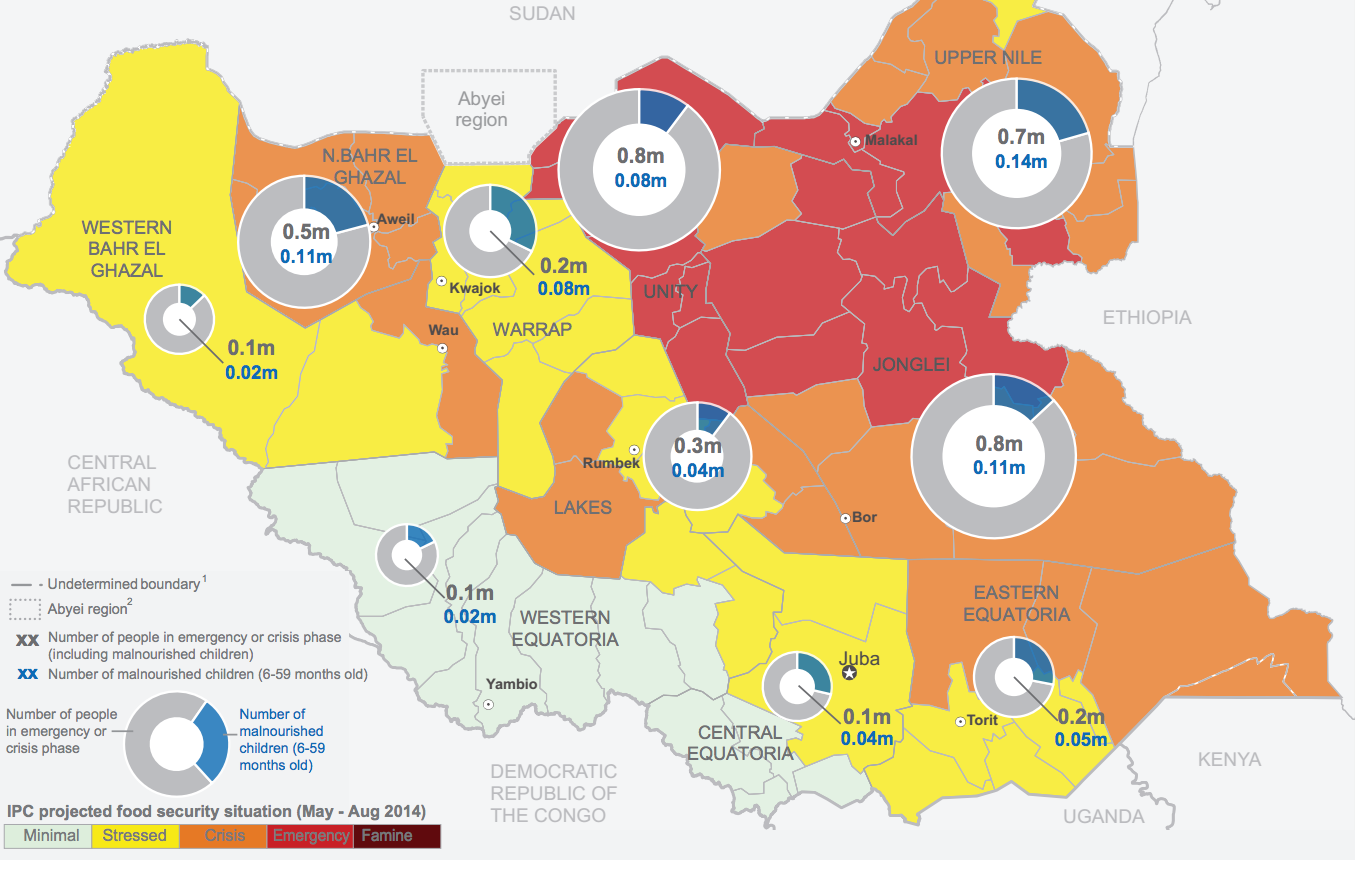
Ty McCormick warns of an impending famine in South Sudan, where over 1 million people are already in dire need of food aid:

The origins of the food-security crisis are layered. War disrupted the planting season, not just where there was active fighting, but across the northern half of the country as farmers fled their fields in anticipation of violence. But systematic underinvestment by the South Sudanese government, which has battled numerous corruption scandals since it became independent in 2011, is also part of the equation: Roughly 90 percent of South Sudanese territory is suitable for agriculture, but only about four percent of it was being cultivated, even before the current crisis. This combination of greed, violence, and lack of capacity has proven deadly. …

Experts have yet to formally declare a famine — a step that requires rigorous analysis of food supply, malnutrition, and mortality rates and can take months to complete — but the United Nations has classified South Sudan a “level-3 emergency,” a designation it shares with only three other countries: Syria, Iraq, and the Central African Republic. But aid agencies, like UNICEF, caution against relying too heavily on formal declarations or quantitative analysis. Waiting for a famine declaration before taking action, they warn, could be catastrophic. “By the time the famine was declared in Somalia in 2011,” said Veitch, “Half of the people that would die in the famine were already dead.”

Unfortunately, Rick Noack indicates, the fact that we can see it coming doesn’t necessarily mean that donor countries will step up to prevent it:

The author of [a Chatham House report on early warnings and responses to famine], Rob Bailey, told The Post that “decision-makers perceive significant downside risks from funding early action,” such as the possibility of money being diverted to hostile groups. Hence, foreign governments often wait until the last moment to provide funding – making it likely to come too late. In the early phases of a crisis, the pressure on decision-makers is low because public awareness is similarly low. Conversely, risks are high: Who wants to spend taxpayer’s money on a foreign, predicted crisis of uncertain scale?

Noack also reports that the US Government is the leading donor of aid to South Sudan, having sent another $180 million last week (out of a total $636 million this year.) But will any other countries follow suit?

(Chart: A UN map showing “South Sudan’s counties by level of food insecurity, and also indicates the number of malnourished children.”)

Is Edward Snowden the World’s Dumbest Spy?, Ctd

by Freddie deBoer

Lots of reader objections on this one:

On Snowden’s motives and capabilities:

“I do know that he’s in Russia because he’s been trapped there by our government, and that if he’s a spy, he’s gotta be the world’s worst.”

Well, you’re half right. Snowden is in Russia because that’s where he chose to go, one day after his passport was revoked. I respect the whistle-blower argument, but Snowden did much more than leak evidence of crimes and overreach by the NSA. He took those documents and fled. Unlike Chelsea Manning, who seems to have far more personal integrity than Snowden, he did not remain here to face the consequences of his actions. If he truly believed he was doing a service for the country, or the world, and was not in flagrant violation of oaths he took, he should have stood his ground here in the US, or at the very least on neutral soil, NOT left to be succored by avowed international enemies of the US.

And his actions have shown that at the very least, he is extremely naive about international relations.

Any information that was on any digital device he took with him on his route to Sheremetyevo via Hong Kong was almost certainly compromised. If they were not (doubtful),  just how secure and careful have Greenwald and others who have access to those documents been in the intervening year? Surely you don’t think it is a coincidence that Aeroflot just happened to be willing to convey him to Moscow on a cancelled passport, do you? Putin loves having Snowden there to irritate the US, and has been playing him like a violin for over a year. Did you watch that pandering April  interview that Snowden claimed later was an attempt to catch Putin in a lie? If that was his aim, he has totally misunderstood both Putin and the nature of the personality cult he has been assiduously building in Russia. As events in Ukraine have shown, Putin *doesn’t care* if the West thinks (or knows) that he’s lying, and most Russians won’t believe the biased Western media even if presented with clear evidence. The West already suspected (and now knows) that Putin is an opportunist with no respect for international law or sanctions if they get in the way of what he wants. Snowden is just one more convenient tool in his arsenal of catspaws to use against what he considers to be a hostile coalition of Western powers.

I am not yet willing to brand Snowden an out-and-out traitor, but his actions are not nearly as blameless as you seem to think. He has repeatedly tried to trade off of information he stole from the NSA to secure asylum with several different governments. If he really wanted to expose US malfeasance while still protected US security interests, he should have left for neutral territory well before leaking any documents, established himself and submitted an asylum claim, THEN started leaking. Instead, his clumsy attempts at whistleblowing and evading responsibility for the same have resulted in him being in the power of an enemy state with no regard for world stability if it stands in the way of their interests.

Snowden’s own words: “I blew the whistle on the NSA’s surveillance practices not because I believed that the United States was uniquely at fault, but because I believe that mass surveillance of innocents – the construction of enormous, state-run surveillance time machines that can turn back the clock on the most intimate details of our lives – is a threat to all people, everywhere, no matter who runs them.” Snowden doesn’t just think the NSA overstepped its legal bounds in surveilling US citizens; he doesn’t think the NSA should be spying on *anyone at all*, and neither should anybody else. Well, that’s fucking great, but that’s just. not. reality. It is this kind of attitude that lead to Sec of State Henry Stimson shutting down the American Black Chamber and dismissing much of its staff without a pension or NDA after World War I. The key figure behind the chamber, Herbert Yardley, went on to write his own expose of their activities, mostly out of financial need, but likely also out of pique. I still have more respect for Yardley and his motivations than I do for Snowden.

The NSA’s own commentary on Yardley’s memoir: “Yardley, with no civil service status or retirement benefits, found himself unemployed just as the stock market was collapsing and the Great Depression beginning. He left Queens and returned to his hometown of Worthington, Indiana, where he began writing what was to become the most famous book in the history of cryptology. There had never been anything like it. In today’s terms, it was as if an NSA employee had publicly revealed the complete communications intelligence operations of the Agency for the past twelve years-all its techniques and major successes, its organizational structure and budget-and had, for good measure, included actual intercepts, decrypts, and translations of the communications not only of our adversaries but of our allies as well.”

I’ll just say, briefly: I wish Chelsea Manning had escaped the way Snowden has. I see nothing noble about her being stuck in a cage for the next several decades.

Email O’Clock

by Dish Staff

workweek

Derek Thompson stayed up late to write an article about working late:

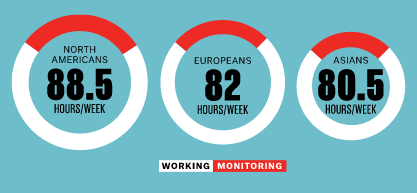
“It really is a global economy,” says David Mars, a New York venture capitalist. But if the pressures of globalization and a flimsy economy have endangered the set-hour workweek, mobile technology has obliterated it. In an unpublished Harvard Business School survey that I reviewed last year, American managers and workers reported that they were “on”—either working or “monitoring” work while being accessible—almost 90 hours a week. With this new denominator, email isn’t 28 percent of a 45-hour workweek. It’s 14 percent of a workweek that begins when our heads lift off the pillow and ends when we fall, face-first and exhausted, back into it. Wake-up-to-power-down is the new 9-to-5.

Getting Out The Vote In Ferguson

by Dish Staff

Ferguson’s government is much whiter than its population. But Yglesias doubts that will be true for long:

Nobody who lives in the area could possibly think that local government doesn’t matter any more, and a community capable of organizing nightly protest marches should have relatively little trouble getting people to come out and vote. And if Ferguson’s African-American residents do vote, they should have relatively little trouble installing a government that hears their concerns and leans against the systemic inequities in the American criminal justice system.

In other words, the town at the center of this drama may well see a real improvement in political representation. The deeper problem is going to lie elsewhere — in the many towns large and small where people of color are a minority of eligible voters and the basis of white political power is firmer.

Friedersdorf wants recall elections:

A successful recall of Ferguson’s mayor and city council is the best outcome I can imagine from a protest movement that is justifiably angry, but uncertain about how to achieve its goals and at risk of losing public support if the streets turn more violent. Protesters want transparency in the investigation into Brown’s death, accountability for the police department, and an end to leadership that demonstrates such disregard and seeming contempt for the city’s black people. Perhaps existing pressure on city leaders, or appeals already made to the Department of Justice, will help advance those goals—but while more night protests would seem to offer scant hope for additional gains, replacing the city’s elected leadership would advance the protesters’ goals directly and dramatically. The effort would be nonviolent, it might well increase civic participation for years or even generations to come, and if successful, it would send an inspiring message to those who feel powerless: that a system very much stacked against them is still a far more powerful weapon than a molotov cocktail.

Jonathan Rodden points out that, “while St. Louis is indeed among the most segregated metropolitan regions in the United States, Ferguson and some of its North County neighbors are among the most racially integrated municipalities in Missouri and well beyond”:

Let us not learn the wrong lessons from recent events in Missouri. By no means does Ferguson prove the defeatist claim that blacks and whites cannot live together in peace as the inner suburbs transform. Those of us who grew up in the integrated Ferguson-Florissant area in recent decades know otherwise. It is not a post-racial paradise, but it is a functioning multiracial community. What we are seeing in Ferguson is not merely the latest manifestation of the age-old problem of segregation and housing discrimination. Rather, it is evidence that the best hope for a solution – -the creation of integrated middle-class neighborhoods such as Ferguson — cannot work without political inclusion and accountability.

Fred Siegel is much more pessimistic about Ferguson’s future:

Riots bring but one certainty—enormous economic and social costs. Businesses flee, taking jobs and tax revenues with them. Home values decline for all races, but particularly for blacks. Insurance costs rise and civic morale collapses. The black and white middle classes move out. Despite its busy port and enormous geographic assets, Newark, New Jersey has never fully recovered from its 1967 riot. This year, Newark elected as its mayor Ras Baraka, the son and political heir of Amiri Baraka—the intellectual inspiration for the 1967 unrest.

The story is similar in Detroit, which lost half its residents between 1967 and 2000. Civic authority was never restored after the late 1960s riots, which never really ended; they just continued in slow motion. “It got decided a long time ago in Detroit,” explained Adolph Mongo, advisor to the jailed former “hip-hop mayor,” Kwame Kilpatrick, that “the city belongs to the black man. The white man was a convenient target until there were no white men left in Detroit.” The upshot, explained Sam Riddle, an advisor to current congressman John Conyers, first elected in 1965, is that “the only difference between Detroit and the Third World in terms of corruption is that Detroit don’t have no goats in the streets.”