In Peter Feaver’s view, Obama’s intervention in Iraq disproves what had been a main feature of his foreign policy doctrine: the value of leading from behind. “In authorizing new combat action in Iraq when he did,” he argues, “Obama conceded that his approach of doing less as a way to make others do more was not working — at least not with respect to Iraq”:
President Obama rightly recognized that there was no long-term solution in Iraq until the Iraqi polity picked a less sectarian successor to Maliki. More controversially, Obama rejected multiple appeals for help from the Iraqis (and from our Kurdish partners) earlier in the crisis in the hopes that withholding aid would drive the Iraqis to dump Maliki in a desperate effort to secure American assistance. … Finally, when Obama was staring at a potential catastrophe in Erbil in the Kurdish region that might eclipse the disaster in Benghazi, he decided he could wait no longer and ordered U.S. forces into combat — despite the failure of Iraqis to meet the hitherto stated conditions for U.S. assistance.
Shortly after Obama acted, the Iraqis finally acted themselves, nominating a (hopefully more inclusive) replacement to Maliki. In other words, the Iraqis themselves may have been waiting to see if they could trust Obama’s offers of help. Perhaps it was Obama’s initiative that catalyzed the Iraqi’s action, rather than vice-versa, as Obama had intended. That, at least, is how the Bush administration would have interpreted the strategic dynamic.
James Jeffrey worries that Obama’s aversion to direct military action makes him reluctant to use one of his most potent tools:
Given Obama’s ambivalent views on the efficacy of military force, and America’s tortured history in Iraq, he downplays his strategy’s second element: direct U.S. military actions. Despite the president’s oft-stated belief that there is never any military solution to, well, almost anything, IS’s advances into Kurdish and Shiite Arab areas of Iraq are not a political or social phenomenon but a military achievement. And one cannot confront a classic military strategy with diplomatic niceties. …
Do military actions of this sort open the door to a “slippery slope” that could lead to new Iraqs and Vietnams? In theory, yes. But Barack Obama is the least likely president to make a mistake of this sort. Moreover, the reality doesn’t equal the fear: Over scores of deployments and combat operations since 1945, the United States has rarely headed down the slippery slope. And let’s be clear: The Iraq adventure under President George W. Bush was not a slippery slope but an intentional regime-change strategy gone wrong. What the president thus must do is to convince first himself and then the American people that our key interests — oil supply, protecting the homeland and allies from terrorism — are at stake so long as the Islamic State is rampant. Americans need to understand that if the United States does not stop them, no one will.
And Nabeel Khoury believes that we have no choice but to take the lead in defeating ISIS or concede hegemony in the Arab heartland to Iran:
There are no good options for the U.S. administration at this point, only bad and worse ones. Any counter-offensive to dislodge ISIS would have to include large forces on the ground, something the president has ruled out. This leaves two options for Washington: Take a deep breath, hunker down, and focus on a long term project to arm and train Kurdish forces, hopefully in collaboration with what’s left of the Iraqi army. The long delayed adoption of the FSA would be a natural part of this strategy. Washington’s failure to lead in these efforts will leave only one other option, which is to step aside and let Iran and Hezbollah take the responsibility for ousting ISIS, and therefore take credit and full control of Iraq after the fight is done.
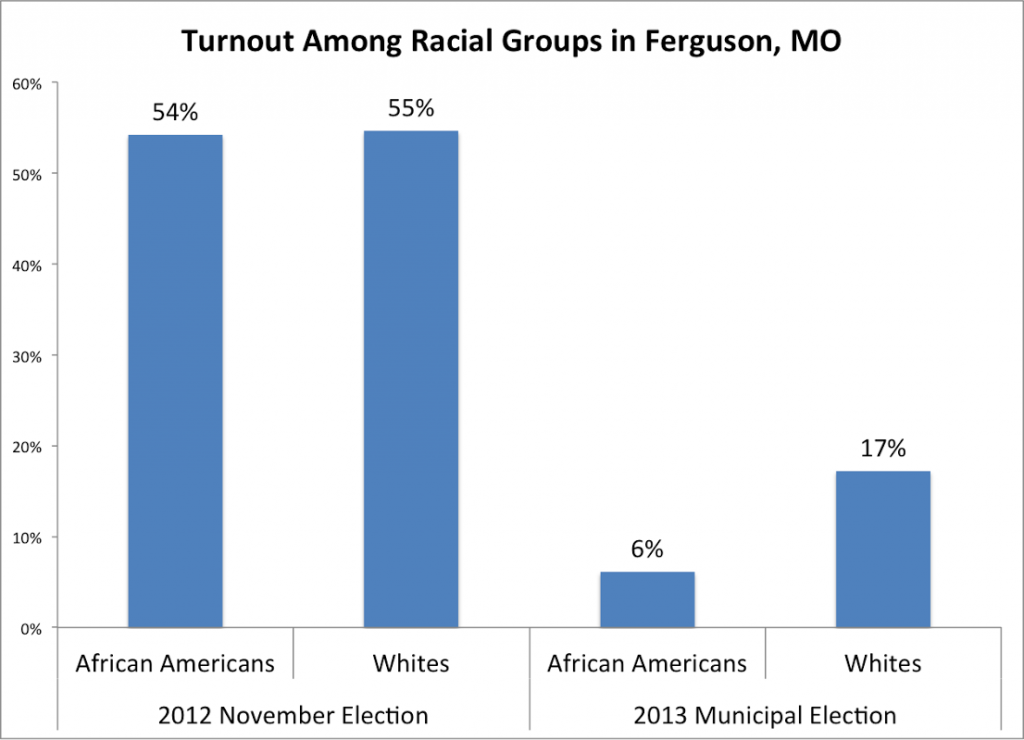
Brian Schaffner, Wouter Van Erve and Ray LaRaja illustrate “why Ferguson’s elected officials look so little like its population”:
The first chart shows turnout rates among African Americans and whites in Ferguson for both the 2012 general election in November and the 2013 municipal election in April. In 2012, African Americans and whites turned out in nearly identical numbers (54 percent and 55 percent, respectively). In the April 2013 municipal election, turnout was dramatically lower among both groups, but whites were three times more likely to vote than African Americans. …
In 2012, when turnout was high and African Americans voted at a similar rate to whites, 71 percent of Ferguson voters were black. However, in 2013, whites became a majority of the Ferguson electorate, by a margin of 52 percent-47 percent. This is a dramatic difference, and it would almost certainly help to account for the extent to which Ferguson’s elected officials are of a much different racial makeup than its population.
But Masket calculates that “Ferguson is a serious outlier” in this regard:
As of 2001, it was a majority African American city with zero African Americans on the city council. The only city with a greater representational disparity was Riverdale, Georgia, but African American representation in that city has increased dramatically since then. Ferguson, meanwhile, has gained one African American city council member since then (17 percent of the council), but its African American population has increased to 67 percent, meaning it’s still a rather extreme outlier in terms of representation. …
This isn’t to dismiss Ferguson as a meaningless outlier. As Clarissa Hayward notes: “Ferguson is anything but anomalous. It’s an all-too-familiar manifestation of how racial injustice lives on, even after significant shifts in white racial attitudes.” There are problems with representation in a number of places across the country, and Ferguson is, sadly, hardly the only city to see an unarmed young black man gunned down by a white police officer.
M.S.L.J. notes a new study on life expectancy for black and white Americans, writing that although a gap persists “despite policies aimed at closing it … the good news is that blacks are slowly catching up”:
Between 1990 and 2009 the difference in average life expectancy for black and white men narrowed from 8.1 to 5.4 years, and for women from 5.5 to 3.8 years. But some places made more headway than others. Washington, DC had the largest gap between blacks and whites of both sexes in 1990 (14.4 years for men and 10.4 for women) and saw the least improvement overall (reducing the spread by just 0.4 years for men and 0.2 for women). The city also underwent a significant demographic shift: the proportion of blacks as a percentage of the District’s population decreased from 70% to 50% in the decades studied. …
In New York campaigns to stamp out crime and provide care for those suffering from HIV/AIDS are seen to have contributed to a 5.6-year reduction in the male black-white gap—the largest reduction in the country. Tougher and smarter policing tactics and a jump in arrest rates helped lower the number of murders in New York City by 73% during the 1990s. This extended the lives of young black men in particular. More than half of America’s murder victims are black, though blacks make up just 13% of the population. Blacks are also more likely to die from AIDS than any other racial group, so new treatments and a decline in needle-sharing amongst drug users has benefited them disproportionately.
I’ve already mentioned how my instinct, when the world seems a bit depressing, is to retreat into books. Reading literature and poetry, for me, always has been therapeutic. An element of escapism surely is a part of this, but I’d like to think there’s more to it than that. The best books don’t move me to avoid reality, but rather see the world with fresh eyes – they remind me not of the world’s limitations, but its possibilities. Sometimes that’s because looking at life from the perspective of a novel’s narrator or the writer of a poem lets me realize just how narrow my own field of vision can be, and getting a purchase on life apart from the whirring of my own brain is just what I need. It’s a way of getting out of the rut of how I usually think about matters. But most of all, reading is a way of feeling less lonely. Certain passages of literature allow me to say, yes, she understands just what it’s like. A kind of communion occurs between the writer and the reader, and the problems of the moment seem more bearable if only because you realize you’re not the first to get there. Books offer the remarkable consolation of getting to a particular point in your life, or reaching a certain impasse, only to look around and see a flag planted in the dust: someone else has been here too.
I’m interested in what books or poems have offered this experience to Dish readers, what texts have been your companion along life’s way. I’ll go first. Often I’ve reached for Marilynne Robinson’s novel Gilead, which takes the form of a long letter written by a dying father to his young son, just to immerse myself in the rhythms of its prose. And I usually turn, at some point, to this passage near its conclusion:
There are two occasions when the sacred beauty of Creation becomes dazzlingly apparent, and they occur together. One is when we feel our mortal insufficiency to the world, and the other is when we feel the world’s mortal insufficiency to us. Augustine says the Lord loves each of us as an only child, and that has to be true. ‘He will wipe the tears from all faces.’ It takes nothing from the loveliness of the verse to say that is exactly what will be required.
Theologians talk about a prevenient grace that precedes grace itself and allows us to accept it. I think there must also be a prevenient courage that allows us to be brave – that is, to acknowledge that there is more beauty than our eyes can bear, that precious things have been put into our hands and to do nothing to honor them is to do great harm. And therefore, this courage allows us, as the old men said, to make ourselves useful. It allows us to be generous, which is another way of saying exactly the same thing. But that is the pulpit speaking. What have I to leave you but the ruins of old courage, and the lore of old gallantry and hope? Well, as I have said, it is all an ember now, and the good Lord will surely someday breathe it into flame again.
I’d love to hear what texts have been by your side as go through life – a favorite passage from a novel, a cherished poem, the short story you return to again and again. Email me at dish@andrewsullivan.com.
Last week, in the wake of Michael Brown’s shooting, making police wear body cameras was suggested as a way to rein in the police. Mark Steyn focuses instead on the lack of dash cam footage:
“Law” “enforcement” in Ferguson apparently has at its disposal tear gas, riot gear, armored vehicles and machine guns …but not a dashcam. That’s ridiculous. I remember a few years ago when my one-man police department in New Hampshire purchased a camera for its cruiser. It’s about as cheap and basic a police expense as there is. … In 2014, when a police cruiser doesn’t have a camera, it’s a conscious choice. And it should be regarded as such. And, if we have to have federal subsidy programs for municipal police departments, we should scrap the one that gives them the second-hand military hardware from Tikrit and Kandahar and replace it with one that ensures every patrol car has a camera.
No argument there. But Jonathan Coppage has concerns about cops wearing cameras:
Yet even setting aside the natural privacy concerns raised by strapping recording devices to every patrol officer circumambulating their city’s streets, it is worth raising a smaller, subtler, but nevertheless potentially significant concern: the increasingly intermediated cop. One only has to glance in the window of a local patrol car to see the sprawling array of screens, keyboards, and communication devices designed to link the officer to all the information they could need. The problem being, of course, that the most important information the common cop needs still can’t be pulled up within his car: the knowledge gained from building relationships with those in the community he patrols.
That relationship-building is a core component of a police officer’s mission, and may be almost entirely divorced from the work he can get done on his car’s mounted notebook computer. It also requires a certain amount of discretion, getting to know a neighborhood’s warts as well as its virtues. The conversations that give an officer an accurate picture of the seedy but not destructive side of his citizens’ lives could very well be more difficult or awkward should the policeman’s sunglasses be rolling film.
However, Conor Friedersdorf bets that cops will want such cameras:
As the police continue to lose the trust of the public, due largely to documented instances of bad behavior by fellow officers, as well as law enforcement’s longstanding inability to police themselves, I suspect that more and more good cops will be clamoring for cameras on their dashboards and lapels. Until then, citizens ought to record police during every incident as it unfolds.
ResearchGate is “essentially a scholarly version of Facebook or LinkedIn” that allows members “a place to create profile pages, share papers, track views and downloads, and discuss research.” It’s certainly gaining traction with researchers:
More than 4.5 million researchers have signed up for ResearchGate, and another 10,000 arrive every day, says Madisch. That is a pittance compared with Facebook’s 1.3 billion active users, but astonishing for a network that only researchers can join. And [co-founder Ijad] Madisch has grand goals for the site: he hopes that it will become a key venue for scientists wanting to engage in collaborative discussion, peer review papers, share negative results that might never otherwise be published, and even upload raw data sets. “With ResearchGate we’re changing science in a way that’s not entirely foreseeable,” he says, telling investors and the media that his aim for the site is to win a Nobel prize.
Though the project has attracted support – and counts Bill Gates among its investors – some have voiced criticism:
[M]any wonder why researchers would deposit their data sets and reviews on these new social networks, rather than elsewhere online — on their own websites, for example, in university repositories, or on dedicated data-storage sites such as Dryad or figshare…. To Madisch, the answer lies with the social sites’ burgeoning communities of users — the famed ‘network’ effect. “If you post on ResearchGate, you are reaching the people who matter,” he says. But Titus Brown, a computational scientist at Michigan State University in East Lansing, is concerned about the sites’ business plans as they seek to survive. “What worries me is that at some point ResearchGate will use their information to make a profit in ways that we are uncomfortable with — or they will be bought by someone who will do that,” he says.
One academic who signed up had more pointed criticism of the “RG score” assigned to users, described as “a metric that measures scientific reputation based on how all of your research is received by your peers”:
The current score is, not to put a too fine point on it, totally useless. There is a more or less universally agreed on ranking of scholars which is based on CVs and the offers they get. There is also a correct ranking based on the originality and quality of research. These two rankings are typically very different. The RG score is similar to neither.
If the score is the most useless feature of RG, the most annoying feature is the aggressive way in which they try to force you to update your site. First, their minions search the web for every old version of your papers, and once they find it they will suggest that you add it you your profile. I say `suggest’ but it’s not like you can refuse. You can choose between `yes’ and `maybe later’. And by `later’ they mean next time you log in. In the end you either surrender or accidentally click yes.
Gabrielle Walker, 5, protests the killing of teenager Michael Brown in Ferguson, Missouri on August 17, 2014. Despite the Brown family’s continued call for peaceful demonstrations, violent protests have erupted nearly every night in Ferguson since his death. By Scott Olson/Getty Images.
Early reports were that the two sides were close to agreement on an Egyptian compromise proposal for a long-term cease-fire. On Friday and Saturday, however, declarations on both sides indicated that positions were hardening as fierce internal divisions emerged, pulling the leaderships on both sides away from the center. The Palestinian side appears to be stymied by the refusal of the organization’s Qatar-based political secretary, Khaled Meshaal, and the head of its military wing, Mohammed Deif, to go along with the compromise proposals laid out by the Egyptians and mostly accepted by both delegations.
On the Israeli side, meanwhile, chaos appears to be reigning. Prime Minister Netanyahu, who rode a wave of popularity during the military operation, has been facing a tsunami of criticism over the past week from the left, the right, the residents of Gaza-adjacent communities and his top coalition ministers. Two of his senior coalition partners, foreign minister Avigdor Liberman of the Yisrael Beiteinu party and economics minister Naftali Bennett of the Jewish Home party, have repeatedly attacked the prime minister’s management of the Gaza conflict from the right, demanding a continuing assault until Gaza has been taken over and Hamas disarmed or dismantled. Broad circles on the right accuse him of giving away the store (i.e. lifting the blockade) in return for “nothing” (i.e. Hamas-Jihad agreement not to shoot, bombard or tunnel).
David Kenner examines one of the key sticking points, namely whether, how, and by whom Gaza will be rebuilt:
In his remarks on Wednesday, Aug. 13, announcing a five-day extension to the cease-fire, Palestinian delegation chief Azzam al-Ahmed said that there had been significant progress in efforts to lift the Israeli economic blockade on Gaza — but that there were still disagreements over reconstruction issues. These debates will not only determine whether residents can rebuild after the war, they also promise to be an important tool in Israeli efforts to weaken Hamas’s hold on the territory. As Finance Minister Yair Lapid put it, Israel would demand that “there is no rehabilitation without some sort of demilitarization [of Gaza].” …
The importing of building materials to rebuild Gaza’s tens of thousands of destroyed homes is one of the most potentially fraught issues. Hamas used large quantities of cement, allegedly smuggled in across the border with Egypt during the presidencies of Hosni Mubarak and Mohamed Morsi, to build its extensive tunnel network, which posed one of the most deadly threats to Israel during the current war. For that reason, Jerusalem has only allowed U.N. agencies to import cement — and is going to be loath to ease restrictions on construction material that could be used by the Palestinian Islamist group to rebuild its tunnel network.
On another major point of contention—lifting the Gaza blockade—the EU is willing to step in and help monitor border crossings in order to make that happen:
The EU has offered to resume its operations at Gaza’s Rafah crossing with Egypt, and to train Palestinian Authority officials who are supposed to take over the bulk of operational work at the crossings. At the U.N. Security Council’s request, it would also expand its operations to other checkpoints. (The EU previously monitored the Rafah crossing between 2005 and Israel’s withdrawal in 2007.)
According to the AP, EU officials said that lifting the blockade is needed for “a fundamental improvement in the living conditions for the Palestinian people in Gaza.” This is one of many outside expressions of disapproval at Israel’s conduct during the latest Gaza operation. The United States recently decided that Israel’s new weapons requests would need individual approval from the presidential administration, rather than going through military channels.
Since Andrew and the Dish team gave me carte blanche to write about what I want, I’m going to go ahead and abuse the privilege by writing a defense of a largely-forgotten, eight-year-old movie, Richard Kelly’s Southland Tales. Because when it isn’t being ignored, it’s usually being reviled, which is a crime. Southland Tales is a masterpiece.
Explaining the plot of the movie could take up thousands of words—and in fact, already has. I’ll leave it to others to explore the complex web of plot lines, references, digressions, and symbols. Suffice is to say for now that Southland Tales is the story of America in the age of terror, an America where a nuclear terrorist attack on Texas leads to a massive surveillance infrastructure, a nascent resistance movement, and the desperate search for an alternative energy source in a world where the Middle East is on fire. While American wars rage in Syria and North Korea, the sprawling USIDENT surveillance system keeps tabs on us through both sophisticated electronic means and more old fashioned, soldiers-with-telescopes techniques. Meanwhile, a genius scientist has discovered Fluid Karma, seemingly a source of unlimited free energy, drawn from the endless churn of the oceans. When we enter the scene, Dwayne Johnson’s character Boxer Santeros, a Schwarzenegger-style movie star and fiancee of a powerful Senator’s daughter, has gone missing, having lost his memory in a mysterious event in the desert. During his disappearance, he’s shacked up with Krista Now, a porn star who wants to start a new life, and sees Santeros as her ticket out. The story really gets rolling when Santeros goes on an ill-fated ride along, ostensibly to research a movie role, with a cop named Roland Taverner—or is it Ronald? Then there’s the question of Santeros and Now’s screenplay, The Power, which keeps mimicking real life….
But, well, there I go, getting into the plot without really meaning to. The movie’s like that.
You won’t understand everything happening in the movie the first time you watch it, and you aren’t really meant to. Among its many references and influences are the great film noirs of the past, and like those films Southland Tales is usually experienced in a state of mild confusion, comprehension always lagging just behind the progression of the Byzantine plot. But you don’t need to understand all of what’s going on for the themes to resonate, or to enjoy the many fantastic set pieces, which are sometimes hilarious and sometimes gorgeous. The characters are pulled into these moments in surprising ways. All of them are portrayed as at least partially comic, and yet all are allowed to entertain grandiose schemes and levels of self-importance. Wallace Shawn’s mad scientist wears the haircut of a synth player from some 80s Euro band; Cheri Oteri’s witless revolutionary/con woman makes up for her bad plans with a talent for violence; Zelda Rubinstein, the diminutive actress from the Poltergeist movies, quotes T.S. Eliot. Kelly arranges them in carefully choreographed moments that play out almost as skits within the larger narrative, and it’s here that they are allowed to achieve some sort of dignity, or at least self-determination. A staged domestic disturbance between Amy Poehler and Wood Harris from the Wire turned real shooting bleeds out into a paranoid escape across the foggy, overgrown lawns of suburban LA, set to The Pixies. The Rock, Mandy Moore, and Buffy the Vampire Slayer dance to Moby in a scene right out of your senior prom. A hallucinating Justin Timberlake, shirt covered in blood, lip syncs to the Killers in a psychedelic arcade. Gorgeous, every frame.
Like Who Framed Roger Rabbit?, Southland Tales is one of the handful of greatest LA movies without being recognized as such. It’s cliched to say that a city is a character in a film, so perhaps I’ll just say that Los Angeles is a ubiquitous presence in Southland Tales. The city is at once a central concern of the film and a subtle one. There’s little about the plot, as plot, that necessitates it being shot in LA, and yet there’s no way it could have been made anywhere else. The city is alluded to in the (excellent) soundtrack and in the voiceover narration, but it reveals itself especially in the movie’s geographic expansiveness, the way it lazily stretches out across its setting. Donnie Darko, the film that made Kelly’s reputation, is a claustrophobic movie, its suburban cul-de-sacs a metaphor for a time line looped back on itself. Southland Tales, in sharp contrast, spreads out across its setting like it’s in no particular rush to get anywhere, mimicking the expansive interconnectedness it dramatizes, as vast and inescapable as the surveillance network that is at the center of both its plot and its themes. In its centerless sprawl and wide boulevards, LA works for this movie in a way that a more cramped city like New York never would.
Though it’s a 9/11 movie and a War on Terror movie and a political movie, show business is at the heart of its themes. The movie is about Hollywood the culture and Hollywood the industry, if not so much Hollywood the place (In its aesthetics, Southland Tales is much more Venice Beach than Hollywood and Vine.) In The Power, Santeros’s name is “Jericho Kane,” a reference to the Arnold Schwarzenegger schlockfest End of Days. That movie, while one of the worst Arnold ever made, is peak meta-Schwarzenegger, the dopiest and most self-important of his blockbuster career, a symbol of overstuffed action movies with overmuscled action stars. And it was the beginning of the end for Schwarzenegger as unironic action star, a relative box office dud from an actor who was once the most reliable draw in Hollywood. Kelly is interested in Hollywood people on the down swing; he’s interested in value in Hollywood, how it’s perceived and what it means. The cast is filled with actors who were seen as Grade C-types even at the time—Oteri, Jon Lovitz, John Laroquette, the guy from Highlander. I’ve heard people suggest that this means that Kelly couldn’t get bigger names in his movie, but that’s wrong; coming off of Darko, his career would have been at peak buzz. Instead, I think Kelly intentionally sought out actors who were perceived as washed up or in some sense ridiculous, like pre-Renaissance Johnson. In his movie, Kelly is working through the idea of who is allowed to be taken seriously. Sarah Michelle Gellar’s porn star character, for example, is underestimated and dismissed, despite taking part in a complex conspiracy that drags in some of the most powerful people in the world. Two feminist neo-Marxist radicals fight for revolution and respect from government officials who underestimate them. A character who fulfills one of the most reviled stereotypes we have—the rich white kid who dresses and talks like a character from a rap video, complete with ridiculous doo-rag—is given respect and compassion, playing a key role in the bravura climax, one of the most indelible visuals I’ve ever seen on screen.
All of this, I’m sure, makes the film sound deeply pretentious. If so, that’s appropriate; it’s a pretentious movie, in the best sense. The rampant fear of pretension has been one of the great mistakes of our current aesthetic era. It’s led to lots of perfectly crafted, perfectly unambitious, perfectly safe movies, the type Manohla Dargis aptly summarized, in her positive review of Southland Tales, as “elegantly art-direct murder.” We’re in an artistic age where the omnipresence of critical judgment has led so many creators to create from a defensive crouch. It’s an age of recappers and social media chatterers and Rotten Tomatoes, and so the response has been the rise of artwork designed to appease them rather than to take the kinds of risks that, sometimes, lead to transcendence. It’s the Era of the Critic Proof, the age of celebrating the perfectly fine. True Detective, Drive, Haim—I enjoy each of these, sometimes a great deal, and I’m happy they exist. But none moves me like the big shaggy mess that is Southland Tales, and in their workshopped perfection, they sand away the natural impurities that are the source of character. It’s kind of a dismal feeling, to perceive so much competence and so little risk, but in a world of towering fan entitlement and an entire industry of nitpickers, it’s probably inevitable. Here’s to the messes, and to Southland Tales.



 The Dish