Policing The Police With Cameras

by Dish Staff

Nick Gillespie wants to make cops wear recording devices:

While there is no simple fix to race relations in any part of American life, there is an obvious way to reduce violent law enforcement confrontations while also building trust in cops: Police should be required to use wearable cameras and record their interactions with citizens. These cameras—various models are already on the market—are small and unobtrusive and include safeguards against subsequent manipulation of any recordings.

“Everyone behaves better when they’re on video,” Steve Ward, the president of Vievu, a company that makes wearable gear, told ReasonTV earlier this year. Given that many departments already employ dashboard cameras in police cruisers, this would be a shift in degree, not kind.

Derek Thompson is on the same page:

When researchers studied the effect of cameras on police behavior, the conclusions were striking.

Within a year, the number of complaints filed against police officers in Rialto fell by 88 percent and “use of force” fell by 59 percent. “When you put a camera on a police officer, they tend to behave a little better, follow the rules a little better,” Chief William A. Farrar, the Rialto police chief, told the New York Times. “And if a citizen knows the officer is wearing a camera, chances are the citizen will behave a little better.”

Matt Stroud talked with attorney Scott Greenwood about putting cameras on cops:

“On-body recording systems [OBRS] would have been incredibly useful in Ferguson,” he says. “This is yet another controversial incident involving one officer and one subject, a minority youth who was unarmed,” a reference to Michael Brown, who was killed by police on August 9th. “OBRS would have definitively captured whatever interaction these two had that preceded the use of deadly force.” Armed with footage from an on-body camera system, it’s possible that police would’ve had no option but to take swift action against the officers involved — or if Brown’s behavior wasn’t as eyewitnesses describe, perhaps protests wouldn’t have swelled in the first place. Instead, the citizens of Ferguson are left with more questions than answers.

Moving forward, Greenwood doesn’t see how on-body cameras can be avoided. “I see no way moving forward in which Ferguson police do not use OBRS,” he says. “The proper use of OBRS is going to be a very important part of how these agencies restore legitimacy and public confidence.”
You Might Be a Millennial If …

by Elizabeth Nolan Brown

I am a member of the millennial generation, which means so are my same-age friends, obviously. Yet they routinely refuse to acknowledge this. Some genuinely don’t realize that they, born in the early 1980s, could possibly be considered part of the same generational cohort as those born in, say, 1997. Some seem to know they are millennials technically but refute the label on grounds of principle. So strong is this Millennial Denial Syndrome that appeals to logic – most generations span 15 to 20 years! not identifying with generational tropes doesn’t change your birth year! – only work about half the time.

Millennial journalist Lauren Alix Brown was recently forced to confront the terrible truth about herself:

No one likes the term “millennial,” with its connotations of narcissism, laziness, and self-delusion. And yet it wasn’t until I was editing a piece on millennials, and my office debated the merits of the term for a global audience, that I realized I was one.

But don’t worry, her pain was short-lived. Brown quickly decides that if she is considered a millennial, the term must be meaningless:

Millennial has become a catchall for everything right and wrong with the younger generation. In being used too broadly and frequently, it’s become meaningless for some of the nuances that differentiate us. It also covers a swath as wide, in some definitions, as those born from 1977 to the year 2000.+

The official millennial birth boundaries are blurry, but most place the start between 1979-1982 and the end between 1994-and the late 90s. Generational scholars William Strauss and Neil Howe, who coined the term “millennial”, defined the generation as those born between 1982 and 2000. Regardless of how you slice it, you’ll hear the same complaint from older millennials: they simply have nothing in common with those born 10, 12, 15 years behind.

“Everyone thinks they are distinct from the generation below them,” Brown acknowledges, but she thinks “among millennials, there truly is a divide”:

Most importantly, the Great Recession: A group of us entered the workforce in a distinctly different economy from today’s graduates. A recent survey conducted by Zogby Analytics looked at millennials in two cohorts—those born between 1979-1989 and those born 1990-1996. The older cohort was more apt to have a college degree, consider their current job a career, and less likely to have lost a job in the past 12 months. Older millennials were born to Baby Boomer parents and graduated college and entered the job market in a boom time.The younger set, which entered adulthood during the financial crisis, are products of Gen X-ers.

Yet millennials who entered the job market pre-recession were quickly greeted by it. Many of my friends had no sooner gotten their first professional, post-college jobs than they were losing them in 2008-2009 layoffs. I’m not convinced that entering the workforce pre- or post-recession is as great a marker of difference as some say it is. Perhaps older millennials are more likely to have college degrees and consider their current jobs a career because they are older? In the Zogby survey, we’re talking about the difference between people 25-35 versus those ages 18 to 24!

Putting economic influences aside, Brown quips that she doesn’t feel at all millennial as she encounters “new grads who drink coffee through a straw during an interview or respond with ‘k’ over Gchat.” Yet I remember hearing similar complaints from folks when my friends and I were just out of college and searching for jobs. Boomers and Gen X-ers assure me that their elders had similar complaints about them as interns and entry-level staffers.

I understand why it may seem weird, looking at a 16-year-old from the ripe old age of 30, and being told that you’re supposed to have something in common with them. But generations are, in theory, taxonomied more for historical shorthand purposes than major in-the-moment meaning. So you remember dial-up Internet and they don’t? So they got a Facebook profile at 12 and you were 20? Compared to the cultural gulf between any millennial and any member of our grandparents’ generation, or any member of the post- post- millennial generation, these differences are minuscule and virtually meaningless. And in 50 or 100 years, they will be undetectable to those looking back.

So anyway, here’s my plea to my fellow millenials: Accept the label, because you’re never going to shake it. But this doesn’t mean you have to accept what they say about us. Part of the reason millennials are so mocked and maligned is because nobody wants to admit to being one. The sooner you admit to your dreaded millennial-ness, the sooner you can start changing the conversation about us.

This Is Why Men Need Feminism

by Elizabeth Nolan Brown

Love, love, love the response from actor Joseph Gordon-Levitt when asked about calling himself a feminist:

I read that you consider yourself a “male o-BITE-YOU-570feminist,” and you credit your parents who are educators and really taught you about the history of feminism. But nowadays, you have a lot of young stars coming out against being labeled a feminist.

Coming out against the label? Wow. I guess I’m not aware of that. What that means to me is that you don’t let your gender define who you are—you can be who you want to be, whether you’re a man, a woman, a boy, a girl, whatever. However you want to define yourself, you can do that and should be able to do that, and no category ever really describes a person because every person is unique. That, to me, is what “feminism” means.

So yes, I’d absolutely call myself a feminist. And if you look at history, women are an oppressed category of people. There’s a long, long history of women suffering abuse, injustice, and not having the same opportunities as men, and I think that’s been very detrimental to the human race as a whole. I’m a believer that if everyone has a fair chance to be what they want to be and do what they want to do, it’s better for everyone. It benefits society as a whole.

What’s great about Gordon-Levitt’s definition is that it shows why feminism is directly relevant to men’s lives as well as women’s. We’re all in this mess of gender expectations together. Feminism isn’t just about raising women up but helping us all – men, women, cis, trans, whatever – get to a place where we’re a bit more free.

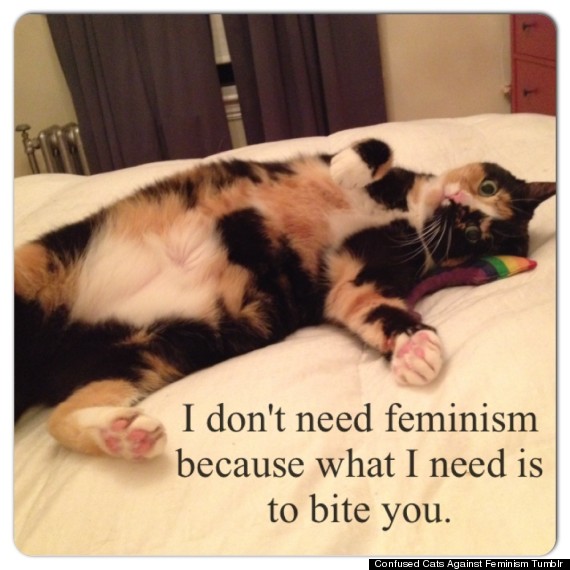
(Image from Confused Cats Against Feminism)

“One Must Respect These Old Names” Ctd

by Phoebe Maltz Bovy

In what has to be a French-major’s anxiety dream come to life, a reader implies that I omitted a definite article in this story:

I’m writing from Normandy, France. I did a quick search to look for some French articles related to that “Mort aux juifs” town, and it looks like the reporting was quite misleading. First of all, the village name is not “Mort aux Juifs” (Death to the Jews) but “La mort aux Juifs” (The death of the Jews). I found another explanation for the origin of the name, which would come from a Jewish uprising in the 16th century against the local lord, during which they were slaughtered.

The town name, as I indicated in my original post, definitely has that “La” – the “Mort aux juifs” in quotes refers to the graffiti I saw on the RER B. It could be that other accounts this reader found left it out. As for what changes when one puts “the” in front of “death to the Jews,” I’d say not much. If one wished to say “The death of the Jews,” one would need “La mort des juifs.” That said, I’m not an expert on medieval French place names, and there could some idiomatic loophole according to which, in this context, the town name translates to “The death of the Jews.” An “à” can be possessive. It’s not impossible. It is striking that “death to the Jews” would have a “the” at the front of it, and I’m grammatically flummoxed. Readers who can clear this up, or who are interested in providing me with fodder for more French-major anxiety dreams, please advise: dish@andrewsullivan.com.

The reader continues:

The “town” itself is in fact a “hameau”, the smallest possible kind of village in France. In our case, “La mort aux Juifs” is composed of only one farm and two houses. The name appears in the “cadastre” (the old official plans you can consult at the townhouse) and so it appears on Google maps too,  but the postal address is completely different and the habitants refer to the place as “La Mare-aux-Geais” (the pond of the jay), probably a phonetic evolution of the original name – that’s understandable, given how distasteful the original name was!

I think the deputy mayor reaction (“one must respect these old names”) has nothing to do with actual antisemitism in France.

She simply says that the name refers to a historical event, not that she condones it. Instead of trying to change that name, I think the Simon Wiesenthal Center should just do the reverse thing: do some historical research on the antisemitic acts that lead to that massacre and then help fund some sort of street sign at that exact location, with some explanations (“In 1565, hundred of Jews were the victims of… etc). That would help educate people and the deaths of these people would be remembered instead of lost in oblivion.

I suppose it’s better that this name belongs to a very, very small town, and not to, like, Paris, but if this reader’s point is that the name is actually a solemn commemoration of anti-Semitism (akin, perhaps, to the plaques in front of French schools listing children killed in the Holocaust), then why should we dismiss it on account of its size?

I agree with this reader that a sign would do wonders (again, France already does this sort of thing), but unless the definite article in this context means more than I think it does (which is, again, possible), it would seem… not so much that the deputy mayor “condones” the massacring of Jews, but that she’s treating French heritage as more important than Jewish sensitivities. If the deputy mayor wished to convey that the place name commemorated a sad event in Jewish history, she might have spelled that out.

Other readers, meanwhile, point out that murderous place-names aren’t limited to France, or to Jews:

Earlier this year, the Spanish hamlet of Castrillo Matajudíos (Castrillo Kill the Jews) voted to change the name to Castrillo Mota de Judíos (Castrillo Hill of the Jews).

Another adds:

This one cuts in many different directions. Ever been to Matamoros (Spain or Mexico)? “Killer of Moors,” or “Kill the Moors.”

Jumping The Shark Week

by Dish Staff

Brad Plumer shakes his head over “that magical time of year when shark scientists tear their hair out over all the misleading claims about sharks that get splashed on TV”:

Case in point: On Sunday, the Discovery Channel aired a two-hour segment called “Shark of Darkness: Wrath of Submarine” about a 35-foot-long great white shark the size of a sub that supposedly attacked people off the coast of South Africa. And, surprise! None of this was real. As zoologist Michelle Wciesel points out at Southern Fried Science, the “submarine shark” in South Africa was an urban legend started by journalists in the 1970s who were trying to fool a gullible public. But the Discovery Channel didn’t debunk the myth — instead, they offered up computer-generated images and interviewed fake experts with fake names (like “Conrad Manus”) about the fake submarine shark.

As Arielle Duhaime-Ross observes, actual scientists are not amused:

Of course, this isn’t the first time Shark Week has experienced backlash for its negative portrayal of sharks and its tendency to rely on fiction rather than fact, as last year’s Megalodon documentary was widely trashed for suggesting that extinct sharks still roam Earth’s waters. But this year feels different, perhaps because a number of shark scientists have begun to explain why they refuse to work with Discovery – and how Shark Week burned them in the past. …

Samantha Sherman, a marine biologist at James Cook University, says that Shark Week was “the best week of the year” growing up, but it has taken a distinct turn toward pseudoscience. As a result, she says, her colleagues have been less than forthcoming when producers have called them and asked for help. “I have a couple friends that have been approached by Discovery and have turned it down because of where it’s going and the fear-mongering,” she says. “They don’t want to be part of the hate, or have their message misinterpreted so they have just said ‘no.'”

Joanna Rothkopf sighs:

In an interview with the Atlantic’s Ashley Fetters, Shark Week’s former executive producer Brooke Runnette outlined Shark Week’s programming strategy:

To a large extent, she says, the ominous tones and the imminent danger are still what draws viewers to Shark Week. In the past 25 years, Runnette and her team managed to isolate “what works” into a neat, distilled list of elements: “The shark is the star. Just keep showing that. Don’t give too much reason to worry. Make sure we stay outside, because it’s summertime, and everybody wants to see the colors and the light outside. You don’t want to be inside talking to people; if anything, you want to be outside talking to people. Just be in the water, with the shark; or be out on the boat, with the shark.”

It’s a classic story of modern media — when clicks and views mean success, accuracy and quality become unnecessary bonuses. We just need to stop being surprised when it happens.

Peer-Reviewed Produce?

by Elizabeth Nolan Brown

K. Annabelle Smith notices that many small farmers aren’t bothering to get certified “organic” because the paperwork is too much of a hassle:

Data from this year’s census shows there are 18,513 certified organic farms and businesses Credit: Atomicity/Flickrin the United States, a 245 percent increase since 2002. But New Jersey is among 17 states that have seen a decline in organic certifications since 2008. [Jennifer] LaMonica’s CSA (Community Supported Agriculture) is one of 40 organic farms the Garden State “lost” in recent years. Though there are a number of reasons for the decline—farm consolidation and limited water resources among them—one major explanation is that formerly certified organic farms are simply dropping their USDA stamp of approval.

(…) It’s not necessarily prohibitive startup costs that are turning farms off of the organic certification process. Depending on the size of a farm, it only costs between $200 and $1,500 to have a USDA inspector survey land for certification. But the required recordkeeping can be unmanageable for a farm of Sea Salt’s size. Farmers with a certification are only inspected by the USDA once a year, but they are required to keep daily records of everything, from how often they irrigate to total hours spent weeding. And the more diverse the crop, the more complicated the paperwork.

The rules also prohibit organic farmers from sharing any equipment with non-organic counterparts. And should a farmer use the label improperly? They can face up to $11,000 in fines per violation. Organic farmers have been long been complaining that the USDA certification process, with its intensive record-keeping requirements and potential risk, puts small farms and food companies at a disadvantage to the organic brands run by food conglomerates.

But how can consumers rest assured their “organic” food really is organic without the aid of USDA certification? Interestingly, a non-governmental certifying board may already be answering that question. It’s called the Certified Naturally Grown program, Smith explains:

It’s based on the USDA’s organic standards, but offers a less bureaucratic method of inspection: peer-to-peer. Each farmer in the program is required to do at least one inspection a year for another CNG farmer. The program, which has been around since October 2002, continues to expand. Farms in 47 states are registered as CNG, and the program received more than 300 new applications last year.

Steven Zwier and Robyn Weber run Asbury Village Farm, a CNG operation in New Jersey. Like LaMonica, they grow a small, diverse crop, but Zwier and his wife have no other hired labor. The USDA organic program was not a good fit for their farm, Zwier explains, because, with a two-person workforce, he needs to put all of his energy into the fields. Like LaMonica, he relies on the farm’s strong community reputation to keep a steady customer base, but wanted the extra level of credibility CNG offers.

“CNG strips down the red-tape bureaucracy of us paying the government our certification fees to keep statistics for them,” he says.

The CNG approach is called a participatory guarantee system (PGS). “While the PGS concept is still new to many in the United States, PGS programs have been in place for decades” elsewhere, the organization says.

Farmers in the Philippines this week launched a such a system, finding their country’s main organic-certification process “too slow” and labyrinthian. “In a second-party certification system like the PGS, we are well-represented in the committee and our opinions and knowledge are recognized,” Jose Ben Travilla, an organic farmer and PGS inspector, told MindaNews.

An American War Zone, Ctd

by Dish Staff

At the first of two press conferences today, Ferguson Police Chief Thomas Jackson IDed the officer who killed Michael Brown and added that the teenager was suspected of robbing a convenience store on the day of his death. At the second, Jackson admitted the robbery had nothing to do with the shooting:

Jackson on Friday said the police officer who shot and killed Michael Brown was not aware that the unarmed 18-year-old was accused of robbing a convenience store just minutes before the shooting. Jackson said that “the initial contact with Brown was not related to the robbery.” Jackson also clarified that Darren Wilson, the officer who shot and killed Brown, wasn’t even responding to a call about the robbery as initially reported. Wilson instead stopped Brown because he was jaywalking.

Brian Beutler confesses, “I find the Ferguson police department’s behavior over the past week even more baffling than I did before”:

For the sake of argument let’s assume (a huge assumption) that the Ferguson police are not trying to build a public case for Wilson’s innocence by assassinating a dead man’s character. Why did it take five days for them to release this information, none of which has anything to do with the circumstances of Brown’s death? … Per Matt Yglesias, if Brown was a suspect in a robbery, why wasn’t his accomplice Dorian Johnson arrested and charged rather than allowed to escape and appear in multiple television news interviews? Was Johnson lying when he claimed that Wilson approached him and Brown not to question or arrest them for robbery but to tell them to “get the fuck onto the sidewalk”?

Aura Bogado argues that the Ferguson police are doing transparency all wrong:

In the images and video released to the media this morning, someone who is purported to be Brown is seen pushing another person assumed to be a store clerk. We’re told that the person identified as Brown stole a box of little cigars. The problem here is that the supposed images of Brown, along with the unverified allegation that he carried out a “strong-arm robbery,” primes the media – and its readers –   to focus on the wrong suspect. Rather than releasing images of Darren Wilson – who’s suspected of something far more serious than theft – this emphasis places blame on the victim. Even if it’s confirmed that Brown took a box of cigars and pushed a store clerk in one place, he was killed in another – and witnesses claim the 18-year-old was essentially executed in cold blood.

Ed Morrissey also raises an eyebrow:

If Brown and Johnson were fleeing from a felony theft, the shooting may have been justified under Missouri law – which may explain why the police handed out the report on the strong-arm robbery. But they still have not released the report on the shooting itself, and it doesn’t explain why it took six days to get around to discussing the robbery.

Meanwhile, German Lopez notes that Missouri Highway Patrol Captain Ron Johnson, who’s been credited with calming the situation in Ferguson, was “not notified” that the local police was going to release the news:

The lack of communication between the two police departments raises questions about the coordination of security in Ferguson. Given the volatility in the St. Louis suburb, law enforcement, protesters, and reporters on the ground are concerned the allegations that Brown robbed a convenience store could escalate the situation. Missouri Highway Patrol Captain Ron Johnson, who’s leading security operations in Ferguson, acknowledged the mood changed in the area after Friday’s news release. Johnson suggested he would have “a serious conversation” with local police about not giving him the information prior to the release.

Jelani Cobb gets to the heart of the matter in describing the latest developments as “an object lesson about the importance of accountability and transparency”:

The release of the images that possibly show Brown assaulting a man makes these issues more important, not less. The reasons that the officer stopped Brown, the possibility that the 18-year-old struggled or just panicked, might become less inexplicable. That Brown appeared to have been involved in a robbery, even that he was a large man who might, conceivably, have resisted arrest, do not abjure the possibility of excessive force in the confrontation at Canfield Green; there is no death penalty for stealing cigars. Brown was shot thirty-five feet from Wilson, and the question of whether Brown’s back was to Wilson when the officer fired the gun—that is, if he was running away, and therefore not a threat—is just as pressing, as is the question of whether his hands were in the air, as witnesses claim, when the final volley of shots came. One of the pieces of information the police has delayed releasing is just how many bullets hit him. We also need to know why this information has been so hard to come by. The answers have not come quickly or completely—and not very willingly. What people who gathered in Ferguson have sought, even more resolutely than the police officer’s name, is, simply, respect.

Follow all our coverage on Michael Brown and Ferguson here.

(Photo: Demonstrators wrote messages while protesting on August 15, 2014, the shooting death of 18-year-old Michael Brown in Ferguson, Missouri. By Joshua Lott/AFP/Getty Images)

Faces Of The Day

Indians Celebrate Independance Day

Youth paint their faces with social message and the colours of the Indian tricolour painted on the eve of Independence Day on August 14, 2014 in Mumbai, India. India celebrates its anniversary of independence from Britain on August 15 with great pomp and the Indian tricolour is hoisted atop prominent buildings and homes. By Vijayanand Gupta/Hindustan Times via Getty Images.

Clinton’s Slide In The Polls

by Dish Staff

Aaron Blake examines it:

A new poll from McClatchy and Marist College documents that decline pretty well. In hypothetical matchups with potential 2016 Republican candidates, Clinton has seen her lead decline from 20-plus points in February to the mid-single digits today. She leads Chris Christie by six points after leading him by 21 points six months ago. She leads Jeb Bush 48-41 after leading him by 20 in February. She leads Rand Paul 48-42 after leading him by the same margin early this year. …

Clinton’s continued lead, at this point, is pretty clearly a function of her superior name ID. While Clinton wins the votes of 97 percent of “strong Democrats” in all three matchups, Christie and Paul take only 91 percent of “strong Republicans.” While Clinton takes 79 percent of “soft Democrats,” Paul only takes 65 percent of “soft Republicans.” That’s largely because these Republicans aren’t as well-known to their base.

Ed Morrissey raises an eyebrow:

Even if the sample gets balanced out with more Democrats and fewer independents, though, it’s clear that Hillary has faded considerably over the summer. Whatever spin Team Clinton wants to put on her individual statements and retreats, the cumulative effect has been to both raise her profile and reduce her support. It’s a bad way to start a presidential campaign.