More readers keep the conversation going about the merits of New Atheism, sparked by this post. One argues that it’s not Nietzsche who atheists should turn to, but a different German philosopher – Schopenhauer:
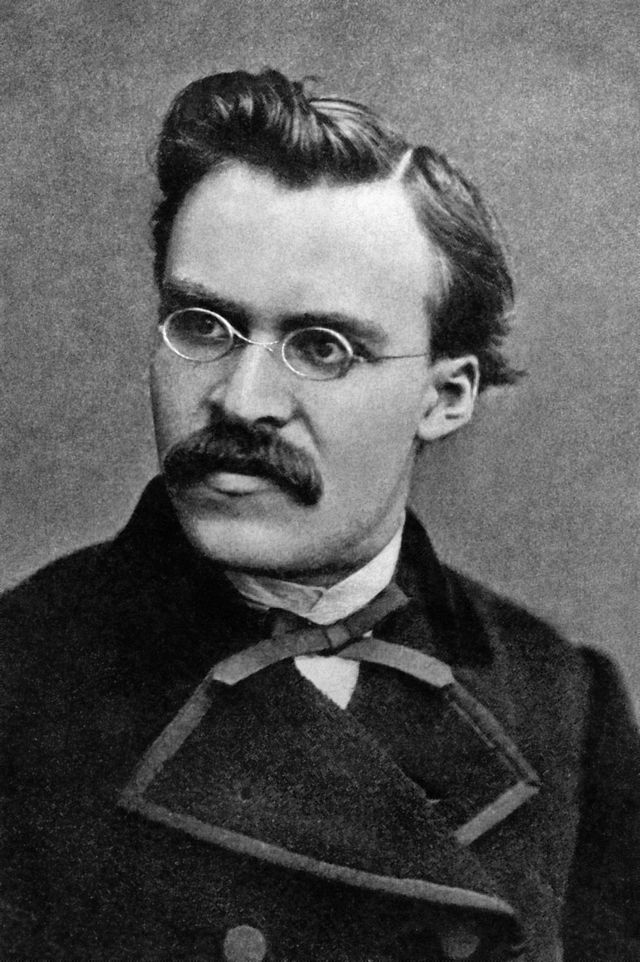
 All the criticisms leveled against Nietzsche that you have posted are valid. Nietzsche is too often assigned to atheists because of his famous “God is dead” line. Nietzsche dismissed the so-called Golden Rule as insipid sentimentalism, as well as Rousseau’s declaration that human empathy proves the goodness of man. Nietzsche operates outside of what we consider conventional morality, and he makes for an exciting read, but in the end must be rejected by agnostics like myself due to his disdain for the vast majority of humanity, those trapped within slave-morality.
The philosopher I admire is Schopenhauer, especially his notion that compassion is the only good. Schopenhauer blended Indian philosophy into his belief, that when one exercises their will it leads to suffering. This is different from Nietzsche’s claim that will should be used to gain power, and that power is only for elite “Supermen” and whatever may be the lot for the rest of humanity does not matter. (Also note that Nietzsche was one of histories great misogynists, and seemed to truly loathe women.)
The atheist/agnostic would be better served by association with Schopenhauer than Nietzsche. Nietzsche is to be admired as a writer and a thinker, but not as a guide to New Atheism.
Another rejects the claim from a previous reader that since “the religion believed and practiced by the vast majority of the religious” isn’t the sophisticated theism of, say, David Bentley Hart, the New Atheists have a point:
I’ve never understood why this is the criteria for judging religion’s validity.
Is this criteria applied to anything else? Is philosophy bunk because most people who understand themselves to be “selves” couldn’t tell you the first thing about the cogito? Are social theories about race to be dismissed because most of us are oblivious to them–or aware of them incorrectly? Of course not. But the sadly all too human behavior and misunderstandings of those that practice religion are regularly pointed to as an excuse to be incurious about its deeper possibilities. Those intellectually curious who want to know about philosophy or race or anything else don’t ask the general populace but turn to the sharpest, most cogent thinkers on the subject. What is so dangerous about doing the same with religion?
Another reader adds that there’s “no reason to be so tentative regarding the case for a secular basis of ethics”:
There are plenty of sophisticated defenses of “secular” ethics. We can look at Derek Parfit’s On What Matters, or Tim Scanlon’s What We Owe to Each Other, or Christine Korsgaard’s Sources of Normativity, or Michael Huemer’s Ethical Intuitionism, or David Enoch’s Taking Morality Seriously, or dozens of other books. (Indeed, from the survey information we have (as found here) moral realism and atheism are both favored positions among academic philosophers.) What’s always so odd to me is the two-pronged attack made by those who insist on the inadequacy of a secular account of morality: on the one hand, they contend that secular ethics doesn’t address various thorny metaphysical and epistemological issues. And yet, when presented with the existence of such sophisticated works that plainly do address such issues, they dismiss the works as being too obscure and complicated — too academic if you will. Well, you can’t have it both ways. If you want a robust and sophisticated defense of secular morality, then you might need to read something a little more dense than a book about atheism designed to be accessible to a popular audience.
Previous reader responses here. Meanwhile, other readers respond to Michael Robbins’ letter to the Dish:
Michael Robbins’ latest defense of his essay review of Spencer’s book, which you posted, conveniently skips past a colossal point that one of your readers quite cogently articulated in dissent:
The religious intelligentsia want to embrace the vast majority of Christians (who believe nothing like they do), as part of their faith, and at the same time decry atheists who focus on that vast majority as failing to engage “true” Christianity and the deep, meaningful arguments for the faith.
Robbins goes on to prove your reader right when he, like John Haught and David Bentley Hart and other “Sophisticated Theologians”, makes the boring mistake of saying that “religious fundamentalism is a soft target.” Is it really that soft when almost half of America believes that God created the world in its current form according to Genesis? Is it really?
Another:
Dammit. I never said anything, positive or negative, about the Hart quote other than Robbins wanted us to focus on it. More to the point: When Michael Robbins writes “Christians have recognized the allegorical nature of these accounts since the very beginnings of Christianity”, or “it’s not God, at least not God as conceived by a single one of the major theistic traditions on the planet”, he’s ignoring the belief of most Christians in the US and elsewhere. To be clear, most living Christians do not recognize the allegorical nature of these accounts (a statement easily proven).
When Robbins says, “I had assumed it was obvious that Origen and Augustine would hardly have taken the trouble to deny literalist readings of the Bible if such readings did not exist” he’s faking left and going right. Reading the Bible literally came after the Reformation (a fact Robbins flags in his article “He Is Who Is“). And while I am insufficiently educated to speak to Origen, I’m happy to go head-to-head on Augustine: $50 for every place Augustine denies literalist readings of the Bible vs. every place Augustine did not. For example, did Augustine believe in a literal Adam and Eve and original sin? (Yes.) Does evolutionary theory destroy both? (Yes.) Will I make good money if Robbins takes me up on my offer? (Yes.)
“Young-earth creationism” is “of course” not based on the Bible. He seriously said that. Robbins’ use of the phrase “of course” illustrates a startling ignorance of the mass of Christianity and their scriptural exegesis. Apparently Ken Ham and Bill Nye’s debate on a 6,000 year-old earth missed the point – nobody watched it.
OK, enough whining, to the heart: Michael Robbins continues to miss the point.
But the New Atheists did not write books that simply attacked creationism. They wrote books that purport to challenge theistic belief as such. They therefore have a responsibility to address the best cases for God, not the dullest.
They wrote books to challenge the theistic belief … of the vast majority of Christians. The audience that believes Noah stuffed 9 million unique species on a boat, and the kangaroos hopped from Mount Ararat to Australia without leaving a single skeleton. That doesn’t require challenging the best cases for God, that requires pointing out that 18 million animals would require a lot of food, produce a lot of waste, and the wolves would probably eat the rabbits. If the target audience doesn’t care (or understand), the best cases, why should atheists focus on them?
Yes “religious fundamentalism” is a soft target – but it is the important target, and the target on which atheists should focus. If Robbins disagrees, he needs to make the argument that attacking the best cases for God is worth doing, not that it’s the “right” thing to do.
Another piles on:
I’ve found Michael Robbins essay and response both unconvincing. The “New Atheists should be more like Old Atheists,” trope aside, there are other tropes I saw in Robbins’ response. Let’s play spot the trope!
But the New Atheists did not write books that simply attacked creationism. They wrote books that purport to challenge theistic belief as such. They therefore have a responsibility to address the best cases for God, not the dullest. When Dennett asks if super-God created God, and if super-duper-God created super-God, he is simply revealing a lack of acquaintance with the intellectual traditions of the major religions. If you want to argue against something, you have to understand what you’re arguing against. That’s axiomatic.
I would say there are two standard tropes in here. First is the atheists don’t address “the best cases for God.” As far as I can tell atheists always deal with the argument for God being made. Whenever I see that phrase I’m reminded of the practice of goal-post shifting. Often when an atheist addresses a “case for God” they’re told that they haven’t addressed the “best case for God.” Which makes me wonder, why don’t proponents of theism use the “best case for God?” Maybe Robbins should check out Jerry Coyne’s website (not blog) Why Evolution is True; he has addressed various “best cases for God.” Most recently he covered David Bentley Harts’ latest book and found that that “best case for God” was a series of non-sequiturs. X exists therefore God is hardly a convincing argument.
The second I noticed has already been addressed through the Courtier’s Reply. I don’t need to spend several years studying fashion to point out someone’s naked just as I don’t have to spend several years studying theology to point out arguments for theism are not rational.
Another thing, this sentence: “Some atheists believe that their faith in scientific naturalism suffices to disprove the existence of God, for instance.” Speaking of caricatures … I will admit that there may be atheists like this but I know of no atheists who make arguments like that. Science simply eliminates various things from various gods portfolios and finds natural explanations. Germ theory of disease is one example. Do bacteria and viruses disprove God? Of course not, it simply means that God is not needed for people to get sick.
The atheists I know are atheist because they found the argument for theism unconvincing. Personally I’ve always found evidence for theism lacking and the philosophical arguments for theism either irrational or creating an irrelevant deity whose existence is identical to it’s nonexistence. Robbins should check out QualiaSoup’s three–part series on morality without God if he wants to some idea of what he’s arguing against.
[snark] Oh wait, stuff like that can’t exist because of the intellectual shallowness of atheists. [/snark]
I love my family and friends. I help others because it is right. I share what pleasure I have with the people I care about. I celebrate life as best I can and share what joy in life as best I can, because this is all we get. There’s no way I’m going to celebrate life any less just because someone told me I should be sad about the death of God.



 The Dish