You have until noon on Tuesday to guess it. City and/or state first, then country. Please put the location in the subject heading, along with any description within the email. If no one guesses the exact location, proximity counts. Be sure to email entries to contest@andrewsullivan.com. Winner gets a free The View From Your Window book or two free gift subscriptions to the Dish. Have at it.
Category: The Dish
Schisms In Schizophrenia
Stanford anthropologist Tanya Luhrmann investigates how culture affects people’s experience of schizophrenia:
[S]he interviewed adults with schizophrenia who live in three different places: Chennai, India, Accra, Ghana, and San Mateo, California. She asked each person to describe his or her auditory hallucinations—how many voices they heard, what the voices said, where they felt the voices were coming from.
Luhrmann found many similarities across the three cultures, but also some important differences. The people from Ghana and India generally found hearing voices to be a positive experience, describing the voices as benign and playful, involving sex, or as spiritual encounters. The 20 people interviewed in California expressed opposite sentiments, describing the voices as angry, hateful, noisy, and violent. One American subject described the voices as giving directions “like torturing people, to take their eye out with a fork, or cut someone’s head and drink their blood, really nasty stuff.”
The differences across cultures, Luhrmann argues, can be explained by several factors. In India and Ghana, people were more likely to hear what they thought of as voices of family members, while in the U.S., schizophrenics tended to regard the voices as strangers, which made them more threatening. She thinks this could reflect differences in family structure—extended families are tighter in Ghana and India than they are here, where we’re more likely to live alone.
Digital Dark Arts
A new project collects artistic renderings of computer viruses:
Inspired by the “dark side of computing,” Amsterdam-based designer Bas van de Poel has launched an illustrated online guide to some of the world’s most destructive computer viruses.
The Computer Virus Catalog charts twenty viruses dating from the 1960s to the present day. Some are fairly harmless – from an animated worm wishing users Happy New Year and one which triggers lichen-inspired visuals when keyboards are inactive – while others have wiped out entire hard drives and caused billions of dollars in damage.
Fernando Alfonso III offers more context:
“Luckily, I never got infected by any of these viruses myself,” de Poel told me. “However, I did got affected by the stories behind some of these viruses. The moment I found out that the disastrous Melissa virus is named after the author’s favorite exotic dancer, I knew I wanted to explore this dark side of computing creatively.”
(Image: LSD, illustrated by Clay Hickson, overwrites computer users files’ before displaying a hallucinogeic-inspired video)
A Poem For Saturday
Dish poetry editor Alice Quinn writes:
Ron Padgett is a master of scale, adept at tiny poems, long poems, and prose poems, too. Here are two from his recent Collected Poems, published by Coffee House Press and winner of both the William Carlos Williams Award from the Poetry Society of America and the Los Angeles Times Book Prize. The first is titled “Song”:
Learning to write,
be a good person and get to heaven
are all the same thing,but trying to do them all at once
is enough to drive you crazyThe second is “Poem”:
No sir!
Trade places with an animal?
Have a muskrat read my books
while I scuttle through the woods in terror?Padgett has many admirers among poets, among them John Ashbery, Thomas Lux, Alice Notley, Charles Simic (“As is often the case, leave it to the comic writer to best convey our tragic predicament.”), and Tom Clark (“These poems mingle the nervy sophistication and cosmopolitan experimentalism of a thriving international avant-garde art tradition with a kind of hillbilly twang that’s unmistakably American.”).
It’s the tenderness and the whimsy that captivate me.
“Glow” by Ron Padgett:
When I wake up earlier than you and you
are turned to face me, face
on the pillow and hair spread around,
I take a chance and stare at you,
amazed in love and afraid
that you might open your eyes and have
the daylights scared out of you.
But maybe with the daylights gone
you’d see how much my chest and head
implode for you, their voices trapped
inside like unborn children fearing
they will never see the light of day.
The opening in the wall now dimly glows
its rainy blue and gray. I tie my shoes
and go downstairs to put the coffee on.
(From Collected Poems © 2013 by Ron Padgett. Used by permission of Coffee House Press. Photo by Mikael Colville-Anderson)
Decriminalize Sex Work To Fight AIDS
That’s the call from the scientists at this year’s International AIDS Conference in Melbourne, Australia:
According to new research — a series of seven studies recently published in the Lancet medical journal — scientists estimate that HIV infection rates among sex workers could be reduced by between 33 and 46 percent if the activity were not illegal.
“Governments and policymakers can no longer ignore the evidence,” asserted Kate Shannon, an associate professor of medicine at the University of British Columbia and the lead author of the study. The research, conducted in Kenya, India, and Canada, found that high rates of violence against sex workers, police harassment, and poor working conditions — all circumstances exacerbated by sex work’s illegal status — combined with lack of access to HIV prevention and care significantly increased the risk of infection among sex workers. According to recent data from the World Health Organization, female sex workers are 14 times as likely to have HIV as other women, yet fear of arrest and stigma often prevents them from seeking medical care. (A Kenyan woman quoted in the study added that when doctors at the health center she visited realized she was a sex worker, she was denied treatment.)
In a report issued earlier this month on how to combat HIV transmission in high-risk populations, the World Health Organization said the same:
What unites these groups is that their activities are either illegal or heavily stigmatized in many parts of the world. That means that they are unlikely to seek out medical help or advice simply because they don’t want to be arrested for being gay or having sex for money. In the case of adolescents, many live in countries where they need parental permission to get birth control or medical care. So they, too, must hide their activities from doctors to avoid being “turned in” to their parents.
When you have populations of people who fear that a trip to the doctor may land them in jail, it makes sense that those populations won’t follow medical guidelines about safer sex or clean needles. Either they don’t know how to reduce their risks; or if they do, they don’t have have access to materials that would allow them to have sex or inject drugs safely. And that’s why the WHO is calling for all countries to decriminalize the behaviors and identities of all these groups so that they can get the health care they need.
Samuel Oakford focuses on the difference between decriminalization and legalization:
Though countries like the Netherlands and Germany have legalized sex work in defined contexts, and nations like Denmark have decriminalized it in certain circumstances (soliciting on the street is still illegal), the only two places in the world to have fully decriminalized it are New Zealand the Australian state of New South Wales. The distinction is important — decriminalization removes all “prostitution-specific regulations imposed by the state,” while legalization introduces new laws and regulations that are less punitive. In the latter framework, sex workers without proper permits or access are still forced to work underground.
“Legalization actually replicates some of the same problems that criminalization does,” [Steffanie Strathdee, director of the University of California at San Diego’s Global Health Initiative and the author of one of the studies,] said. “The perspective is about taxes and control and not about human rights. Even in legalized environments there are police crackdowns.” Countering a common concern voiced against reform, the number of sex workers in New Zealand hasn’t changed significantly since the profession was decriminalized in 2003. In New South Wales, which decriminalized sex work in 2009, sex workers actually have a lower prevalence of HIV than in the rest of the country.

Playing Like A Pro
With the largest video-game tournament in history recently coming to a close, Vlad Slavov examines the challenges of making a career as a pro gamer:
Without the financial support of a team or committed sponsors, it’s basically impossible to put in the time necessary to refine your skills to the highest level. Juggling pro matches with school or work responsibilities is particularly awkward in the US, where most competitive games are played in the morning. It’s an all-in or all-out affair, and the way the players talk about it reveals the sustained intensity that’s required.
[Career gamer] ppd speaks of “disengaging” in the afternoon after at least six hours of team practice every day. That’s later followed by playing solo or live-streaming matches on Twitch late into the night. [Gamer] UNiVeRsE adds that there’s also no such thing as a holiday from the game: players take some time off after The International, but otherwise The Chinese e-sports teams take the commitment to training to its logical extreme by having the whole team live together under one roof throughout the year. They don’t even consider it proper practice unless all five players are in the same room, working as a team.
The tournament closed “following an epic best-of-five clash between two of China’s biggest teams”; with the victorious five-person team taking home $5 million of the tournament’s $10-million prize pool.
(Photo of Seattle’s KeyArena for the International DOTA 2 Championships on July 18, 2014, by Jakob Wells)
The Name’s Bond. @JamesBond
Have smartphones and Facebook ended the golden age of the spy novel? Charles Cumming worries that it “may be that technology strips the spy of mystique”:
Once upon a time, spies like [John le Carré’s] Alec Leamas could move across borders with ease. Passports were not biometric, photographs were not sealed under laminate, and there were no retinal scanners at airports (which, incidentally, can’t be fooled by fitting a glass eye or wearing contact lenses manufactured by ‘Q’ branch). … Nowadays, travelling “under alias” has become all but impossible. If, for example, an MI6 officer goes to Moscow and tries to pass himself off as an advertising executive, he’d better make sure that his online banking and telephone records look authentic; that his Facebook page and Twitter feeds are up to date; and that colleagues from earlier periods in his phantom career can remember him when they are contacted out of the blue by an FSB analyst who has tracked them down via LinkedIn. The moment the officer falls under suspicion, his online history will be minutely scrutinised. If the contacts book on his Gmail account looks wrong, or his text messages are out of character, his entire false identity will start to fall apart.
“All of this has affected storytelling,” continues Cumming, who describes how he circumvented the issue as a novelist himself:
If a character can be reached or tracked by phone, it follows that he or she can be warned of impending danger, or rescued from peril. In my novel A Foreign Country, it was necessary to set a crucial sequence deep in the English countryside so that the principal characters were thwarted by feeble mobile reception. Likewise, unless a character knows to remove the battery from their phone (something, incidentally, that can’t easily be done with an iPhone) he or she can be followed 24 hours a day, seven days a week. Even when switched off, a phone emits a signal that can be picked up by GCHQ and others. The phone’s position can be then be pinpointed to within a few feet by “triangulating” the signal to the nearest satellite or mobile phone mast.
The View From Your Window
Fractions Are Hard!
Kevin Drum is most amused by this anecdote from Elizabeth Green’s NYT essay about math education:
One of the most vivid arithmetic failings displayed by Americans occurred in the early 1980s, when the A&W restaurant chain released a new hamburger to rival the McDonald’s Quarter Pounder. With a third-pound of beef, the A&W burger had more meat than the Quarter Pounder; in taste tests, customers preferred A&W’s burger. And it was less expensive. A lavish A&W television and radio marketing campaign cited these benefits. Yet instead of leaping at the great value, customers snubbed it.
Only when the company held customer focus groups did it become clear why. The Third Pounder presented the American public with a test in fractions. And we failed. Misunderstanding the value of one-third, customers believed they were being overcharged. Why, they asked the researchers, should they pay the same amount for a third of a pound of meat as they did for a quarter-pound of meat at McDonald’s? The “4” in “¼,” larger than the “3” in “⅓,” led them astray.
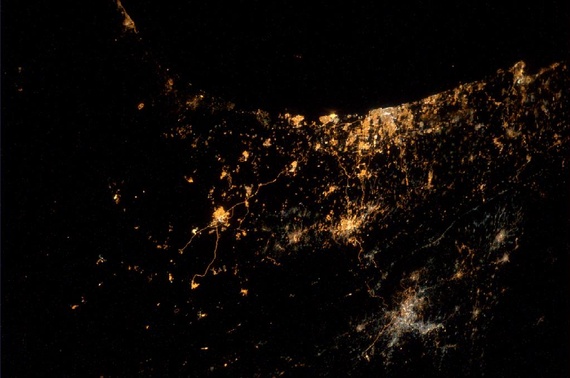
The Holy Land From On High
Megan Garber captions:
The orbiting space station—itself a symbol of international cooperation and, in that, global unity—passed over Israel and Palestine as it orbited Earth’s surface yesterday. It was nighttime on that side of the planet, as one human habitat passed over another; everything was dark save for the man-made lights studding the land. And save for one other thing, too: explosions. The flashes of bright light—brighter than the other ones—that are distantly visible evidence of human bloodshed. “From #ISS we can actually see explosions and rockets flying over #Gaza & #Israel,” [Astronaut Alexander] Gerst tweeted. He then shared the image above. He noted, as he did so, that it was his “saddest photo yet.”