Bibi’s Strategy, Ctd

Larison is unconvinced by Rich Lowry’s cheerleading for Israel in the Gaza war, which Lowry attributes entirely to Hamas’ “depraved indifference to the safety of Gazans”. If Lowry is right about Hamas’ aims, Larison argues, that actually illustrates why Israel going to war hurts its own interests in the long term:

The summary is misleading at best, but even if we accept all of it as true it doesn’t make Israel’s current military operation defensible. Hamas may want war and civilian casualties, and it is fully responsible for everything that it does, but that doesn’t justify Israel in giving them what they want. Nothing could better sum up the irrationality of defenders of the current operation than the argument Lowry is offering here. We’re supposed to accept that Israel’s government mustn’t be faulted for what it’s doing, because Israeli forces are inflicting death and destruction that predictably redounds to Hamas’ political benefit. According to this view, Hamas is the only one to be blamed for the consequences of the military overreaction that has stupidly given Hamas an unwelcome boost. This is little better than the foreign policy equivalent of saying “the devil made me do it,” as if it that made everything all right.

And Daniel Byman argues that Israel’s strategy of heavy-handed deterrence often ends up producing the opposite outcome:

Because Israel is arguably the most casualty-sensitive country in the world, deterrence is even harder. With nuclear weapons and carpet-bombing off the table, Israel needs to go in on the ground to achieve its objectives — but ground operations can lead to Israeli casualties that actually undermine its deterrence.

In 2011, it traded over 1,000 prisoners for Gilad Shalit, an Israeli soldier captured by Hamas in 2006. Israel has even traded high-level prisoners for the bodies of its dead soldiers. As a result, the body counts for successful deterrence are often staggering and highly disproportionate: In the 2008-2009 Cast Lead operation, Israel killed more than 1,200 Palestinians and suffered only 13 losses of its own — roughly a 100-1 ratio. This, of course, makes Israel look even more callous.

Brent Sasley doesn’t think much of Netanyahu’s stated goal of “sustainable quiet”:

As far as I can tell, “quiet” is defined as a number of rockets, preferably not by Hamas, so long as they don’t cause any damage, certainly don’t kill any Israelis, and there’s nothing else that requires a bigger Israeli response. That, I think, is the goal.

Now, my concern is that Israel doesn’t have a strategic agenda for the region as a whole, which means it doesn’t have a strategic goal in this operation. Not a Bibi problem, it’s an Israel problem. There’s a history to it — that’s how Israel developed, it’s been forced on the defensive, it thinks reactively instead of proactively, and so on. Those are all important explanations, but it goes beyond that. After a certain point, it becomes a cop-out to say “Israel just can’t think long-term.”

Now, some people say that there is a strategy — that horrible term “mowing the grass,” or I guess a “war of attrition” is a more sophisticated way of saying it. That’s a holding pattern, as far as I can see. Israel doesn’t have a national security strategy, it’s never really articulated one.

So what Hamas has to gain by firing rockets is more political than anything else:

Israeli officials say the system has intercepted more than 80 percent of the incoming rockets it targeted during this conflict, with most others missing their targets or landing in empty space. But Jeffrey White, a defense fellow at the Washington Institute for Near East Policy, says Hamas reaps benefits from showering Israel with missiles, even if they don’t hit their targets. “Their ability to disrupt life in Israel is big, because every time they fire a volley of rockets, sirens go off and everyone runs for shelter,” White says. “School gets closed, life gets disrupted, it puts people under a lot of strain.”

The strikes could have economic effects as well, as evidenced by this week’s decision from the Federal Aviation Authority to halt all flights into Israel after a long-range missile landed near Ben Gurion airport outside Tel Aviv — a decision that White describes as “a huge development.” (The ban was lifted late Wednesday, after the FAA said it was satisfied with safety measures that Israel implemented.)

Goldblog, however, is more concerned about Hamas’s tunnels than its rockets:

Israelis appear adamant that any cease-fire agreement reached between the parties must eradicate the threat of these kidnapping tunnels, at a minimum. Anything short of this will fail to bring any stability to the region. Hamas, which is incapable of envisioning peace and reconciliation in the manner of advocates for a two-state solution, and which has already rejected multiple calls for cease-fires, is demanding that Israel and Egypt (which has Gaza’s southern border blockaded as well) reopen both Gaza’s borders and its ports.

This would be insanity. For years, Hamas leaders demanded that Israel allow them to import concrete in order to build homes for Gaza’s poor. We now know where so much of this concrete went — into the tunnels that run under Israel’s border, and into bunkers and bomb shelters for Gaza’s ruling elite. (The civilians of Gaza, the ones exposed to Israel’s bombardments, do not benefit from these exclusive bomb shelters).

Overall, Mitchell Plitnick contends, Hamas is sort of winning:

Palestinian President Mahmoud Abbas has been working to help find a ceasefire formula. In the past, Hamas would disavow Abbas’ authority to negotiate for them, but they have not done so this time. That’s because Abbas is arguing for Hamas’ terms for a ceasefire. That makes Abbas, rather than any Egyptian or Turkish leader, the contact point between Hamas and Israel. It also symbolically demonstrates that the Palestinians have a unified government — Abbas is presenting himself as the leader of all of Palestine, including Gaza, without saying so or ruffling any of Hamas’ feathers.

Israel’s goal in starting this round of fighting was to destroy the unity deal between the Palestinian Authority and Hamas. Thus far, the opposite seems to have materialized. Abbas is in agreement with Hamas’ goals, and is apparently fully representing them. That represents a major failure for Netanyahu.

Previous Dish on Netanyahu’s political and military strategy in the Gaza war here.

Stone-Age Skepticism

9326300253_04b16feb2d_z

Elizabeth Kolbert has her doubts about the paleo diet:

There are, of course, lots of ways to resist progress. People take up knitting or quilting or calligraphy. They bake their own bread or brew their own beer or sew their own clothes using felt they have fashioned out of wet wool and dish soap. But, both in the scale of its ambition and in the scope of its anachronism, paleo eating takes things to a whole new level. Our Stone Age ancestors left behind no menus or cookbooks. To figure out what they ate, we have to dig up their bones and study the wear patterns on their teeth. Or comb through their refuse and analyze their prehistoric poop.

And paleo eating is just the tip of the spear, so to speak. There are passionate advocates for paleo fitness, which starts with tossing out your sneakers. There’s a paleo sleep contingent, which recommends blackout curtains, amber-tinted glasses, and getting rid of your mattress; and there are champions of primal parenting, which may or may not include eating your baby’s placenta. There are even signs of a paleo hygiene movement: coat yourself with bacteria and say goodbye to soap and shampoo. …

Three days into my family’s experiment in Stone Age eating, my sons were still happily gorging themselves on sausage and grass-fed steak. My husband was ruminating on the tenuousness of existence, and, probably true to the actual Paleolithic experience, I found that I was spending more and more time preparing the few foods that we could eat.

Kolbert adds, “Paleo may look like a food fad, and yet you could argue that it’s really just the reverse. Anatomically modern humans have, after all, been around for about two hundred thousand years. The genus Homo goes back another two million years or so. On the timescale of evolutionary history, it’s agriculture that’s the fad.” Nathanael Johnson sharpens the knife:

[A]griculture is an unusual sort of fad – a fad our lives depend upon. It’s got its hooks in us. Farming allowed the human population to exceed the earth’s previous carrying capacity. The creation of synthetic fertilizers expanded that carrying capacity again. And now, like it or not, we’re stuck. A new study, just out from the Proceedings of the National Academy of Sciences, reaffirms that meat production has an outsized impact on climate change, and that beef is the worst offender. It suggests that, if we want to reduce our greenhouse gas emissions, it would be more effective to give up red meat than to stop driving cars. This means that, “from an environmental standpoint, paleo’s ‘Let them eat steak’ approach is a disaster,” Kolbert wrote.

Damian Carrington elaborates on the PNAS study:

[Beef] requires 28 times more land to produce than pork or chicken, 11 times more water, and results in five times more climate-warming emissions. When compared to staples like potatoes, wheat, and rice, the impact of beef per calorie is even more extreme, requiring 160 times more land and producing 11 times more greenhouse gases.

(Image by Flickr user Next TwentyEight)

You Can’t Believe Everything You Read About Iraq

A UN official who claimed that ISIS had ordered genital mutilation for all women and girls in Mosul appears to have been the victim of a hoax:

The story quickly began to go viral, racking up hundreds of shares on social media. Soon thereafter, however, journalists with contacts in Iraq began reporting that the story didn’t hold up. “My contacts in #Mosul have NOT heard that ‘Islamic State’ ordered FGM for all females in their city,” Jenan Moussa, a reporter with Al Anan TV tweet out. “Iraqi contacts say #Mosul story is fake,” echoed freelance writer Shaista Aziz, adding: “Iraqi contact on #FGM story: “ISIS are responsible for many horrors, this story is fake and plays to western audience emotions.’”

NPR’s Cairo bureau chief also claimed that the story was false, tweeting “#UN statement that #ISIS issued fatwa calling 4 FGM 4 girls is false residents of Mosul say including a doctor, journalist and tribal leader.” Not long after a version of a document in Arabic, bearing the black logo that ISIS has adopted, began circulating on Twitter. The document, those who shared it said, is a hoax and the basis for the United Nations’ claim.

That wasn’t the only inaccurate story to come out of the Islamic State. David Kenner highlights some others:

Last week — as the jihadist group’s very real campaign to force Christians to pay a tax levied on non-Muslims, convert to Islam, or face death reached fever pitch — multiple news outlets reported that the Islamic State had burned down the St. Ephrem’s Cathedral. There was just one problem:

The pictures published by news outlets and shared on social media of the supposed burning of the Syriac Catholic cathedral were from church burnings in Egypt or Syria. To this day, there has been no confirmation from anyone in Mosul that a cathedral was burned.

But the most spectacular story about the Islamic State relates to what would have been one of history’s most spectacular bank heists. Shortly after the group stormed Mosul, the provincial governor in the region told reporters that it had raided the city’s central bank, making off with more than $400 million, in addition to a “large quantity of gold bullion.” … There’s only one problem: The heist doesn’t appear to have happened.

The news that ISIS militants destroyed the tomb of the prophet Jonah, on the other hand, appears depressingly credible:

Residents said on Thursday that the militants first ordered everyone out of the Mosque of the Prophet Younis, or Jonah, then blew it up. … Several nearby houses were also damaged by the blast, said the residents, speaking on condition of anonymity because they feared for their own safety. The residents told AP that the militants claimed the mosque had become a place for apostasy, not prayer. The extremists also blew up another place of worship nearby on Thursday, the Imam Aoun Bin al-Hassan mosque, they said.

Face Of The Day

BRITAIN-FRANCE-THEATRE-WWI

A massive marionette known as the “Giant Grandmother” is paraded through the streets of Liverpool in north-west England on July 25, 2014. The parade entitled “Memories of August 1914” by French theatre company Royal de Luxe features a giant grandmother, a giant little girl and her dog named Xolo, and tells the story of the city’s involvement in World War One. By Lindsey Parnaby/AFP/Getty Images.

When “Me, Me, Me” Means “You, You, You”

Katy Waldman examines one subtle way people inadvertently signal their insecurities:

We know now that the linguistic expression of low confidence plays out in pronouns. Until recently, many experts believed that first-person singular referents were verbal playthings for the powerful and narcissistic, the me-me-me-me-me people who demand attention. But as James Pennebaker, a psychologist from the University of Texas at Austin, has written, the pronoun “I” often signals humility and subservience. A more confident person is more likely to be surveying her domain (and perhaps considering what “you” should be doing), rather than turning inward. …

[Linguist William] Labov’s experiment suggests that punctilious attention to “proper” usage may come from a place of insecurity. The extreme form of this is hypercorrection, in which “a real or imagined grammatical rule is applied in an inappropriate context, so that an attempt to be ‘correct’ leads to an incorrect result.” (Think substituting “you and I” for “you and me” as the object of a sentence, or all the stilted uses of whom.) Labov and his successors found that people hypercorrect most in moments of self-consciousness—when switching into a shaky second language or addressing a crowd. Perhaps their zeal to “get it right” is just another version of the desire for belonging.

America’s Mixed Feelings On Gaza

5s7kx2l-zkoypyrmn6f49a

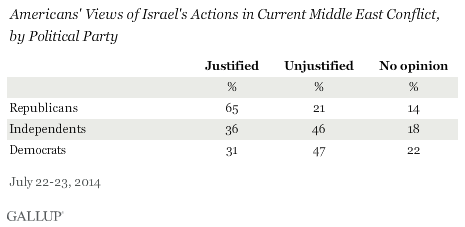
Larison flags a new Gallup poll suggesting that US public opinion on the Gaza war is more complicated than our government’s response to it:

Gallup finds that Americans are split on the question of whether Israel’s actions in Gaza have been justified or not. Overall, 42% say that they are justified, 39% say they are not, and 20% have no opinion. These results are comparable to a Gallup poll taken during the second intifada twelve years ago, but there are slightly more on the ‘unjustified’ side than there were then. As we have seen in other polls on related matters, there is a significant gap between Republicans and everyone else[.]

It is striking how evenly divided the public is on this question when there is total uniformity among political leaders in the U.S. that Israel is justified in what it has been doing. There is always a significant gap between popular and elite views on foreign policy issues, but it is still fairly unusual for a view held by almost 40% of Americans to have virtually no representation in Congress.

Another poll from YouGov finds that more detailed questions yield more nuanced answers:

Americans are much more likely to hold Hamas responsible for the current crisis than they are to put responsibility on Israeli Prime Minister ResponsibilityBenjamin Netanyahu. But that doesn’t mean that Netanyahu is totally blameless:  47% of the public says he deserves at least half the blame.  But two-thirds say that about Hamas. Three in four Republicans give Hamas at least half the blame. Just 40% of Republicans say that about Netanyahu. Democrats share the responsibility more evenly: 60% give Hamas at least half the responsibility; 54% say that about Netanyahu.

But some are concerned about Israeli actions. One in four believes Israel is using too much force in Gaza, with Democrats and those under 30 especially concerned.  But more believe Israel is using the right amount of force; 15% (and nearly one in four Republicans) believe Israel is using too little force.

But as we know, the right wasn’t always reflexively behind Israel. Looking back on the history of American-Israeli relations, Zack Beauchamp susses out the sources of the staunchly pro-Israel foreign policy the US follows today:

For one thing, the US approach to the Middle East didn’t change that much after the Cold War. The US became increasingly involved in managing disputes and problems inside the Middle East during the Cold War, and it maintained that role as the world’s sole super-power in the 90s. Stability in the Middle East continued to be a major American interest, for a number of reasons that included the global oil market, and the US took on the role as guarantor of regional stability.

That meant the US saw it as strategically worthwhile to support states like Egypt, Saudi Arabia, and Israel, which saw themselves as benefitting from an essentially conservative US approach to Middle Eastern regional politics. Unlike, say, Iran, Syria, and Saddam’s Iraq, these countries were basically OK with the status quo in the Middle East. The US also supported the status quo, so it supported them accordingly.

Previous Dish on the partisan divide in American public opinion of Israel here.

What Ex-Prisoners Need Most

Christopher Moraff lauds the “housing first” approach:

Although education, employment, and treatment for drug and mental health issues all play a role in successful reintegration, these factors have little hope in the absence of stable housing.

Yet, few leaving prison have the three months’ rent typically required to get an apartment. Even if they did, landlords are given wide latitude in denying leases to people with a criminal record in many states. Further, policies enacted under the Clinton administration continue to deny public housing benefits to thousands of convicted felons — the majority of whom were rounded up for non-violent offenses during the decades-long War on Drugs. Some are barred for life from ever receiving federal housing support. As a result, tens of thousands of inmates a year trade life in a cell for life on the street. According to [criminal justice professor Faith] Lutze, with each passing day, the likelihood that these people will reoffend or abscond on their parole increases considerably.

Lutze and a team of researchers recently completed a comprehensive assessment of a Washington State program that aims to reduce recidivism by providing high-risk offenders with 12 months of housing support when they are released from prison. The study tracked 208 participants in three counties and found statistically significant reductions in new offenses and readmission to prison. It also found lower levels of parole revocations among participants.

Quote For The Day

Tensions Remain High At Israeli Gaza Border

“I still felt the same [way about Israel] in 1973, during the Yom Kippur War when Israel reeled before a devastating Egyptian and Syrian surprise attack. From amid the Israelis’ camp fires, as a correspondent I wrote expressing my admiration for the nation, for what it had created from a near-wasteland: ‘They are a very great people, who have come closer to destruction than blind Europe seems willing to recognise.’

The veteran journalist James Cameron, who had known Israel since its inception, wrote me a generous note after that piece was published, saying: ‘It is quite impossible to work in combat with the Israeli army without this response, if you have any sense of history and drama.’ But then he added reflectively: ‘I have sometimes wondered over the past few years whether this irresistible military mesmerism hasn’t clouded for us some of the political falsities.’

Some 40 years on, I have become sure that Jimmy Cameron was right. Too many of us allowed ourselves to become blinded by military success to the huge injustice done to the Palestinians. Israelis, confident that they can defeat any Arab military threat, bolstered by almost unqualified U.S. support, assume that they can persist indefinitely with the creeping annexation of the West Bank, and the subjection of Gaza …

A few years ago, I revisited the West Bank and Gaza, and like most visitors recoiled from their squalor, the prevailing culture of rage and despair. It is true that the Palestinians, led by men skilled in guerrilla war but little else, speak a language of emotion and unreason. But I have also watched the soldiers of the Israeli Army that I once loved disport themselves among the Palestinians like other arrogant occupiers through the ages, displaying at best casual rudeness, at worst murderous brutality. Israel aspires to exploit its military dominance to create irreversible facts on the ground in the West Bank and Jerusalem, heedless of Palestinian rights,” – Max Hastings, no peacenik, saying what so many others actually think, in the Daily Mail.

(Photo: An Israeli soldier weeps at the grave of Israeli Sergeant Adar Barsano during his funeral on July 20, 2014 in Nahariya, Israel. Sergeant Barsano was killed along with another IDF soldier on the twelfth day of operation “Protective Edge,” when Hamas militants infiltrated Israel from a tunnel dug from Gaza and engaged Israeli soldiers. By Andrew Burton/Getty Images)

Mental Health Break

We might end up making an executive decision and declare this one the best cover song ever:

Update from a reader:

How dare you put Cartman’s “Poker Face” ahead of the epic “Come Sail Away” from the Chef Aid episode.  The video doesn’t exist, but the rendition alone is pure gold:

Don’t Call It A “Muslim Democracy”

Bobby Ghosh objects to pundits and politicians who are praising Indonesia as an example to other Muslim countries in light of its successful presidential election:

Over the next few days, you will see and hear commentary on how Indonesia’s election is—or should be — an inspiration for all of Islam. It is proof, the commentators will say, that Islam is not antithetical to democracy. This is an old trope, too frequently embraced by Western political leaders, such as David Cameron and Hillary Clinton. Its subtext is not subtle: If only the Arabs could be more like the Indonesians, they too could enjoy the fruits of democracy and nonviolent transfers of power. And the world would be a much more peaceful place. That view is highly patronizing, of Indonesians, of Arabs and of Muslims in general. …

After years of living and traveling in Arab countries, I am not persuaded that people there need the inspiration of a “Muslim democracy,” if such a thing even existed. I was a correspondent in Baghdad in 2004, when the current Indonesian president, Susilo Bambang Yudhoyono, was first elected. Iraq was four months away from its first post-Saddam election. People there looked forward to a chance to cast their votes freely, and there was a great deal of discussion about democracy. I cannot recall a single instance where anybody invoked Indonesia as an inspiration. Nor was there much reference to nearby democracies, like Turkey. Iraqis were already familiar with the mechanics of voting, even though the “elections” under Saddam were pure sham. All they wanted was genuine choice.

Well, how about a “consolidated democracy”? That’s the term Jay Ulfelder uses in praising Indonesia’s progress:

By my reckoning, this outcome should increase our confidence that Indonesia now deserves to be called a consolidated democracy, where “consolidated” just means that the risk of a reversion to authoritarian rule is low. Democracies are most susceptible to those reversions in their first 15–20 years (here and here), especially when they are poor and haven’t yet seen power passed from one party to another (here).

Indonesia now looks reasonably solid on all of those counts. The current democratic episode began nearly 15 years ago, in 1999, and the country has elected three presidents from as many parties since then—four if we count the president-elect. Indonesia certainly isn’t a rich country, but it’s not exactly poor any more, either. With a GDP per capita of approximately $3,500, it now lands near the high end of the World Bank’s “lower middle income” tier. Together, those features don’t describe a regime that we would expect to be immune from authoritarian reversal, but the elections that just occurred put that system through a major stress test, and it appears to have passed.