Lonely Planet

Ethan Chiel recounts the strange story behind the decade-old Internet phenomenon I am lonely will anyone speak to me:

[Ten years ago] an unregistered guest poster using the name “lonely” started a thread on the forums at moviecodec.com, a site usually dedicated to discussing digital video files. The thread was titled “i am lonely will anyone speak to me,” and the first post read:

please will anyone speak to about anything to me …

Ten days after the thread was created, another guest, wetfeet2000, made the first of what of what would be many similar posts:

dude, i typed in “I am lonely” in google, and your post was the very first reposnse. does that make you the most popular lonliest person on the planet ?

Noting that the thread is now nearly 2,200 pages long, Chiel considers its significance:

I’ve never posted in the thread, but I think about some of the posts in it often. Having spent time as the top search result for lonely people seeking help through Google means that it doubles as a public archive of mostly anonymous human loneliness. …  There are definitely bad elements in “i am lonely will anyone speak to me,” but I think of it fondly anyway because for a long time it’s struck me as an enduring example of something the Internet is well suited for: an impromptu place where people can say something out loud, and where doing so might help them a little.

Which makes us all a little less lonely.

Some Clarity On Russia And Ukraine

Anne Applebaum has a really sober and accurate description of what has been going on:

This embed is invalid

A reader adds:

For too long, news reports have spoken of the “Ukrainian rebels” as if the warfare underway in the Donetsk to Luhansk corridor were some sort of bona fide local uprising. It is true that the populace in this zone have pro-Russian sympathies. But the suggestion that they rose up against Kiev is nonsense. Everyone who has looked closely at these operations–starting with a study of the personnel who sprouted up out of nowhere as local “mayors” or “leaders” has come to the same conclusion–this is a very sophisticated covert operation of Russian intelligence, using Russian personnel with clear links to the Russian intelligence services (but covert nevertheless) in all the starring roles, drawing on support from regular Russian military as well as the elite Spetsnaz units, with money, weapons, munitions and logistical support all supplied with a go-ahead from the Kremlin. In other words, Putin really is calling all the shots–including telling the “Ukrainian rebels” to make a show of being independent.

Now, that being established, let us not lose sight of the fact that the United States decided back in the Bush years to rely principally on covert operations for its counterterrorism operations, and Obama fully embraced this.

This is the reason for the full militarization of the CIA, its outfitting with its own air force, and the revving up of JSOC as the covert military unit of the Pentagon. The Kremlin has tracked all of this very carefully, and it’s firmly of the view that if the Americans can wage covert war around the globe using the CIA/JSOC, so can they, using their Spetsnaz and their covert military operations. This in no way excuses MH17, of course, but it provides some important context.

The U.S. decision to turn steadily in the direction of covert warfare has consequences, and we see some of them in the tools used by the Kremlin to fight in Ukraine. It’s a darker, nastier world, and Obama’s decisions have made a significant contribution to that.

Notwithstanding that observation, I’d say his handling of the MH17 incident, and the rest of the Russian adventure in Ukraine, has been pitch perfect. I can hardly imagine where we’d be with someone like John McCain or Butters at the helm. Probably inching our way towards global thermonuclear war… over whether Donetsk and Luhansk are part of Ukraine or part of Russia (talk about issues which matter not an iota in terms of U.S. national interest).

Treating Prostitutes Like Children

Elizabeth Nolan Brown sees the Swedes doing so:

Many areas have adopted or are considering what’s known as the “Swedish” or “Nordic Model,” which criminalizes the buying, rather than the selling, of sexual services (because, as the logic goes, purchasing sex is a form of male violence against women, thus only customers should be held accountable). In this nouveau-Victorian view, “sexual slavery” has become “sex trafficking,” and it’s common to see media referring to brothel owners, pimps, and madams as “sex traffickers” even when those working for them do so willingly.

The Swedish model (also adopted by Iceland and Norway and under consideration in France, Canada and the UK) may seem like a step in the right direction—a progressive step, a feminist step. But it’s not.

Conceptually, the system strips women of agency and autonomy. Under the Swedish model, men “are defined as morally superior to the woman,” notes author and former sex worker Maggie McNeill in an essay for the Cato Institute. “He is criminally culpable for his decisions, but she is not.” Adult women are legally unable to give consent, “just as an adolescent girl is in the crime of statutory rape.”

From a practical standpoint, criminalizing clients is just the flip side of the same old coin. It still focuses law enforcement efforts and siphons tax dollars toward fighting the sex trade. It still means arresting, fining and jailing people over consensual sex. If we really want to try something new—and something that has a real chance at decreasing violence against women—we should decriminalize prostitution altogether.

Previous Dish on the Swedish model here. More Dish on prostitution in Europe here and here. Update from a reader:

I completely agree with the excerpts you posted from Elizabeth Nolan Brown. It is indeed a problem in many areas of feminism currently. Fighting for equality in all the “good” ways – like undoing all the ways they have been held back by being treated like children or less important or less intelligent – yet many feminists refuse to accept any of the “bad/negative” aspects of not being treated like children.

Can Kerry Fix The Gaza Mess?

John Kerry rushed off to Cairo last night to try and broker a ceasefire between Israel and Hamas, but it’s not at all clear that he can get the deal he wants:

Kerry reiterated Sunday what Obama told Netanyahu on Friday: that the US supports a return to the 2012 cease-fire that halted rocket fire into Israel from Gaza. Hamas says Israel did not hold up its side of that agreement. And the militant group that governs Gaza is also deeply suspicious of the Egyptian government, which – since the 2012 cease-fire – has banned the Muslim Brotherhood. Hamas is affiliated with the Muslim Brotherhood. But just returning to the 2012 agreement is unlikely to happen, says WINEP’s [Eric] Trager. “Egypt today is not going to accede to anything that would allow Hamas to come out of this strengthened,” he says. Egypt is also not likely to accept opening the Gaza-Egypt border at Rafah, another Hamas demand.

As of this writing, the Cairo visit has produced no breakthroughs. Steven Cook argues that Egypt is a terrible interlocutor, given that Sisi’s regime actually benefits from the conflict:

The Egyptians seem to believe that a continuation of the fighting — for now — best serves their interests.

Given the intense anti-Muslim Brotherhood and anti-Hamas propaganda to which Egyptians have been subjected and upon which Sisi’s legitimacy in part rests, the violence in Gaza serves both his political interests and his overall goals. In an entirely cynical way, what could be better from where Sisi sits? The Israelis are battering Hamas at little or no cost to Egypt. In the midst of the maelstrom, the new president, statesman-like, proposed a cease-fire. If the combatants accept it, he wins. If they reject it, as Hamas did — it offered them very little — Sisi also wins.

Pointing to signs that Israel is reluctant to escalate the conflict further, John Cassidy raises hopes for a ceasefire soon:

Reports from Israel suggest the I.D.F. has been surprised (and even impressed) by the ferocity and effectiveness of the Hamas fighters, and that there is a mounting feeling that, with seven more Israeli soldiers having been killed in the past twenty-four hours, Benjamin Netanyahu’s government will soon be faced with the choice of escalating the military campaign or declaring victory and withdrawing. “In view of the stiff resistance put up by Hamas, the level of destruction, if fighting continues, may reach that of Beirut in 2006,” Amos Harel wrote in Haaretz.

Is Netanyahu prepared for that? Is Israel? Since the Prime Minister of Israel has insisted all along that the aims of Operation Protective Edge are limited—degrading Hamas’s infrastructure and reducing its ability to launch rocket attacks—he seems to have some wiggle room. On Tuesday, the I.D.F. announced that it had already uncovered fourteen tunnels in the Gaza Strip, some of which were twenty-five metres deep and reinforced with concrete. Having destroyed these tunnels and foiled, or so he claims, several terrorist attacks on Israeli communities close to the border, Netanyahu may be able to claim that the military escapade has accomplished its aims, and he may be able to bring it to an end. That, at least, is what Kerry and the embattled residents of Gaza will be hoping for.

Michael Totten suspects that Hamas is also ready to declare “victory” and agree to a truce, but is pessimistic that this war will bring the parties any closer to a permanent peace than the last war, or the one before that:

By the time the Israelis finish their work, Hamas may have killed enough Israelis and fired enough of its rockets that it can save face with an empty “victory” boast despite losing so many people, despite emptying its vast arsenal with little to show for it, and despite having [its] tunnels collapsed. Then its leaders will agree to a cease-fire. It doesn’t matter that no one will believe Hamas won. Hamas just needs to be able to say it. The Israelis and Palestinians won’t be an inch closer to peace after that happens, but at least the conflict will go back into the refrigerator. It will start up again at some point, though, and we’ll take another ride on the deadly and stupid merry-go-round, so savor the calm while it lasts.

The Challenge Of Reform Conservatism, Ctd

Last week, in response to me, Douthat kicked off a conversation about reform conservatives’ foreign policy views. Ross, for his part, advocates for a “kind of unifying center for conservatives weary of current binaries (Tea Party versus RINOs in the domestic sphere, ‘isolationists’ versus ‘neocons’ in foreign policy), which would internalize lessons from the Bush and Obama eras (especially lessons about the limits of military interventions and nation-building efforts) without abandoning broad Pax Americana goals“:

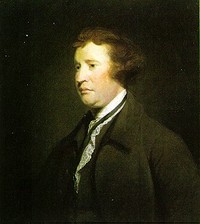
I liked Ben Domenech’s way of framing this point, when he wrote [last week] in the Transom that the Republican Party “has always burke.jpgincluded realists and idealists, and there was in the past a degree of trust that elected leaders could sound more like idealists but govern more like realists.” It’s that trust that was forfeited by some of the Bush administration’s follies, and that needs to be recovered if the G.O.P. is to deserve anybody’s vote. But because it’s a trust, ultimately, in competence and caution, it’s a bit hard to say exactly what this kind of “new realism” or “realist internationalism” or “chastened idealism” (or whatever phrase you prefer) would look like case by case … beyond, I suppose, saying “let Robert Gates drink from the fountain of youth, and put him in charge of Republican foreign policy forever,” which is certainly an idea, but probably not a sufficient foundation for an actual agenda.

Justin Logan argues that a “big part of the problem here is the conservative donor class”:

To put it bluntly, the portion of the GOP donor class that cares about foreign policy is wedded to a militaristic foreign policy, particularly in but not limited to the Middle East. Tens of millions of dollars every year are pumped into an alphabet soup of magazines, think tanks, fellowships, lobby groups and other outfits in Washington to ensure that conservative foreign policy stays unreformed.

If we conceive of the Right broadly, comparatively dovish voices on the Right consist of Rand Paul, those writing at the American Conservative, and the foreign and defense policy staff at the Cato Institute, the latter of which Wall Street Journal editorial page editor Paul Gigot once derisively but not entirely inaccurately referred to as “four or five people in a phone booth.” (We have actual offices, for the record.) But until there is some larger countervailing force in the conservative movement, the well-financed and well-entrenched status quo will persist.

Suderman engages in the conversation:

Too much of our foreign policy conversation, on both sides of the aisle, is conducted with a kind of chest-thumping certainty about what we can know, what we should do, and what the results will be if we follow through. That attitude is perhaps understandable, given the context of war and international power, but it’s also frequently frustrating and unhelpful, especially given how difficult it can be to establish even the most basic facts on the ground when it comes to the particulars of many foreign policy conflicts and disputes.

A foreign policy of caution and humility, of uncertainty and wariness, might help help turn down the heat on foreign policy debates, by focusing on the limitations of America’s power and—even more—its ability to determine foreign policy outcomes, and by talking as much about what we don’t know as what we do.

Larison sees foreign policy as the GOP’s greatest weakness:

Bush-era foreign policy has been politically toxic for Republicans in three of the last four national elections. There is good reason to assume that it will continue to be an important liability in future presidential elections unless the party makes a clear break with at least some of its Bush-era assumptions and positions, and for the most part that isn’t happening at all. Until that happens, everyone outside the party will reasonably assume that the GOP hasn’t changed, that it has learned nothing, and that it still shouldn’t be trusted with the responsibility to conduct foreign policy. It seems unlikely that a domestic reform agenda will even get off the ground as long as the public doesn’t trust a Republican president to carry out some of his most important primary responsibilities.

But Drum remains skeptical that the GOP’s foreign policy split is real:

I’ve seen no evidence of change within the mainstream of the party. Aside from Paul, who are the non-interventionists? Where exactly is the fight? I don’t mean to suggest that everyone in the Republican Party is a full-blown unreconstructed neocon. There’s a continuum of opinion, just as there’s always been. But as near as I can tell they’re nearly all about as generally hawkish as they’ve ever been—and just as eager as ever to tar Democrats as a gang of feckless appeasers and UN lovers.

Kilgore is less dismissive of the GOP “civil war”:

I’m less interested in Paul’s own views than in the possibility that he will make it possible for other 2016 presidential candidates to break away from the old neocon and realist schools that share a commitment to higher defense spending and U.S. global hegemony. Already Ted Cruz has declared himself “half-way” between Paul and John McCain on foreign policy. And such potential candidates as Scott Walker, Bobby Jindal and even Mike Huckabee have the flexibility to position themselves at any number of points on the spectrum.

My concern is that their rubric for understanding Obama’s foreign policy is that he is weak, doesn’t call enough foreign leaders thugs and is too deliberative. It’s hard to see a response to that that doesn’t privilege the unreconstructed neocons and Cheneyites. Or, worse, the idiotic ramblings of Rubio.

The View From Your Window

Tromsø-Norway-1223AM

Tromsø, Norway, 12.23 am. The reader writes:

Tromsø is 70 degrees north in the Arctic circle, and it never goes dark during June and July. I’ve been in Norway just a few weeks now and predictably haven’t had a decent night’s sleep since I got here. Still, Norway is such a happy wonderful country and I feel lucky to be here during such weird and sad times. Wishing you the best; I remain a subscriber, admirer, & c.,

100 Percent Efficacy

That’s the effectiveness of Truvada in preventing HIV infection in the latest large study just unveiled at the AIDS conference in Melbourne:

PrEP had no significant efficacy in people who took fewer than two doses a week. However, the efficacy of PrEP was 84% in people who took 2-3 doses a week – there was only one infection in this group – and no infections at all were seen in people taking at least four doses a week. This 100% efficacy translates into a minimum efficacy of 86% if the statistical uncertainty of the result is taken into account.

Did they all throw condoms away?

The study found absolutely no “sexual risk compensation” among participants—that is, those taking PrEP did not abandon other forms of protection, namely condoms. That data was self-reported. But researchers also tested participants for syphilis, another marker of sexually risky behavior, and found that those on PrEP were no more likely to carry the sexually transmitted infection than those not taking the drug.

The debate in the gay community is not really a debate at this point; it’s a function of the deep difficulty of psychologically navigating from a way of life dominated by plague to a normal way of life. It will take time. But the potential of this drug, combined with condoms and cocktail therapy for the infected, is nothing less than the eradication of HIV among gay men in our lifetimes.

The Last Great English Romantic

Reviewing Oakeshott’s recently published Notebooks, John Gray sketches a charming portrait of the idiosyncratic philosopher:

When I knew him towards the end of his life, the impression he made was of a Twenties oakeshottoutsidecaius.jpgfigure, whose values and attitudes – notably an uncompromising commitment to personal authenticity – echoed those of D H Lawrence, so I was interested to find a number of references to Lawrence in the notebooks. O’Sullivan comments that Oakeshott ‘was really the last great representative not only of British Idealism but also of English Romanticism’. It is a shrewd observation. Where he differed from Lawrence was in not expecting, or wanting, any wide acceptance of his view of things. Here Oakeshott’s aestheticism may have been important: if he praised and defended conventional morality, one reason could have been that he enjoyed contemplating a world composed of people unlike himself.

It is difficult, if not impossible, to imagine a figure like Oakeshott in academic life at the present time. For one thing, he had a wider experience of the world than most academics nowadays.

Joining the army on the fall of France and being rejected for SOE because he looked too unmistakably English to be parachuted into Germany, he ended up serving in Phantom, a reconnaissance unit that, among other tasks, supplied information to the SAS. For a time his work involved using pigeons, whose behaviour he studied assiduously: when the birds were released, he once told me with a smile, many of them ‘just flew off and got lost’. Finding comedy, even an element of absurdity, in the most earnest business, it was a remark characteristic of the man.

He would have found the industrial-style intellectual labour that has entrenched itself in much of academic life over the past twenty-odd years impossible to take seriously. He wrote for himself and anyone else who might be interested; it is unlikely that anyone working in a university today could find the freedom or leisure that are needed to produce a volume such as this. Writing in 1967, Oakeshott laments, ‘I have wasted a lot of time living.’ Perhaps so, but as this absorbing selection demonstrates, he still managed to fit in a great deal of thinking.

Previous Dish on Oakeshott’s notebooks here and here.

Book Club: A Guide To Living

The stroke of genius in Sarah Bakewell’s book about Montaigne is that she framed his biography as a guide to life. You could justify this as a way to appeal to a distracted 21st Century audience otherwise highly unlikely to read about a sixteenth century French essayist, but she makes that entirely unnecessary. What she shows is why Nietzsche had such a fondness for the diminutive and inquisitive skeptic: everything he wrote was really about his own life, and how best to live it, and he does it all with such brio and detail and humanity that you cannot help but be encouraged to follow his lead. He proves nothing that he doesn’t simultaneously subvert a little; he makes no over-arching argument montaigne.jpgabout the way humans must live; he has no logician’s architecture or religious doctrine. He slips past all those familiar means of telling other people what’s good for them, and simply explains what has worked for him and others and leaves the reader empowered to forge her own future – or, rather (for this is Montaigne), her own present.

It’s a philosophy rooted in the most familiar form of empiricism. It is resolutely down to earth. You can see its eccentric power by considering the alternative ways of doing what Montaigne was doing. Think of contemporary self-help books – and all the fake certainty and rigid formulae they contain. Or think of a hideous idea like “the purpose-driven life” in which everything must be forced into the box of divine guidance in order to really live at all. Think of the stringency of Christian disciplines – say, the spiritual exercises of Ignatius of Loyola – and marvel at how Montaigne offers an entirely different and less compelling way to live. Think of the rigidity of Muslim practice and notice how much lee-way Montaigne gives to sin. This is a non-philosophical philosophy. It is a theory of practical life as told through one man’s random and yet not-so-random reflections on his time on earth. And it is shot through with doubt. Even the maxims that Montaigne embraces for living are edged with those critical elements of Montaigne’s thought that say “as far as I know” or “it seems to me” or “maybe I’m wrong”. And of course it begs the question that Pascal posed: how can skepticism not be skeptical about itself? Is it, in fact, a self-refuting way of being?

Logically, of course it refutes itself. And you can easily torment yourself with that fact. When I first tried to grapple with philosophy, the need to force every text I read into the rubric of “is this the truth about the world?” dominated everything. And in retrospect, there’s nothing wrong with that. If you do not have a desire to figure out the truth about the whole, you’ll never start the philosophical project at all. And you can find in philosophy any number of clues about how to live; you can even construct them into an ideology that explains all of human life and society – like Marxism or free market fundamentalism or a Nietzschean will to power. But as each totalist system broke down upon how-to-live-sdmy further inspection, I found myself returning to Montaigne and the tradition of skepticism he represents (and that reached one of its modern high points in the thought of Michael Oakeshott). Maybe we need to start with what little we actually do know – through experience, narrative, anecdote and conversation.

And here’s what we do know. We are fallible beings; we have nothing but provisional knowledge; and we will die. And this is enough. This does not mean we should give up inquiring or seeking to understand. Skepticism is not nihilism. It doesn’t posit that there is no truth; it merely notes that if truth exists, it is inherently beyond our ultimate grasp. And accepting those limits is the first step toward sanity, toward getting on with life. This is what I mean by conservatism. You can see why it has scarcely any resemblance to the fanatics, ideologues and reactionaries who call themselves “conservative” in America today.

But what Bakewell helped me see better is that Montaigne’s Stoic disposition really was influenced by a couple of epiphanies. The first was the loss of his dear friend, Etienne de la Boétie. The second was his own near-death experience in a riding accident. What he’s grappling with in both cases is loss. And what he seeks to do with his friendship is to understand what he lost more completely, which makes his essay “On Friendship” the greatest treatment of that theme ever penned. But his near-death experience – which he subsequently wrote down with eerily modern skills of careful observation – could be seen as the window onto his entire body of work. He works back from this reality – our inescapable finitude – to construct a deeper and more humane understanding of what life is for. By seeing the limits, he seems to say, we actually live more vividly and well and can die at peace with the world.

If I were to single out one theme of Montaigne’s work that has stuck with me, it would be this staringbookclub-beagle-tr-2 of death in the face, early and often, and never flinching. It is what our culture refuses to do much of the time, thereby disempowering us in the face of our human challenges. I was lucky in some ways – and obviously highly unlucky in others – that I experienced something like this early in my life as well: the prospect of my own imminent death and the loss of one of my closest friends and soulmates to AIDS. There was Scripture to salve it all; there was friendship to shoulder it all; there was hope to sustain it all. But in the end, I found myself returning to Montaigne’s solid sanity, his puzzlement and joy at life’s burdens and pleasures, his self-obsession that never somehow managed to become narcissism.

Is this enough? Or is it rather a capitulation to relativism, a manifesto for political quietism, a worldview that treats injustice as something to be abhorred but not constantly fought against? This might be seen as the core progressive objection to the way of Montaigne. Or is his sensibility in an age of religious terror and violence and fanaticism the only ultimate solution we have?

Email your thoughts to bookclub@andrewsullivan.com. You can still buy the book here and join the conversation (or use the public library here). Update from our first participant:

As Sarah Bakewell points out in her wonderful book, people don’t just “read” Montaigne; they “meet” him. He’s not a classic author to tick off a personal must-read list but more like a good friend. Though I’ve never laid eyes on a word of his Essays, he has been my companion, my guru, my pal, my virtual best friend. My Michel has the friendly, bracing, comforting voice of an actor named Christopher Lane on my 49 hour, 39 minute audio book. For two months last year, Montaigne was alive, talking quietly to me, confiding in me his thoughts as I walked, drove, did household chores, rode the bus, and saw all my own fears and thoughts and immediate surroundings through his eyes.

I spend a great deal of time walking through Chicago with my son Walker, who has autism.

He’s now 28, a lively, happy, intelligent guy hobbled by a near inability to converse. I talk to him in frequent speeches about everything around us, but I also listen to audiobooks. The one rule in choosing them is that they must be funny or positive or somehow life-affirming. I don’t need any more angst, thank you, walking mile after mile as I fight anxiety about my son’s future life without me and his mother. P.G. Wodehouse’s Jeeves and Wooster books are my great standbys. I walk along laughing while Walker smiles his big appreciative grin.

But Montaigne is special. He calmly reminds me that nothing I fear or think is new. Just as he found all his wisdom in ancient authors, I find mine in him. This 16th-century French aristocrat sitting alone in his tower as the wars of religion swirled around him speaks to me with great immediacy. Never mind that it’s 2014 and I’m walking along Rush Street in Chicago or in the sand on Oak Street Beach in 2014. He’s as personal as say, Andrew Sullivan talking about God and war and life’s meaning.

One of the big challenges for us parents of autistic children is isolation. We often feel out of touch with friends, with the buzz of life. Most people have learned to not even ask my wife and me out to dinner – they know we’re, I have to say it, “trapped.” But Montaigne brings companionship right into my ears in a very personal way, as though he were walking alongside Walker and me, sitting in the car with us, smiling at Starbucks baristas with us.

Thanks to Sarah Bakewell and her lively book. She reminds all of us that Montaigne lives.

The View From Your Window Contest: Winner #214

VFYWC-214

Sherlock Holmes writes:

I’m gonna go with … America.

Another gets more specific:

Outskirts or small old town enveloped by Pittsburgh.

Another questions our motives:

Okay, you know you set me up. Sports Authority and Home Depot in the same center … should be easy, right? After screening out obvious “not possible” states: Utah, Oklahoma, Texas, Arizona, etc, I concentrated on all the others and did a Google Street view of each Sports Authority (they have fewer stores) and could not find one single match. I’m betting that was a red herring because you would never make it that easy …

Another also ended up empty-handed:

I thought I had a chance this week. Not to win, but at least, maybe, to get a location right and build up my credentials. I knew everyone would froth at the bit this week. So many clues! I started with the Sports Authority website and either cross referenced the location with Home Depot, or later, just started looking up the Sports Authority addresses on Google Maps. Do you know how often they are practically right next to each other like in your photo? Too many. Of course, none of those were the contest site. And FYI, other places that Sports Authority likes to cozy up next to are Best Buy and Target.

In the end, I failed. I couldn’t find it. Not even with all those clues. I must have missed one. The right one. But I bet you get a lot of right answers this week. Just not mine.

Another yawns:

The Home Depot, Sports Authority, Exxon? Really? Seldom have I been less inspired to make even my standard random guess.

But this one gets pretty close:

I was convinced this was in eastern Canada – an Esso gas station, deciduous trees, a one-way sign (so not Quebec). But a few searches convinced me Home Depots in Canada are built in sprawling power centres with no trees anywhere. And maybe that is an Exxon sign. I’m pretty sure it’s somewhere in the New England, an industrial-ish town, near a canal, in a place long-enough established to have an old stone church. Massachusetts.

It’s a beautiful day here in Montreal. I’m going for a walk.

Another nails the right city:

VFYWC-214-myguess

I was overwhelmed at first to find that there were 2,256 Home Depots in the United States, but relieved when Google revealed that there were only 450 Sports Authorities. Wheh. (Better than starting with the Exxon station on the corner – of which there are over 10,000 in the US – though I couldn’t find an official number for Exxon retail stores. It’s supposedly a practice ExxonMobil is abandoning in favor of supplying third-party owned/operated stations.)

Fortunately this looked like the Northeast U.S. and that narrowed it down pretty quick. A Google Maps search finally revealed this view to be in Waterbury, CT – specifically the Courtyard Waterbury Downtown – Marriott located off I-84.

Another shares the details of his search:

This looked like a scene from the northeastern United States, so I checked out Sports Authority stores in Pennsylvania, New Hampshire, New York, then Virginia and North Carolina.  Somehow, I skipped Connecticut and I then went through a tour of Sports Authority stores in virtually all the states, including California, Texas, and far-flung Alaska and Hawaii.  When I finally decided to check Connecticut, my mind was in such a blur that I failed to properly recognize the location when it showed up.

What about the tower in the distance? I searched for “water towers” – that didn’t help.  The Waterbury Generationnext day, I decided to stick to the Northeast, and search for built-up cities with hilly profiles, which finally brought me to Waterbury, CT. I checked for Home Depot and it looked exactly like the one in the photo, with the Garden Center on the right and across the parking lot was the Sports Authority.  When I noticed that there was even an Exxon nearby, I started to believe that I was in the right place.

The funky tower turned out to be part of a power plant: Waterbury Generation.

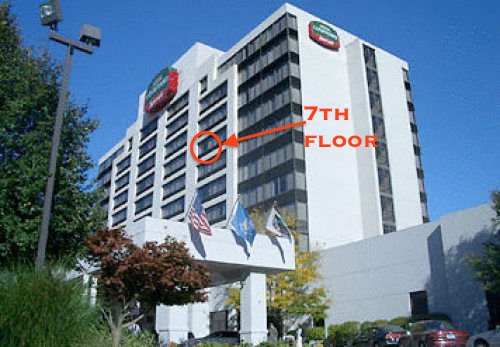
It was then easy enough to locate the location from which the photo was taken – Courtyard Waterbury Downtown Marriott – I believe it’s the 6th floor in the window indicated in the image (note: the bottom floor is hidden in the image).

 Another recognized the terrain:

I got this one on a gut feeling. I grew up in Connecticut, and the general vibe instantly said New England. I am also a child of the big box era and remember when people looked in awe at Home Depot, Sport’s Authority and the like; these are clearly aged. As a teenager, I also drove around the state constantly assisting my father, who through much of that time was a self-employed commercial real estate appraiser. The topography, highways, and industrial and cultural markers of the city suggested something like Waterbury. The Sports Authority gable, it turns out, is relatively distinct for its kind. With Google street view I almost was able to go into the back parking lot of the bank.

Another adds:

The landscape and the depressing green paint on the highway bridges instantly spoke to this Connecticut native and I knew that we were looking at the perpetually depressed Naugatuck River valley.

A few readers could barely make out a Connecticut license plate as well.

Below is this week’s OpenHeatMap of everyone’s guesses (zoom in by double-clicking an area of interest, or drag your cursor up and down the slide):

This embed is invalid

Most players had a love/hate relationship with this week’s view:

For goodness’ sake, do you have any idea how many Sports Authority shops are located near Home Depots in the United States?  I didn’t until now.  I think it probably says something about the homogenization of American commerce to find so many big-box retailers in proximity to each other in so many places.

My method for this contest, after identifying the aforementioned superstores in the photo, was to use their own website store locators to narrow the list of states where they do business.  It turns out that Sports Authority does business in 45 states, so I only eliminated 10% of states.  The terrain is green and hilly, though, so that ruled out most of the dry western and flat plains states, and based on the architecture, I decided to focus on the northeastern United States.  I worked through New Jersey, Pennsylvania, New Hampshire and Massachusetts before I found Waterbury, Connecticut.  This view was taken from the Courtyard Waterbury Downtown at 63 Grand Street, looking south across Interstate 84 (Yankee Expressway) toward the shopping center.

Another:

VFYW-Waterbury Conn.

Do you know how many of the 420 US Sports Authority stores share a common street with a Home Depot? I never did. Do now. 80. Fortunately this one was in Connecticut, not Wyoming. I might still be working at it.

 Another

I’ve spent almost 2 hours looking at The Sports Authority’s website looking for the right building. (By the way, the photo of Bemidji, Minnesota’s store is taken in the snow, which amuses me.) I’m sure the webmaster is shocked by the increase in web traffic today on their locations site as I’m probably not the only one doing this.

Another player brought in the geeks:

We did this the ridiculous way: my brother and my fiance, both programmers, wrote scripts to take all the locations of Home Depots and Sports Authorities in the US, convert them to GPS coordinates, and spit out a list of all the ones that were close together. Then I got really good at evaluating Home Depots on Google satellite images until, finally, we got to this one, which had all the right elements: a Home Depot with three pointy greenhouses and four round ones, a Sports Authority across the way (with 0.34km between them, if you’re wondering), an Exxon off to the side, and a bank with a drive-through across the highway. And, bonus, a hotel behind the bank with just the right line of sight!

Another used his gut:

Never been there but lived in Connecticut as a child (1965 – 1970) and recognized the state right away. I guess you just imprint on the place where you grew up and even 40 years later it’s just instant recognition, like an ancestral memory.

Another wonders, “Is there a more American scene in the entire world?”

A lovely tree-filled hillside is punctuated with big box stores and a two-tiered highway. The bland office building in the foreground houses an insurance company. All that’s missing is a McDonald’s and a Starbucks.

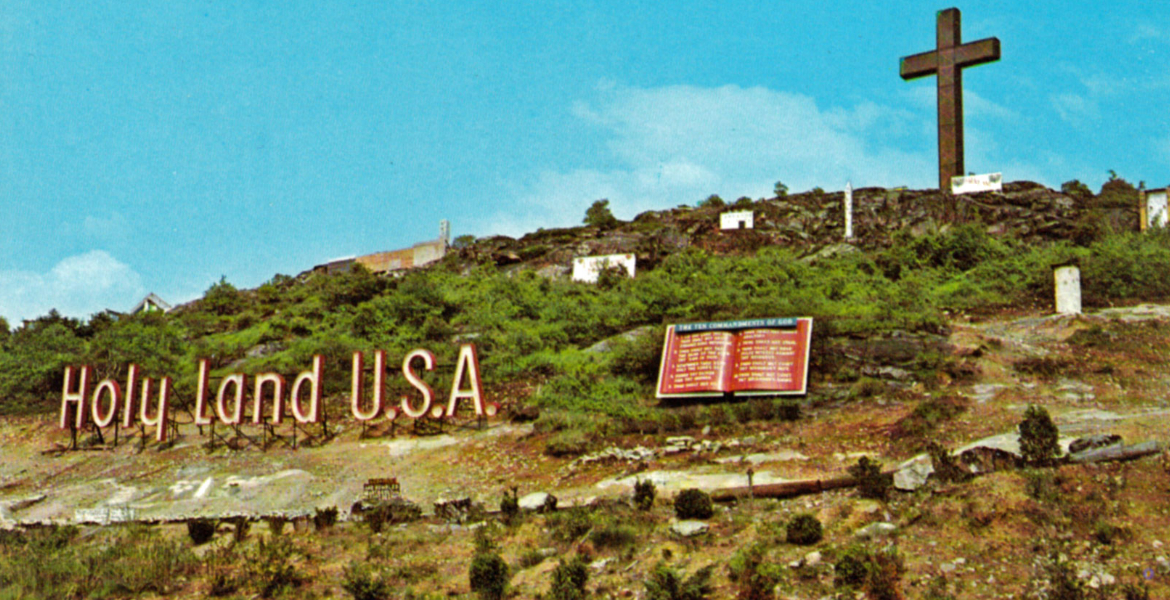
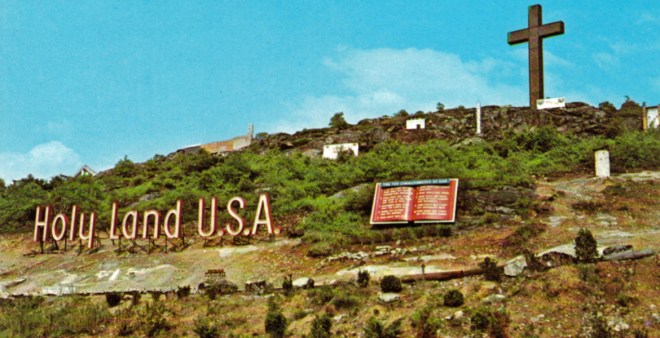
Waterbury has a significant history in brass production and watch manufacturing, but I hope you’ll use this contest to educate your readers about the unusual theme park that was built there in the 1950s. “Holy Land USA” was built as an hommage to Bethlehem and Jerusalem as they existed in the Biblical era. It’s complete with a replica of the Garden of Eden, catacombs and Israelite villages (pre-Iron Dome, of course):
holyland

The Timexpo Museum is nearby as well:

We have visited with my in-laws. I love visiting any museum and this one combines the clock and Timex history in Waterbury with an exhibit about Easter Island and Thor Heyerdahl’s expeditions. It seems Heyerdahl was friends with the Timex owners and the Kon-Tiki expedition was partly funded by them.

In 2004, the Hartford Courant ran an interesting story about the “Radium Girls” of Timex. These young girls were paid for each piece produced; they painted the dial faces for the glow-in-the-dark wristwatches. Many died of radium poisoning as the girls “were told they could paint faster if they dipped their brushes into the radium-laden paint and sharpened the bristles with their lips.” This was known as lip pointing. Being good at your job was deadly.

Don’t expect this reader to visit any local attractions:
waterbury-courtyard-marriott

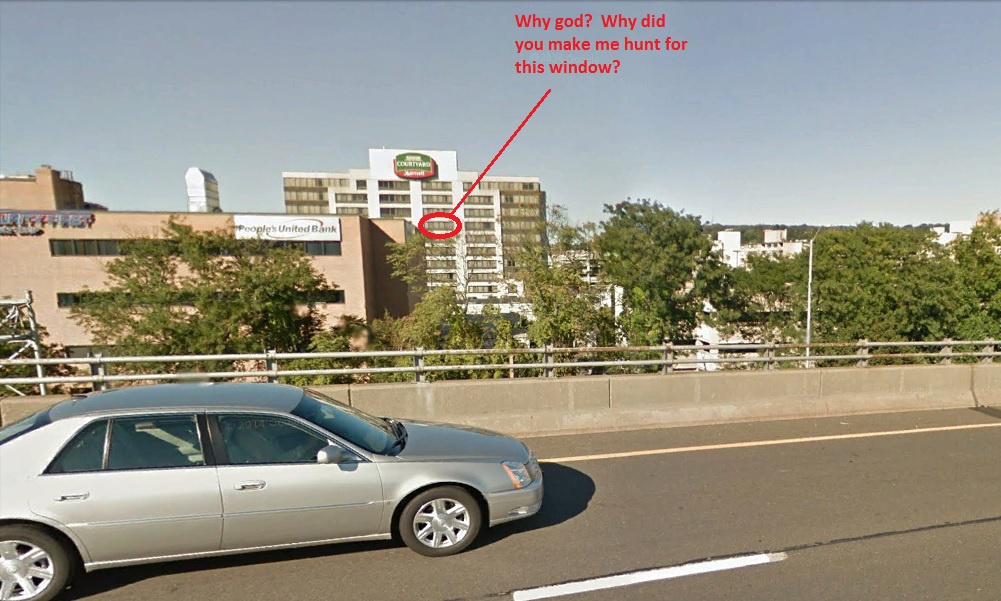
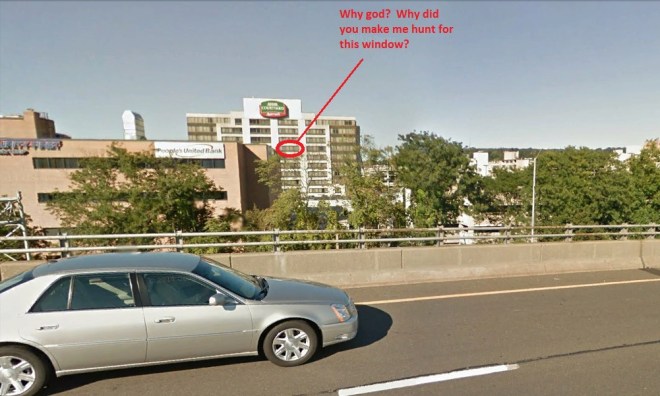
This week’s view was taken from a room in the back of the Courtyard Marriott at 63 Grand St, Waterbury, CT, overlooking I-84 and the desolate hellscape that is central Connecticut. Please pardon my crankiness … it’s just that I think I may have nightmares for months about the finishing details of Home Depot and the graphic design of the Sports Authority logo.  I’ve attached a picture with my best guess at the window circled.  I’m not sure what the room numbering system is, so I’ll just guess 815.

A former winner:

Waterbury looks like a nice place with a wonderful history of political corruption, including being the old stomping grounds for both a convicted lieutenant governor and a convicted governor. The former was T. Frank Hayes who, according to the New York Times, in the 1930s “invested some of his kickbacks in a company called the Electric Steam Sterilizer Company [and] had a bill introduced requiring the installation of electric steam sterilizers in all of Connecticut’s public toilets… Coincidentally, the only electric steam sterilizers were manufactured by Electric Steam Sterilizer.” John G. Rowland was the convicted governor, who upon his release from federal prison became Waterbury’s allegedly “no show” economic development coordinator before leaving to host a talk radio show.
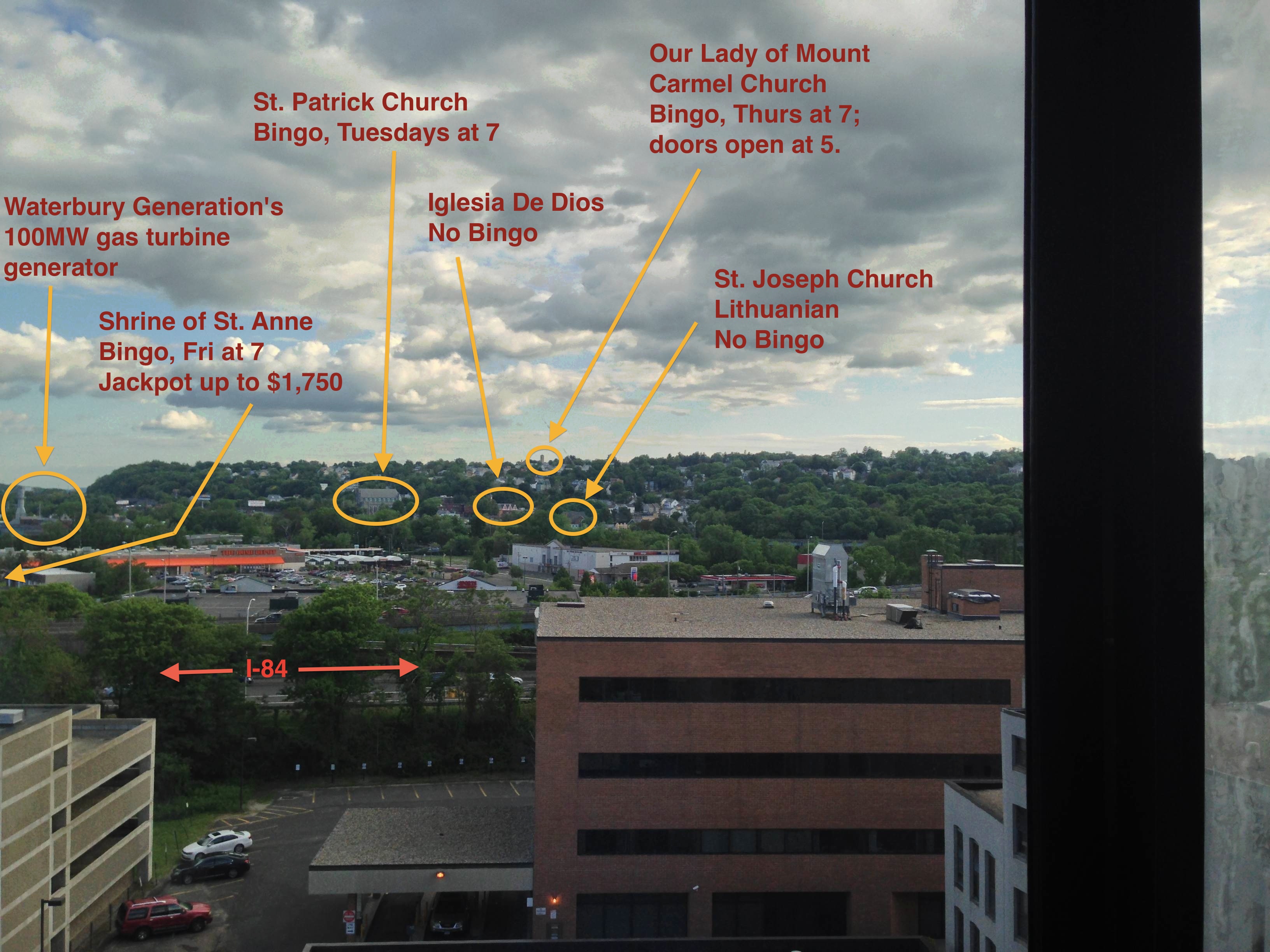
214 with labels

Above is the contest photo with some of the sights identified, including information on which churches host bingo nights in the vicinity. I know. Critical information. For some reason my wife thought I might have better things to do with my time than research area bingo options. Given the alternative was weeding in the garden, I thought otherwise.

We, and your weeds, are grateful. Meanwhile, Chini is not impressed:

Did you know that Waterbury, Connecticut is the “brass capitol” of the world? Well, it is and … dear lord, even the Wikipedia factoids are putting me to sleep with this one. This week’s pic was taken from roughly the eighth story of the Courtyard by Marriott and looks south by southwest along a heading of 212.23 degrees.

Missed the floor though, unlike this week’s winner, who had the most previous correct guesses among the handful who got this key detail right:

I would guess about the ninth floor!

Some other correct guessers are among these visual entries:

vfywc-collage-214

From the reader who submitted the contest’s view:

I was in Connecticut at the end of May for the wedding of my partner’s cousin. The bride is Portuguese and Italian American and the groom is of Irish descent; all three immigrant groups have a sizable presence in Waterbury.

As for the photo itself, it was taken from Room 915 of the Courtyard Marriott. If you search for “Waterbury Courtyard Marriott view” in Google Images, actually, you’ll find a very similar picture taken by someone else in the ninth row of results. I’m guessing that the triple combo of Home Depot, Sports Authority and the gas station is going to be the giveaway clue and there’ll be a swarm of correct identifications. Looking forward to seeing all the funny, impressive and obsessive answers that Dishheads will come up with!

The Dish has posted a few of my submissions as VFYWs in the past two years (which is about how long I’ve been a regular reader), but this is my first time being picked for the contest, so this is quite an honor. My next goal is to actually *win* the book–though I’m still a very long way off, thanks to those aforementioned funny, impressive and obsessive Dishheads.

(Archive: Text|Gallery)