Putin Creates His Own Reality

The Russian leader continues to deny any wrongdoing:

Putin’s government also held a news conference [yesterday], in which it denied that Russia had supplied the separatists with a BUK missile system “or any other weapons,” and suggested that the Ukrainian government is the prime suspect in the crash. Air Force Lieutenant General Igor Makushev said that Russian radar detected the presence of Ukrainian fighter jets close to the Malaysian flight, suggesting that one of them may have shot down the airliner.

Margaret Hartmann unspins Russia’s spin:

Unfortunately for Russia, the scant evidence available doesn’t appear to support its fighter-jet theory. Photographs of wreckage riddled with holes have begun surfacing on social media, and experts say that suggests the plane was targeted by a missile that exploded nearby. After analyzing photos taken by New York Times reporters, IHS Jane’s, a defense consultancy, concluded that the damage was consistent with that caused by a Buk system. The missiles are designed to explode below a target, increasing the likelihood that a fast-moving Western military aircraft will be damaged even if it avoids a direct hit.

Which makes the entire spectacle riveting. What happens when a Tsar’s propaganda becomes completely untenable in a porous media world? What he can get away with at home is not as possible when your drunken proxies take down a plane from the civilized world? Watching that video statement from Putin in the early hours of the morning gave me some solace. Just look at the body language, the deflected gaze, the nervousness:

A Tsar never had to do this, or felt compelled to. He’s hanging by a thread, and we should take some pleasure in watching him struggle. Alex Altman examines Russia Today’s absurdist coverage:

In the aftermath of the crash last week, the RT machine kicked into overdrive, churning out a steady stream of strange reports. In an effort to implicitly assign blame on the Ukrainians, it noted the proximity of Putin’s own plane. It quoted a Russian defense ministry source asking why a Ukrainian air force jet was detected nearby. And it quoted another anonymous Russian official, who volunteered the juicy claim that a Ukrainian anti-aircraft missile was operational in the vicinity at the time of the incident. This is how RT works, explains [former RT employee Sara] Firth: by arranging facts to fit a fantasy.

Kirchick piles on:

A particularly egregious example was the most recent episode of the inaptly named Truthseeker, a program devoted to conspiracy theories. Titled “Genocide in Eastern Ukraine,” the 14-minute segment accused the Ukrainian government of conducting a crime on par with the 1994 Rwandan genocide (which claimed anywhere from 500,000 to 1 million victims), which, for good measure, the host accused the United States of sponsoring. The Ukrainian government (“the most far-right wing government on the face of the Earth,” a description that far better suits the current Russian regime), whose leaders“repeat Hitler’s genocidal oath,”is “bombing wheat fields to ensure there’s famine,” a perverse claim in light of the Soviet-orchestrated Holodomor, the killing by starvation that took the lives of millions of Ukrainians in 1932 and 1933. The segment featured an interview with crank “historian” William Engdahl, a regular columnist for the virulently anti-Semitic website Veterans Today, where he has suggested that terrorist bombings in Russia earlier this year were conducted by Israel in retribution “for Putin’s role in winning Obama away from war against Syria last fall and openly seeking a diplomatic resolution of the Iran nuclear problem.”

Such ravings are par for the course on RT, but what happened afterwards surprised observers who have grown accustomed to the network’s practice of throwing out an endless stream of indefensible allegations in hopes that some of them will stick in the media ecosystem. Two days after the program aired, RT announced via Twitter that it had removed the episode from its website due to “uncorroborated info.” If this were to be the new standard by which RT determines what material to air, it would have no choice but to shut down altogether.

Why Russia Wants A Cease-Fire

It’s a tactical move Russia has used before:

Putin supports a cease-fire, as he has all along, because that leaves the Russian-sponsored forces in control of Ukrainian territory, a status quo that suits Russian interests. This is precisely why the Ukrainian authorities originally ended the cease-fire, and why they have continued operations even after the downing of the aircraft. They suspect that the longer the territory remains in Russian hands, the more likely it is that it will never be returned.

To see why a cease-fire works to Russia’s advantage, the Ukrainian leadership need only look to Ukraine’s western border, where a slice of its neighbor Moldova known as Transnistria has been occupied by pro-Russian forces since 1992. The conflict began when a group that did not want Moldova to secede from the Soviet Union took up arms, with extensive support from the Soviet/Russian military. A cease-fire was declared in July 1992, and the conflict has remained “frozen” ever since.

Anna Nemtsova reports that fighting in Donetsk has heated up:

Clearly, all of the statements from Moscow and Kiev about a cease-fire for the period of the investigation have been forgotten. Rebels reinforced their positions in Donetsk, bringing tanks and armored personnel carriers closer to the railway station on Panfilova Avenue. Glass was blown out of the windows of five-story buildings on Slavatskaya Street. Local radio reported that the Ukrainian military blew up railroad tracks and blocked approaches to the city.

Once again civilians paid the price of this ferocious war. Shells killed pedestrians running to try to escape into basements. A young woman’s body was lying on the dusty road by a row of garages: her head was destroyed, both of her shoes had been thrown in the air by the shock wave of the explosion and had landed a few steps away from her motionless body.

For Israel, There’s No Such Thing As An Innocent Gazan

Neve Gordon and Nicola Perugini scrutinize the logic by which Israel treats virtually any building in Gaza as a legitimate target and any civilian killed as a “human shield”:

All civilians in Gaza are being held hostage by Hamas, which is considered a war crime and a gross violation of international law governing armed conflict. This, then, provides legal and moral justification against the accusation that Israel is the one killing civilians. Presumed human rights violations carried out by Palestinians against Palestinians – taking hostages and human shielding – thus become the legitimization of lethal and indiscriminate violence on the part of the occupying force. Hence, the use of human shields is not only a violation. In contemporary asymmetric urban wars, accusing the enemy of using human shields helps validate the claim that the death of “untargeted civilians” is merely collateral damage. When all civilians are potential human shields, when each and every civilian can become a hostage of the enemy, then all enemy civilians become killable.

And, critically, Israel is absolved of any moral responsibility for any of it. That’s what worries me. When military might is expended on crowded civilian areas and all civilian casualties are presumed the responsibilities of others … you get well over 500 dead, including countless women and children, including attacks on hospitals and families breaking the Ramadan fast in their own home. You get this:

Monday morning, the Abu Jameh family pulled 26 bodies, 19 of them children, from the rubble of their home near the southern Gaza town of Khan Younis, the largest toll from a single strike since the battle began July 8. Four people were killed at Al Aqsa Martyrs Hospital, the main one serving the center of the crowded coastal enclave. An airstrike Monday night destroyed the top five floors of an apartment building called Al-Salam — the Peace — in central Gaza City, an area that had been seen as a safe haven, killing 11.

And yet some even argue that this horrifying spectacle is actually a moral necessity:

The deaths of innocents are not simply outweighed by Israelis’ right to live without daily rockets and terrorists tunneling into a kibbutz playground; but by the defense of a world in which terrorists cannot use morality to achieve victory over those who try to fight morally. It is the protection of that world, one in which moral soldiers still have a fighting chance, that justifies Israel’s operations against Hamas today. And it is that greater cause that decisively outweighs the terrible toll in innocent life.

When you are killing scores of children, it is not enough to argue self-defense (even though the Iron Dome has given Israel about as robust a defense against home-made rockets as you can get). You have to argue for something grander to nullify the corpses of children. And the dehumanization of those living in Gaza – to the point at which spectators with popcorn cheer their deaths – has led to Israeli indifference to the deaths of human beings that, if they were Jews, would be regarded as the harbinger of calamity. Can you imagine the response in Israel if over 200 Israeli children were killed by a rocket attack by Hamas? Can you imagine anyone saying that the Israelis did this to themselves? That tells you everything about how deep the moral rot has gone, how this kind of zero-sum war and brutalizing occupation over decades cannot but destroy a country’s soul.

Larison, meanwhile, tackles the trope that Gazans forfeited their right to be treated as innocent civilians by voting for Hamas and allowing the group to operate in their communities:

Non-combatant status can be forfeited only by becoming a combatant, and that doesn’t happen by having voted for the current rulers or simply by living under their rule. Forfeiting non-combatant status requires taking up arms or directly lending aid to those that are fighting, and that doesn’t appear to apply to the civilian victims killed during the current operation at all. It may please Hamas to make use of these victims’ deaths for their own purposes, but that doesn’t absolve the Israeli government of its responsibility for causing those deaths. If Hamas benefits politically from these civilian deaths, and it seems likely that they do, it would seem obvious that Israel should not want to cause any more, and yet at each step over the last few weeks Israel’s government has responded with tactics that are guaranteed to continue killing many more non-combatants for as long as this operation continues.

And this is the truth about the state of Israel today. To endure it must crush. The more it crushes the deeper the resistance will run; the deeper the resistance the more unthinkable the carnage will have to go. This is an abyss of revenge and hatred, the dreadful consequence of every utopian scheme in human history.

Anti-Zionism And Anti-Semitism

Pro Palestinian Demonstrations Are Held Throughout Europe

Some of the protests against the Israeli assault on Gaza have veered definitively into the realm of rank Jew-hatred. The NYT has a decent round-up of the worst today, and it’s especially troubling in France. As the world responds to Israel’s latest incursion in Gaza, Brendan O’Neill remarks on what he sees as the ever-thinning line between anti-Zionism and anti-Semitism:

[I]n the latest rage against Israel, it isn’t only the Israeli state or military that have come in for some loud flak from so-called radicals – so have the Israeli people, and even the Jews. In Paris on Sunday, what started as a protest against Israel ended with violent assaults on two synagogues. In one, worshippers had to barricade themselves inside as anti-Israel activists tried to break their way in using bats and planks of wood, some of them chanting ‘Death to Jews!’. Some have tried to depict such racist behaviour as a one-off, a case of immigrants in France losing control. But on that big demo at the Israeli Embassy in London last week some attendees held placards saying ‘Zionist Media Cover Up Palestinian Holocaust’, a clear reference to the familiar anti-Semitic trope about Jews controlling the media. On an anti-Israel protest in the Netherlands some Muslim participants waved the black ISIS flag and chanted: ‘Jews, the army of Muhammad is returning.’

His theory as to why this happens:

Why does being opposed to Israel so often and so casually tip over into expressions of disgust with the Israeli people and with the Jews more broadly? It’s because, today, rage with Israel is not actually a considered political position.

It is not a thought-through take on a conflict zone in the Middle East and how that conflict zone might relate to realpolitik or global shifts in power. Rather, it has become an outlet for the expression of a general feeling of fury and exhaustion with everything – with Western society, modernity, nationalism, militarism, humanity. Israel has been turned into a conduit for the expression of Western self-loathing, Western colonial guilt, Western self-doubt. It has been elevated into the most explicit expression of what are now considered to be the outdated Western values of militaristic self-preservation and progressive nationhood, and it is railed against and beaten down for embodying those values.

Koplow, meanwhile, flags some nasty Jew-bashing in Turkey:

Ankara’s mayor Melih Gökçek, fresh off the heels of tweeting out pro-Hitler sentiments, urged his government yesterday to shut down the Israeli embassy in Ankara, referring to it as “the despicable murderers’ consulate” and stating that “they are 100 times more murderous than Hitler.” Not to be outdone, Bülent Yıldırım, the odious head of the “humanitarian relief NGO” IHH – the same NGO that organized the Mavi Marmara flotilla – warned Jewish tourists (yes, he said Jewish rather than Israeli, and yes, that was deliberate on his part) not to show their faces in Turkey and threatened Turkish Jews that they would pay dearly for Israel’s actions in Gaza. …

I get the anger and frustration, and I see it personally from Turkish friends on my Facebook feed and my Twitter stream, who are furious with Israel not because they are Jew-hating anti-Semites but because they deplore the mounting civilian death toll in Gaza, which they see as disproportionate and excessive. … But there is a world of difference between criticizing Israel out of a deeply held difference of opinion versus comparing Israelis to Hitler, equating Israel with Nazi Germany, throwing around the term genocide, openly advocating violence against Israeli nationals and property, and threatening Jews over Israel’s behavior. It is completely beyond the pale, and anyone who cares a lick about liberal values should be denouncing it loud and clear without qualification.

Amen.

Update from a reader:

The Dish cites the incident outside the Synagogue de la Roquette, which has been basically debunked/seriously disputed – the President of the synagouge himself confirming the details of this alternative report, on video.

(Photo: A Pro-Palestinian demonstrator holds a placard with the symbols ‘Swastika equal to Star of David’ during a demonstration on July 17, 2014 in Madrid, Spain. By Pablo Blazquez Dominguez/Getty Images.)

Borderline Politics On The Left

Josh Kraushaar casts doubt on the notion that immigration reform is a winning issue for the Democrats:

The conventional wisdom has long held that immigration is the equivalent of Kryptonite for Republicans: If they don’t pass comprehensive reform, their party is writing its own extinction. Indeed, GOP officials have been publicly telegraphing their own vulnerabilities on the subject for years, highlighted by a 2013 RNC-commissioned report where immigration was the only policy area where the authors recommended the party moderate its positioning.

But what if that isn’t the case? A look at the current politics surrounding immigration suggest that Democrats are facing as much conflicting internal pressures from the current border crisis as Republicans face from their own base when it comes to “amnesty,” or legalizing illegal immigrants. President Obama is caught between his base, which has been pushing him to treat the migrants as refugees and settle them in the country, and the majority of voters, who believe that most should be returned to their home countries.

If the House Judiciary Committee’s numbers are correct, the base is winning that particular fight. Byron York relays the new figures, which show that “the ‘vast majority’ of unaccompanied minors seeking asylum are granted it before even appearing before a judge”:

“Information from U.S. Citizenship and Immigration Services (USCIS) that shows 65 percent of unaccompanied alien minors’ asylum applications have been immediately approved by asylum officers in Fiscal Year 2014,” says a Judiciary Committee statement. “And this is just the first bite of the apple. Many more cases can be approved later. Where an asylum officer does not approve the application, it is then referred to an immigration judge where the applicant can try again. If that fails, they can continue to appeal their case.”

The Judiciary Committee says asylum approval rates have “increased dramatically” under the Obama administration. Overall, according to the committee statement, “Approval rates by asylum officers have increased from 28 percent in 2007 to 46 percent in 2013 and approval rates by immigration judges in affirmative cases have increased from 51 percent in 2007 to 74 percent in 2013.” And that does not count appeals.

On the other hand, it’s not as though the GOP is offering any great alternatives. Alex Nowrasteh slams the Asylum Reform and Border Protection Act, introduced in the House last week, which would expedite deportation procedures for undocumented minors:

H.R. 5137 allows children apprehended at the border to be removed without any asylum screening to a “safe third party country” (i.e. Mexico) without an agreement from that country, as is required by current law. If H.R. 5137 becomes law, the U.S. government would immediately start dumping Honduran, El Salvadoran, and Guatemalan children into Mexico.

The crisis along the Southwest border has prompted many Americans to want all unlawful immigrants and children removed. But this bill goes far beyond that desire. H.R. 5137 would remove many foreigners who have legal rights under our current immigration laws. H.R. 5137 would be a disastrous blow to America’s asylum system and send numerous children with legitimate asylum claims back into danger.

Recent Dish on immigration politics and the border crisis here, here, and here. Read our complete coverage of the crisis here.

Your Home Will Be Destroyed In One Minute, Ctd

Martin Longman isn’t buying Israel’s claim that its warning shots are a humane gesture:

What’s clear is that these operations have a different purpose than killing individuals who belong to Hamas. The purpose is to make it clear that belonging to Hamas will cause your family to lose their home and quite possibly their lives. Even living in the same building as a Hamas member or maybe even in the house next door or across the street is a threat to your whole family.

This policy, then, is designed to turn the Palestinian population against Hamas.

It’s designed to make families disown children who fraternize with Hamas. It’s designed to cause apartment dwellers to purge their buildings of tenants who work with Hamas. The Israelis have a term for people who don’t leave their dwellings once they have been warned that a Hamas member is living among them. They are “human shields.” And, as human shields, they have made a decision that denies them any further human rights. …

Perhaps this policy can force Palestinian patriarchs (or matriarchs) to forbid their sons and daughters from associating with Hamas, but if Hamas goes away will their replacements be better? More compliant? Easier to negotiate with? This is a policy of beating people into terrified submission, but similar policies in the recent past have only seemed to bring short stints of calm. The Israelis call this “mowing the lawn.” The grass always grows back, and quicker if it is nourished with rain.

Watch an example of the other terrifying euphemism – a “knock on the roof” – here.

Why Not Have A Two-Tiered Medical System?

Richard Gunderman argues in favor of concierge medicine, a system in which patients pay hefty fees to spend more time with their doctors:

The concierge model of practice is growing, and it is estimated that more than 4,000 U.S. physicians have adopted some variation of it. Most are general internists, with family practitioners second. It is attractive to physicians because they are relieved of much of the pressure to move patients through quickly, and they can devote more time to prevention and wellness….

Of course, there are drawbacks to concierge practice. For one thing, some patients cannot afford it, and others will choose not to pay the fee. Critics also see such models as promoting a two-tiered system of healthcare, in which those with more money get better care.

“But we have always had a two-tiered system,” [internist Frederic] Becker counters, “and it is better to care for 600 patients well than just adequately for three or four times that number. Someday patients, physicians, and healthcare payers will recognize that slower-paced but truly high-quality medical care is a better value than the fast medicine many physicians feel pressured to practice today.”

Meanwhile, Christopher Flavelle fears the rise of specialists who demand cash payments:

The slice of the population that’s willing and able to pay for specialty care in cash is small; the share of physicians in cash-only practices was just 6 percent last year. But that’s double the level from 2011. And if the income gap keeps growing, so will the number of doctors who can find enough cash-only patients to stop taking insurance. …

If the trend accelerates, it may call for new guidelines from the American Medical Association. The AMA now says doctors moving to cash-only practices must “facilitate the transfer of their non-participating patients to other physicians” – for instance, not charging for the transfer of medical records. If no other physicians are available in the community, the doctor “may be ethically obligated to continue caring for such patients.” The AMA also reminds doctors of their “professional obligation to provide care to those in need.” Those guidelines may start to look too vague if the best specialists drop out of the insurance system altogether.

Previous Dish on concierge medicine here.

The Most Egalitarian Of All Possible Worlds?

poverty world

Pointing to a new study showing that income inequality is rapidly declining at the global level, Tyler Cowen argues that the redistribution favored by egalitarian movements in the US would end up hurting international prosperity:

Although significant economic problems remain, we have been living in equalizing times for the world — a change that has been largely for the good. That may not make for convincing sloganeering, but it’s the truth. … Many egalitarians push for policies to redistribute some income within nations, including the United States. That’s worth considering, but with a cautionary note. Such initiatives will prove more beneficial on the global level if there is more wealth to redistribute. In the United States, greater wealth would maintain the nation’s ability to invest abroad, buy foreign products, absorb immigrants and generate innovation, with significant benefit for global income and equality.

Mark Perry backs up Cowen’s thesis with the above chart. But Daniel Little criticizes Cowen’s “Panglossian” picture of global inequality:

Cowen bases his case on what seems on its face paradoxical but is in fact correct: it is possible for a set of 100 countries to each experience increasing income inequality and yet the aggregate of those populations to experience falling inequality. And this is precisely what he thinks is happening.

Incomes in (some of) the poorest countries are rising, and the gap between the top and the bottom has fallen. So the gap between the richest and the poorest citizens of planet Earth has declined. The economic growth in developing countries in the past twenty years, principally China, has led to rapid per capita growth in several of those countries. This helps the distribution of income globally — even as it worsens China’s income distribution.

But this isn’t what most people are concerned about when they express criticisms of rising inequalities, either nationally or internationally. They are concerned about the fact that our economies have very systematically increased the percentage of income and wealth flowing to the top 1, 5, and 10 percent, while allowing the bottom 40% to stagnate. And this concentration of wealth and income is widespread across the globe.

Ryan Avent pushes back as well:

There is an alternative hypothesis, however, which Mr Cowen mostly disregards: that redistribution provides insurance against economic dislocation and therefore softens resistance to globalisation. It’s worth pointing out that the world has experienced two great eras of globalisation. The first combined minimal redistribution with minimal political power for non-elites. The second combined universal suffrage with substantial redistribution. I don’t think it’s unreasonable to conclude that redistribution is the price democracies pay for globalisation.

And that makes perfect sense! Reducing barriers to trade generates net gains, but those gains will occasionally be distributed in highly unequal fashion. If gains are concentrated and no provision is made for redistribution, then a voting majority might well conclude that openness is a losing proposition. Mr Cowen seems to want voters to recognise that whether or not they personally are made better off by globalisation it is a good thing to support, because it enables the enrichment of poor areas of the globe. But few voters are content to have their economies run as charities (and a good thing for economists that they aren’t, as that would make a baseline assumption of rational self-interest look pretty absurd).

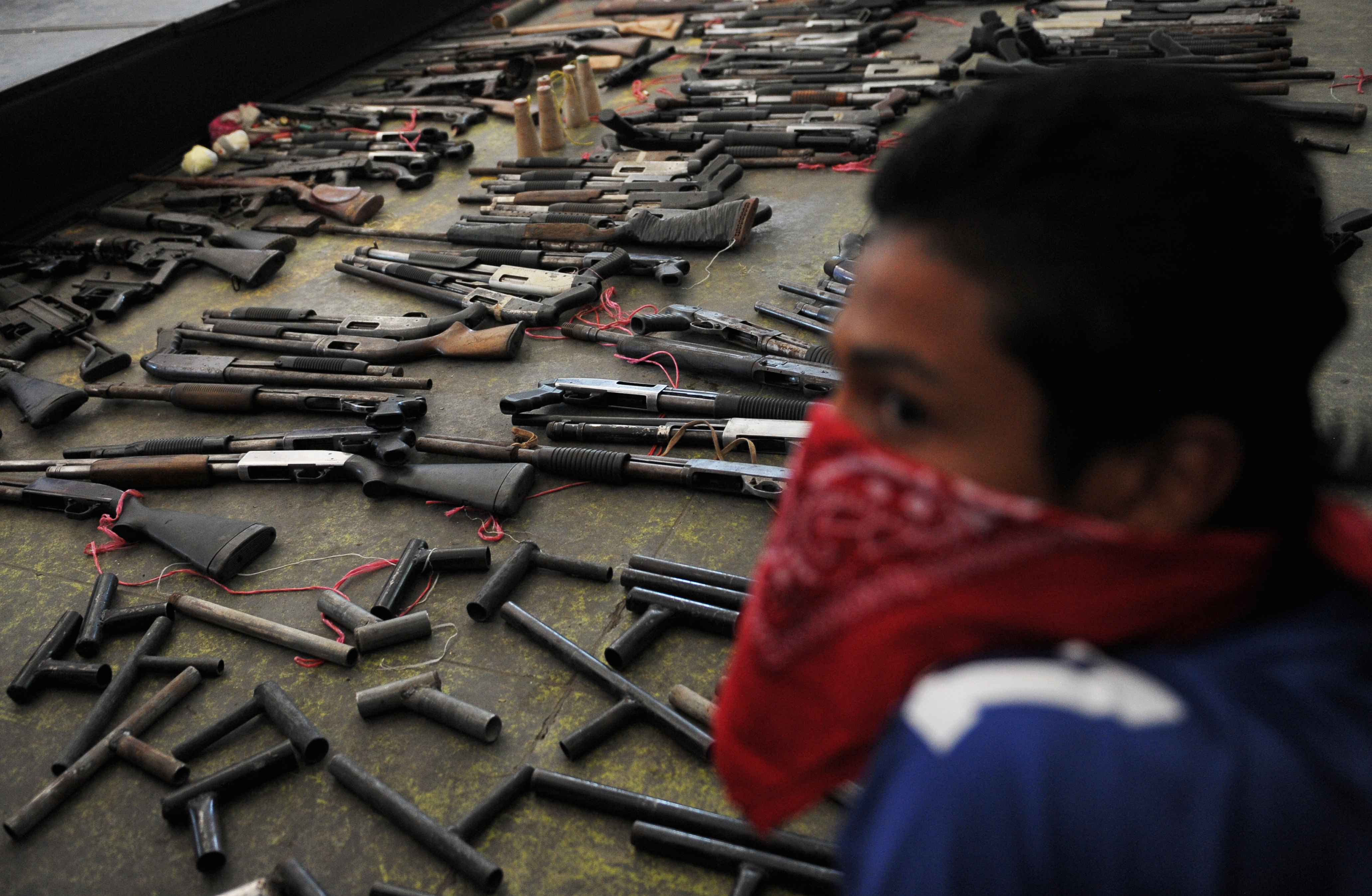
Are We Abetting Central American Gangs? Ctd

EL SALVADOR-GANGS-TRUCE

Alec MacGillis shines a light on US gun trafficking to Central America, making the argument that our loose gun regulations are contributing to these countries’ gang violence problem:

According to data collected by the ATF, nearly half of the guns seized from criminals in El Salvador and submitted for tracing in the ATF’s online system last year originated in the U.S., versus 38 and 24 percent in Honduras and Guatemala, respectively. Many of those guns were imported through legal channels, either to government or law enforcement agencies in the three countries or to firearms dealers there.

But a not-insignificant number of the U.S.-sourced gunsmore than 20 percent in both Guatemala and Honduraswere traced to retail sales in the U.S. That is, they were sold by U.S. gun dealers and then transported south, typically hidden in vehicles headed across Mexico, though sometimes also stowed in checked airline luggage, air cargo, or even boat shipments. (Similar ratios were found in traces the ATF conducted in 2009 of 6,000 seized guns stored in a Guatemalan military bunker40 percent of the guns came from the United States, and slightly less than half of those were found to have been legally imported, leaving hundreds that were apparently trafficked.)

“It is a problem,” says Jose Miguel Cruz, an expert in Central American gang violence at Florida International University. “The problem is we don’t have any idea how many [of the trafficked guns] there are. It’s a big, dark area.”

Cynthia Arnson, director of the Latin American Program at the Woodrow Wilson International Center for Scholars, tells Dylan Matthews that an effective US response to the crisis must address its root causes:

Of the $3.7 billion requested by the administration for dealing with the child migrant crisis, a very small percentage of it, about $295 million, goes to addressing root causes of the violence. I think that ever since the United States, starting with the end of the Bush administration, began to pay more attention to Central America as the drug violence was spilling over from Mexico to Central America, there’s been an overemphasis on security and controlling drug trafficking and also just not enough resources overall. …

There’s been a focus in the US and elsewhere in the region on capturing drug kingpins, but I think a lot of people who have looked at this, given the weakness of institutions, including police and law enforcement, including the judiciary, have said that a better approach is to try to reduce the violence connected with local illegal markets, and focus on providing citizen security to the general population. You can’t abandon the attempt to capture major traffickers, but you cannot do that without providing for safer communities and creating greater resilience at the individual and the community level.

Previous Dish on the violence in Central America and the US’s role in it here and here.

(Photo: A member of the “18 street” gang takes part in an event to hand in weapons in Apopa, 14 Km north of San Salvador, El Salvador on March 9, 2013. Gang leaders surrendered about 267 weapons as part of the truce process between gangs in El Salvador. By Jose Cabezas/AFP/Getty Images)